pols 4
 Call Kai
 Learn
 Practice Test
 Spaced Repetition
 Match
 Flashcards
 Knowt Play
1/256

There's no tags or description
Looks like no tags are added yet.
257 Terms
Local gov’ts in the U.S. political system
The U.S. Constitution outlines the basic relationship b/t states & national gov’t.
• It recognizes states as sovereign political entities.
• But… it contains no mention of local gov’t!
• It recognizes states as sovereign political entities.
• State authority does not derive from the national gov’t.
• State authority comes from the people.
• But… it contains no mention of local gov’t!
• Not even for Washington, D.C.
• What about the 90,000+ local gov’ts in the U.S?
Then what exactly are local gov’ts?
• Local gov’ts are subdivisions of state gov’ts.
These political subdivisions exercise authority delegated by their state government.
• The relationship b/t state & local gov’t is unitary.
• Local gov’ts are subdivisions of state gov’ts.
• No independent authority
• No inherent powers
Dillon’s Rule
Municipal corporations owe their origin to, and derive their powers and rights wholly from, the legislature. It breathes into them the breath of life, without which they cannot exist. As it creates, so may it destroy. If it may destroy, it may abridge and control
• Dillon’s Municipal Corporations (1872)
• Systematic study of local governments & their powers
• S.C.O.T.U.S. cites in landmark Hunter v. Pittsburg (1907
The Status of Local Gov’ts
Dillon’s Rule sets out a narrow interpretation of local authority.
As a political matter, however, local gov’ts may enjoy substantial autonomy.
Dillon’s Rule sets out a narrow interpretation of local authority.
• Local gov’ts have ONLY those powers granted to them by state
• Powers must be expressly granted by constitution or by law
As a political matter, however, local gov’ts may enjoy substantial autonomy.
• Wariness of one-size-fits-all solutions
• Tradition of local governance
• Especially true in some regions
• Advantage of some local control
The Status of Local Gov’ts, cont’d.
But… As a political matter, states can also greatly restrict
E.g. TX “Death Star” Bill
Latest attempt to rein in its “Blue” cities via a broad local-control bill
Localities in the U.S.
• Great diversity of communities'
• Great diversity in their governing structures:
• Trends in U.S. local governments & governance:
• Great diversity of communities'
In terms of their geographic size, population, & socioeconomic composition
• Great diversity in their governing structures:
• Form & organization
• Powers & responsibilities
• Method of selecting officials
• Trends in U.S. local governments & governance:
• Becoming more urban
• Increased demand for more services
• Increased centralization & professionalization
Two Functions of Local Gov’ts
• Service Function
• Political Function
• Functions frequently overlap
• Service Function
Providing services not offered by private sector
i.e. market failure, natural monopolies, merit goods
• Political Function
• Questions of ‘Who gets what?’
• Managing conflict over public policy
• Functions frequently overlap
Who gets high-quality services vs. who gets low-quality services?
Two General Categories of Local Gov’ts
1. General Purpose
2. Special Purpose
1. General Purpose
• Governments that provide wide range of services
2. Special Purpose
• Governments that fulfill specific purpose
• Most provide a single service
General Purpose Gov’ts
• County Gov’ts (~3,000 in U.S; 254 in TX)
• Municipal / City Gov’t (~19,500 in U.S; 1,225 in TX)
• Towns & townships (~16,000 in U.S.)
• County Gov’ts (~3,000 in U.S; 254 in TX)
In Texas counties have a dual role: •
Provide basic services, such as law enforcement, courts, roads, public health, public records
• Serve as limited administrator for state functions, such as vehicle licensing, voter registration, elections
• Municipal / City Gov’t (~19,500 in U.S; 1,225 in TX)
Responsible for police, fire, parks, streets, sanitation, welfare & (sometimes) education
• Towns & townships (~16,000 in U.S.)
• Differences w/ municipalities not easily defined
• Rooted in history, population, region of U.S…
Special Purpose Gov’ts
• Special Districts
• Special Districts
Usually serve single specific purpose, such as:
Most common type of gov’t, but least understood & often least transparent!
• U.S: ~12,500 ISDs + ~39,500 others
Usually serve single specific purpose, such as:
e.g. fire-protection, mosquitocontrol, MUD, parks, library
County Government in the U.S.
Oldest form of U.S. local government
Traditional form is body of commissioners w/ both legislative & executive power
• Other elected or appointed officials:
Traditional form is body of commissioners w/ both legislative & executive power
• ~3-50 members, called a board, court, etc.
• Members usually share general responsibility of all county functions---NO chief executive!
• Other elected or appointed officials:
• Sheriff
• Constable
• County clerk
• County attorney
• Tax assessor
• Treasurer
• Auditor
• Health officer
• Coroner
• Library board
Commission Form


Council-Executive Form
More centralized variation on county gov’t
Found in ~15% of U.S. counties
More centralized variation on county gov’t
• Has a county executive or “county mayor” as chief executive
• Board of Commissioners acts as legislature
Council-Administrator Form
Professionalized variation on county gov’t
Found in ~12% of U.S. counties
Professionalized variation on county gov’t
• Has county administrator who answers to elected commissioners
• Commissioners fulfill political function, administrator oversees efficient delivery of services
Other Institutional Variations
Some states permit counties more autonomy from state
• 37 states allow ”home rule” counties
Some states permit counties more autonomy from state
County residents may adopt a charter that allows them a unique form of organization
• 37 states allow ”home rule” counties
• Only ~9% of U.S. counties are home rule counties
County Government in Texas
TX counties all use traditional county commission structure (regardless of size, population)
Controls land use for unincorporated land
• Service-provider whose biggest expenses are:
• Local administrator for the state
TX counties all use traditional county commission structure (regardless of size, population)
• Structure & powers defined by TX Constitution
• Commissioners’ Court w/ 4 elected commissioners
• + county judge (w/ some executive functions)
Service-provider whose biggest expenses are
• Law enforcement, including courts & jails (~50%)
• Roads & bridges (10-30%)
• Health & welfare (~10%)
What is a city?
• Legal status is a “municipal corporation”
• Governed by a document called a charter
• City charter:
• Legal status is a “municipal corporation”
This status is referenced in language of “incorporated” & “unincorporated” areas.
• City charter:
• State grants power of self-gov’t to incorporated community
• Determines structure & powers of city gov’t
• i.e. what it may or may not do
• Like a “mini-constitution”
History of the Municipal Charter
• Royal charters
• United States:
• Royal charters
• Granted “town privileges” in feudal
Europe
• E.g. Market privileges, guild rights, limited degree of self-gov’t
• Residents were burghers (not serfs)
• Still in use in some constitutional monarchies
• United States Charter
Rules for municipal incorporation set by state legislatures
Types of Municipal Charter
1. Special act
2. General act/law
3. Home rule
Special Act Charter
Specific charter for one community granted directly by the state
Charter given special enactment by legislature
Specific charter for one community granted directly by the state
Once common practice, now relatively rare
Charter given special enactment by legislature
Thus, legislative approval also required for any changes
General Act / Law Charter
Legislature defines size at which an area can choose incorporate
• “One-size-fits-all” city
• “One-size-fits-all” city
• Municipalities only have powers specifically granted to them by the state
• State statutes often specify form of gov’t
Home Rule Charter
Local community adopts own form of gov’t
“Home Rule” cities have inherent powers not granted by state constitution or laws
Local community adopts own form of gov’t
• Voter approval required for adoption of charter
• Charter amended by local referenda
“Home Rule” cities have inherent powers not granted by state constitution or laws
May exercise those powers not forbidden by their charters or by the state
Cities in Texas
• General Law Cities
• Home Rule Cities
• General Law Cities
• Smaller cities
• Limited powers of self-gov’t
• Form of gov’t defined by law
• Types A, B, & C
• Limited powers of self-gov’t
• State law defines powers & duties
• No powers beyond this (Dillon’s Rule)
• Home Rule Cities
• Cities of over 5,000 may adopt charter
• “Full power of self-government”
• Can do all but what legislature forbids
Advantages of Home Rule
• Reduced legislative interference in city affairs
• State legislature can focus on state affairs
• Democracy, citizen participation, & choice
• Democracy, citizen participation, & choice
• May choose form of gov’t & local administration
• More control over local gov’t policie
Disadvantages of Home Rule
Fragmentation of public policy
Local interest groups may have more influence
Frequent amendment of charter can lead to perception of instability
What form of gov’t does the charter establish?
1. Commission
2. Town meeting & representative town meeting
3. Council-manager
4. Mayor-council
Commission
Elected commissioners form small governing board (w/ nominal mayor who presides)
May suffer problems of “gov’t by committee” & infighting among commissioners
<1% of all municipal gov’ts
Elected commissioners form small governing board (w/ nominal mayor who presides)
• Combined executive & legislative functions
• Commissioners often represent departments of city gov’
Town Meeting
• Found largely in New England
A form of direct democracy rooted in settler communities
• Found largely in New England
• ~5% of municipal gov’ts
• “Scaled up” in representative town meeting (<1% of gov’ts)
Despite ideal presented, actual participation may be low!
A form of direct democracy rooted in settler communities
• All voters decide policy
• Elected officials called Board of Selectmen implements policy
Council-Manager
Form of gov’t that attempts to separate political & administrative functions
• ~55% of municipal gov’ts
Form of gov’t that attempts to separate political & administrative functions
• Elected council (+ mayor?) makes policy & sets budget
• Council appoints city manager to carry out city business
• Manger is a contracted professional hired by city
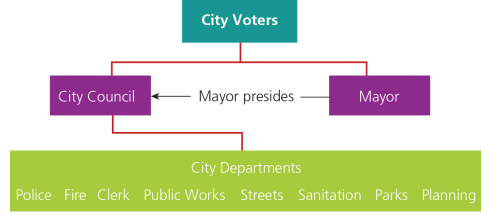
Council-Manager Form

Mayor-Council
• Common in larger cities
• Both strong & weak sub-forms
• Common in larger cities
• May be best at dealing with problems of major urban areas
• Strong opinions, big actions can galvanize large groups
• ~39% of U.S. cities
• Both strong & weak sub-forms
• Key difference: What formal powers does the mayor have?
• Historically, strong form has sometimes been associated w/ political corruption
Strong Mayor-Council
• Separation of powers, with:
• Mayor has considerable formal powers, including:
• Separation of powers, with:
• Council = legislative
• Mayor = chief executive w/ veto
• Mayor has considerable formal powers, including:
• Agenda-setting power
• Manages depts. & daily operations
• Appointment & removal powers
• Fiscal power over budget
Strong Mayor-Council Form

Weak Mayor-Council
• Council has legislative & executive authority
• Mayor (elected OR peer selected):
• Mayor has ceremonial, figurehead role
• Council has legislative & executive authority
• Mayor has little power outside council
• Mayor (elected OR peer selected):
Limited agenda-setting power
• Limited exec. power over city gov’t
• No veto
• Mayor has ceremonial, figurehead role
• Informal power important to mayoral success
Weak Mayor-Council Form
Local Politics & Governance
Important things w/ direct, measurable effects on quality of life, including:
• Still, few actually participate
Important things w/ direct, measurable effects on quality of life, including:
• Policing
• Property
• Noise
• Sewage treatment
• Zoning
• Local taxes
• Schools
• City roads
• Still, few actually participate
• Voter turnout is low, especially in off-years
• Disproportionate influence of seniors & middle class voters
• Economically prosperous persons w/ more “at stake”!
Nonpartisanship in Local Elections
80% of U.S. local gov’ts have non-partisan elections, including TX municipal gov’ts
• However, candidates may be partisan “coded”
80% of U.S. local gov’ts have non-partisan elections, including TX municipal gov’ts
• Voters lack key electoral cue
• Greater importance of image
• Greater importance of “neighborhood politics”
What matter in local elections?
• Group identities & interests > partisan identification’
• Who gets what > ideological debates
• Issues are more personal
• Less media coverage
• Who gets what > ideological debates
• Which groups & neighborhoods with benefit?
• Issues are more personal
• Moral & fiscal issues can have big impact on turnout
Two Types of Local “Legislative” Seats
Cities may elect council members from either singlemember districts or at-large (or use a combination).
• Single-member districts (i.e. ward, precinct)
• At-large seats
• Single-member districts (i.e. ward, precinct)
• City is divided into geographic districts whose residents elect one member to represent them on the council
• Better represents diversity that presents geographically
• Important for minority representation due to housing patterns
• At-large seats
Voted on by all city residents w/o regard to geographic area or neighborhood
In theory, these members are expected to be non-partisan, take broad view of the city & its problems
A Murkier Rationale for “At Large” Seats
“At large” representatives may not seek to represent everyone in the city but only those who voted for him/her
Therefore, efforts to convert single-place seats to “at large” seats may be a thinly-veiled effort to provide less representation to minorities & poorer sections of a city
“At large” representatives may not seek to represent everyone in the city but only those who voted for him/her
• Who votes in city elections?
• Older, white, economically prosperous men & women!
Therefore, efforts to convert single-place seats to “at large” seats may be a thinly-veiled effort to provide less representation to minorities & poorer sections of a city
Such amendments often justified as preventing “a few members” blocking decisions that are good for the entire city