Chapter 14::Nitrogen, Sulfur, Phosphorus, and other nutrients
 Call Kai
 Learn
 Practice Test
 Spaced Repetition
 Match
 Flashcards
 Knowt Play
1/28

There's no tags or description
Looks like no tags are added yet.
29 Terms
What is the most common form of nitrogen form?
N2 gas and it makes up to 78% atmosphere.
What is combined nitrogen?
Organic and inorganic forms that are utilized by organisms.
What are the two most important forms of nitrogen in aquatic systems?
Nitrate (NO-3)
Ammonium (NH4+) generally found in neutral to acidi, it converts to ammonia gas, NH3.
What is the sum of Nitrate, Nitrite and ammonium?
Dissolved Inorganic Nitrogen
What are the forms of Nitrogen?
Organic N includes animo acids, nucleic acids, proteins, urea,
Urea and Ammonium are excreted by organisms and crucial in nitrogen cycling
What are the two categories Organic N can broken down into?
Dissolved organic Nitrogen< 45um
Particulate Organic Nitrogen >45um
What are nitrogen fluxes?
•Is essential to organisms because it is required in many biological molecules.
•Most organisms can only assimilate organic nitrogen.
•Primary producers and bacteria use nitrate, nitrite or ammonium.
Ammonium is the preferred form in the cell, thus nitrate and nitrite are typically converted into ammonium via the enzymes nitrate reductase and nitrite reductase.
What is the Nitrogen Fixation in Cyanobacteria?
What is Nitrification?
The microbial processes that convert nitrate to ammonium, yielding energy.
Used to produce energy for carbon fixation (alternative pathway to photosynthesis)
How are ammonium and nitrate oxidation important?
•Nitrification forms a vital link in the nitrogen cycle
•Nitrite formed by this process can have negative health implications
Nitrifying bacteria compete for ammonium with primary producers
What is dentirfication?
Conversion of nitrate to N2 gas by microorganisms, a form of respiration that uses nitrate rather than O2 to oxidize organic carbon.
What is nitrogen a predominant from in what waters?
Oxidized waters
Ammonium predominate in what waters?
Anoxic waters
What is the nitrogen Cycle?
What are the forms of inorganic sulfur?
•S2- sulfide
•So elemental sulfur
•S2O32- thiosulfate
SO42- sulfate
_______ is a significant gaseous product of phytoplankton metabolism.
Dimethylsufide
What is Dissimlatory Sulfur Reduction?
Oxidizes sulfur can be used as an electron acceptor respire organic carbon and is primarily source of sulfide found in anoxic sediments and waters.
What is disproportionation?
An anoxic transformation in which thiosulfate is converted to sulfate and sulfide, yielding energy.
What is the Sulfur Cycle?
What is the dominate forms of Phosphate (PO43)
Form of inorganic phosphorus in natural waters but in concentration are below detection.
Where are organic phosphorus found?
Lipids and Nucleic acids.
What are the two categories of organic phosphorus?
•DOP – dissolved organic phosphorus
•PP – Particulate phosphorus
TP – Total Phosphates = DOP + PP + Phosphates
What are the Phosphorus transformations?
•Phosphorus will bind to ferric iron in oxic conditions precipitating out of solution, however it disassociates in anoxic conditions going back into solution.
•Phosphate will precipitate out with calcium as apatite in waters with high alkalinity, high phosphate and high pH. Can deplete all of the phosphorus out of the system and lead to the long term storage of phosphorus.
•Unlike other compounds discussed, phosphorus is not used by organisms for carbon fixation or respiration.
What is the Phosphorus Cycle?
Characteristics of Silicon?
Dominance of Diatoms
•Aluminosilicate minerals are the most abundant in Earth’s crust, however silicate is not commonly dissolved in water because of limited solubility.
•Microbes contribute to weathering rates of silicates.
•It can exists in several forms including silica (SiO2) and silicic acid (H4SiO4), with silicic acid being the most common dissolved form.
•Most commonly found in watersheds below volcanoes and in very low concentrations in limestone watersheds.
What are common silicate particulate in waters
•Clays and Sands are common silicate containing particulates in waters and benthic substrata.
•Used in the frustules of diatoms, spicules of freshwater sponges, and in emergent grasses.
•It is typically depleted seasonally from the epilimnion.
However, river concentrations are typically constant.
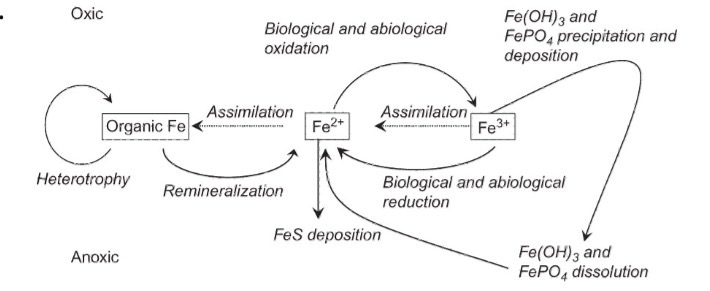
What are the several forms of Iron?
•Ferric iron (Fe3+) under high redox(oxic) conditions.
•Ferrous iron (Fe2+) under low redox conditions.
•O2 coverts Ferrous to Ferric iron.
Ferric iron reacts with hydroxyl (OH-) ions to form ferric hydroxide (Fe(OH)3) which is a flocculent precipitate.
Characteristics of Iron?
•Ferric iron can precipitate phosphate in oxic environments and disassociate in anoxic environments leading to cycling of phosphate in during seasonal mixing.
•Iron pyrite forms with sulfide.
Ferrous iron in the presence of O2 can be used by some bacterial species as a source of energy.