L2 - Hematopoiesis
 Call Kai
 Learn
 Practice Test
 Spaced Repetition
 Match
 Flashcards
 Knowt Play
1/72

There's no tags or description
Looks like no tags are added yet.
73 Terms
What is Hematopoiesis?
Production of all blood elements, including erythrocytes, leukocytes, and platelets
What is the Difference between Myelopoiesis and Lymphopoiesis?
Myelopoiesis produces non-lymphoid blood cells
Lymphopoiesis produces lymphocytes
What are Erythropoiesis, Granulopoiesis, and Thrombopoiesis?
Myelopoiesis produces non-lymphoid blood cells:
Erythropoiesis: Production of erythrocytes
Granulopoiesis: Production of neutrophils, eosinophils, and basophils
Thrombopoiesis: Production of platelets
What is the Difference between Stem Cells, Progenitor Cells, and Precursor Cells?
Stem cells: Can produce all blood cell lineages and self-renew
Progenitor cells: Have restricted differentiation potential and limited self-renewal
Precursor cells: Morphologically recognizable immature cells without self-renewal capacity
What does the Hematopoietic Pyramid illustrate?

Can Stem Cells and Progenitor Cells be distinguished by Morphology Alone?
No
Their identity depends on functional or molecular characteristics
What Morphologic Changes occur as Bone Marrow Cells mature?
Cell and nuclear size decrease
Nucleus-to-cytoplasm ratio decreases
Nucleoli disappear
Chromatin condenses
Cytoplasmic basophilia decreases as RNA content falls
Why does Cytoplasmic Basophilia decrease during Maturation?
RNA content decreases as lineage-specific products accumulate
Which Hematopoietic Lineage is the Exception to decreasing Cell Size during Maturation?
Megakaryocytes increase in size as they mature
What is the Developmental Sequence of Erythropoiesis?
Rubriblast → Prorubricyte → Basophilic rubricyte →
Polychromatic rubricyte → Metarubricyte → Reticulocyte → Mature erythrocyte

How does Erythroid Cell Morphology change during Maturation?
Cells become smaller
Chromatin condenses
Cytoplasm becomes progressively pinker as hemoglobin accumulates
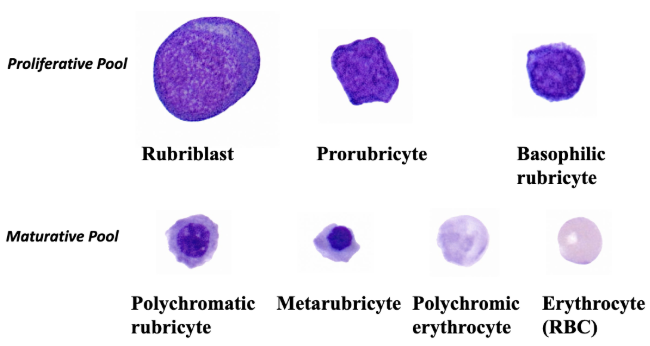
What is the Last Nucleated Stage of Erythropoiesis?
Metarubricyte

What is the Difference between Reticulocytes and Mature Erythrocytes?
Reticulocytes retain residual RNA → while mature mammalian erythrocytes lack a nucleus and have minimal residual RNA

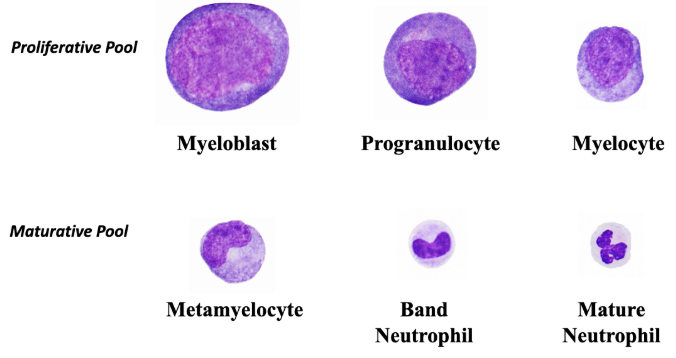
What is the Developmental Sequence of Granulopoiesis?
Myeloblast → Progranulocyte → Myelocyte →
Metamyelocyte → Band neutrophil → Segmented neutrophil

When do Primary and Secondary Granules develop during Granulopoiesis?
Primary granules: Progranulocyte stage
Secondary granules: Myelocyte stage

How does Nuclear Shape change during Granulocyte Maturation?
Round → Indented → Band-shaped → Segmented
What is the Developmental Sequence of Megakaryocytes?
Megakaryoblast → Early promegakaryocyte →
Late promegakaryocyte → Megakaryocyte

What Morphologic Changes occur during Megakaryocyte Maturation?
Cells become larger
Develop multilobulated nuclei
Accumulate abundant granular cytoplasm
Platelets are released from their cytoplasm

What is Endomitosis?
DNA replication without normal cell division, increasing megakaryocyte ploidy and size
What is the Proliferative Pool?
Mitotically active precursor cells that divide to increase blood cell numbers
Which Cells belong to the Proliferative Pool?
Erythroid: Rubriblasts, prorubricytes, and basophilic rubricytes
Granulocytic: Myeloblasts, progranulocytes, and myelocytes
What is the Maturative Pool?
Postmitotic cells that complete differentiation without further cell division
Which Granulocytic Cells belong to the Maturative Pool?
Metamyelocytes, band neutrophils, and segmented neutrophils

What is the Bone Marrow Storage Pool?
A reserve of mature neutrophils that can be rapidly released into circulation when needed
Which Species have Large vs. Small Neutrophil Storage Pools?
Large: Dogs and cats
Small: Horses and cattle
What is the Primary Stimulus for Erythropoiesis?
Hypoxia (decreased oxygen availability)
Where is Erythropoietin (EPO) primarily produced?
The kidneys, specifically renal cortical peritubular interstitial fibroblast-like cells
The liver is a secondary source
What is the Function of PHD2 under Normal Oxygen Conditions?
PHD2 uses oxygen to hydroxylate HIF-2α, targeting it for degradation

What is the Function of HIF-2α?
A transcription factor that promotes EPO gene transcription
How does Hypoxia stimulate EPO Production through the PHD2–HIF-2α Pathway?
Hypoxia
Decreased PHD2 activity
HIF-2α stabilization
Increased EPO transcription
Increased erythropoiesis

What are the Major Effects of EPO on Erythropoiesis?
Proliferation of erythroid progenitor cells
Erythroid cell maturation
Hemoglobin synthesis
Earlier release of reticulocytes (*species variation)
Why is the Regenerative Response delayed after Acute Blood Loss?
Erythroid precursors require approximately 3–6 days to proliferate and mature before regeneration becomes detectable
How Many RBCs can One Rubriblast produce?
Approximately 16–32 RBCs after 4–5 mitoses
What is RBC Senescence?
Aging-associated oxidative and membrane damage that reduces erythrocyte deformability
Where are Senescent RBCs primarily removed?
By macrophages in the spleen
Liver macrophages also contribute
What are Erythroblastic Islands?
Erythroblastic island consists of a central macrophage surrounded by erythroid precursors

What is the Function of the Central Macrophage in an Erythroblastic Island?
Supports erythroid proliferation and maturation, including iron supply
QUESTION 1: Which of the following cell types has the highest hemoglobin concentration?
a.) Rubricyte
b.) Rubriblast
c.) Erythrocyte
d.) Metarubricyte
ANSWER → c.) Erythrocyte
Hemoglobin accumulates as erythroid cells mature
While the strong basophilia of early precursors reflects abundant RNA
What is the Primary Regulator of Granulopoiesis?
Granulocyte colony-stimulating factor (G-CSF)
Which Cells produce G-CSF?
Primarily endothelial cells
Fibroblasts
Macrophages
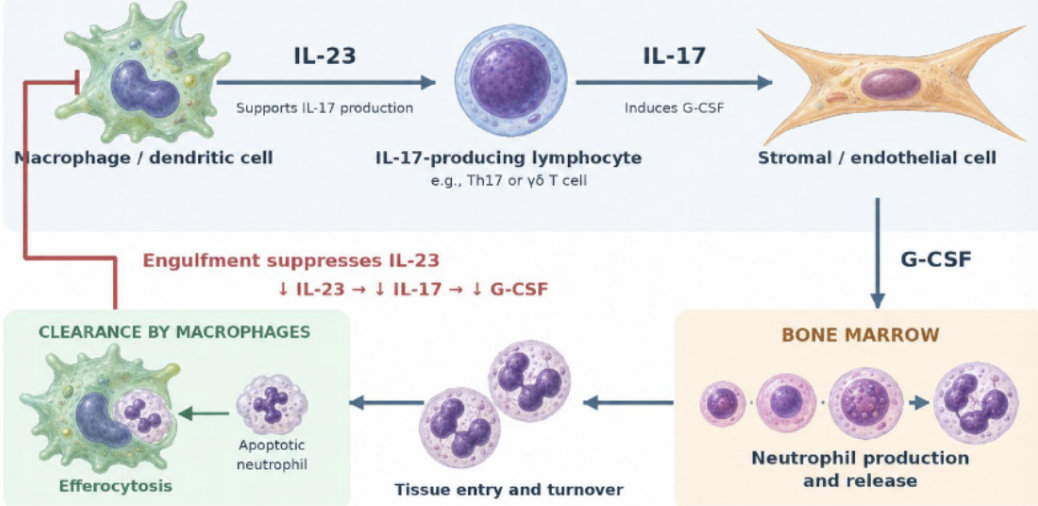
What is the IL-23–IL-17–G-CSF Pathway?
IL-23 stimulates IL-17 production
IL-17 stimulates tissue cells to produce G-CSF
G-CSF increases granulopoiesis

How does Neutrophil Clearance regulate Granulopoiesis?
Macrophage clearance of apoptotic neutrophils decreases IL-23 production → reducing IL-17 and G-CSF signaling

What happens to the IL-23–IL-17–G-CSF Pathway when Neutrophil Numbers decrease?
Reduced neutrophil clearance → Increased IL-23 → Increased IL-17 → Increased G-CSF → Increased neutrophil production
What is the Function of the CXCL12–CXCR4 Axis?
Promotes neutrophil retention within bone marrow

What is the Function of CXCR2 Signaling?
Promotes neutrophil mobilization from bone marrow into circulation

Which Chemokines are associated with Neutrophil Mobilization?
CXCL1, CXCL2, and CXCL8
Their relative roles vary by species

How do Corticosteroids affect the Neutrophil Storage Pool?
They promote the release of stored neutrophils into the peripheral circulation
Which Inflammatory Mediators increase Granulopoiesis during Infection?
G-CSF
GM-CSF
IL-1
IL-6
TNF-α
What is a Left Shift?
Increased immature granulocytes in circulation
Interpret with neutrophil count and clinical context
Which Cytokine promotes Eosinophil Production, Maturation, and Survival?
IL-5
What is the Monocyte Differentiation Sequence?
CFU-M → monoblast → promonocyte → monocyte
What is CFU-GM?
A shared progenitor of neutrophils and monocytes
Do Monocytes have a Bone Marrow Storage Pool?
No
They leave marrow and can differentiate into tissue macrophages
QUESTION 2: Which of the following mediators is produced by tissue (i.e. non-hematopoietic) cells and directly stimulates granulopoiesis?
a.) IL-17
b.) CXCL8
c.) G-CSF
d.) IL-23
ANSWER → c.) G-CSF
What are Mammalian Platelets?
Anucleate cytoplasmic fragments of megakaryocytes containing granules important in hemostasis

What is the Approximate Circulating Lifespan of Platelets?
Approximately 6–10 days
How do Non-mammalian Thrombocytes differ from Mammalian Platelets?
Thrombocytes are nucleated cells
Mammalian platelets are anucleate fragments

How are Mammalian Platelets released into Circulation?
Megakaryocyte proplatelets extend into sinusoids and fragment with cytoskeletal remodeling and blood flow
How do Avian Thrombocytes enter Circulation?
They develop within marrow sinusoids and enter blood without crossing vessel walls
What is Thrombopoietin (TPO), and Where is it produced?
A hormone produced primarily by the liver, with additional production by the kidneys, that regulates megakaryocyte development
What are the Major Effects of TPO?
Supports megakaryocyte progenitor survival, expansion, and maturation
How is Free TPO regulated by Circulating Platelets?
TPO is produced continuously, while circulating platelets bind and remove it
How do Thrombocytopenia and Thrombocytosis affect TPO Levels?
Thrombocytopenia: Decreased platelet mass → Increased free TPO → Increased megakaryopoiesis
Thrombocytosis: Increased platelet mass → Decreased free TPO → Decreased megakaryopoiesis

What is the Main Difference between EPO, G-CSF, and TPO Regulation?
EPO: Regulated by oxygen availability
G-CSF: Regulated by neutrophil turnover and inflammation
TPO: Free levels are regulated by circulating platelet mass
QUESTION 3: Which of the following statements regarding thrombopoiesis is correct?
a.) Megakaryocyte maturation involves progressive reduction in cell size
b.) Macrophages provide the main source of circulating TPO
c.) Mature mammalian platelets retain a nucleus
d.) TPO supports megakaryocyte progenitor survival, expansion, and maturation
ANSWER → d.) TPO supports megakaryocyte progenitor survival, expansion, and maturation
How can you distinguish the Proliferative Pool from the Maturative Pool using Cell Morphology?
Proliferative pool:
Immature cells with larger nuclei
Higher nucleus-to-cytoplasm ratios
More basophilic cytoplasm
Maturative pool:
More differentiated cells with condensed chromatin
Lower nucleus-to-cytoplasm ratios
Less basophilic cytoplasm
What are the Key Differences between Erythroid, Granulocytic, and Megakaryocytic Maturation?
Erythroid:
Cells become smaller,
Accumulate hemoglobin
Lose their nuclei
Granulocytic:
Cells develop specific granules and segmented nuclei
Megakaryocytic:
Cells become larger
Develop multilobulated nuclei
Release platelets
Stem Cells vs. Progenitor Cells vs. Precursor Cells SUMMARY
Characteristic | Stem Cells | Progenitor Cells | Precursor Cells |
Differentiation potential | All blood lineages | Restricted lineages | Committed lineage |
Self-renewal | Long-term | Limited | None |
Morphologically recognizable | No | No | Yes |
Main function | Maintain hematopoiesis | Expand specific lineages | Mature into functional cells |
Key concept: Stem cell → Progenitor cell → Precursor cell → Mature blood cell
Morphological Characteristics of Hematopoietic Cell Lineages SUMMARY
Characteristic | Erythroid Lineage | Granulocytic Lineage | Megakaryocytic Lineage |
Cell size | Decreases | Decreases | Increases |
Nuclear changes | Condenses → nucleus lost | Round → indented → band → segmented | Becomes multilobulated |
Cytoplasmic changes | Blue → pink (hemoglobin accumulation) | Primary → secondary granules | Abundant granular cytoplasm |
Key identifying stage | Metarubricyte = last nucleated stage | Myelocyte = first secondary granules | Mature megakaryocyte = very large cell |
Final product | Erythrocyte | Mature granulocyte | Platelets |
Important: Megakaryocytes are the exception to the general rule that hematopoietic cells decrease in size during maturation
Proliferative vs. Maturative vs. Storage Bone Marrow Pools SUMMARY
Characteristic | Proliferative Pool | Maturative Pool | Storage Pool |
Main function | Cell division | Cell maturation | Reserve for rapid release |
Mitotic activity | Yes | No | No |
Erythroid examples | Rubriblast, prorubricyte, basophilic rubricyte | Later rubricytes, metarubricyte, reticulocyte | Not emphasized |
Granulocytic examples | Myeloblast, progranulocyte, myelocyte | Metamyelocyte, band neutrophil | Mature segmented neutrophils |
Key concept | Proliferation | Differentiation | Storage |
Remember:
Proliferative = Division
Maturative = Differentiation
Storage = Reserve
Erythropoiesis — PHD2–HIF-2α–EPO Regulation SUMMARY
Characteristic | Normoxia | Hypoxia |
Oxygen availability | Normal | Low |
PHD2 activity | Active | Decreased |
HIF-2α | Degraded | Stabilized |
EPO production | Baseline | Increased |
Erythropoiesis | Baseline | Increased |
Pathway to memorize: Hypoxia → ↓ PHD2 → ↑ HIF-2α → ↑ EPO → ↑ RBC production
Important: EPO is primarily produced by renal cortical peritubular interstitial cells
Granulopoiesis — Major Regulatory Pathways SUMMARY
Pathway/Mediator | Main Function |
G-CSF | Primary regulator of granulopoiesis |
IL-23 → IL-17 → G-CSF | Feedback regulation of neutrophil production |
CXCL12–CXCR4 | Retains neutrophils in bone marrow |
CXCR2 signaling | Promotes neutrophil release into circulation |
IL-5 | Promotes eosinophil development |
GM-CSF, IL-1, IL-6, TNF-α | Support increased granulopoiesis during inflammation |
Key distinction:
CXCR4 = Retention
CXCR2 = Release
Thrombopoiesis — TPO Regulation SUMMARY
Characteristic | Thrombocytopenia | Thrombocytosis |
Platelet mass | Decreased | Increased |
Free TPO | Increased | Decreased |
Megakaryopoiesis | Increased | Decreased |
Result | Stimulates platelet production | Reduces stimulation of platelet production |
Pathway to memorize: ↓ Platelets → ↑ Free TPO → ↑ Megakaryopoiesis → ↑ Platelet production
Important: TPO is primarily produced by the liver and removed from circulation through binding to platelets.