Week 9 - Gene Regulation
 Call Kai
 Learn
 Practice Test
 Spaced Repetition
 Match
 Flashcards
 Knowt Play
1/32

There's no tags or description
Looks like no tags are added yet.
33 Terms
What is the difference between constitutive, inducible, and repressible genes?
Constitutive genes:
Are continuously expressed in most cells because their products are essential for normal cellular functions.
Examples include genes encoding tRNAs, rRNAs, ribosomal proteins, RNA polymerase subunits, and enzymes involved in housekeeping functions.
Inducible genes:
Are expressed only when their products are needed under certain environmental conditions.
Regulatory mechanisms allow these genes to be turned ON when needed.
Repressible genes:
Can be turned OFF when their products are no longer needed.
Regulatory mechanisms prevent unnecessary synthesis of gene products.
At what levels can gene expression be regulated, and which level is the focus of this chapter?
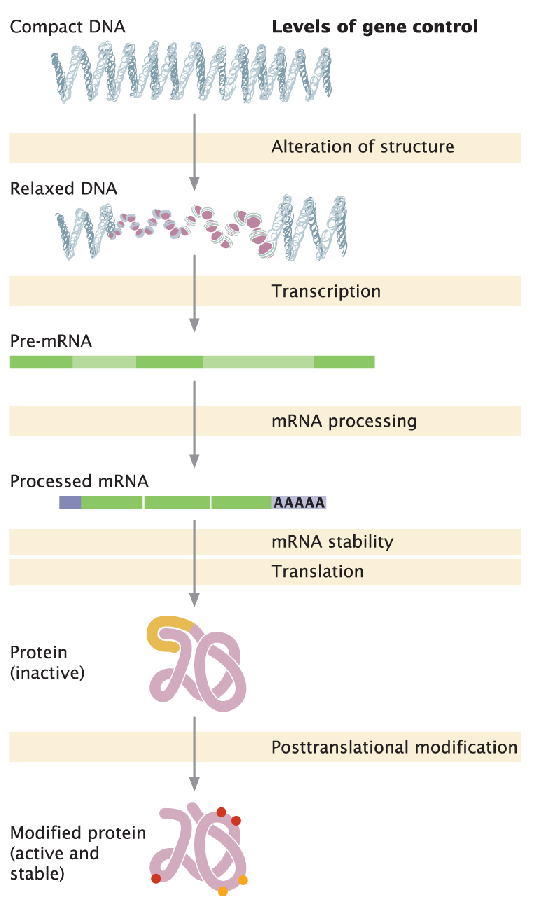
Gene expression can be regulated at multiple stages, including:
DNA structure
Transcription
mRNA processing
mRNA stability
Translation
Post-translational modification
This chapter focuses specifically on regulation of transcription initiation.
Regulation at this stage requires transcription factors (DNA-binding proteins) to bind to DNA and influence whether transcription begins.
What are DNA-binding transcription factors, and how do they regulate transcription?
Transcription factors are DNA-binding proteins that can act as activators or repressors of transcription.
They are common in both prokaryotes and eukaryotes.
They contain DNA-binding domains (approximately 60–90 amino acids) that recognize specific DNA sequences through interactions with DNA grooves.
Common DNA-binding motifs include:
Helix-turn-helix
Zinc fingers
Leucine zipper
These proteins bind to DNA through non-covalent interactions.
They regulate transcription by either:
Recruiting or facilitating RNA polymerase binding (activators).
Inhibiting RNA polymerase binding (repressors).

What is an operon, and how does it regulate gene expression in bacteria?
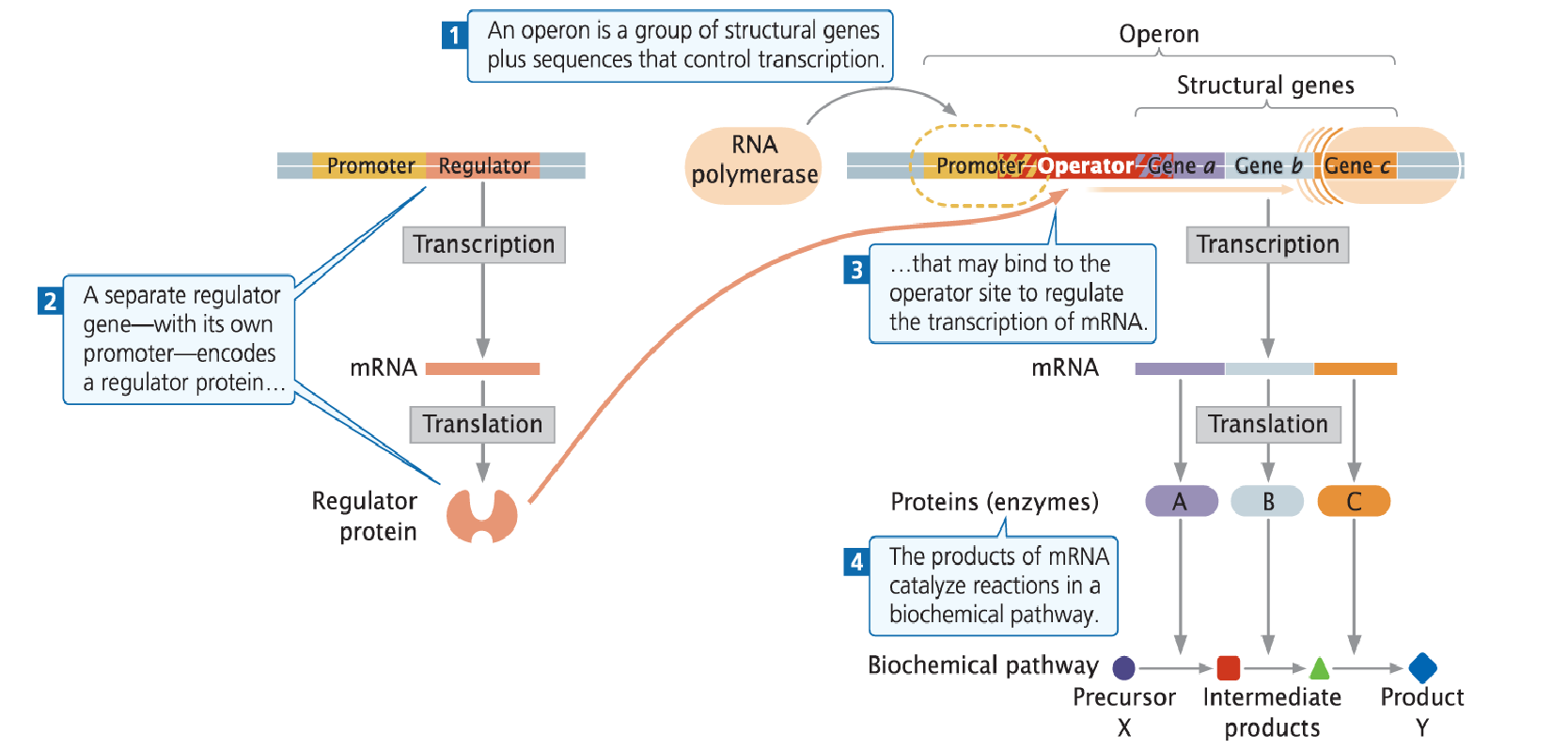
An operon is a group of structural genes and associated regulatory DNA sequences that control their transcription.
Multiple structural genes (e.g., genes a, b, and c) are transcribed together into a single mRNA molecule.
This mRNA can be translated into multiple proteins, such as enzymes involved in the same biochemical pathway.
Transcription is controlled by a regulator protein (transcription factor), which is encoded by a separate regulator gene with its own promoter.
The regulator protein binds to the operator to regulate transcription of the structural genes.
This allows bacteria to coordinate the expression of multiple genes.
What is the operator, and what is its role in bacterial gene regulation?
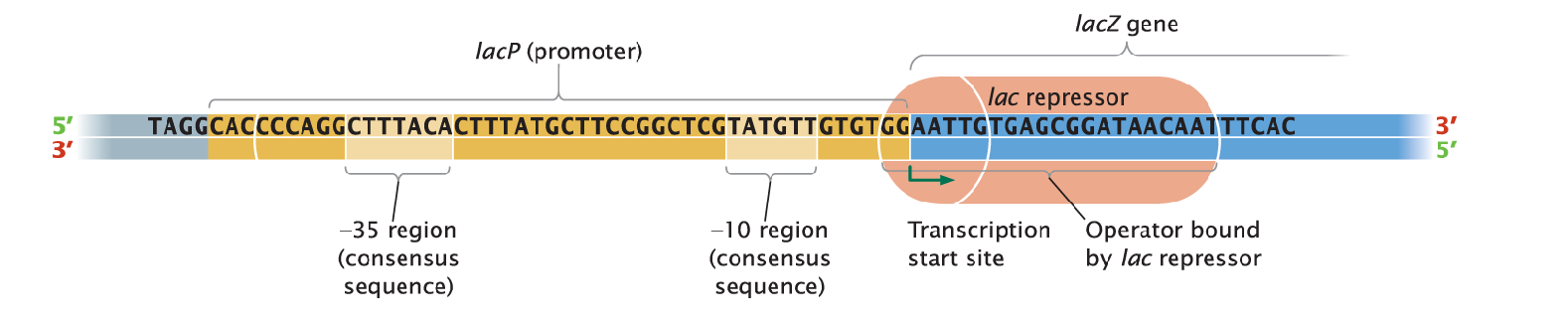
The operator is a regulatory DNA sequence within an operon that helps determine whether transcription can occur.
It serves as a binding site for regulatory proteins, such as repressors.
According to the lecture, the operator overlaps:
The 3′ end of the promoter.
The region near the 5′ end of the first structural gene, around the transcription start site.
The operator's sequence is specific to each operon, allowing particular regulatory proteins to recognize it.
When a repressor binds to the operator, it can prevent RNA polymerase from initiating transcription.
What is the difference between negative and positive gene regulation, and inducible and repressible operons?
The promoter/operator combination helps regulate transcription of an operon.
Negative regulation: A regulatory protein called a repressor inhibits transcription.
Positive regulation: A regulatory protein called an activator stimulates transcription.
Inducible operons:
Transcription is normally OFF.
Something causes transcription to be turned ON.
Repressible operons:
Transcription is normally ON.
Something causes transcription to be turned OFF.
Different regulatory mechanisms allow cells to express genes according to their needs.
What is a negative inducible operon, and why is transcription normally OFF?
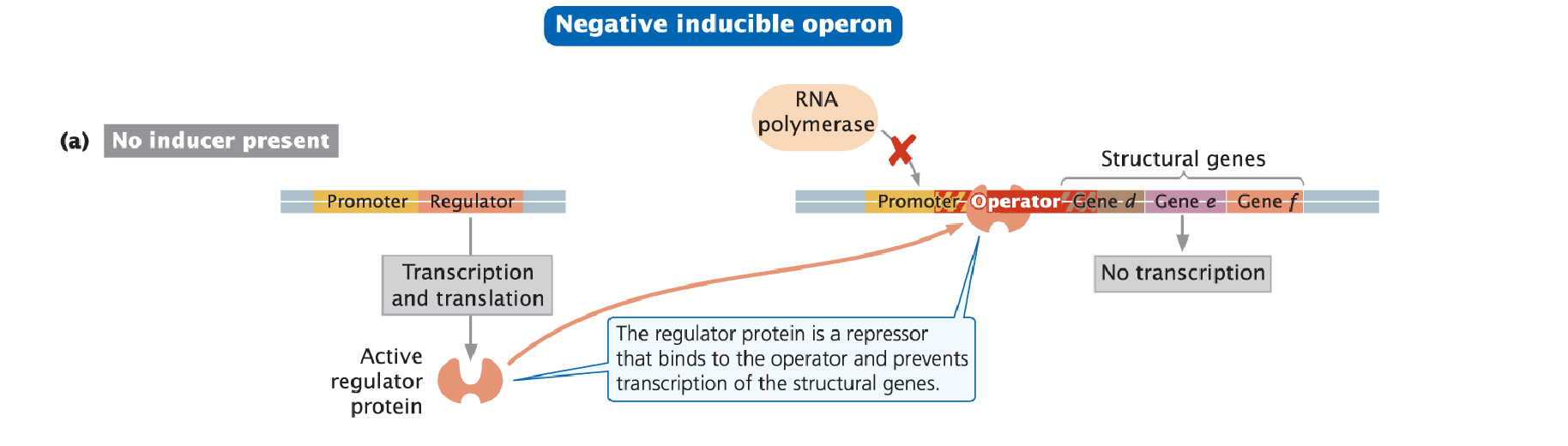
A negative inducible operon is normally OFF and must be activated for transcription to occur.
A separate regulator gene encodes an active repressor protein.
The repressor is active in the absence of a cofactor.
The active repressor binds to the operator, blocking RNA polymerase from binding to or effectively using the promoter.
This prevents transcription of the structural genes.
For transcription to occur, the repressor must be inactivated or removed from the operator.
How does an inducer activate transcription in a negative inducible operon?
The repressor is initially active, binding to the operator and preventing transcription.
A small molecule called an inducer binds to the repressor.
Inducer binding causes a conformational change in the repressor, inactivating it.
The repressor can no longer bind to the operator.
RNA polymerase can access the promoter and initiate transcription of the structural genes.
Negative inducible operons are usually involved in the degradation or metabolism of molecules.
Negative: The regulator is a repressor.
Inducible: Something inactivates the repressor, allowing transcription to occur.

How does the presence or absence of an inducer affect a negative inducible operon?
Without an inducer (OFF):
The repressor protein is active and binds to the operator.
This blocks RNA polymerase from initiating transcription of the structural genes.
With an inducer (ON):
An inducer binds to the repressor, causing a conformational change.
The repressor becomes inactive and can no longer bind to the operator.
RNA polymerase can access the promoter and initiate transcription of the structural genes.
This ensures the genes are expressed only when needed, usually for the metabolism or degradation of molecules.

How does the lac operon in E. coli demonstrate negative inducible regulation?
The lac operon in E. coli is an example of a negative inducible operon involved in lactose metabolism.
In the absence of lactose:
The lac repressor binds to the operator.
This prevents transcription of genes required for lactose metabolism.
When lactose is present:
Lactose acts as an inducing signal, causing the repressor to become inactive.
The repressor can no longer bind to the operator.
RNA polymerase can transcribe the genes involved in lactose metabolism.
This allows the bacterium to produce lactose-metabolizing enzymes when lactose is available.
What is a negative repressible operon, and why is transcription normally ON?
A negative repressible operon is normally ON, meaning transcription occurs until something causes it to be turned OFF.
A separate regulator gene produces a repressor protein.
The repressor is initially inactive in the absence of a cofactor (corepressor).
Because the inactive repressor cannot bind to the operator, RNA polymerase can initiate transcription.
The structural genes are transcribed, producing proteins that often function as enzymes in biosynthetic pathways.
Transcription must be turned OFF when the gene products are no longer needed.

How does a corepressor inhibit transcription in a negative repressible operon?
The repressor is initially inactive and cannot bind to the operator without a corepressor (cofactor).
A small molecule called a corepressor binds to the repressor.
This causes a conformational change, activating the repressor.
The active repressor–corepressor complex binds to the operator, preventing transcription.
Negative repressible operons usually regulate biosynthetic pathways.
This prevents unnecessary production of molecules that are already present in sufficient amounts.
Negative: The regulatory protein is a repressor.
Repressible: Something activates the repressor, causing transcription to be inhibited.
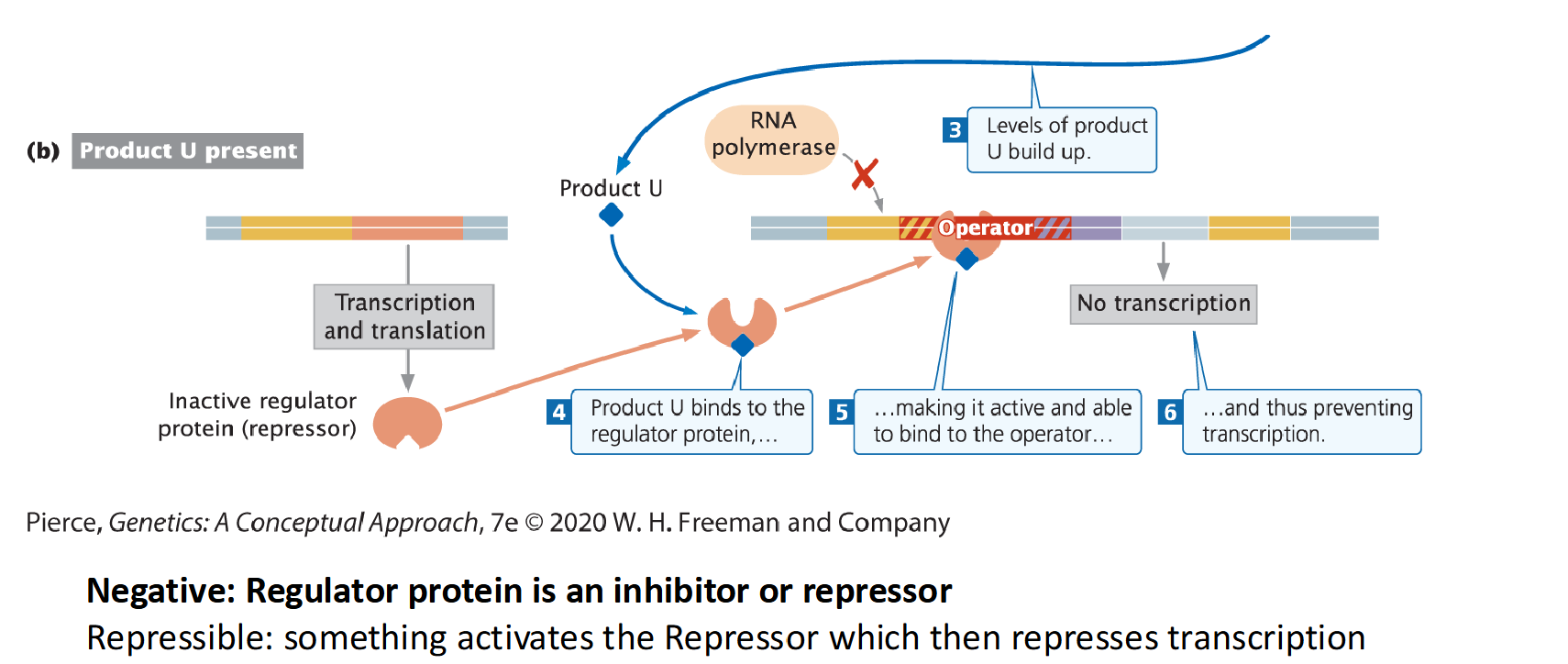
How does the trp operon demonstrate negative repressible regulation?
The trp operon contains genes involved in tryptophan biosynthesis.
When tryptophan levels are low:
The repressor is inactive and cannot bind to the operator.
Transcription occurs, allowing enzymes for tryptophan synthesis to be produced.
When tryptophan levels are high:
Tryptophan acts as a corepressor, binding to and activating the repressor.
The active repressor–corepressor complex binds to the operator.
Transcription is inhibited.
What is the difference between negative inducible and negative repressible operons?
Negative inducible operon:
Transcription is normally OFF because an active repressor binds to the operator.
An inducer binds to and inactivates the repressor, preventing it from binding to the operator.
Transcription becomes ON.
Usually regulates molecule degradation or metabolism.
Negative repressible operon:
Transcription is normally ON because the repressor is inactive without a corepressor.
A corepressor binds to and activates the repressor, allowing it to bind to the operator.
Transcription becomes OFF.
Usually regulates biosynthesis.

What is positive control of gene expression, and how does CAP regulate transcription?
Positive control involves a regulatory protein called an activator, which stimulates transcription.
Activators can bind to the operator or to DNA sequences upstream of the operator to influence transcription.
Catabolite Activator Protein (CAP) is a positive regulator of transcription.
CAP binds just upstream of the promoter, enhancing the binding of RNA polymerase to the promoter.
This promotes transcription initiation.

How is the lac operon regulated by both negative inducible and positive control?
Negative inducible regulation:
The regulator protein is a repressor (inhibitor) that prevents transcription.
Allolactose acts as an inducer, binding to and inactivating the repressor.
This allows transcription to proceed.
Positive regulation:
CAP (Catabolite Activator Protein) and cAMP work together to enhance transcription.
The CAP–cAMP complex promotes RNA polymerase binding to the promoter.
Therefore, the lac operon is controlled by both repression and activation.
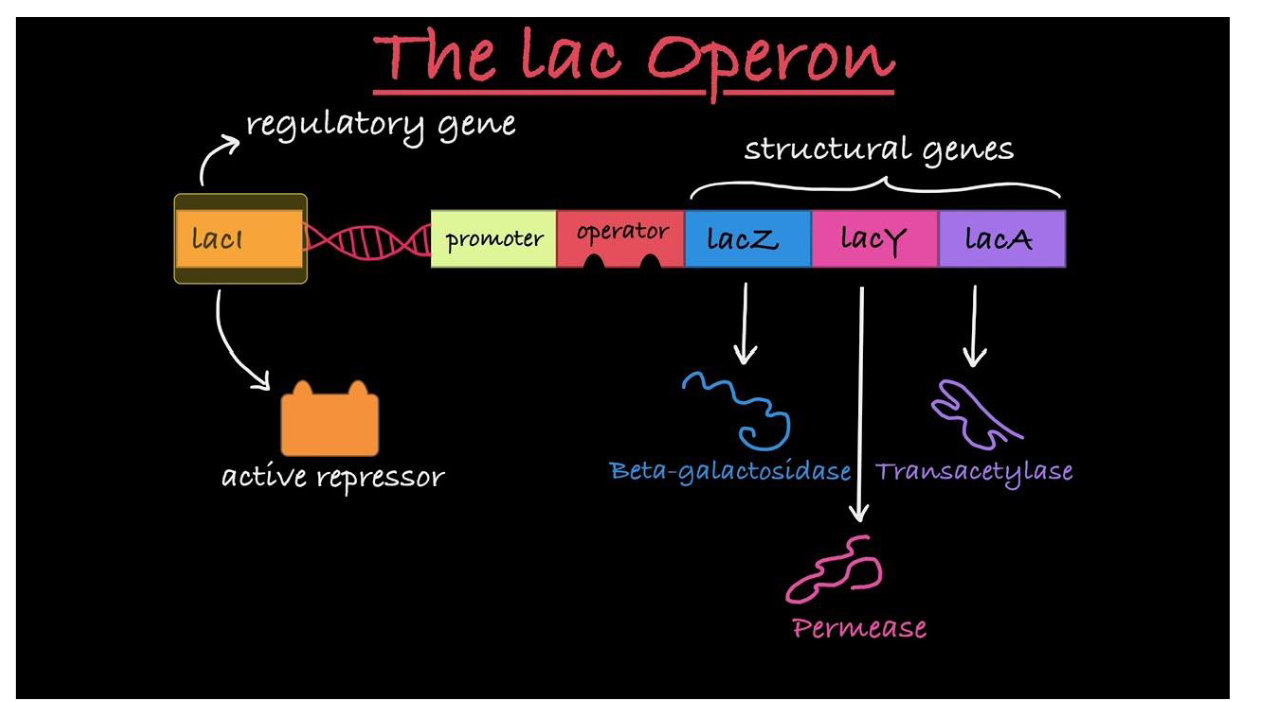
What are the three structural genes of the lac operon, and what are their functions?
The lac operon contains three adjacent structural genes that share a common promoter (lacP).
lacY → Permease:
Transports lactose across the bacterial cell membrane.
lacZ → β-galactosidase:
Breaks lactose into glucose and galactose.
Also converts some lactose into allolactose, the inducer of the lac operon.
lacA → Thiogalactoside transacetylase:
Encodes the third enzyme in the operon.
Its function is described as unclear in the lecture.
What happens to the lac operon in the absence of lactose, and what is coordinate induction?
In the absence of lactose:
The lacI regulator gene produces an active repressor protein.
The repressor binds to the lacO operator, inhibiting transcription of the structural genes.
Very little transcription occurs, but it is not completely shut down.
When lactose is added instead of glucose:
The rate of synthesis of the lac operon increases approximately 1000-fold within 2–3 minutes, according to the lecture.
Coordinate induction: The simultaneous synthesis of several proteins in response to a specific molecule called an inducer.

How does the presence of lactose activate the lac operon, and what happens when lactose is depleted?
When lactose is present:
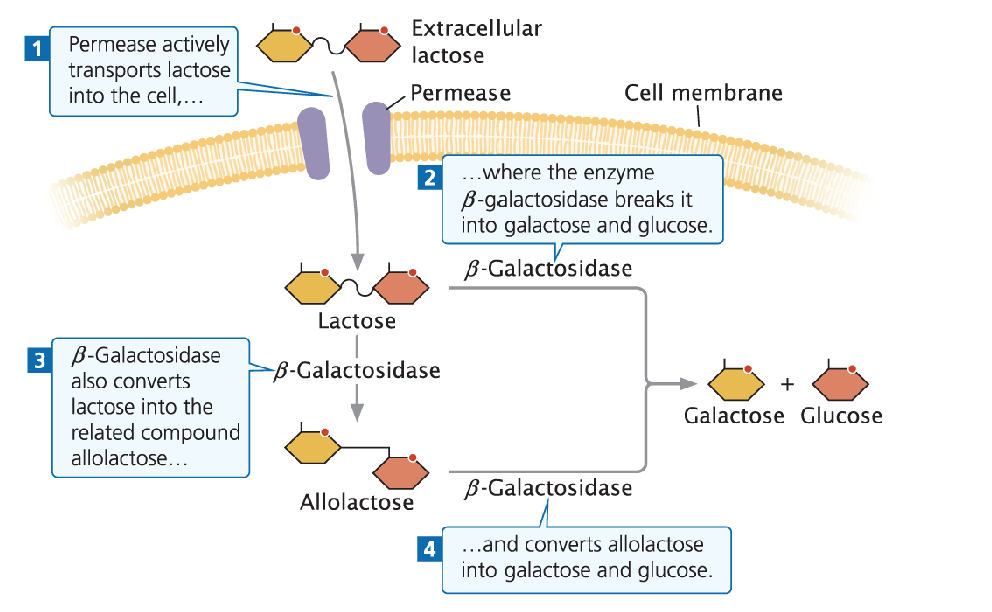
Lactose enters the cell through permease (lacY).
β-galactosidase (lacZ) converts lactose into glucose and galactose, as well as some allolactose.
Allolactose binds to the lac repressor, causing a conformational change that inactivates it.
The repressor can no longer bind to the lacO operator.
RNA polymerase can access the lacP promoter and transcribe the three structural genes (lacZ, lacY, lacA).
When lactose is depleted:
No additional allolactose is produced.
The repressor becomes active again and binds to the operator, inhibiting transcription.

How can the lac operon become induced if permease and β-galactosidase are required to bring lactose into the cell and produce allolactose?
Repression of the lac operon is not completely effective.
A small amount of basal transcription occurs even when the repressor is bound to the operator.
Therefore, low levels of permease (lacY) and β-galactosidase (lacZ) are always present in the bacterial cell.
Permease allows some lactose to enter the cell.
β-galactosidase converts some lactose into allolactose.
Allolactose inactivates the repressor, allowing increased transcription of the lac operon.
What did François Jacob and Jacques Monod discover about bacterial gene regulation?
François Jacob and Jacques Monod studied the lac operon in E. coli and helped establish the operon hypothesis.
They demonstrated that genes can be turned ON or OFF depending on environmental conditions.
Genes involved in the same metabolic pathway can be regulated together through an operon.
They identified key regulatory components:
Structural genes: Encode enzymes.
Promoter: Binding site for RNA polymerase.
Operator: Regulatory DNA sequence controlling transcription.
Repressor: Protein that binds the operator to inhibit transcription.
Their experiments also showed that mutations can disrupt gene regulation.
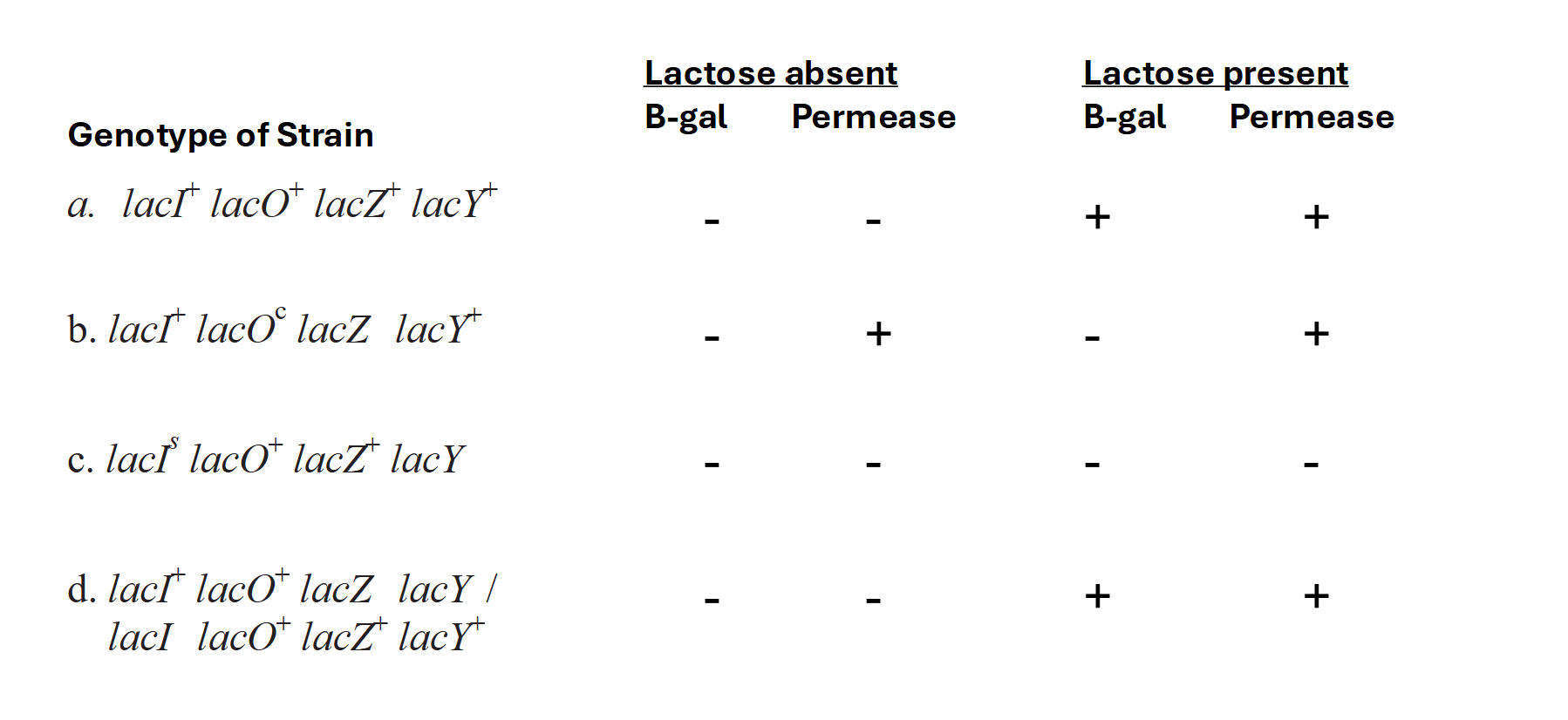
How can lacI⁻ and lacOᶜ mutations cause constitutive expression of the lac operon?
Constitutive expression means the operon is expressed continuously, regardless of whether lactose is present.
lacI⁻ mutation:
Occurs in the lacI regulator gene, which encodes the repressor.
Prevents the production of a functional repressor protein.
Without a functional repressor, the operator cannot be properly repressed.
Therefore, transcription occurs even when lactose is absent.
lacOᶜ mutation:
Occurs in the operator DNA sequence.
Prevents the repressor from binding to the operator.
Therefore, the operon is expressed continuously.
Both mutations disrupt normal transcriptional regulation, but they affect different components of the operon.

How do mutations in the structural genes lacZ and lacY affect lactose metabolism?
lacZ encodes β-galactosidase, which breaks lactose into glucose and galactose and can produce allolactose.
lacY encodes permease, which transports lactose into the bacterial cell.
Mutations in either gene can disrupt the cell's ability to metabolize lactose.
These mutations affect the function of the encoded proteins, rather than directly changing the transcriptional regulation of the operon.
Therefore, a gene may be properly regulated and transcribed but still produce a nonfunctional protein.
What is the difference between cis-acting and trans-acting regulation of gene expression?
Cis-acting regulatory elements:
Control gene expression only on the same piece of DNA.
They are generally regulatory DNA sequences.
Example: The promoter acts in cis to regulate lacZ on the same DNA molecule.
Trans-acting regulatory factors:
Can regulate genes located on other DNA molecules.
They are typically diffusible regulatory products, such as proteins.
Example: The lac repressor protein acts in trans because it can bind to operators on different DNA molecules.

What is a partial diploid (merodiploid), and how is it used to study gene regulation?
Bacteria are normally haploid, carrying one copy of their chromosome.
A partial diploid (merodiploid) contains an additional copy of certain genes, often introduced on a plasmid.
For example, a bacterium may contain:
One copy of the lac operon on its chromosome.
Another copy of the lac operon on a plasmid.
It is called a partial diploid because only some genes are duplicated, not the entire genome.
Scientists can compare mutations on the chromosome and plasmid to determine how regulatory elements function.

How are wild-type and mutant genes represented in partial diploid genotypes?
A + superscript indicates a wild-type (functional) allele, such as lacZ⁺.
A − superscript indicates a mutant (nonfunctional) allele, such as lacZ⁻.
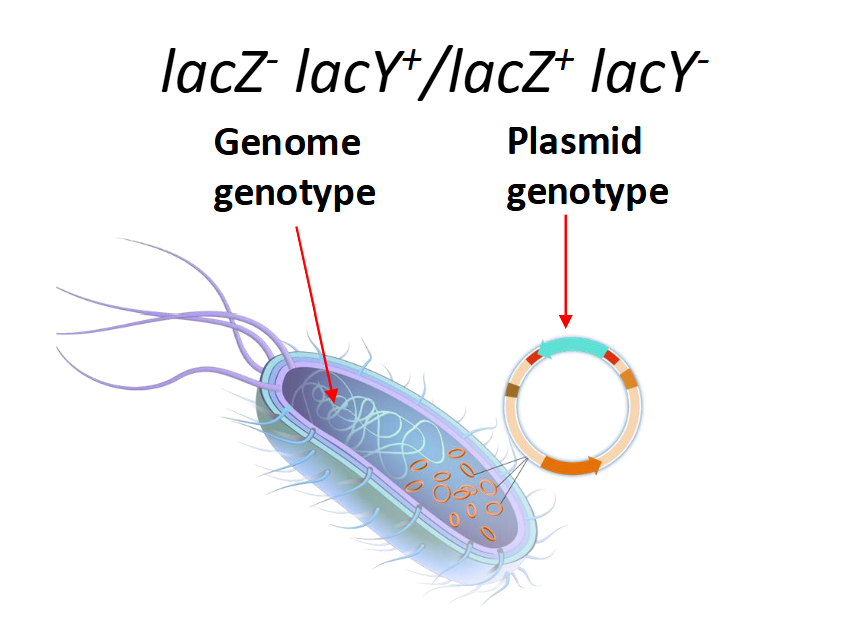
In a partial diploid, a slash (/) separates the chromosome genotype from the plasmid genotype.
Example: lacZ⁻ lacY⁺ / lacZ⁺ lacY⁻
Chromosome: Mutant lacZ, functional lacY.
Plasmid: Functional lacZ, mutant lacY.
One functional copy of each structural gene allows the bacterium to produce the enzymes needed for lactose metabolism.
Why is lacI⁺ dominant over lacI⁻ in a partial diploid?
lacI⁺ produces a functional repressor protein, whereas lacI⁻ produces a nonfunctional repressor.
The lac repressor is trans-acting, meaning it can regulate operons on different DNA molecules.
In lacI⁺ lacZ⁻ / lacI⁻ lacZ⁺, the functional lacI⁺ repressor can control the lacZ⁺ gene on the plasmid.
Without lactose: The active repressor binds to the operator and inhibits transcription.
With lactose: The inducer inactivates the repressor, allowing transcription and functional β-galactosidase production.
Therefore, the bacterium exhibits normal (wild-type) inducible regulation, and lacI⁺ is dominant over lacI⁻.

What is a lacIˢ super-repressor, and how does it affect transcription of the lac operon?
lacIˢ is a mutation in the lacI repressor gene that produces a super-repressor.
The super-repressor is insensitive to allolactose, meaning the inducer cannot inactivate it.
Therefore, the super-repressor binds to the operator whether lactose is present or absent.
Because the repressor is trans-acting, it can inhibit transcription on both the chromosome and plasmid.
lacIˢ is dominant over lacI⁺ because the super-repressor continues blocking transcription even when a functional lacI⁺ repressor is present.
Transcription remains OFF regardless of lactose availability, preventing the bacterium from metabolizing lactose through the lac operon.

Why are lacOᶜ operator mutations considered cis-acting?
lacOᶜ is an operator mutation that prevents the lac repressor from binding.
The resulting operon undergoes constitutive transcription, regardless of lactose availability.
The operator is cis-acting, meaning it only regulates structural genes located on the same DNA molecule.
Therefore, lacOᶜ cannot cause constitutive transcription of genes located on another chromosome or plasmid.
If lacOᶜ is linked to lacZ⁺, functional β-galactosidase is produced continuously.
If lacOᶜ is linked to lacZ⁻, transcription occurs continuously, but the resulting β-galactosidase is nonfunctional.

Summary of Mutations
What is catabolite repression, and how does glucose availability affect bacterial gene expression?
Glucose is the preferred energy source for bacteria because it requires less energy to metabolize than alternative sugars.
Even when other sugars, such as lactose, are present, bacteria preferentially metabolize glucose.
Catabolite repression:
When glucose is present, bacteria repress other metabolic pathways, including lactose metabolism.
This prevents unnecessary expression of genes involved in metabolizing alternative sugars.
Positive control:
When glucose levels are low, transcription of alternative metabolic pathways (e.g., the lac operon) is stimulated.
This regulation occurs independently of and in addition to negative regulation by repressors.
Positive control involves two important molecules: CAP (Catabolite Activator Protein) and cAMP.
cAMP levels are inversely proportional to glucose levels.
How does the CAP–cAMP complex stimulate transcription of the lac operon when glucose levels are low?
CAP (Catabolite Activator Protein) is a helix-turn-helix transcription factor that positively regulates transcription.
CAP requires cAMP to bind efficiently upstream of the lac operon promoter.
When glucose levels are low:
cAMP levels increase because glucose and cAMP levels are inversely related.
cAMP binds to CAP, forming the CAP–cAMP complex.
The CAP–cAMP complex binds to DNA upstream of the lac promoter.
This enhances RNA polymerase binding, promoting transcription of the lac operon by approximately 50-fold
CAP–cAMP also positively regulates more than 20 operons in E. coli.
Strong lac operon expression also requires that the lac repressor is inactivated by allolactose.

How do high glucose levels inhibit transcription of the lac operon through catabolite repression?
When glucose levels are high, intracellular cAMP levels decrease significantly.
Without sufficient cAMP, few CAP–cAMP complexes form.
CAP cannot efficiently bind to DNA upstream of the lac promoter.
As a result, RNA polymerase has a reduced affinity for the promoter.
This causes significantly reduced transcription of the lac operon.
Therefore, bacteria preferentially metabolize glucose rather than alternative sugars such as lactose.
This mechanism is called catabolite repression.
