Checkpoint 3 Practice
 Call Kai
 Learn
 Practice Test
 Spaced Repetition
 Match
 Flashcards
 Knowt Play
1/65

There's no tags or description
Looks like no tags are added yet.
66 Terms
Intensity increases by 2x. How many dB increase?
10 log (I2 / I1)
10 log (2)
10 x 0.301 = 3 dB
Intensity increases by 10x. How many dB increase?
10 log (I10 / I1)
10 log (10)
10 x 1 = 10 dB
If Ix = 10-5 w/m2, what is dB IL?
10 log (Ix/ 10-12)
10 log (10-5 / 10-12)
10 log 107 = 70 dB IL
If Ix = 2 x 10⁻⁵ w/m2, what is dB IL?
10 log (2 x 10⁻⁵ / 10-12)
10 log (2 x 10⁷)
10 [log 2 + log 107]
10 [0.301 + 7] = 73.01 dB IL
If Px = 2000 μPa and Pr = 20 μPa, what is the relative sound pressure level?
20 log (2000 / 20)
20 log 100
20 log 102
20 x 2 log 10
20 x 2 = 40 dB SPL
If pressure increases by 2x, what is the increase in dB?
Given - Px : Pr = 2
20 log 2 = 6 dB
If pressure increases by 10x, what is the increase in dB?
Given - Px : Pr = 10
20 log 10 = 20 dB
If Px = 2 x 10⁵ μPa, what is dB SPL?
20 log (Px / 2 x 101)
20 log (2 x 10⁵ / 2 x 101)
20 log 104
20 x 4 = 80 dB SPL
If Px = 4 x 10⁵ μPa, what is dB SPL?
20 log (Px / 4 x 101)
20 log (22 x 105 / 2 x 101)
20 log (2 x 10⁴)
20 [log 2 + 4 log 10]
20 [0.3 + 4]
20 x 4.3 = 86 dB SPL
If dB IL = 70 dB, then what is Ix?
Ix = 10-5 w/m2
Calculate dB IL for sound intensity Ix = 2 x 10⁻²
10 log10 ((2 x 10⁻²) / 10-12)
10 log10(2 x 10¹⁰)
10 [log 2 + 10 log 10]
10 [0.301 + 10]
103.01 dB IL
Calculate dB IL for sound intensity Ix = 0.25 x 10⁻¹²
10 log10((0.25 x 10⁻¹²) / 10-12)
10 log10(0.25)
-6.02 dB IL
Calculate dB SPL for sound pressure Px = 4 x 10³
20 log10(4000 / 20)
20 log10(200)
20 log10(2 x10²)
20 [log 2 + 2 log 10]
20 [0.301 + 2]
46.02 dB SPL
Calculate dB SPL for sound pressure Px = 1.05 x 10⁶
20 log10(1.05 x 10⁶ / 2 x 10)
20 log10(1.05 x 10⁵/2)
20 log [(1.05/2) x 105)]
20 log [0.525 x 10⁵]
20 [ log 0.525 + log 105]
20 [-0.279 + 5]
20 x 4.721
94.42 dB SPL
A 10-fold increase in sound pressure corresponds to an increase in how many dB?
A 10-fold increase in sound pressure corresponds to an increase of 20 dB
Calculation: 20 log10(10) = 20 dB
What is the perceptual correlate of frequency?
The perceptual correlate of frequency is pitch
What is the acoustic correlate of loudness?
The acoustic correlate of loudness is sound intensity

Will a 125 Hz tone at 40 dB SPL be audible to the average young listener with normal hearing? Briefly describe how you know.
Yes, a 125 Hz tone at 40 dB SPL will be audible to the average young listener with normal hearing because it is above the absolute hearing threshold at that frequency

Which will be perceived as louder: a 50 dB SPL tone at 125 Hz, or a 50 dB SPL tone at 2000 Hz? Briefly describe how you know.
The 50 dB SPL tone at 2000 Hz will be perceived as louder because human hearing is more sensitive at 2000 Hz than at 125 Hz. According to the equal loudness contours, the 2000 Hz tone has a higher loudness level in phons.
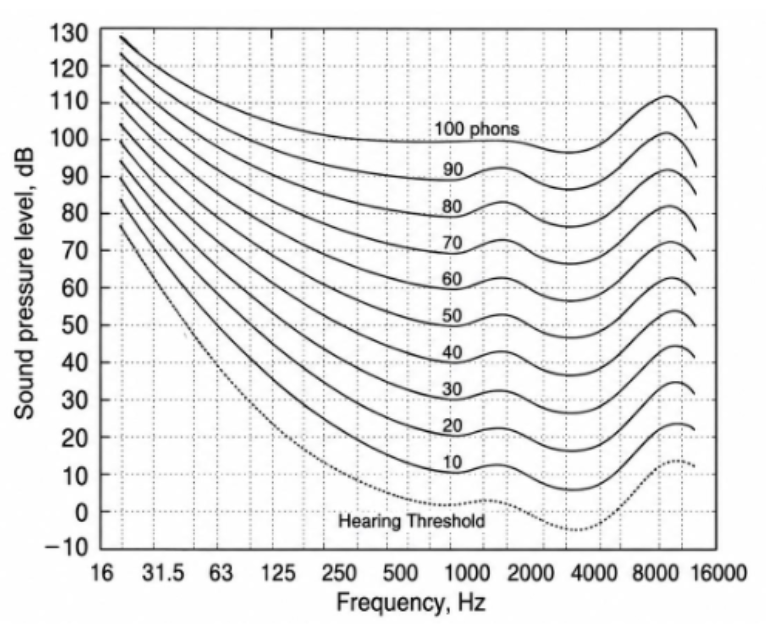
For this question, assume “audible” refers to the range of amplitudes between the 0-phon line (that is, the absolute hearing threshold curve) and the 100-phon line. What are the lowest and highest amplitudes (in dB SPL) that are audible at 4000 Hz?
At 4000 Hz, the lowest audible amplitude is approximately -5 dB SPL, and the highest is approximately 97 dB SPL

For this question, assume “audible” refers to the range of amplitudes between the 0-phon line (that is, the absolute hearing threshold curve) and the 100-phon line. What are the lowest and highest amplitudes (in dB SPL) that are audible at 31.5 Hz?
At 31.5 Hz, the lowest audible amplitude is approximately 62 dB SPL, and the highest is approximately 120 dB SPL

For this question, assume “audible” refers to the range of amplitudes between the 0-phon line (that is, the absolute hearing threshold curve) and the 100-phon line. Is the dynamic range of hearing greater at 4000 Hz or 31.5 Hz? How do you know?
The dynamic range of hearing is greater at 4000 Hz because the difference between the lowest and highest audible amplitudes is larger
At 4000 Hz: 97 - (-5) = 102 dB
At 31.5 Hz: 120 - 62 = 58 dB
Two pure tones an octave apart (say, for example, 2000 Hz and 4000 Hz) have _________ (the same/different) pitch height and _________ (the same/different) pitch chroma
Two pure tones an octave apart have different pitch height and the same pitch chroma

Match column A (the type of filter) to column B (the respective filter diagram)
A.1 Band-pass = B.2
A.2 Low-pass = B.3
A.3 High-pass = B.1
A.4 Band-pass = B.4

What kind of filter was applied to the input to get an output like the one shown in the following figure?
A high-pass filter
Draw a bandpass filter with a bandwidth of 60 Hz and a center frequency of 1500 Hz. Assume the passband is symmetrical around the center frequency.
Draw a high-pass filter with a lower cutoff frequency of 900 Hz
For each of the following, state whether it is best associated with the source (A) or the filter (B), as defined in the source-filter theory of speech production: Fundamental frequency, Formants, Harmonics, Oral cavity, F0, F1, Resonances, Vocal tract, Vocal folds, Pitch of the voice
How are the dimensions of time, frequency, and amplitude represented in a
spectrogram?

Below is a waveform and spectrogram of two vowels (“ah” followed by “ee”). How much time is shown, and what axis of the visualization represents this?

Below is a waveform and spectrogram of two vowels (“ah” followed by “ee”). At approximately what timepoint does the vowel change from “ah” to “ee”?
On what basis did you choose that timepoint?

Below is a waveform and spectrogram of two vowels (“ah” followed by “ee”). Which vowel has a higher average amplitude, and how can you tell?

Below is a waveform and spectrogram of two vowels (“ah” followed by “ee”). Given that the Y axis of the spectrogram scales from 0 to 5000 Hz, give an
estimate for the frequency of the first formant for each vowel. Does F1 increase or decrease when the vowel changes from “ah” to “ee”?

Below is a waveform and spectrogram of two vowels (“ah” followed by “ee”). Give an estimate for the frequency of the second formant for each vowel. Does F2 increase or decrease when the vowel changes from “ah” to “ee”?
You record a sine wave at 1000 Hz for 5 milliseconds, with a peak amplitude of 1 μPa. Draw a waveform representing the recorded sound.
You record a sine wave at 1000 Hz for 5 milliseconds, with a peak amplitude of 1 μPa. Draw a spectrum representing the recorded sound.
You record a sine wave at 1000 Hz for 5 milliseconds, with a peak amplitude of 1 μPa. Draw a spectrogram representing the recorded sound. You can assume that the amplitude does not change.
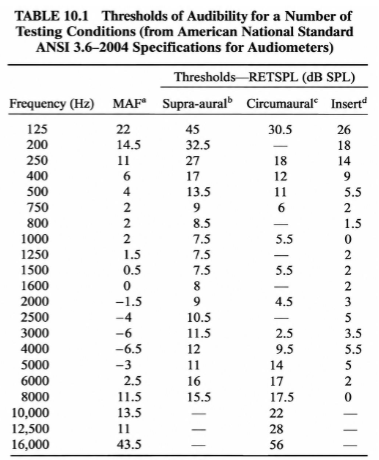
Find dB HL if threshold = 64 dB SPL at 4000 Hz and RETSPL = 9.5 dB SPL (circumaural)
64 - 9.5 = 54.5 dB HL
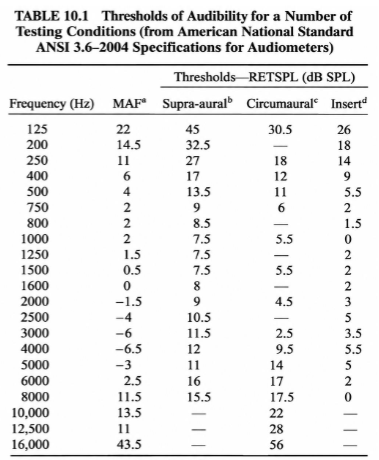
Find dB SPL if threshold = -5 dB HL at 500 Hz and RETSPL = 11 dB SPL (circumaural)
(-5) + 11 = 6 dB SPL

Compare C4 and C3
The higher note (C4) has a fo that is 2x the fo of the lower note (C3)

Compare C, C3 and C4
C, C3 and C4 have the same pitch chroma, but different pitch heights

Compare C, C#, D, and D#
C, C#, D, D#, etc., within the same octave have different pitch chromas

What vowel is this spectrum representing?
/i/

What vowel is this spectrum representing?
/u/

What is this spectrogram showing?
Complex periodic waveform
fo = 100Hz (missing)
2nd to 6th harmonics are present, with amplitudes progressively decreasing

What is this spectrogram showing?
Complex aperiodic - white noise

What is this spectrogram showing?
Pink noise around 1/f power spectrum

What is this spectrogram showing?
Brownian/Red noise around 1/f2 power spectrum
What fricative is voiced and alveolar?
/z/
What nasal is voiced and velar?
/ng/
What approximant is voiced and bilabial?
/w/
What stop is unvoiced and other?
/k/
What does 0 dB mean?
Ix = Ir
If Ir is not mentioned, what is the convention that you should consider?
10-12 W/m2
Pitch is unidimensional, but loudness has three dimensions (true/false)
False
The level at which sound can be detected 50% of the time is called…
Absolute threshold
A tuning fork has a stronger ________ than a snake’s hiss
Pitch strength
The unit of loudness is…
Phons
The pitch of a harmonic complex tone is related to its…
Fo
Band-reject filters remove a specific range of frequencies (true/false)
True
The amplitude of vibration increases when the driving frequency is close to the system’s natural frequency (true/false)
True
If a release burst occurs at 125 ms and the onset of voicing occurs at 122 ms, is this a voiced or voiceless stop?
Voiced
The consonants /p/ and /s/ differ from one another in…
Manner and place
What shows amplitude as a function of frequency?
Spectrum
A sound has an intensity level of 30 dB IL. The corresponding sound pressure level is…
30 dB SPL
Which will be perceived as louder - a 60 dB SPL tone at 31.5 Hz, or a 60 dB SPL tone at 4000 Hz?
60 dB SPL tone at 4000 Hz