PS370: Childbirth, family systems, siblings
 Call Kai
 Learn
 Practice Test
 Spaced Repetition
 Match
 Flashcards
 Knowt Play
1/58

There's no tags or description
Looks like no tags are added yet.
59 Terms
More people choosing not to have children
Childless versus childfree
Presence of children associated with different marital structures and processes (lower interaction, finance stress, division of labor, etc.)
Demographic differences between couples who are childbearing age who decide to not have kids–more educated
Choosing to parent
No children: higher levels of marital satisfaction and happiness
Birth of first child drastically decreases likelihood of divorce in first 5 years
Pay attention to methods. When were parents asked, what were they asked, etc.
Child rearing does take away from time with spouses – if marriage quality is based on the time spent doing things together of course it suffers.
Still, ~80-90% of Americans will procreate. Why?
Utilitarian purpose – help with family business, work on farm
Emotional connection
Family planning (control is the key driver) – joins theme of ‘increased autonomy’
Genotype
DNA content of cell’s nucleus; whether trait is externally observable or not
Phenotype
How genotype (alleles) are observably expressed through the interaction of proteins which may come about from environmental need/stimuli
Ex. behavior (irritability), emotional regulation, schizophrenia
Phenotypic plasticity
High: environmental factors have a strong influence on phenotype
Low: phenotype can be reliably predicted from genes
Heritability
Low phenotypic plasticity → high heritability
Amount of variation in a trait or class of behavior
Within a specific population
Attributed to hereditary factors
Heritability coefficient
Numerical estimate, ranging from .00 to 1.00, of the amount of variation in an attribute that is due to hereditary factors
H = (r identical twins – r fraternal twins) X 2
Intelligence: twins reared in same home
Fraternal = .60
Identical = .86
H = (.86 - .60) X 2 = .52
Chromosomes
Thread-like structures located inside the nucleus of animal cells. Each chromosome is made of protein and a single molecule of deoxyribonucleic acid (DNA).
Genes are stretches of DNA which make up the chromosomes
Humans have ~20,000-25,000 genes total, and genes are located on chromosomes
23 chromosomes from mother’s ovum (22 autosomes, 1 sex-chromosome)
23 chromosomes from father’s sperm (22 autosomes, 1 sex-chromosome)
Chromosones contain many genes
DNA must be unwound from the histones (acetylation)
Gene expression
Single-gene inheritance patterns
Simple dominant-recessive inheritance
Codominance
Polygenetic inheritance
Single gene-pair inheritance
Alleles: different versions of genes
Homozygous: the two alleles from both parents are the same
Heterozygous: the two alleles are different
Dominant alleles
More powerful allele in a heterozygous combination
Only 1 allele necessary to express phenotype
Recessive allele
weaker allele in a heterozygous combination
2 alleles necessary to express the phenotype
Codominance
Phenotype produce is a compromise between two genes
Alleles for human blood types A and B are equally expressive
Aka blood type AB
One of the heterozygous alleles is stronger than the other but fails to mask all of its effects – “incomplete dominance”
Sickle cell trait – “carriers” – overt symptoms rarely experienced unless they experience oxygen deprivation
Two recessive sickle-cell genes = Sickle-cell anemia
Polygenic or Polygenetic Inheritance
Traits influenced by multiple pairs of genes
Many degrees of the trait are possible
E.g., Schizophrenia, Depression, Personality,
height, weight, intelligence, skin color,
Temperament
Cambridge paper
(PGS) for depression aggregate across heterogeneity in thousands of genetic variants across the genome.
Polygenic research often uses genome-wide association studies (GWAS)
Scan entire genome for variants associated with some outcome → use statistical methods to aggregate that variability into a single score
Findings
Some evidence that PGS → Changes in depression, are they related?
Intervention can buffer these links
(more nuance in findings as a function of individual characteristics including ancestry, but we’re not getting into that much detail - just an example of how this type of work is done now)
Molecular genetics
Involves the analysis of genes and their effect
Tag SNPs–single nucleotide polymorphism
Very targeted instead of being genome-wide
Allelic variation
SNP or long/short
Focuses on 5-HTTLPR
Influences serotonin uptake
Long/short variation study
Associated with depression risk likely due to serotonin influence
Short 5-HTTLPR linked to depression, but not a for-sure predictor
Gene-environment interaction
Range of possible phenotypes for each genotype—dependent on environment
Nature sets range
Nurture determines exactly what is observed
Example:
Range of reaction for weight
Nutritional availability determines exact weight
Epigenetics
The study of how your behaviors and environment can cause changes that affect the way your genes work (changes in what the DNA does as a function of experience, does that at the point where the genetic sequence is read)
Unlike genetic changes, epigenetic changes are reversible and do not change your DNA sequence, but they can change how your body reads a DNA sequence.
DNA methylation
Adding a chemical group to specific places on the DNA where it blocks the proteins that attach to DNA to “read” the gene.
Methylation typically turns genes “off” and demethylation turns them “on”
Histone modification
DNA wraps around proteins called histones. DNA wrapped tightly around histones cannot be accessed by proteins that “read” the gene.
Methylation of specific genetic sites
Try and understand mental health risks
Differences in methylation between non-maltreatment and maltreatment on children
Traumatic events–more chronic–change the efficiency at which genes function
End up with greater risk of things like depression and anxiety
Passive genotype → environment
Passive genotype → environment correlation
Genetically related parents provide a rearing environment that is correlated with the genotype of the child (+ or - );
Cannot interpret cause of “nurture” (parent-child interaction effects) in biologically related families
Shared risk that is genetically influenced or related but is most often exerted through parents or whoever shares genes and is shaping the developmental environment of a child
Ex. child who struggles keeping organized in the present because the parent was also unorganized
Evocative Genotype → Environment
Evocative genotype → environment correlation
Child receives responses from others that are influenced by his/her genotype;
Different genotypes evoke different responses from the same environment
Some shared genetic risks evoke changes in the kid’s environment
May study how often parents have conflicts–child’s risk for irritability that is evoking from their peers, intimate partner–if they did not have that genetic risk it would be because it was not evoked as much
Plasticity
How much the variability in the outcome is influence by genes
Not one individual who has that genetic risk will have that outcome
How to lower the risk of Alzheimers article
APOE4 gene variant
Link between some genetic risk or individual characteristics will have a different effect as a function of variability and experience
Experiences or habits–implications of that outcome could be different depending on genetic risk
Diathesis-stress/dual-risk model
Some individuals, due to their biological, temperamental and/or behavioral characteristics (i.e., “diathesis” or “risk 1”), are more vulnerable to the adverse effects of negative experiences (i.e., “stress” or “risk 2”), whereas others are relatively resilient with respect to them
Vantage Sensitivity: The same idea but only “for better”
In the context of a positive environment, some people benefit more than other people
More vulnerable to risky experiences than others who do not have that characteristic
In a positive environment, resilient and vulnerable people look the same
Some negative experience of an early environment is not determined to lead to some negative outcome for all individuals

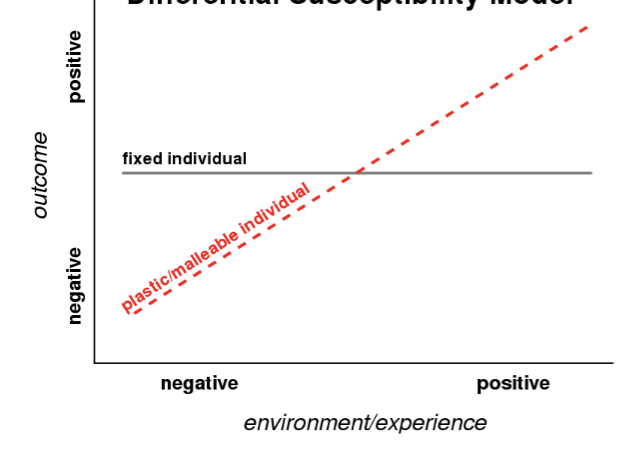
Differential susceptibility model
Influence of the environment is dependent on the characteristics of the individual–says that an individual who is very often “more susceptible or malleable” that a negative environment will make them do worse, but in positive environments they do a lot better
Ex. kid does better with structure and may be better than other kids despite being super hyperactive
Belsky’s differential susceptibility hypothesis and Boyce and Ellis’ (2005) related notion of biological sensitivity to context: Individuals do not simply vary in the degree to which they are vulnerable to the negative effects of adverse experience but, more generally, in their developmental plasticity
More susceptible than others to environmental influences in a for- better-and-for-worse manner
X-axis: characterizes the environment
Ex. classroom noise
Y-axis: outcome
Ex. academic performance
Line: individual work
Ex. noise sensitivity
Vagal flexibility
How flexible are kids' regulatory systems
Higher externalizing problems is worse
Good flexible regulatory system even in the context of non-sensitive parents is
Parents insensitive: higher sensitivity to the environment, especially if they cannot regulate themselves

Pregnancy
Pre-natal: before birth
Perinatal: around birth (shortly before/after)
Post-natal: after birth
Germinal period (2 weeks after conception)
From Zygote to blastocyst
Zygote: Single cell formed at conception (sperm + ovum)
Blastocyst: Ball-like structure into which the zygote transforms through cell division. Has 100-150 cells.
Implantation – Blastocyst must attach to the uterine wall – nearly 3 out of 4 zygotes fail to survive the initial phase of prenatal development
Highly susceptible to external influence, either successful or unsuccessful pregnancy
Embryonic Period (2-8 wks after conception)
Organogenesis: Every major organ is being formed.
Development proceeds in order of importance (more important organs for survival develop first).
Ex. heart before fingers
Lead in water, malnutrition, unclean air → implications for long term effects depending on what organs are developing
Fetal Period (9th week of pregnancy through birth)
Bodily structures and systems develop to completion
Muscular development
Bone formation
Weight gain
Central nervous system develops at a rapid pace
Practice makes perfect
Infants practice suckling, breathing, and walking during the fetal period
22-28 weeks age of viability
Teratogens
Any substance in the environment that can cause physical malformations during prenatal development.
Effects of Teratogens
Critical/sensitive periods/timing–when does exposure happen
Dosage and duration–severity of outcome
Thalidomide, nicotine, alcohol, cocaine, diseases like rubella and aids, environmental hazards
Nicotine/tobacco
Having a child is a major turning point or disruption in the family system, one of the major inflection point that causes reorganization in the family
Motivates switching from tobacco cigarettes to electronic cigarettes because they were viewed as being healthier
Negative impacts on fetal development–low birth weight, organ development
Alcohol
Similar to nicotine–use percentages are high prior to pregnancy
Low end of use, varying types of information in the public sphere, etc.
Social and experiential factors parents have to navigate through
Observed down the road–may have birth complications
Effects do not manifest until later in development
Increased risk of ADHD
Cocaine
Possible association with preterm delivery, abortions, premature rupture of membranes (PROM) and pregnancy –induced hypertension
Increased risk for placenta abruption
Increased risk for neonatal withdrawal symptoms, intrauterine and neonatal death, Sudden infant death syndrome (SIDS)
Maternal nutrition
Malnutrition: possibility for low birth weight babies at risk for underdeveloped organs and death
Obesity: High blood pressure, gestational diabetes, labor and birth complications, pre-term birth
Folic Acid: Orange juice, spinach, supplement
Prenatal Vitamins: Not too few and not too many
Prolonged /severe emotional stress and anxiety could result in:
Restricted blood flow to the uterus and oxygen deprivation
Restricted prenatal growth, low birth weight, premature birth, and birth complications
Babies may also be more irritable following birth
Recall our discussion of prenatal programming and allostatic load.
Potentially important role of (perceived) social support
Maternal age (35 or older)
Higher risk for:
Miscarriage: 18 – 25%
Down Syndrome:
At age 40- 1 in 106 (~1%)
At age 45 – 1 in 38 (~2.6%)
At age 49 – 1 in 11 (~9%)
Chronic Diseases (of Aging):
Gestational diabetes
Hypertension
Arthritis
What contributes to higher maternal age?
Advances in fetal medicine support healthier outcomes
Increasing autonomy and access to family planning options
Education
Sibling statistics
Sibling relationship = often longest-lasting relationship
% of US children who grow up with a sibling is higher than % of US children who grow up with a father.
88% of US children grow up with a sibling
Most siblings in US spaced 3-4 yrs apart (up from ~2.5 in 1990s)
Siblings with age-gap of 5-7+ years considered “functional only children”
Why are siblings important in development?
Children’s non-school hours in middle childhood:
Most time is spent with siblings
When a sibling joins the family
Transition to siblinghood
Possibly accompanied by some rivalry, resentment
Challenges for older siblings
Newborn gets a lot of attention
Older child may feel neglected, and have temporary adjustment problems
ONE KID: Since the publication of LeMasters’ article entitled “Parenthood As Crisis” (LeMasters, 1957), a vast literature has documented how having a baby changes the lives of married couples— typically, a decrease in positive marital interchange, an increase in marital conflict, and a decline in marital satisfaction.
TWO +: Overwhelming assumption that birth of sibling will be associated with difficulty
Focus on resentment and jealousy
Why?
Volling’s Longitudinal Work on Siblings
Followed for 15-20 years
Answer questions of the impact of the addition of child on siblings in the family
Figure 1
Increase in behavior problems from when the sibling is born
May seem short-term adjustment changes
Long term adaptation will stabilize
Across all problem areas examined, there was no evidence of a pattern of long-term maladjustment after the birth of a sibling that would indicate sudden increases in problem behavior immediately following the birth that persisted over time.
If low on behavior/emotion problems to start, remained low
In some cases, children’s behavioral and emotional problems actually declined, which may reflect the gradual maturation and growth in social and cognitive functioning over the toddler years.
Aggression: adjustment and adaptation response, a sudden increase from prenatal to 1 month with a subsequent decline to prebirth levels by 4 months.
Infancy/preschool
Formation of the sibling bond
Playmates
Enhancement of cognitive development
E.g., conservation task, scaffolding
Enhancement of social-cognitive development
Beginnings of imitation and social learning
Unique balance that cannot be achieved in child-adult interactions compared to child-child
Younger sibling has earlier onset for things because of their older sibling
E.g., walking, talking, empathy tasks
Middle childhood
Siblings spend much time together
Sibling interactions
E.g., coercive interactions
Social learning/modeling
E.g. antisocial behaviors
Sibling caretaking
Sibling rivalry
Positive and negative types of interactions, conflict
Adolescence
Increased autonomy from family
Increases, then decreases in sibling conflict
Decreases in sibling warmth
Social learning / partners on crime: risky behaviors
Buffers in adverse life circumstances
Young adulthood
Sibling(s) may move out of the home
Renegotiation of sibling role (more equality)
Relationship more volitional
Midlife
Establishing own family, careers
Taking care of elderly and sick parents
Sister-sister relationships are typically closest
Old age
Siblings maybe most long-lasting relationship in life
Emotional support, reminiscing about life experiences
Sibling social learning in adolescence
Children observe and learn behaviors from their siblings
Delinquency and Crime
Substance Use/Smoking
Attitudes toward Sexuality
Indirect sibling influences
Age gap
Close in age: most competition
More than 7 years: “functional only children”
Sex-composition
Different-sex dyads: opportunities for sex-typed treatment
Direct sibling influences
Siblings influence each other’s development via interactions with one another
E.g., support, conflict
Indirect sibling influences
The mere presence and siblings, and siblings’ characteristics shape children’s and youth’s developmental contexts
Examples:
Structural characteristics of the sibling dyad
Parental Differential Treatment
Family members learn from experience
Jambon 2018
Both younger and older siblings’ observed empathic concern uniquely predicted relative increases in the other’s empathy over a period of 18 months.
E.g. dad stubs toe, siblings learn empathy from each other
The strength of the partner effects did not differ by birth order.
Sex composition moderated the younger sibling partner effect (not as strong for younger brothers influencing older sisters)
Whereas age gap moderated the older sibling partner effect (older on younger stronger in dyads further apart in age)
Parental differential treatment (PDT)
Is common
Commonly reported for privileges and responsibilities.
E.g., in mixed-sex gender constellation, girl has to do more housework, especially if she is the older sister
Less commonly reported for parental warmth and conflict.
Buffering Children from Adverse Effects of PDT: Perceptions of Fairness Matter
If siblings perceive PDT as fair, it is not related to adjustment!
Some of these findings came out of work on families who have children with special needs.
E.g., having a sibling with autism
Buffering Children from Adverse Effects of PDT: Family-Orientation Matters
Also: If children score high on familism values, then link between PDT and depressive symptoms weakens.
Thus, scaffolding reasons for differential treatment and increasing
family-orientation could help buffer children from negative effects of
parental differential treatment.