BSC2010 - Chapter 11 Vocabulary
 Call Kai
 Learn
 Practice Test
 Spaced Repetition
 Match
 Flashcards
 Knowt Play
1/54

There's no tags or description
Looks like no tags are added yet.
55 Terms
DNA
deoxyribonucleic acid, a self-replicating material present in nearly all living organisms as the main constituent of chromosomes. It is the carrier of genetic information.

replication
Copying process by which a cell duplicates its DNA
chromosomes
threadlike structures made of DNA molecules that contain the genes
Frederick Griffith
Discovered transformation during an experiment that involved injecting mice with smooth S cells, rough R cells, heat-killed S cells, and heat-killed S cells with living R cells.
transformation
process in which one strain of bacteria is changed by a gene or genes from another strain of bacteria

Avery, MacLeod, McCarty
Determined that DNA was Griffith's "Transforming Factor."
DNAse
digests DNA
RNAse
degrades RNA
protease
enzyme that digests protein
nucleic acids
DNA and RNA
nucleotides
Basic units of DNA molecule, composed of a sugar, a phosphate, and one of 4 DNA bases

double helix
two strands of nucleotides wound about each other; structure of DNA

genome
all of an organism's genetic material
purines
Bases with a double-ring structure.
Adenine and Guanine

pyrimidines
cytosine, thymine, uracil

phosphoester linkage
Bond that holds together two nucleotides

DNA backbone
Made of deoxyribose SUGAR and Phosphate

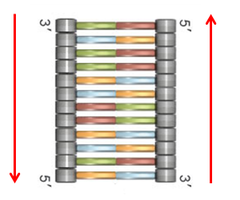
DNA directionality
one end has an exposed hydroxyl group on the 3' carbon of deoxyribose and the other end has an exposed phosphate group on a 5' carbon
Erwin Chargaff
Discovered that DNA composition varies, but the amount of adenine is always the same as thymine and the amount of cytosine is always the same as guanine.

Rosalind Franklin
Woman who generated x-ray images of DNA, she provided Watson and Crick with key data about DNA

Watson and Crick
discovered the structure of DNA

base pairs
A-T
G-C
AT/GC rule
Refers to the phenomenon that an A in one DNA strand always hydrogen-bonds with a T in the opposite strand, and a G in one strand always bonds with a C.
complementary DNA strands
The relation between the two nucleotide strands of DNA in which each purine on one strand pairs with a specific pyrimidine on the opposite strand (A pairs with T, and G pairs with C).
antiparallel strands
Strands parallel to each other going in opposite directions (3'-5' and 5'-3')

major groove
a groove that spirals around the DNA double helix; provides a location where a protein can bind to a particular sequence of bases and affect the expression of a gene

minor groove
the smaller of the two grooves in the DNA double helix

DNA replication
the process of making a copy of DNA

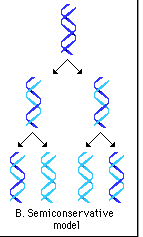
semiconservative replication
Method of DNA replication in which parental strands separate, act as templates, and produce molecules of DNA with one parental DNA strand and one new DNA strand
Messelson and Stahl
Used light and heavy nitrogen to prove the theory of semiconservative replication
origin of replication (ori)
A sequence of DNA at which replication of DNA is initiated.

replication forks
portions of DNA where the double helix separates during DNA replication
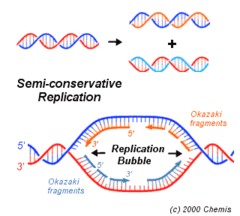
bidirectional replication
the process in which DNA replication proceeds outward from the origin in opposite directions

DNA Helicase
An enzyme that unwinds the DNA double helix during DNA replication

DNA Topoisomerase
Relives additional coiling ahead of replication fork
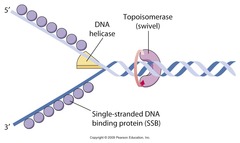
single strand binding proteins
bind to and stabilize single-stranded DNA

DNA Polymerase
Enzyme involved in DNA replication that joins individual nucleotides to produce a DNA molecule

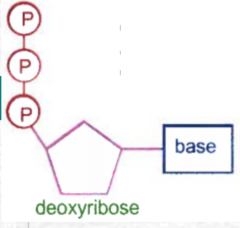
Deoxynucleoside triphosphates
Free nucleotides with three phosphate groups; Breaking covalent bond to release pyrophosphate (two phosphates) provides energy to connect nucleotides
DNA primase
synthesizes a short RNA primer to provide a 3'-OH group for the attachment of DNA nucleotides

leading strand
The new continuous complementary DNA strand synthesized along the template strand in the mandatory 5' to 3' direction.

lagging strand
A discontinuously synthesized DNA strand that elongates by means of Okazaki fragments, each synthesized in a 5' to 3' direction away from the replication fork.

Okazaki fragments
Small fragments of DNA produced on the lagging strand during DNA replication, joined later by DNA ligase to form a complete strand.

DNA Ligase
an enzyme that eventually joins the sugar-phosphate backbones of the Okazaki fragments

Proofreading
function of DNA polymerase in which it reads the newly added base before adding the next one

telomere
repetitive DNA at the end of a eukaryotic chromosome

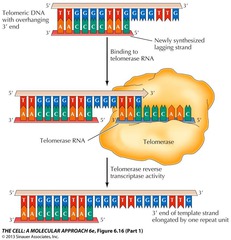
telomerase
An enzyme that catalyzes the lengthening of telomeres. The enzyme includes a molecule of RNA that serves as a template for new telomere segments.
chromatin
Substance found in eukaryotic chromosomes that consists of DNA tightly coiled around histones
histones
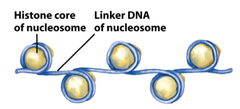
Globular protein that assist in DNA packaging in eukaryotes. Histones form octamers around which DNA is wound to form a nucleosome.

nucleosome
Bead-like structure in eukaryotic chromatin, composed of a short length of DNA wrapped around a core of histone proteins
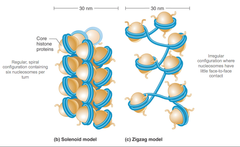
30-nm fiber
nucleosome units organized into a more compact structure that is 30 nm in diameter
nuclear matrix
a framework of protein fibers extending throughout the nuclear interior

nuclear lamina
A netlike array of protein filaments lining the inner surface of the nuclear envelope; it helps maintain the shape of the nucleus.

radial loop domains
A loop of chromatin, often 25,000 to 200,000 base pairs in size, that is anchored to the nuclear matrix.

heterochromatin
Eukaryotic chromatin that remains highly compacted during interphase and is generally not transcribed.
euchromatin
The less condensed form of eukaryotic chromatin that is available for transcription.