1 / Geology of Planets / GEOL 109 / BYU / Exam 1 Flashcards
 Call Kai
 Learn
Learn Practice Test
 Spaced Repetition
 Match
Match Flashcards
 Knowt Play
1/97

Earn XP
Description and Tags
Taken from the quiz questions of lessons 1-15.
Name | Mastery | Learn | Test | Matching | Spaced | Call with Kai | Chat |
|---|
No analytics yet
Send a link to your students to track their progress
98 Terms
Order of the planets, Pluto, & Asteroid Belt- increasing distance from the Sun.
Mercury, Venus, Earth, Mars, Asteroid Belt, Jupiter, Saturn, Uranus, Neptune, Pluto
Which statement is true for the outer planets of our solar system?
They are largely made of hydrogen and helium.
Water ice is:
Most abundant on the moons of outer planets
What sets the composition of the moons of the outer planets apart from the inner planets?
The moons of the outer planets generally have lower densities.
Which objects have orbits that take them the farthest from the Sun in our solar system?
Comets
Which of the following objects is most like Earth in size and composition?
Venus
What is a major difference between planets and stars?
Planets are much smaller in diameter than the stars around which they revolve.
Planets do not generate energy through nuclear fusion.
What are the major differences between a moon and a planet?
Planets revolve around the Sun.
Moons revolve around a Sun-orbiting planet.
Which of the following IS NOT a characteristic of the asteroid belt? (Select all that apply.)
It consists of thousands of small bodies, all less than about 10 km in diameter.
According to our best modern day evidence, how long ago was the Big Bang?
About 14 billion years ago.
Which IS NOT one of the most basic subatomic particles include which of the following?
Isotopes
How are elements heavier than iron produced?
During a supernova explosion
What is the principal method of light element (up to iron, atomic number 26) production?
nuclear fusion
The T-Tauri phase of a star's history:
is typified by extreme fluctuations in energy and a strong magnetic field
Many supernovas are the result of:
collapse of a star with multiple burning shells
How will the Sun's life probably end?
With the formation of a planetary nebula.
Which of the following are correct about red giant stars? (Select all that apply.)
They form as a star expands and the surface cools.
They evolve from medium-sized stars.
What is the correct order of sequences for the evolution of a medium-sized star?
Molecular Cloud, Protostar, Main Sequence Star, Red Giant, Planetary Nebula
Which kind of stars have the longest lifetimes (~10 billion years)?
Medium-sized stars like our Sun.
A giant molecular cloud is best described by which statement?
It is a cool mass of gas and dust that can be light years across.
Which of the following is INCORRECT about the nebulas we see in the sky today? (Select all that apply.)
They formed during the "Big Bang."
A "star" that shines, but not as a result of nuclear reactions, is called a ____.
protostar
Condensation in the solar nebula and accretion of planets is thought to have occurred about how many years ago?
4,500,000,000 y
Most of the mass of the solar nebula resided in materials which
did not condense to form solids.
What were the most common solids that condensed from the solar nebular gases?
They were water ice.
Examples of highly refractory materials are:
tungsten (W), osmium (Os), and zirconium (Zr)
Which list is made of very volatile materials?
helium (He), argon (Ar), ammonia (NH3), and methane (CH4)
Why are the inner planets depleted (poor) in volatile elements?
Their constituents condensed at high temperatures.
Which of the following is involved in collisional accretion?
The aggregation of planetismals when they impact one another.
Which of the following are true about planetary accretion? (Select all that apply.)
As these particles accreted, the planets became hot as kinetic energy was converted to thermal energy.
The planets grew larger and larger via repeated impact.
The planets became internally differentiated to different degrees.
The particles that accreted to form the planets were in orbit around the Sun.
When did the planets form?
The planets formed about the same time as the Sun in a relatively short period of time only a few million years long.
Which of these is evidence for planetary accretion?
The heavily cratered surfaces of the Moon and other planetary bodies.
How did the giant outer planets obtain their thick atmospheres?
By collapse of nebular gas onto a protoplanet's icy core.
Large planetary bodies failed to accrete in some parts of the solar system and did not sweep their neighborhoods clear of debris. Select the two most prominent zones of this "debris."
between Mars and Jupiter, beyond Neptune
Which of the following are characteristics of the orbits of the objects that accrete to make planets? (Select all that apply.)
Their orbits form a flattened disk shape.
Their orbits form a spherical zone centered on the star.
Their orbits define an elliptical zone tilted about 90° to the eliptic.
They orbit in the equatorial plane (ecliptic) of the star.
The spin axes of some planets are tilted relative to the plane in which most orbit. What could have caused this?
The impact of a large object late in the history of accretion changed the spin.
Think about the process of planetary accretion. Which statement best describes our current ideas about the rate of impact cratering in the inner solar system?
Initially, the rate declined smoothly, but there was a later episode of heavy bombardment followed by resumption of the decline.
Which of the following best describes the orbital evolution of the planets in our solar system according to the Nice Model?
The orbits of the outer planets changed significantly about 3.9 billion years ago as Uranus and Neptune moved outward from the Sun.
Which is true about our current understanding of extrasolar planets (exoplanets)?
Exoplanets are common and found around many different types of stars.
In general , large planets cool
more slowly than small planets of similar compositions
Important sources of planetary heat include all of the following except
the Big Bang
Which of the following is not a mechanism of heat transport?
magnetism
What is the weak layer within a terrestrial planet that behaves like a viscous (flowing) fluid?
the asthenosphere
Consider two planets that are the same age. Which one will have the thicker lithosphere?
A small rocky planet
Why are the rocks found at the surface of a planet, say Mercury, so different in elemental composition from the meteoritic material from which it formed?
The planet differentiated after accretion.

Study this thermal evolution diagram which shows how the interior of a terrestrial planet should change with time. Click on the section of the diagram that represents the asthenosphere?
The white (shark-tooth-esque) layer that dives deep


Study this thermal evolution diagram which shows how the interior of a terrestrial planet should change with time. Click on the section of the diagram that represents the crust?
The thin, top layer (underwater)


Study this thermal evolution diagram which shows how the interior of a terrestrial planet should change with time. Click on the section of the diagram that represents the magma ocean?
The black layer, on the top right corner.


This diagram plots the average temperature and age of various inner planets and Earth's Moon. Click on the curve that is the correct curve for Earth?
The top red line. Earth is the largest inner planet. Large planets will have the highest initial internal temperature and will cool more slowly. So the larger the planet the higher the internal temperature at any given time.


This diagram plots the average temperature and age of various inner planets and Earth's Moon. Click on the correct curve for Mercury.
The yellow line. Mercury is the smallest Inner planet. Large planets will have the highest initial internal temperature and will cool more slowly. So the larger the planet the higher the internal temperature at any given time.

Consider the interior structure of a planet. How is a lithosphere different from a crust?
A lithosphere is a mechanical subdivision, and crust is a compositional term.
Where did the water in Earth's hydrosphere come from?
From the volatiles released by volcanoes.
What properties of the atmophile elements (hydrogen, helium, carbon, nitrogen, oxygen) allow them to generate atmospheres?
They are volatile elements.
They form molecules with low densities
Which of the following is not a way that a planet's atmosphere can lose gas?
the process of outgassing
Why do the inner planets lack thick atmospheres of hydrogen and helium?
Because they are too small to have retained such gases.
How did Earth's atmosphere form?
By gaseous exhalations from rocks deep inside.

Study this graph of the sizes (diameters) and densities of the planets and some of their satellites. Each color represents a different class of planetary bodies. Click on the grouping that represents the inner planets.
grey grouping with high density and about 10,000 km diameter
The inner planets are dense and small.

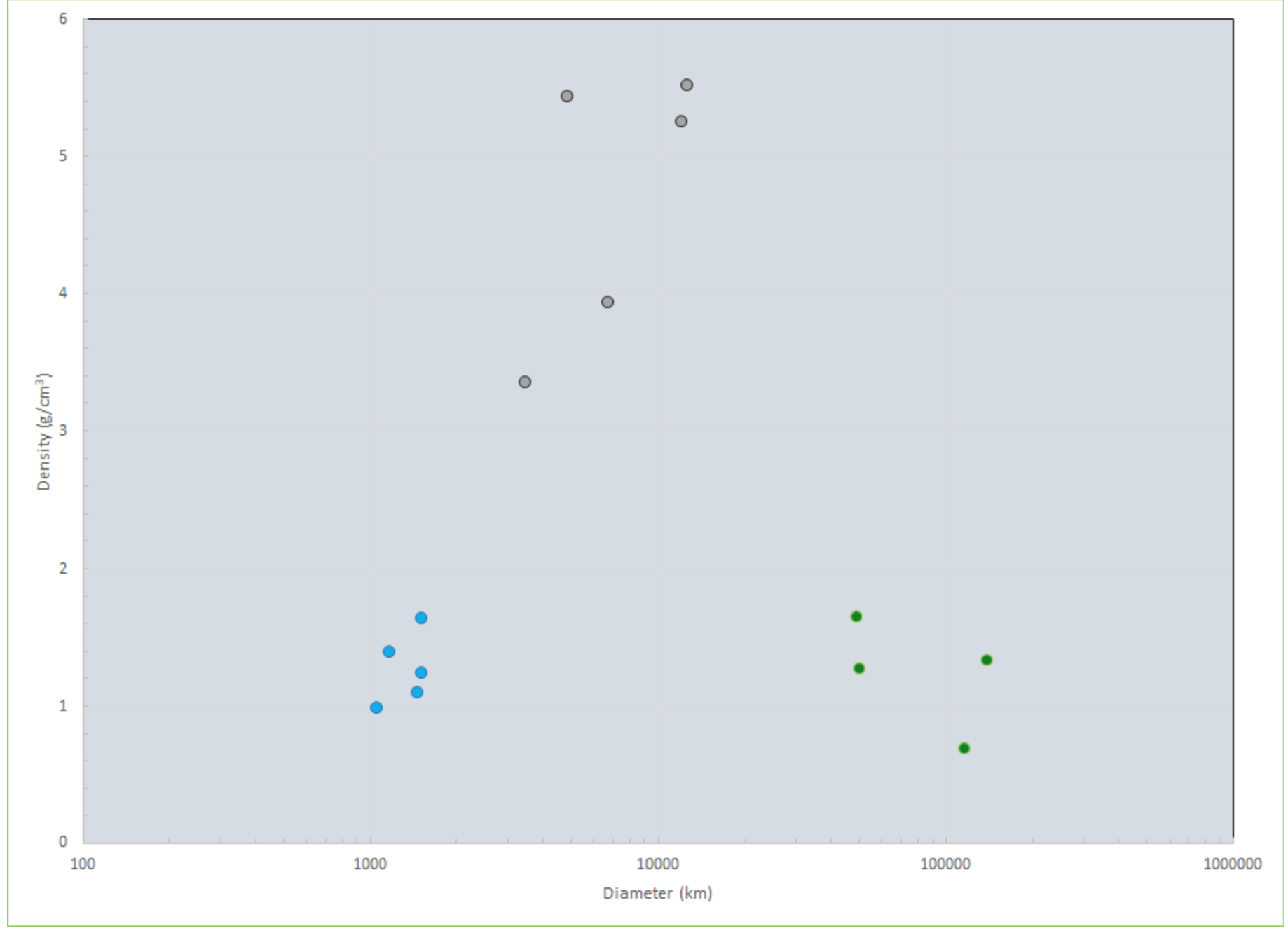
Study this graph of the sizes and densities of the planets and some of their satellites. Each color represents a different class of planetary bodies. Click on the grouping that represents the outer planets.
green grouping with low density and about 100,000 km diameter
The outer planets have small densities and large diameters.


Study this graph of the sizes and densities of the planets and some of their satellites. Each color represents a different class of planetary bodies. Click on the grouping that represents the moons of the outer planets?
blue grouping with low density and about 1,000 km diameter
The moons of the outer planets are low density and small.

Why do the planets have different densities?
The planets have different mixtures of ice, silicates, iron, and gas
What is the age of most meteorites that fall to Earth?
Almost all have ages of about 4.6 billion years.
Why are chondritic meteorites so important?
They are undifferentiated, and preserve evidence about the age and nature of condensation in the ancient solar nebula.
Most meteorites that fall to Earth are of which type?
stony meteorites
Which is true about iron meteorites?
Iron meteorites formed during the internal differentiation of small asteroids.
Some stony-iron meteorites appear to have ______________________.
been formed at the core-mantle boundary of an asteroid
What is one evidence suggesting that SNC meteorites came from Mars?
their young ages
What is the size range of asteroids?
0 to 1000 km across
Most asteroids are probably in which size range?
0 to 10 km across
What geologic process is most common on asteroids?
Impact cratering
Which of the following is most accurate about volcanic activity on the asteroids?
Volcanism occurred anciently on at least some asteroids.
Why is there a density difference between Vesta and Ceres? (Select all that apply.)
Because Vesta is rich in silicates and metals.
Because Ceres has an outer shell of water ice.

Study this image of Vesta. What is the most likely cause of the linear ridges and grooves near its equator?
Near disruption by a large impact

Why are asteroids closer to Jupiter (just off the right side of the image) so much darker than those near Mars (on the left)?
Dark carbonaceous materials are common on the asteroids near Jupiter.
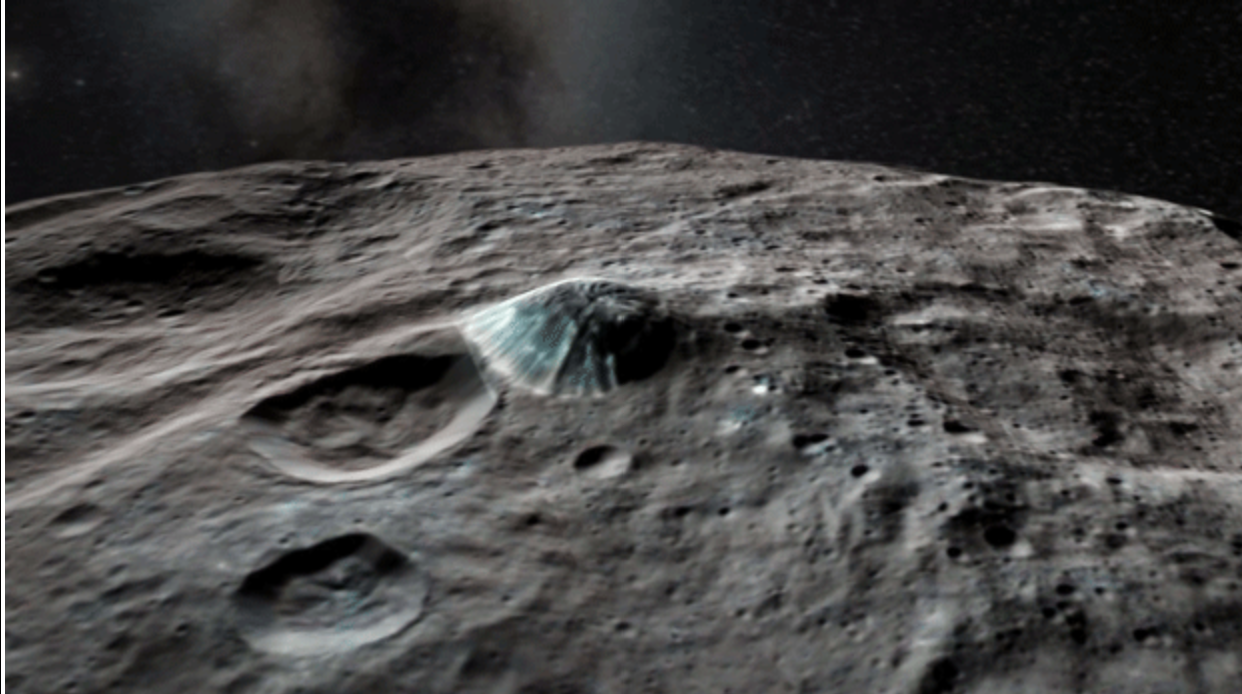
What is the best explanation for this dome shaped mound on Ceres?
Cryovolcanism (ice volcano).
The surface of the Moon can be divided into two general terrains. What are they?
bright and dark terrains, old and young terrains, high and low terrains, the maria and the terrae
The lunar highlands, or terrae, are typified by ___________.
closely spaced impact craters
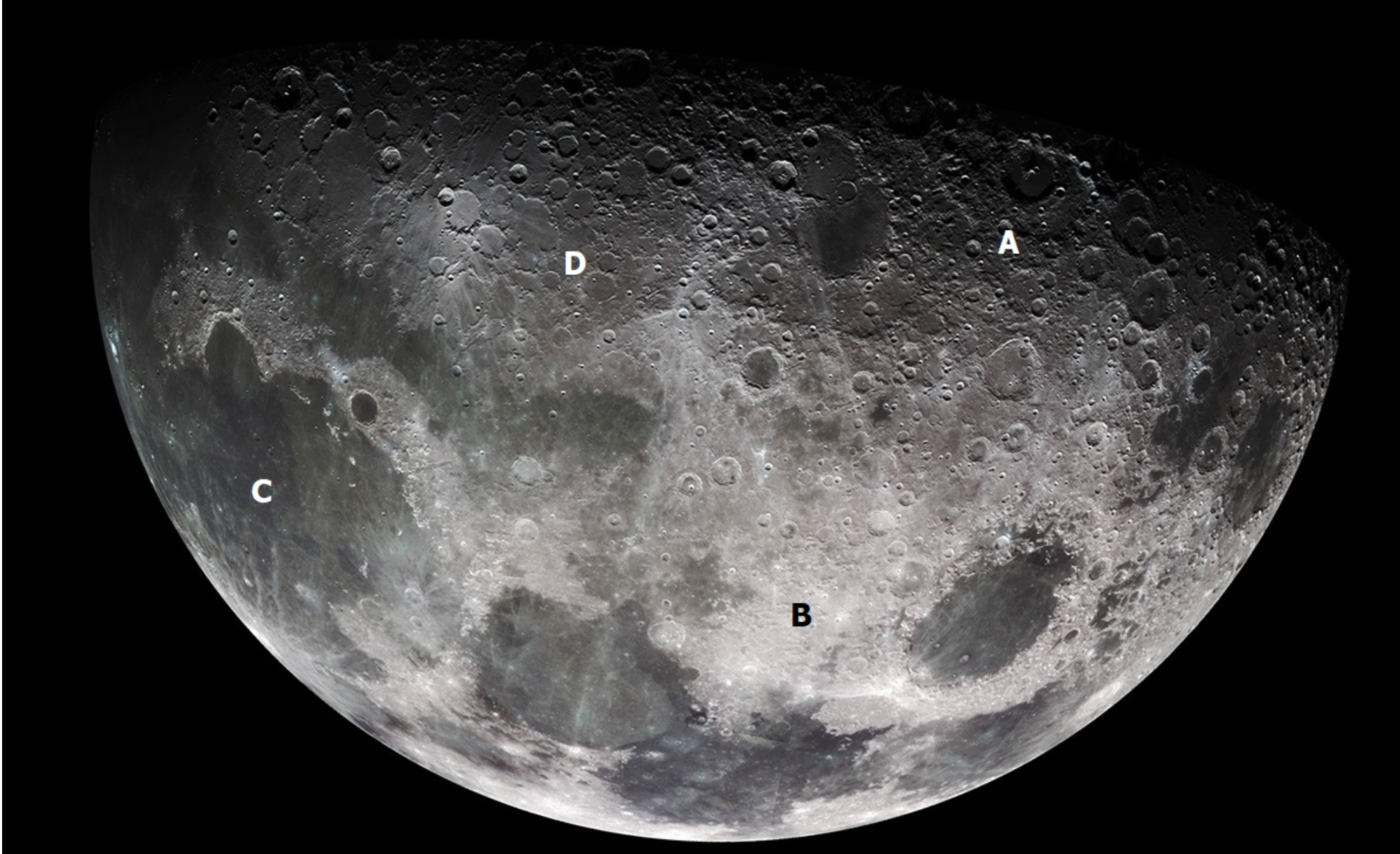
On this photo of the Moon, click on one of the maria.
The maria are the dark, low lying basins.

On this photo of the Moon, click on a part of the highlands.
The highlands are the "mountains" of the Moon and are brighter than the maria.

The most important mineral in the upper mantle of the Moon is _______.
olivine
Which of the following statements about the Moon's core are correct? (Select all that apply.)
The Moon's core is probably made of iron.
The Moon's core was once molten and convected to make a magnetic field.
The energy of crater formation is expended in which of the following ways?
slumping to create terraces, heat, seismic (earthquake) waves, fracturing of the bedrock
Which of the following types of energy is mostly responsible for crater generation?
kinetic energy
Which of the following is not a feature formed by impact on the Moon?
sinuous rilles
Which of the following is least important for the appearance of an impact crater developed on the surface of a planet?
the presence of a magnetic field
Craters with central peaks generally ______________.
have terraced walls

Click on the oldest crater depicted below.
A - least defined, therefore the oldest


Arrange these impact craters from smallest (on top) to largest (on bottom)

Sort the lunar time periods chronologically, from the youngest period to the oldest.
Copernican, Eratosthenian, Imbrian, Nectarian
Which is NOT a reason impact craters make good geologic time indicators?
One of them could be from the moon landing’s human effect.

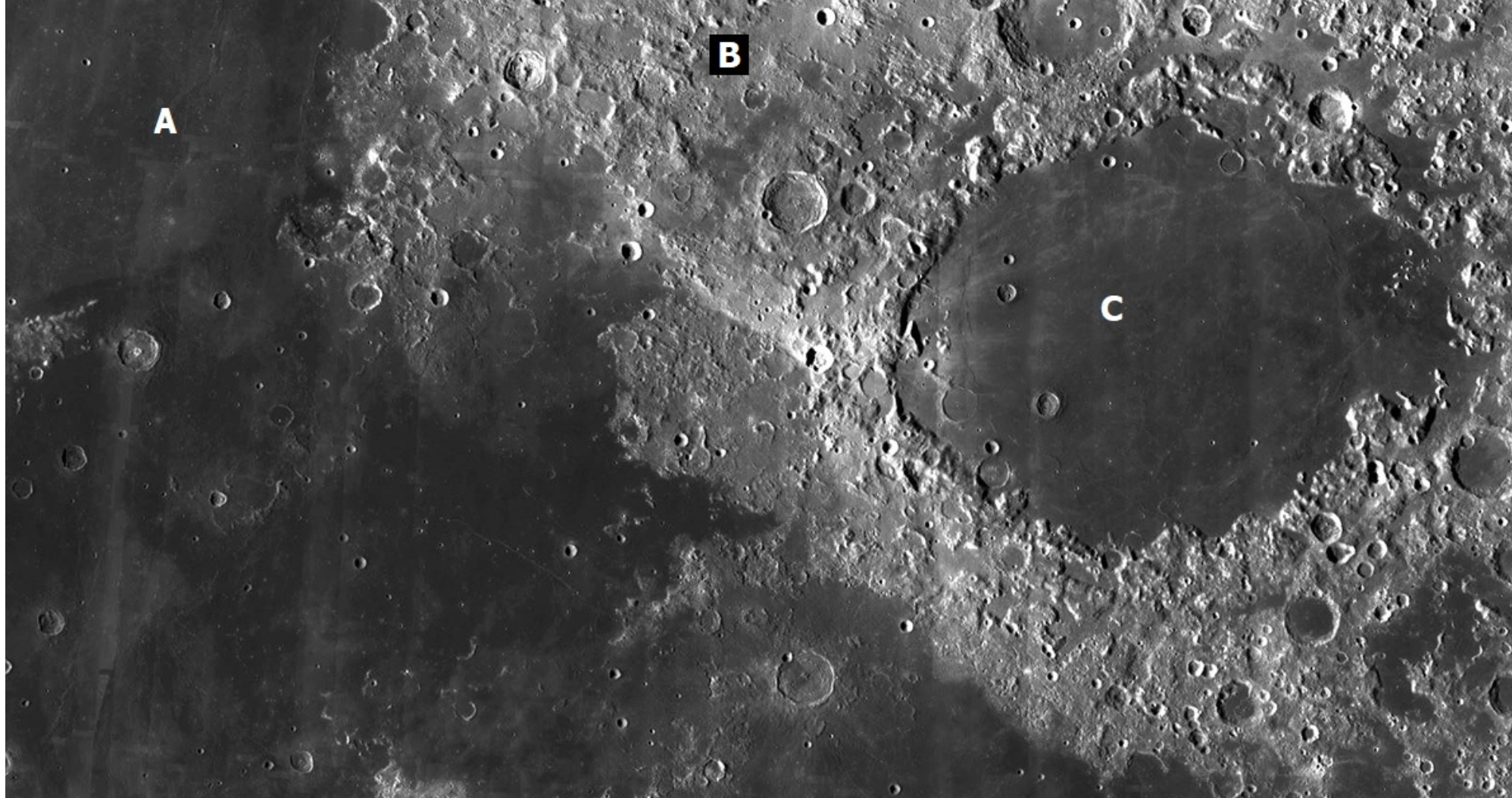
Which of the images of the Moon shows the oldest surface? They are all about the same scale and about 200 km across.
B


This graph shows impact crater sizes versus the number of craters per square kilometer for several different regions of the Moon. Click on the line that corresponds to the youngest terrain.
Teal line


Which of these four lunar impact craters is the oldest?
A

Do the principles of superposition and cross cutting relations tell us how old a particular crater or surface is in number of years (the absolute age)?
No
What is the basis for our understanding of the absolute time scale of the Moon?
Rock samples brought back from the Moon have been dated using radiometric techniques to give their absolute ages.
What do the absolute ages of lunar rocks tell us about changes in the rate of impact cratering during the Moon's history?
The rate of impact on the Moon has declined dramatically with time so that modern impact rates are much lower than they once were.
How old are the oldest rocks found so far on the Moon?
The oldest rocks found on the Moon so far are about 4.5 billion years old.

Examine this photograph of the nearside of the Moon. What shows that the crater Copernicus is younger than Eratosthenes? (Select all that apply.)
It has fresh rays of impact ejecta radiating from it.
The rays from Copernicus cross over Eratosthenes crater.

Examine this photograph of the nearside of the Moon. How can you tell that Eratosthenes crater is younger than Imbrium Basin? (Select all that apply.)
Imbrium is buried by smooth lava plains, but Eratosthenes is not.
Eratosthenes formed on the rim of Imbrium.