1H NMR spectra: peak splitting (coupling)
 Call Kai
 Learn
Learn Practice Test
 Spaced Repetition
 Match
Match Flashcards
 Knowt Play
1/5

There's no tags or description
Looks like no tags are added yet.
Name | Mastery | Learn | Test | Matching | Spaced | Call with Kai | Chat |
|---|
No analytics yet
Send a link to your students to track their progress
6 Terms
Peak splitting in the 1H NMR of paracetamol
Hydrogens that are in equivalent environments give the same signal
So for paracetemol there are 5 peaks
But 2 of these peaks look more like 2 peaks than one

Peak splitting in 1H NMR
Coupling is most commonly seen between non-equivalent hydrogens that are separated by 3 bonds (through bonds, not space)
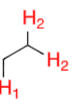
The presence of the neighbouring hydrogen (H2) and which spin state it occupies leads to a small change in the magnetic field experienced by H1 – and so can affect delta E causing it to change giving multiple values for delta E

Peak splitting with one adjacent hydrogen
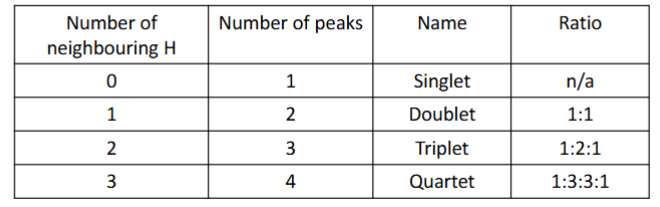
When a hydrogen (environment) is adjacent to a single proton this creates 2 energy levels and hence the peak will split in 2 equal parts - this given 2 peaks, a doublet, with a ratio of 1:1

Peak splitting with 2 adjacent hydrogen
When a hydrogen (environment) is adjacent to 2 protons this creates 3 energy levels: up, up; up, down (and down, up); down, down
The central energy level contains 2 equivalent states (up, down and down, up) and therefore the peak has twice the magnitude of the other 2 (it’s twice as likely to occur)
This gives 3 peaks, a triplet, with a ration of 1:2:1
Peak splitting with 3 adjacent hydrogen
When a hydrogen (environment) is adjacent to 3 protons this creates 4 energy levels
The central energy levels are the result of 3 equivalent states (up, up, down; up, down, up; down, up, up) and therefore the peaks have 3 times the magnitude of the other two
This gives four peaks, a quartet (or quadruplet), with a ratio of 1:3:3:1
One single peak (a singlet) means that the hydrogen environment is not next to any other hydrogens (there is only one delta E as it is not perturbed by nearby 1H)

Peak splitting summary table
Splitting can be predicted using the ‘n+1’ rule (n = number of hydrogens on neighbouring C)
number of peaks = number of neighbouring hydrogens + 1