Behavioural Ecology
 Call Kai
 Learn
 Practice Test
 Spaced Repetition
 Match
 Flashcards
 Knowt Play
1/50

There's no tags or description
Looks like no tags are added yet.
51 Terms
Behaviour
action (stimulus-response) that alters the relationship between an organism and its environment (biotic and abiotic)
stimulus may be external e.g. vervet monkey alarm or internal e.g. hunger pains
Types of Response
innate - inherited or inborn
reflexive - bypasses the brain
flexible behaviour:
condition-dependent
learned
Innate Response
inherited or inborn, an inflexible automatic response that is not affected by learning or environmental conditions
stimulus triggers a response “automatically”
e.g. kangaroo rat and rattlesnake rattle, baby’s cry when uncomfortable, spider weaving web
Reflexive Response
simple, bypassing thought
e.g. touching a hot object
helps you avoid injury
needs to be fast so bypasses the brain:
pain receptors go to spinal cord
spinal cord goes to nerves controlling muscles
muscles flex away

Instinctual Response
inborn, inflexible, independent of environmental conditions
e.g. wildebeest calves standing and walking immediately after birth to avoid predators and keep up with the herd
Condition Dependent Flexible Behaviour
flexible in response to environmental conditions
e.g. spiny lobsters hide more when there are more predators, but can’t eat or mate when hiding, so the amount of time spent hiding is a function of how common predators are to their environment
cost-benefit analysis in behaviour in terms of: energetic cost, risk cost, opportunity cost
Learned Flexible Behaviour
changes in response to learning e.g. food choices that grizzly bears teach their cubs
learning is a change in behaviour that results from a specific experience in the life of an individual (i.e. not inherited)
Foraging Behaviour Example
fruit fly larvae have a genetic predisposition to foraging patterns - either rover or sitter allele leading to different phenotypes
rover travels to look for food no matter what (fixed trait)
sitters only wander is food is scarce
foraging trail is longer in rovers when food is available
high population density:
roving is adaptive since there is a higher probability of encountering unexploited food
low population density:
sitting is adaptive since moving would waste energy
Condition-dependent behaviours are often the outcome of a __________ that reflects a ______ in fitness or performance for individual.
cost-benefit analysis; trade-off
optimality theory: the costs of travel are linear; the benefits of travelling are NOT so there is a maximum where the least travel has the most benefit

Models in Behavioural Ecology
use models to predict or explain behaviour in light of optimality theory (but these are a simplification so it’s not perfect)
foraging behaviour
diet choice
mate choice
whether to cooperate or not
all of these decisions should balance the costs and benefits to the individual’s fitness in the environment
marginal value theorem
optimal diet model
ecology of fear
hawk-dove
Ecology of Fear
created by Joel Brown: foragers (prey animals) respond to the perception of predation risk - includes type of predators, refugia, time of day, etc.
this increases the costs of foraging behaviours, which is the risk of being killed
increases the giving up density (GUD) - measured by amount of food left uneaten at a location, birds concerned about predation means less time foraging so there is more seed left behind
Behavioural ecologists focus on the _____ value of behaviours and how they evolved ______ more than the mechanisms and ontogeny of behaviours.
adaptive; phlyogentically
Behavioural Models
used by behavioural ecologists to understand trade-offs and cost-benefit analyses
optimal foraging theory
optimal group size
optimal clutch size
optimal territory size
What should I eat?
white-fronted bee eaters are central place foragers and have an adaptive behaviour to avoid ingesting bee venom (can only really catch one at a time and knock out stinger by holding them by the wings and bashing against a branch)
optimize foraging based on the distance between foraging territory and nesting colony
should go home with smaller bug if the search effort involved in finding a bigger bug is more than the E content of the bigger bug divided by the ratio of the E content of the smaller bug to its handling time, minus the handling time for the larger bug

Foraging behaviour depends on _____ _______.
distance travelled - want to have the minimum cost of finding/ingesting food and risk of predation with the maximum useable energy taken in
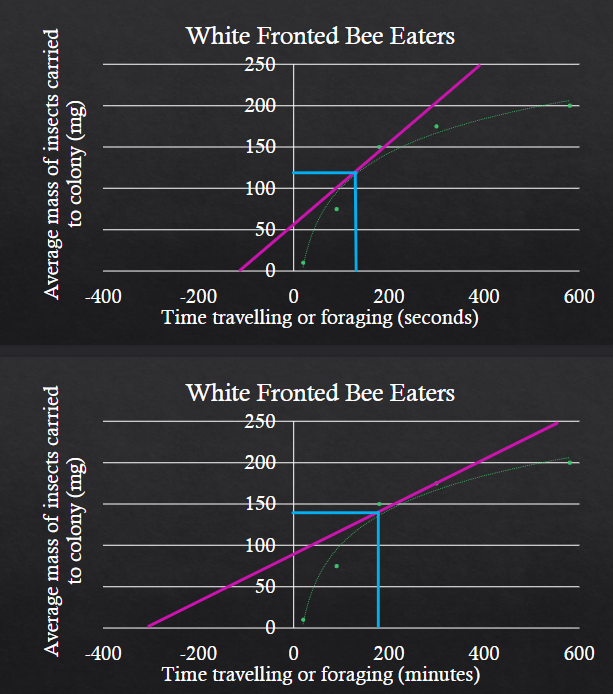
the gain curve: the mass of bug is positively related to distance from colony but a plateau exists since it’s not worth going back with a small meal with larger distances

Critical Search Time
gain more energy more quickly by settling on the less profitable prey item when found, rather than continuing to search for a more profitable prey item
Profitability
harvest efficiency assuming you’ve already caught the item
calculated by E1/h1 (ratio of the energy content and handling time)
Marginal Value Theorem
model to predict what the optimal behaviour should be for any individual facing diminishing returns on an investment
for example central place foragers face choices about foraging bout time
harvest rate (H) is food load (L) divided by total foraging bout time (Tt + Tf)
H = L (Tt + Tf)

What does the intersection between the gain curve and travel time line?
the optimal load for the feeder for the optimal looking time
this can change based on how far the feeding grounds are
Imperfect Predictions
reality often deviates from the prediction of a model
imperfect food item identification
forager sampling to identify quality of prey options (don’t predict all the prey items available at the time, might catch the wrong thing and let it go, might be trying out new foods)
risk of predator strike
broader nutritional requirements than simply energy content
requirements change by season or reproduction or raising young, etc.
Models are based on ______ about factors governing the _____ value of behaviours, and are not always _______ predictors of behaviours.
assumptions; adaptive; accurate
Communication
social process in which a signal from one individual modifies the behaviour of another individual
stimulus is a signal and it evokes a response in another individual
no response means no communication
e.g. alarm calls of the vervet monkey
signals may be acoustic, visual, olfactory, or tactile; the type of signal an organism uses correlates with its habitat
Trade-Offs in Communication
systems have been honed by natural selection to maximal benefits and minimal costs
song announces location to both mates and predators
visual cues only work when it’s light out
sound travels differently in water
Red Wing Black-Birds
use and respond to multiple signal types
researchers wanted to provoke their signals - sound of blackbird call and the red epaulettes
projected the call in a speaker and put red thread on socks to put over the speaker (looks and sounds like male bird)
with only the sound and only the sock, males were cautiously watching the source
with both audio and visual signals, male goes berserk
corroborating stimuli used to double check the threat to get a stronger response, a more powerful change in behaviour

Fireflies
use distinct flash patterns (timing, shape, colour, blink rate)
signals bad taste to predators
attracts mates of the correct species
tough with light pollution since bioluminescence is energy expensive so decreased mating success means increased species decline
Liars
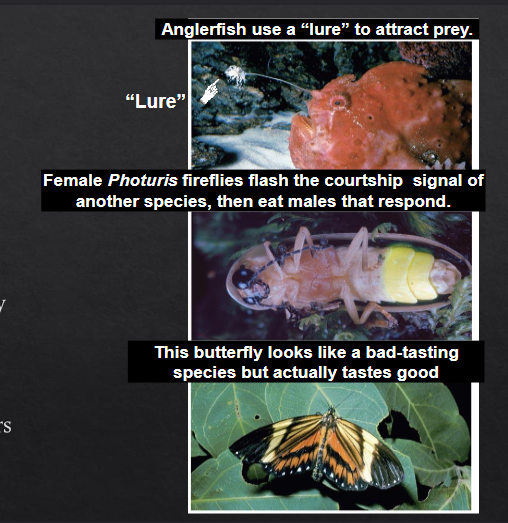
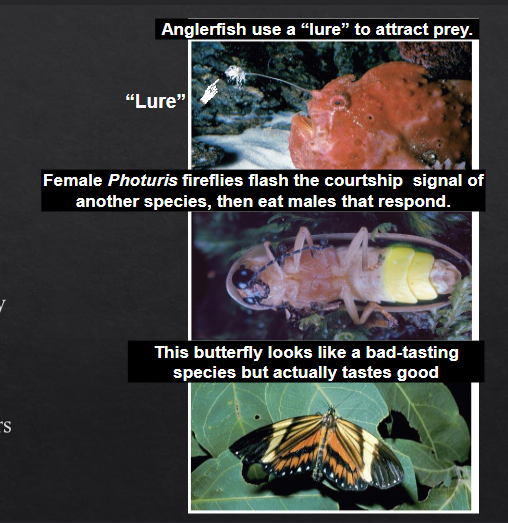
individuals sometimes increase their fitness by providing inaccurate or misleading information to members of the same or different species (natural selection will favour the liar)
negative frequency dependent selection: lying only works when it is relatively rare otherwise will be punished
anglerfish use a lure to attract a prey
female Photuris fireflies flash the courtship signal of another species then eat the males
butterfly looks like a bad-tasting species but actually tastes good
applies to plants too
Negative Frequency Dependent Selection
fitness of a phenotype or genotype increases as it becomes rarer in a population
works for liars
if common, natural selection favours individuals that can detect and avoid or punish liars
Hawk-Dove Game
represents the payoff matrix: fitness outcomes for the challenger for combinations of strategy - depend on the costs, benefits, and probabilities of each outcome
if the challenger is hawk, it will fight but it will risk physical injury against another hawk and wins 50%; against dove wins 100%
dove won’t fight anyone but risks the loss to hawk and loses 100% of the time; beats other dove 50%

Expected Payoff Equation
E = expected payoff
L = benefit of loss
V = benefit of victory
I = cost of injury
D = cost of display

Evolutionary Stable Strategy
unbeatable strategy: when adopted by all members of a population, cannot be successfully invaded by an individual with a different strategy
Frequency-Dependent Selection
favours the co-existence of strategies
pure: not composed of other strategies a player could adopt
mixed: a mix of strategies, each of which is played with the same probability, not dependent on conditions
individuals are consistent and at equilibrium there is a certain frequency of each kind
each individual in the population plays both strategies, each with a certain frequency
conditional: player adopts a strategy according to a set of conditions
hawk-dove-bourgeois conditional strategy where you play hawk if you own the territory and dove if you don’t
Prisoner’s Dilemma
best strategy isn’t one that gives the greatest fitness because you can’t predict the behaviour of other individuals
scenario where police bring in two individuals that they know committed a crime and potentially a second - if they confess they get away with and partner gets more jail time, but if they confess both get put away
e.g. male satin bower birds making nice bower to attract a mate
can choose to guard their own bower or go marauding (cost is not being at their own bower)
can’t know what their neighbours will do
Anisogamy
investment in sperm is way less than the investment in eggs
sperm are small and cheap to make and spread
eggs are more energetically expensive
males compete for mates, females choose
Sexual Selection
natural selection acting on sexually reproducing species where one sex selects a mate from many options
intrasexual selection
intersexual selection
Barn Swallows
are seasonal migrants that feed on insects and nest in human-made structures (used to nest in caves before humans)
experiment wanted to see if tail length affects female choice
short tail with outermost tail feathers cut
elongated tail with outermost feathers cut and elongated with feathers from other males glued on
control 1: outermost tail cut and glued back
control 2: caught, handled, but not cut
on average, males with longer tails mate sooner and have second clutches more often than those with shorter tails
why? - long-tailed mates are more efficient in flight (good for finding food and higher fitness) and sexy son

Trade-Offs in Mating
fitness requires reproduction, not just survival
traits can be advantageous that actually decrease survival so long as it increases your “attractiveness” to the opposite sex, thanks to sexual selection
peacock tails, swordtail fish
risks: swimming efficiency (metabolic cost), higher predation (less maneuverable so get caught)
benefits: increased reproductive success because of intersexual pressure
Intersexual Selection
within-sex competition for mates
promotes sex traits like aggressiveness and weapons like antlers
Intersexual Selection
between the sexes (attractiveness)
courtship and ornamentation
results in assortative mating: mate choice based on phenotype traits
often is the females choice (since female gametes are more costly - anisogamy)
Selection Pressure on Males and Females
male: competition
fitness is enhanced by mating with as many females as possible (fertilize more eggs)
little investment in each baby
females: choice
eggs and rearing offspring is energetically expensive
multiple mating is risky due to possibility of catching parasites, disease, predation, etc
best genes, best territory or most shared parental care
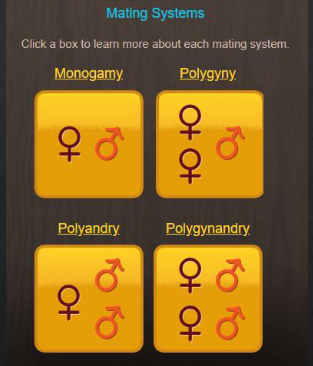
Mating Systems in Animals
collection of behaviours describing how males and females pair in sexually reproducing species
parental care
territory heterogeneity
sex ratio
monogamy, polygyny, polyandry, polygynandry
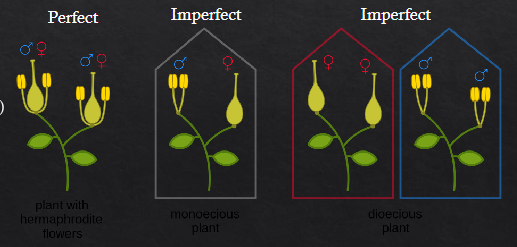
Types of Plant Reproduction
unisexual: separate male and female individuals
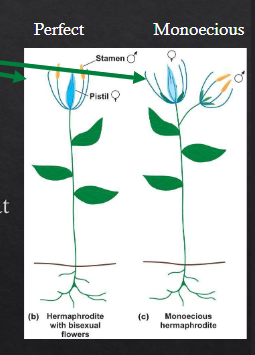
hermaphroditic: individuals possess both male and female organs - “perfect”
rapid expansion following colonization
imperfect:
dioecious (2 houses)
monoecious (1 house) - separate flowers on the same plant
Mating Systems in Plants
outcrossing: reproductive fertilization
autogamy: self-fertilized seeds (pollen from the same individual pollinizes own egg)
apomixis: unfertilized seeds (clones)
combinations of these are common
Autogamy and apomixis when no suitable mates (good for invasive species)
Allows rapid expansion of newly colonized habitat
Mechanisms to avoid self-pollinationAsynchronous maturation of male and female flowers
Self-incompatibility (either in flower shape or genetics)
Types of Social Interaction
selfishness: winner gets benefit, loser suffers cost
spite: actor and recipient both face cost e.g. bowers
mutual benefit: cooperation e.g. elephants defending young
altruism: actor faces a cost but recipient receives a benefit
Altruiam
behaviour with a direct fitness cost to the individual carrying out the behaviour and a direct fitness benefit to the recipient (Self-sacrifice)
flexible, condition-dependent behaviour
alarm calls in ground squirrels and vervet monkeys
worker casts like bees and nats
food sharing in wild dogs
no mutation that reduces an individual’s fitness should persist in the gene pool, so why does this happen?
Kin Selection
pass down your genetic info by making offspring OR helping your relatives produce more offspring (contributes your genes to the next gen)
if the benefits of altruistic behaviour are high, the benefits are dispersed to close relatives who likely also possess the trait for altruism
if the costs are low, alleles associated with altruistic behaviour will be favoured by natural selection

Hamilton’s Rule
if Br > C, then altruism is favoured by natural selection
direct fitness: derived from your own offspring
indirect fitness: derived from helping relatives have more offspring than they could otherwise (affected by kin selection)
direct + indirect fitness = inclusive fitness

JBS Haldane Quote
I would jump in a river to save the life of 8 cousins or 2 brother
Prairie Dogs
do black-tailed prairie dogs prefer to help relative when they give an alarm call?
conditions: no kin and no offspring in coterie, kin but no offspring in coterie, offspring but no kin in the coterie
used a stuffed badger and dragged it across the ground to see when and how often alarm calls were made
results showed that having no kin in the coterie had the least calls and kin but no offspring and offspring but no kin both were equal and greater than none

Male Sunfish
paternity certainty: parental care of eggs declines if a rival is seen during spawning OR parental care of fry declines if they do not smell like a male’s own offspring
care has a fitness cost and parents are more willing to pay if it benefits their own kin

Reciprocal Altruism
exchange of fitness benefits that are separated in time, not necessarily due to relatedness
vervet monkey groom unrelated individuals that groomed them in the past
vampire bats share blood meals with unrelated individuals that previously shared food with them
this increases likelihood of receiving help in the future from non-kin

3 Rationales for a Behaviour
behaviour benefits the actor
behaviour benefits a relative (kin selection)
behaviour is reciprocated