12-13
 Call Kai
 Learn
 Practice Test
 Spaced Repetition
 Match
 Flashcards
 Knowt Play
1/52

There's no tags or description
Looks like no tags are added yet.
53 Terms
Pancreatic acinar cells
Produce pancreatic digestive enzymes and fluid; acinar cells contain zymogen granules and release their contents into the acinar lumen by exocytosis
Pancreatic ducts, percentage
Produce most of the pancreatic fluid and secrete a bicarbonate-rich secretion into the duodenum; about 80–90% of pancreatic secretion originates in the ducts
Pancreatic secretion
The pancreas produces about 1–2.5 L of fluid per day containing digestive enzymes (often secreted as inactive precursors, amylase= digests carbs so not a threat to pancreas, lipase won’t work unless at the right pH RNAse and DNAse safe bc shouldn’t be floating around anyway) plus water and electrolytes; pancreatic fluid becomes increasingly rich in bicarbonate as secretion rate increases

Signal transduction in pancreatic acinus
Stimulus secretion coupling, similar to salivary glands with different regulation, secretin not effective, CCK and ACh most impactful, activating channels leads to release of contents into the lumen
Trypsinogen activation
Trypsinogen is activated in the intestine by enterokinase located on the brush border; activated trypsin then activates other pancreatic protease precursors
Trypsin
Active pancreatic protease that initiates activation of other pancreatic zymogens including chymotrypsinogen proelastase and procarboxypeptidases
Stimulus-secretion coupling in pancreatic acinar cells
Neural or hormonal stimulation activates intracellular signaling and ion channels which promotes exocytosis of enzyme-containing granules into the acinar lumen
Pancreatic bicarbonate secretion
Bicarbonate secreted primarily by pancreatic ducts to neutralize acidic gastric contents/provide an appropriate pH for digestive enzymes, Brunner’s glands secrete in duodenum, 60% of the fluid needed in the duodenum comes from the pancreas, high rates of secretion= mostly sodium bicarbonate (low= mostly sodium chloride)

Pancreatic fluid composition
Pancreatic fluid is largely water and sodium bicarbonate; chloride and bicarbonate concentrations vary inversely with secretion rate, 80-90% of pancreatic fluid originates in the ducts

Pancreatic duct bicarbonate mechanism
Chloride enters the cell through CFTR (from the lumen) and is exchanged for intracellular bicarbonate; bicarbonate then enters the lumen while intracellular chloride is recycled (used to pump bicarb in next cell)
Cystic fibrosis pancreas
Defective CFTR disrupts chloride and bicarbonate secretion and can reduce pancreatic juice delivery into the intestine
Ion transport in pancreatic duct
Sodium/chloride from lumen, chloride swapped for bicarbonate (from carbonic anhydrase) using CFTR, proton ATPase pushes protons back into the blood, as well as the sodium proton exchanger

Cephalic phase of pancreatic secretion
Thinking about or anticipating food activates the vagus nerve; vagal stimulation releases ACh and promotes pancreatic secretion before food reaches the stomach

Gastric phase of pancreatic secretion
Stomach distension activates vagovagal reflexes and increases neural stimulation of the pancreas; increased gastrin and ACh contribute to increased pancreatic secretion

Intestinal phase of pancreatic secretion
Products entering the duodenum stimulate enteroendocrine cells and vagal pathways; CCK increases enzyme secretion while secretin increases ductal fluid and bicarbonate secretion, ACh is still being released, food stimulates S (secretin) cells, stimulating fluid secretion in ducts
Secretin release
Secretin is released from S cells in the duodenum primarily in response to acidic contents and physiologically important fatty acids; secretin strongly stimulates pancreatic ductal bicarbonate secretion
CCK release
CCK is released from I cells in the duodenum in response to fat especially long-chain fatty acids and also peptides and amino acids; CCK strongly stimulates pancreatic enzyme secretion
Bicarbonate vs pH
Increased protons → decreased pH → ramped up bicarbonate secretion, pH in duodenum rarely gets low enough to cause so food is the main stimulator of secretin release

Neural regulation of pancreatic secretion
The cephalic phase is mediated by vagal efferents in acinar cells and ducts; the gastric phase involves vagovagal reflexes triggered by stomach distension; the intestinal phase involves reflexes responding to digestion products in the duodenal mucosa
Hormonal pancreatic secretion regulation
pH <4.5 → fatty acids release secretin from S cells in the duodenum
fat, peptides, amino acids release CCK from I cells in the duodenum
secretin, CCK and ACh work together to regulate secretion
para/neurocrines may also impact secretion
Bile
Exocrine secretion of the liver (stored/concentrated in gallbladder) that is produced by hepatocytes and modified by bile ducts; contains bile acids, cholesterol, phospholipids, pigments, electrolytes and other organic components
Sphincter of Oddi/regulation
Controls the entry of bile and pancreatic secretions into the duodenum; CCK promotes relaxation during digestion
Bile acids, primary vs secondary
Amphipathic molecules that act as powerful detergents to emulsify dietary lipids and facilitate formation of micelles for fat digestion and absorption, bacterium in gut switch primary to secondary by stripping 7-OH
Bile composition
Bile contains bile acids conjugated with glycine or taurine (makes more soluble in gut pH) plus cholesterol, phospholipids, pigments, electrolytes and other components; gallbladder bile becomes concentrated compared with hepatic bile
Bile acid secretion by hepatocytes
Actively transported by hepatocytes, exported into bile canaliculi to become hepatic bile
Bile duct secretion/regulation
Modify bile by adding water and bicarbonate; secretory mechanisms similar to pancreatic ducts, somatostatin can shut off

Enterohepatic circulation
Most bile acids are recycled between the liver and small intestine; reabsorbed after lipid digestion primarily in the terminal ileum, returned through hepatic portal circulation to the liver

Bile acid circulation
Bile acids are secreted by the liver into bile then enter the small intestine where they aid fat digestion; most are reabsorbed in the terminal ileum and returned to the liver for resecretion

Bile secretion formula

Bile acid feedback
Returning bile acids inhibit their own synthesis in the liver, stimulate continued bile secretion; recovery of bile acids allows the same bile acid pool to support repeated secretion
Gallbladder Water Reabsorption
Pulls in sodium and chloride, gets rid of both to pull water into the basolateral compartment, leaky (to electrolytes) epithelium, not much moving salt allows movement of lots of water

Regulation of bile secretion/gall bladder stuff
Secretin → bile duct secretion of water and bicarbonate; bile acid recycling regulate hepatocytes; CCK and vagal stimulation promote gallbladder contraction
Jaundice
Pre-hepatic: unconjugated bilirubin, increased hemolysis (sickle cell, thalassemia, hemolytic newborn)
Intra-hepatic: bilirubin buildup, can be deposited in brain, decreased conjugation/uptake of bilirubin (hepatitis, cirrhosis, liver cancer, neonates)
Post-hepatic: blocking ducts, bile can’t flow, spills into blood, conjugated (cholelithiasis, structural bile duct disorders, obstruction from tumors)
Bilirubin metabolism
Formed from degradation of hemoglobin, taken up by the liver, conjugated to glucuronic acid (making it more soluble), excreted into bile and gut, removed in fecal waste
Amylopectin
Major component of starch, polymer of repeating glucose units with branches, needs to be broken down into monosaccharides, starting with amylase in the salivary glands (only cuts 1,4 linkages, won’t cut end of chain, next to a branch point or 1,6 linkages) → only products= maltose, isomaltose, maltotriose, or limit dextrins

Carbohydrate digestion
Starch is broken down into smaller sugars by amylase and then brush-border enzymes complete digestion; carbohydrates can only be absorbed as monosaccharides
Disaccharides
Sucrose= glucose-fructose
Lactose= galactose-glucose
Trehalose, Maltose, Isomaltose, and Cellulose= glucose-glucose
Specific enzymes used to break down each sugar (found in brush border, have to be hit by the sugar to break down
Carbohydrate absorption
Glucose enters cell from lumen through 2ndary active transport with a sodium gradient to enter (SGLT1- sodium cannot move in without bringing a glucose/galactose with it) OR with high sugar concentrations allowing simple diffusion through GLUT 2
Exits to interstitial space/blood through simple diffusion through GLUT 2 receptors
Fructose relies on GLUT5 receptors that are gradient-dependent, passive diffusion

Protein digestion (broad)
Digested by pepsin in the stomach and pancreatic proteases in the small intestine; brush-border peptidases → absorbable amino acids and small peptides
Endopeptidases
Proteases that cleave internal peptide bonds; many begin inactive and activate in the stomach (ex: trypsinogen → trypsin (which allows chymotrypsinogen to convert to active chymotrypsin), pepsinogen → pepsin (stomach, rest are pancreatic), proelastase → elastase)
Exopeptidases/examples
Proteases that remove amino acids from the ends of peptide chains; pancreatic examples include carboxypeptidase A and carboxypeptidase B
Protein absorption pathways
Free AAs through Na+-dependent 2ndary active transporters, can then enter blood through facilitated diffusion
Dipeptides and tripeptides (most) through H+-dependent PepT1 (protons pumped out in exchange for sodium to maintain pH, brush border forms microclimate with low pH, so protons want in) (kinetic advantage)
intact proteins through phagocytosis

Intact protein absorption
Some intact proteins can enter enterocytes by phagocytosis and are then degraded into amino acids; M cells can take up intact proteins and present to lymphocytes

as part of immune surveillance
Fat digestion
More complicated b/c gut is aqueous, involves emulsification and micelle formation → lipase action → absorption of fatty acids and monoglycerides by enterocytes

Dietary lipids
About 90% of dietary lipids are triglycerides; other dietary lipids include phospholipids, cholesterol, and fat-soluble vitamins A D E and K, salivary lipase begins the process of digestion but is deactivated by acidic stomach (gastric lipase)
Emulsification
Linguinal lipase and gastric lipase (10-30%) begin process, grinding of stomach increases, emulsion stabilized by phospholipids, in duodenum= pancreatic lipases and bile salts
Lipase digestion products
Triglycerides (insoluble in micelles, lipase breaks into free fatty acids), bile salts prevent this reaction
Colipase
Binds to bile-salt-coated fat droplets and stabilizes pancreatic lipase so lipase can continue digesting triglycerides
Micelles
Emulsified fat droplets with fatty acids inside
Fatty acids attract bile acids, which wrap themselves around to form the micelle
Bile acids behave as detergents, breaks fat into micelles (preventing you from being able to see them)
Transports fats through the gut
Long-chain fatty acid absorption
Long-chain fatty acids enter enterocytes from micelles and are transported to the smooth ER where they are resynthesized into triglycerides
Short- and medium-chain fatty acids
Short- and medium-chain fatty acids can leave enterocytes without being repackaged into chylomicrons and enter the hepatic portal circulation
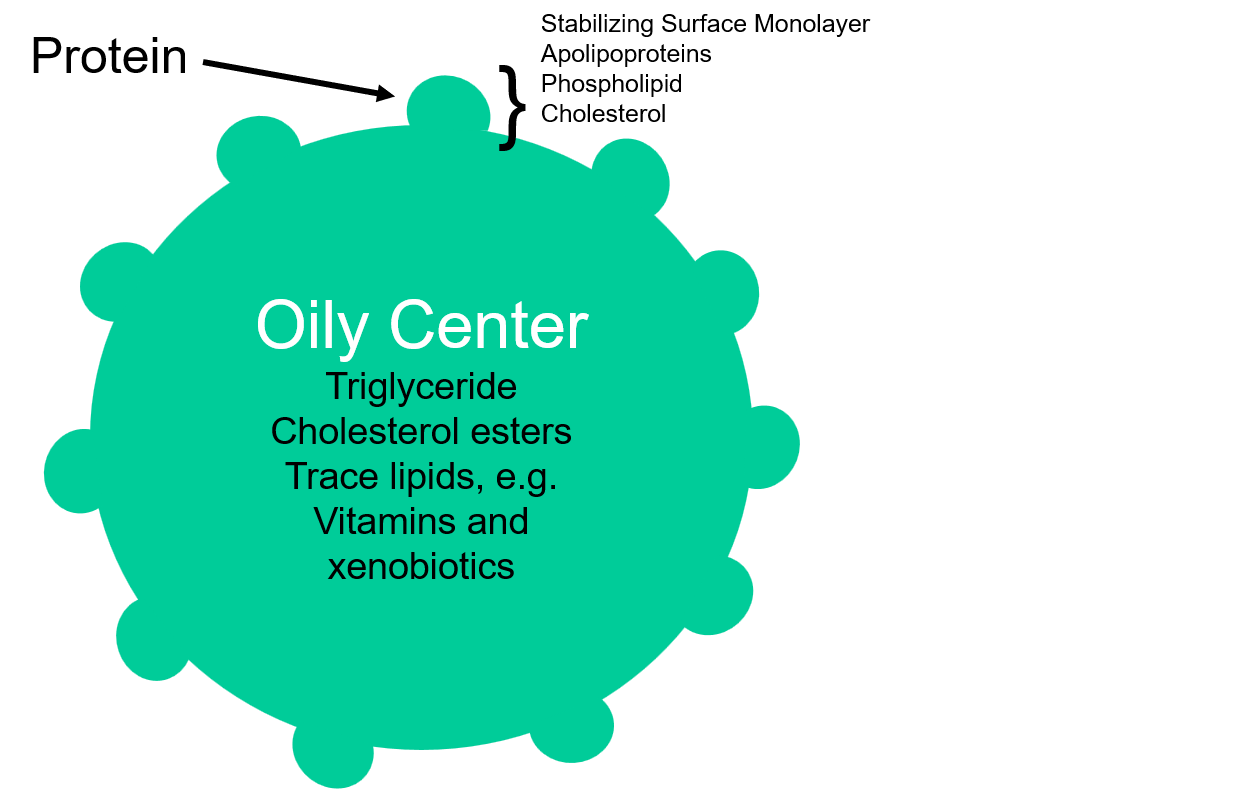
Chylomicrons
Lipoprotein particles formed by enterocytes to transport dietary long-chain lipids; they contain a triglyceride-rich core surrounded by phospholipids, cholesterol, and apolipoproteins, exocytosed and taken up by lymph lacteals, bypass liver and enter systemic circulation at the left thoracic duct
Cholesterol absorption
Cholesterol is one of the later lipid components released from micelles; after lipid delivery the micelle can disintegrate and bile acids continue toward the ileum for reabsorption