Viruses (Lesson 12/13: final exam)
 Call Kai
 Learn
 Practice Test
 Spaced Repetition
 Match
 Flashcards
 Knowt Play
1/41

There's no tags or description
Looks like no tags are added yet.
42 Terms
Viruses
-Obligate intracellular parasites
-contain DNA or RNA but not both
-all contain a protein coat
-are ACEULLULAR
-no ribosomes
-no ATP-generating mechanisms
-no enzymes (generally)
Host Range
-the spectrum of host cells a virus can infect
-most viruses infect only specific types of cells in one host; determined by specific host attachment sites and cellular factors
-known as bacteriophages; viruses that infect bacteria
Nucleic Acid
-all viruses have nucleic acids
-DNA or RNA but never both
DNA-containing viruses
-can be single or double stranded; linear or circular
RNA-containing viruses
-can be single or double stranded; linear
-one molecule or segment
Capsid
-protein coat around the nucleic acid
-made of CAPSOMERES; one protein or several proteins
Function
-carriers nucleic acid from cell to cell
-protects nucleic acid from nucleases
-attaches to specific cell receptors (naked viruses)
-antigenic
-capsid proteins illicit an immune response
Envelope
-made of up of mainly lipids from the host cell
-surround the capsid
-may contain viral glycoproteins called spikes
-spikes are antigenic and the body illicit a response
General Morphology
-Helical viruses—hollow, cylindrical capsid; many copies of the same protein wrapped in a helical
• Polyhedral viruses—many-sided (icosahedral); Each side is an equilateral triangle?
• Enveloped viruses; any shaped
• Complex viruses—complicated structures; has capsid, sheath, tail fibers, pin, baseplate
Taxonomy of Viruses
Genus names end in -virus
Family names end in -viridae
Order names end in -ales
Viral Species
a group of viruses sharing the same genetic information and ecological niche (host)
• Descriptive common names are used for species
• Subspecies are designated by a number
Growing Bacteriophages
-viruses must be grown in living cells
-bacteriophages are grown in bacteria
-bacteriophages form plaques
-each plaque corresponds to a single virus; can be expressed as PFU
Growing animal viruses
-in living animals
Viruses can grow in embryonated eggs
-virus injected into the egg
-viral growth is signaled by changes or death of the embryo
In Cell Cultures
-tissues are treated with enzymes to separate the cells
-virally infected cells are detected via deterioration, known as the cytopathic effect (CPE)
-continuous cell lines are used; a culture of cells capable of unlimited subculture under suitable conditions. provide a renewable, stable source of cells.
Viral Identification
Can see viruses through electron microscope
Cytopathic effects
• Serological tests
-Western blotting—reaction of the virus with antibodies
• Nucleic acids
-RFLPs; restriction (enzyme) fragment length polymorphism
-PCR
Viral Multiplication
For a virus to multiply (virions)
-It must invade a host cell
-It must take over the host's metabolic machinery
Eclipse Period
-the stage of viral replication after the virus enters the host cell but before any mature infectious virions can be detected inside the cell
-no complete virus inside the cell yet; virus only exists as its parts

Multiplication of Bacteriophages
Lytic cycle
• Phage causes lysis and death of the host cell
Lysogenic cycle
• Phage DNA is incorporated in the host DNA
• Phage conversion
-Also carries out a lytic cycle. Are called temperate or lysogenic phage
• Specialized transduction
Lytic Life Cycle
Attachment
-Tail fibers recognize receptors on outer membrane of E. coli B.
-Virus squats down
Penetration
-Phage penetrates host cell and injects its DNA.
Biosynthesis: Phage DNA directs synthesis of viral components by the host cell.
Maturation
-Viral components are assembled into virions
Release
-Host cell lyses, and new virions are released.
Lysogenic Cycle
Temperate phage can enter lytic cycle or lysogenic cycle
Lysogeny: phage remains latent
• Phage DNA incorporates into host cell DNA
• Inserted phage DNA is known as a prophage
• When the host cell replicates its chromosome, it also replicates prophage DNA
• Results in phage conversion—the host cell exhibits new properties
Results of Lysogeny
The bacterial cell has a new genotype.
• Cell may have a new phenotype.
-Lysogenic conversion or viral conversion occurs when one or more viral genes are expressed
. -Corynebacterium diphtheriae- pathogenic strains are lysogenic with prophage. A phage gene codes for exotoxin that causes diphtheria.
• Lysogenic cells are immune to reinfection by the same phage
• Specialized transduction may occur
Multiplication of Animal Viruses
Attachment: viruses attach to the cell membrane
Penetration: Entry by receptor-mediated endocytosis or fusion
Uncoating removing the nucleic acid from the protein coat by viral or host enzymes
Biosynthesis: production of nucleic acid and proteins
Maturation: nucleic acid and capsid proteins assemble
Release by budding (enveloped viruses) or rupture
Attachment or Absorption of Animal Viruses
Viral particle attaches to host cell via specific receptors on the surface of the host cell
Some proteins and glycoproteins on host cell membranes can function as receptors for some viruses
Viral particles have attachments sites made of spikes or fibers that bind these receptors
Naked viruses - nucleocapsid
Enveloped viruses - envelope
Penetration and Uncoating of Animal Viruses
-Fusion of envelope of an enveloped virus with cell membrane. (only with envelope viruses)
-Degradation of capsid (naked virus) on cell membrane
-Receptor mediated endocytosis (RME) of both types of viruses
The Biosynthesis of DNA viruses
DNA viruses replicate their DNA in the nucleus of the host using viral enzymes
• Synthesize capsid in the cytoplasm using host cell enzymes
Paravoviridae (dsDNA, nonenveloped viruses)
ssDNA, nonenveloped viruses
Fifth disease; skin rashes in children, mild, fever, headaches, “slap cheek rash'“
Anemia in immunocompromised patients
Diseases Not on Exam
Papillomavirus
-Human wart virus
Polyomavirus
-Cause tumors; some cause cancer
HPV: human papilloma virus – more than 60 types, benign warts, plantar warts, laryngeal warts, and cervical warts.

Adenoviridae
dsDNA, icosahedral, naked
Cause respiratory diseases in humans
Tumors in animals

Poxviridae
dsDNA, complex symmetry, Largest of all viruses.
• Orthopoxvirus (vaccinia and smallpox viruses)
• Smallpox virus is the variola virus.
• Cowpox virus is the vaccinia virus
Herpesviridae (dsDNA, enveloped virus)
Varicella-zoster virus (VZV): chickenpox and shingles is one.
Herpes simplex viruses (HSV)
-HSV-1 - fever blisters
-HSV-2 - venereal herpes
Espstein Barr Virus (EBV): mononucleosis
Hepadnaviridae (dsDNA, enveloped virus)
Hep B
-use reverse transcriptase
The Biosynthesis of RNA Viruses?
Virus multiplies in the host cell’s cytoplasm using RNA-dependent RNA polymerase
• ssRNA; + (sense) strand; when virus enters cell it can be read by ribosomes and made into proteins
Viral RNA serves as mRNA for protein synthesis
• ssRNA; − (antisense) strand; do not look like mRNA, have to be turned into a sense strand
Viral RNA is transcribed to a + strand to serve as mRNA for protein synthesis
• dsRNA—double-stranded RNA
Poliovirus
Picornavirdiae
-cause polio
Poliomyelitis
-cause by the poliovirus
-transmitted by the ingestion of water containing feces
-Initial symptoms: sore throat and nausea
-Viremia May Occur: enters the CNS
-1% become paralytic
-destroy motor cells
-death from respiratory failure
Post polio syndrome: muscle weakness occurring decades after infection
Developed the Iron Lung
Polio vaccine was introduced and declined polio cases
Rubella
-Measles like virus- Germen Measles Virus
-Togaviridae
-Rubella has distinctive red rash
-Serious problems for unborn fetuses
Coronavirus
Upper respiratory infections
-Coronaviridae
-SARS2
-Has an envelope; handwashing is great to get rid of virus
Common Cold
-200+ different viruses
-Rhinoviruses (30-50%): thrive in temperatures lower than body temperature
-Coronavirus (10-15%)
-Symptoms: sneezing, nasal congestion, nasal secretion, no fevers, can lead to laryngitis and otitis media
-antibiotics are of no use
-treatment of suppressants and antihistamines
Rhabdoviruses
-proteins are wrapped around a helix and the RNA is inside
-Bullet-shaped viruses (rod shaped)
-Rabies virus (zoonoses); obtained via bite, scratch
-invades nerve cells or nervous system
-appearance of symptoms depend on where you were infected and how close it is to the nervous system
-once symptoms appear hard to treat

Biosynthesis of RNA Viruses That Use DNA
Single-stranded RNA, produce DNA
-Use reverse transcriptase to produce DNA from the viral genome
-Viral DNA integrates into the host chromosome as a provirus
Retroviridae (retroviruses)
-Lentivirus (HIV)
-Oncoviruses (viruses that cause cancer)
Multiplication and Inheritance Processes of the Retroviridae
-RNA-containing viruses that replicate through a DNA intermediate
1.Attachment by peplomers.
2.Penetration by fusion
3.Biosynthesis
-RNA is converted to dsDNA via RNA dependent DNA polymerase (reverse transcriptase)
-integrated viral genome is expressed (i.e.. transcription occurs, followed by translation
4.Assembly
5. Release by budding
Virus Release
1.Naked viruses usually released from host cell by lysing the cell
-host cell dies
-Burst Time = length of time from attachment to release
-Burst Size = number of particles released from 1 cell (50-200 virions released)
-Enveloped viruses usually bud out of the cell; as they leave the cell, they acquire their envelope from the host cell plasma membrane

How Viruses Cause Disease
1.Lysing cells
2.Causing chromosomal breaks
3.Promoting surface changes on cell
4.Causing shrinkage to the cell nucleus
5.Causing vacuole formation in cells
6. Promoting apoptosis
7.Promoting tumor formation
8.Causing cells to fuse forming a polykaryocyte
Define Oncogenes
transformation of normal cells into cancerous cells
Oncogenic Viruses
-Become integrated into the host cell’s DNA and induce tumors
-A transformed cell harbors a tumor-specific transplantation antigen (TSTA) on the surface and tend to be irregularly shaped
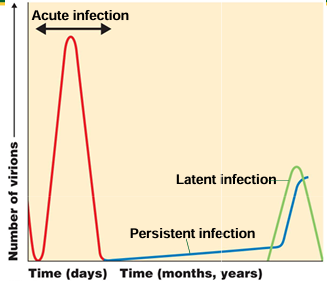
Latent Viral Infections
-Latent Virus remains in asymptomatic host cell for long periods
-may reactivate due to changes in immunity; cold sores, shingles
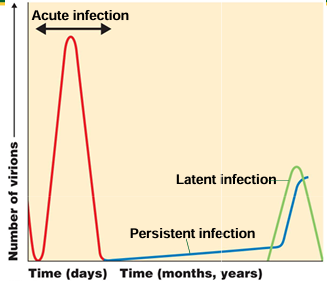
Persistent Viral Infections
-A persistent viral infection occurs gradually over a long period and is generally fatal
-Ex: subacute sclerosing panencephalitis
Antiviral Drugs
-Antibiotics are not effective against viruses
-Challenging to target viruses with drugs
1.Entry and Fusion Inhibitors:
-Block the receptors on the virus that bind to the host cell
-Block fusion of the virus and cell
2.Uncoating, genome integration, and nucleic acid synthesis inhibitors:
-Prevent viral uncoating
-Inhibit viral DNA integration into the host genome
-Nucleoside analogs inhibit RNA or DNA synthesis
3.Protease Inhibitors
-block the cleavage of protein precursors
4.Exit Inhibitors
-inhibit neuraminidase, an enzyme required for some viruses to bud from the host cell
Prions
-Proteinaceous infectious particles
-Inherited and transmissible by ingestion transplant, and surgical instruments