MCB 244 Chapter 10 The Muscular System
 Call Kai
 Learn
 Practice Test
 Spaced Repetition
 Match
 Flashcards
 Knowt Play
1/105

There's no tags or description
Looks like no tags are added yet.
106 Terms
The study of the muscular system is known as_________.
A) kinesiology
B) pathophysiology
C) myology
D) biology
E) neurology
mythology
Which of the following is not a function of the muscular system?
A) Stability
B) Heat production
C) Control of openings
D) Secretion
E) Breathing
secretion
What term best describes the relationship between the pronator quadratus and supinator?
A) Fixators
B) Antagonists
C) Synergists
D) Prime movers
E) Depressors
antagonists
Muscle fibers are arranged in bundles called_________.
A) compartments
B) fascicles
C) retinacula
D) aponeuroses
E) groups
fascicles
Which of the following describes muscular tissue emerging directly from bone rather than
being separated from it by an obvious tendon?
A) Direct attachment
B) Indirect attachment
C) Inverted attachment
D) Aponeurosis
Direct attachment
6) The rectus femoris is an example of what muscle shape?
A) Fusiform
B) Parallel
C) Triangular
D) Elongated
E) Pennate
Pennate
Groups of muscles are separated by which of the following?
A) Epimysium
B) Fascicles
C) Perimysium
D) Fascia
E) Endomysium
Fascia
Which term below best describes the deltoid?
A) Fusiform
B) Intrinsic
C) Involuntary
D) Extrinsic
E) Parallel
Intrinsic
Which term best describes the relationship of the deltoid and SITS muscles during shoulder
abduction?
A) Prime movers
B) Antagonists
C) Synergists
D) Fixators
E) Adductors
Synergists
The semitendinosus is an example of what muscle shape?
A) Triangular
B) Fusiform
C) Sphincter
D) Convergent
E) Pennate
Fusiform
Which of the following muscles is the prime mover for inhalation?
A) Internal intercostals
B) External intercostals
C) Diaphragm
D) Stylohyoid
E) Hyoglossus
Stylohyoid
Which of the following extensors of the head is the most superficial?
A) Trapezius
B) Semispinalis capitis
C) Splenius capitis
D) Sternocleidomastoid
E) Temporalis
Trapezius
The occipital and frontal bellies of occipitofrontal are connected via the_________.
A) galea retinaculum
B) galea aponeurotica
C) galea cranium
D) galea orbicularis
E) galea neurotica
galea aponeurotica
Which of the following muscles of facial expression is not innervated by the facial nerve?
A) Orbicularis oculi
B) Zygomaticus major
C) Corrugator supercilii
D) Levator palpebrae superioris
E) Buccinator
Levator palpebrae superioris
A point of convergence for several muscles of the lower face is the_________.
A) retinaculum
B) aponeurotica
C) modiolus
D) nuchal line
E) galea
modiolus
The_________ attaches to the zygomatic arch and also to the angle of the mandible.
A) masseter
B) buccinator
C) temporalis
D) genioglossus
E) stylohyoid
masseter
Which one of these muscles helps to open the mouth (depress the mandible)?
A) Zygomaticus major
B) Digastric
C) Sternohyoid
D) Depressor anguli oris
E) Hyoglossus
Digastric
The palatoglossus is innervated by which nerve(s)?
A) Hypoglossal
B) Accessory
C) Vagus
D) Hypoglossal and accessory
E) Accessory and vagal
Accessory and vagal
Which of the following muscles of mastication would be responsible for mandibular
elevation?
A) Temporalis
B) Lateral pterygoid
C) Stylohyoid
D) Zygomaticus major
E) Zygomaticus minor
Temporalis
The aponeurosis of the external oblique forms the_________ at its inferior margin.
A) linea alba
B) rectus sheath
C) linea semilunaris
D) medial retinaculum
E) inguinal ligament
inguinal ligament
The deepest muscle of the abdominal wall is the_________.
A) transverse abdominal
B) internal oblique
C) rectus abdominis
D) latissimus dorsi
E) pectoralis minor
transverse abdominal
While sitting at your desk, you drop your pencil onto the floor. You bend over to pick up the
pencil. In order to straighten up and continue your exam you must use which of the following
muscles?
A) Tibialis anterior
B) Erector spinae
C) Semimembranosus
D) Tibialis anterior and semimembranosus
E) Extensor hallucis longus
Erector spinae
23) Which of the following muscles is not externally visible on the trunk of the body?
A) Transverse abdominal
B) Latissimus dorsi
C) Trapezius
D) Pectoralis major
E) External abdominal oblique
Transverse abdominal
24) Unilateral contraction of which muscle causes ipsilateral flexion of the lumbar vertebral
column?
A) Multifidus
B) Latissimus dorsi
C) External intercostals
D) Serratus anterior
E) Quadratus lumborum
Quadratus lumborum
25) In lifting a heavy weight from the floor, one should use the power of the_________ in order
to avoid straining the lower back.
A) biceps brachii and brachialis
B) gastrocnemius and soleus
C) external and internal abdominal obliques
D) knee and hip extensors
E) trapezius and latissimus dorsi
knee and hip extensors
26) In a whiplash injury, the neck undergoes forced hyperextension then hyperflexion, injuring
multiple muscles in the neck. Which of the following muscles would be injured during the
hyperextension phase of the injury?
A) Trapezius
B) Splenius capitis
C) Sternocleidomastoid
D) Semispinalis capitis
E) Levator scapulae
Sternocleidomastoid
27) Tendinous intersections divide the_________ into segments that are externally visible on the
abdomen of a well-muscled person.
A) vastus lateralis
B) serratus anterior
C) rectus abdominis
D) quadriceps femoris
E) transverse abdominal
rectus abdominis
28) The rectus abdominis is a_________ muscle, while the rectus femoris is a_________ muscle.
A) fusiform; parallel
B) parallel; bipennate
C) convergent; unipennate
D) bipennate; parallel
E) multipennate; convergent
parallel; bipennate
29) Which of the following correctly states the proximal and distal attachments of the
sternocleidomastoid?
A) Sternal manubrium and lateral one-third of clavicle; mastoid process and lateral half of superior nuchal line
B) Sternal manubrium and medial half of clavicle; mastoid process and medial one-third of superior nuchal line
C) Sternal manubrium and medial one-third of clavicle; mastoid process and lateral half of superior nuchal line
D) Sternal manubrium and lateral half of clavicle; mastoid process and lateral one-third of superior nuchal line
E) Mastoid process and lateral half of superior nuchal line; sternal manubrium, medial one-third of clavicle
Sternal manubrium and medial one-third of clavicle; mastoid process and lateral half of superior nuchal line
The muscles that laterally rotate and depress the scapula, as in shrugging and lowering the
shoulders, are the_________.
A) trapezius and serratus anterior
B) pectoralis minor and serratus anterior
C) levator scapulae and rhomboideus
D) trapezius and rhomboideus
E) trapezius and latissimus dorsi
trapezius and serratus anterior
Which cranial nerve innervates the sternocleidomastoid and trapezius?
A) Abducens
B) Facial
C) Vagus
D) Accessory
E) Trigeminal
Accessory
Which muscle(s) of respiration is(are) innervated by the phrenic nerve?
A) Diaphragm
B) External intercostals
C) Internal intercostals
D) Innermost intercostals
E) Pectoralis major
Diaphragm
After taking their wedding vows, a bride and groom often ceremonially use which of the
following muscles before walking away from the altar?
A) Depressor anguli oris
B) Orbicularis oris
C) Levator labii superioris
D) Platysma
E) Quadriceps femoris
Orbicularis oris
Which muscle attaches to the manubrium and the thyroid cartilage, and aids in singing low
notes?
A) Omohyoid
B) Thyrohyoid
C) Sternothyroid
D) Stylohyoid
E) Lateral pterygoid
Sternothyroid
Some people suffer involuntary urination due to incompetence of what muscle?
A) External urethral sphincter
B) Bulbospongiosus
C) Compressor urethrae
D) Ischiocavernosus
E) Levator ani
External urethral sphincte
A sacral fracture affecting the S3 and S4 nerve roots would result in a person having
difficulty with evacuation of the bowels.
true
false
true
A baseball pitcher who injures one of their SITS muscles most commonly sustains tears to
the tendon of which muscle?
A) Supraspinatus
B) Infraspinatus
C) Teres minor
D) Subscapularis
E) Deltoid
Supraspinatus
Which of the following is true regarding the levator scapulae? A) It is innervated by the
phrenic nerve.
B) It elevates the scapula if the scapula is fixed.
C) It rotates the scapula and depresses the apex of the shoulder.
D) It flexes the neck if the scapula is fixed.
E) It protracts the scapula if the humerus is fixed.
It flexes the neck if the scapula is fixed.
Which of the following is an intrinsic muscle of the hand?
A) Extensor carpi radialis brevis
B) Adductor pollicis
C) Extensor pollicis longus
D) Extensor indicis
E) Abductor pollicis longus
Adductor pollicis
The serratus anterior is innervated by which nerve?
A) Accessory
B) Dorsal scapular
C) Long thoracic
D) Lateral pectoral
E) Axillary
Long thoracic
Which muscle acting on the arm assists in deep inspiration?
A) Pectoralis major
B) Trapezius
C) Teres minor
D) Diaphragm
E) Deltoid
Pectoralis major
A butcher who cuts the distal portion of their fingers may cut the_________ tendon.
A) flexor pollicis longus
B) flexor carpi ulnaris
C) palmaris longus
D) adductor pollicis
E) flexor digitorum profundus
flexor digitorum profundus
When a nurse draws blood, it is not uncommon for the needle to penetrate which muscle near
the cubital region?
A) Pronator quadratus
B) Semimembranosus
C) Pronator teres
D) Buccinator
E) Supinator
Pronator teres
The antagonist to the triceps brachii is the_________.
A) deltoid
B) anconeus
C) biceps brachii
D) supinator
E) teres minor
biceps brachii
Which of the following best describes the insertion of the extensor digitorum? A) It indirectly
inserts on all digits of the hand.
B) It indirectly inserts on all digits of the hand except the thumb.
C) It directly inserts on all digits of the hand.
D) It directly inserts on all digits of the hand except the thumb.
E) It directly inserts on the index finger only.
It indirectly inserts on all digits of the hand except the thumb.
Tennis elbow is a common term describing injury to the attachment of which of the
following?
A) Extensor hallucis longus
B) Pronator quadratus
C) Extensor carpi radialis longus
D) Subscapularis
E) Flexor digitorum profundus
Extensor carpi radialis longus
An injury that results in complete functional loss of the ulnar nerve will affect which of the
following muscles?
A) Abductor digiti minimi
B) Abductor pollicis brevis
C) Flexor carpi radialis
D) Brachioradialis
E) Extensor indicis
Abductor digiti minimi
Carpal tunnel pressure is sometimes relieved by surgically excising part or all of which
structure?
A) Palmar aponeurosis
B) Extensor retinaculum
C) Flexor retinaculum
D) Extensor aponeurosis
E) Median nerve
Flexor retinaculum
What is the longest muscle in the human body?
A) Iliopsoas
B) Sartorius
C) Erector spinae
D) Semitendinosus
E) Semimembranosus
Sartorius
Which of the following muscles is in the medial compartment of the thigh?
A) Soleus
B) Adductor longus
C) Piriformis
D) Vastus medialis
E) Semimembranosus
Adductor longus
Which of the following muscles attaches on the head of the fibula?
A) Extensor digitorum longus
B) Tibialis anterior
C) Popliteus
D) Biceps femoris
E) Semitendinosus
Biceps femoris
Which muscle is innervated by the tibial nerve?
A) Extensor digitorum longus
B) Tibialis anterior
C) Semimembranosus
D) Fibularis longus
E) Vastus lateralis
Semimembranosus
Which of the following muscles is responsible for medially rotating the tibia on the femur
when the knee is flexed?
A) Piriformis
B) Semitendinosus
C) Adductor brevis
D) Vastus medialis
E) Sartorius
Semitendinosus
Which of the following muscles adducts and medially rotates the thigh?
A) Gracilis
B) Piriformis
C) Adductor magnus
D) Rectus femoris
E) Sartorius
Adductor magnus
Which of the following muscles is innervated by the obturator nerve?
A) Gracilis
B) Biceps femoris
C) Tibialis anterior
D) Soleus
E) Sartorius
Gracilis
Injury to the deep fibular nerve would cause inability to extend one's toes. true false
true
The triceps surae consists of three muscles in the lower limb. true
false
false
A clinician induces contraction of the gastrocnemius and soleus and notices that the foot does not plantar flex as expected. Which of the following would be a logical diagnosis?
A) Peroneal nerve injury
B) Ruptured calcaneal tendon
C) Anterior compartment syndrome
D) Shinsplints
E) Lateral plantar nerve injury
Ruptured calcaneal tendo
A weightlifter sustains a crushing injury to their foot. After a couple weeks, they begin to
notice that they cannot bend the little toe on their right foot. Which of the following would be
a logical diagnosis?
A) Atrophy of the flexor hallucis brevis
B) Atrophy of the fibularis brevis
C) Atrophy of the soleus
D) Atrophy of the flexor digiti minimi
E) Atrophy of the adductor hallucis
Atrophy of the flexor digiti minimi
An out of shape middle-aged insurance salesperson accepts a friend's invitation to a pickup
basketball game. When attempting a jump shot, they fall to the ground in pain, grasping at
their calf. There is an enormous bulge in their leg immediately below the popliteal fossa, and
they are unable to plantar flex that foot. Most likely they have injured their_________ and
the bulge is_________.
A) quadriceps tendon; their rectus femoris
B) calcaneal tendon; their triceps surae
C) patellar ligament; their fibularis longus
D) tibia; a previously undetected bone tumor
E) hamstrings; a large hematoma (blood clot)
calcaneal tendon; their triceps surae
An Olympic sprinter readies for a race. After the sound of the starting gun, they propel
themselves forward from the starting block and immediately grimace in pain, grabbing for
the back of their thigh. Within 48 hours they begin to notice extensive bruising on the back of
their thigh extending down behind their knee. They have difficulty standing from a seated
position and flexing their knee, and bending at the waist generates more pain. Which muscle
is likely injured?
A) Gluteus maximus
B) Popliteus
C) Biceps femoris
D) Gastrocnemius
E) Iliopsoas
Biceps femoris
After childbirth, a woman begins experiencing tremendous pain in her groin, making it
difficult for her to walk. An X-ray shows a fracture extending from her symphysis pubis to
the inferior ramus of the pubis. As a result of the fracture, which group of muscles might be
impaired?
A) Hip flexors
B) Thigh abductors
C) Hip extensors
D) Lateral rotators
E) Thigh adductors
Thigh adductors
A skydiver's parachute fails to deploy but after some struggle, their reserve chute opens in time to save their life. However, their landing is harder than normal and they feel their knee slightly hyperextend. Later that day they begin experiencing knee pain. Two days later they notice that their knee "pops" when they crouch and soon discover they have dislocated their femur. Which muscle was likely initially injured?
A) Popliteus
B) Tensor fasciae latae
C) Soleus
D) Sartorius
E) Quadriceps femoris
Popliteus
A skateboarder falls and lands directly on their buttocks and lower back. They do not feel
much pain and continue skating. After a couple of days they begin experiencing right hip
pain and notice their right foot and leg are rotated to the right. A doctor diagnoses a muscle
spasm. Which of the following muscles is most likely causing the leg and foot rotation?
A) Quadratus lumborum
B) Tibialis posterior
C) Piriformis
D) Adductor longus
E) Sacrospinalis
Piriformis
An_________ muscle is contained within a region whereas an_________ muscle acts upon
one region but has an attachment elsewhere.
A) intrinsic; extrinsic
B) extrinsic; intrinsic
C) innate; extraneous
D) extraneous; innate
intrinsic; extrinsic
You hear a loud noise behind you and look back over your left shoulder. Which of the
following is true?
A) This was a contralateral contraction of your right sternocleidomastoid muscle.
B) This was a contralateral contraction of your left sternocleidomastoid muscle.
C) This was an ipsilateral contraction of your right sternocleidomastoid muscle.
D) This was an ipsilateral contraction of your left sternocleidomastoid muscle.
This was a contralateral contraction of your right sternocleidomastoid muscle.
Short ribs are a cut of beef often used for barbeque. "Back ribs" are taken from the area near
the spine where the meat tends to be thinner. Which muscle forms the meat on this type of
rib?
A) Intercostal muscles
B) Diaphragm
C) Rectus abdominus
D) External abdominal oblique
E) Trapezius
Intercostal muscles
What is a retinaculum?
A) A band of connective tissue that covers and stabilizes a group of tendons
B) A particularly thick fascia that separates functional muscle groups into compartments
C) A thick, sheet-like tendon
D) A sheath of connective tissue that wraps muscle fibers together to form fascicles
E) A thin sleeve of connective tissue that surrounds each muscle fiber.
A band of connective tissue that covers and stabilizes a group of tendons
The skeletal muscles are innervated by_________.
A) spinal nerves and cranial nerves
B) spinal nerves only
C) cranial nerves only
D) spinal nerves and autonomic nerves
E) cranial nerves and autonomic nerves
spinal nerves and cranial nerves
Which of these muscles attaches to both the thyroid cartilage of the larynx and to the hyoid
bone?
A) Thyrohyoid
B) Sternothyroid
C) Sternohyoid
D) Stylohyoid
E) Sternothyroid
Thyrohyoid
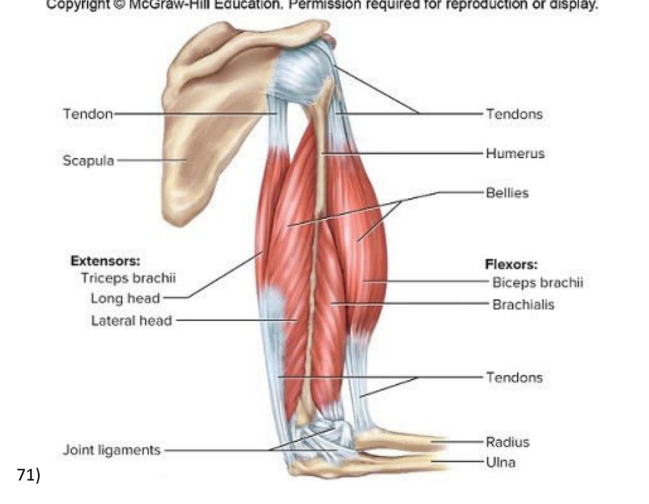
Based on this figure, which two muscles have direct attachments?
A) The brachialis and the lateral head of the triceps brachii
B) The brachialis and the biceps brachii
C) The brachialis and the long head of the triceps brachii
D) The lateral and long heads of the triceps brachii
E) The biceps brachii and the long head of the triceps brachii
The brachialis and the lateral head of the triceps brachii
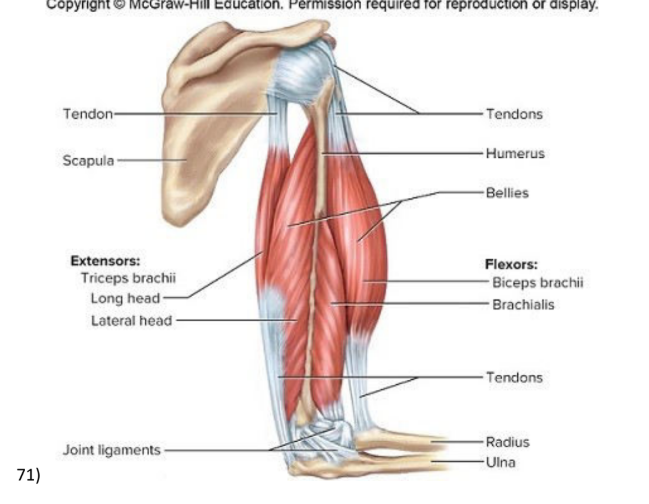
Based on this figure, which two muscles have indirect attachments?
A) The brachialis and the lateral head of the triceps brachii
B) The brachialis and the biceps brachii
C) The brachialis and the long head of the triceps brachii
D) The lateral and long heads of the triceps brachii
E) The biceps brachii and the long head of the triceps brachii
The biceps brachii and the long head of the triceps brachii
The muscles of the head and neck are innervated by the_________.
A) cranial nerves
B) spinal nerves
C) muscle fibers
D) aponeuroses
E) muscle capillaries
cranial nerves
What is the action of the depressor labii inferioris?
A) Lowers the bottom lip
B) Flexes the smallest finger
C) Aids in urine retention
D) Elevates the scapula
E) Extends the wrist
Lowers the bottom lip
What is the action of the flexor digiti minimi bevis?
A) Lowers the bottom lip
B) Flexes the smallest finger
C) Aids in urine retention
D) Elevates the scapula
E) Extends the wrist
Flexes the smallest finger
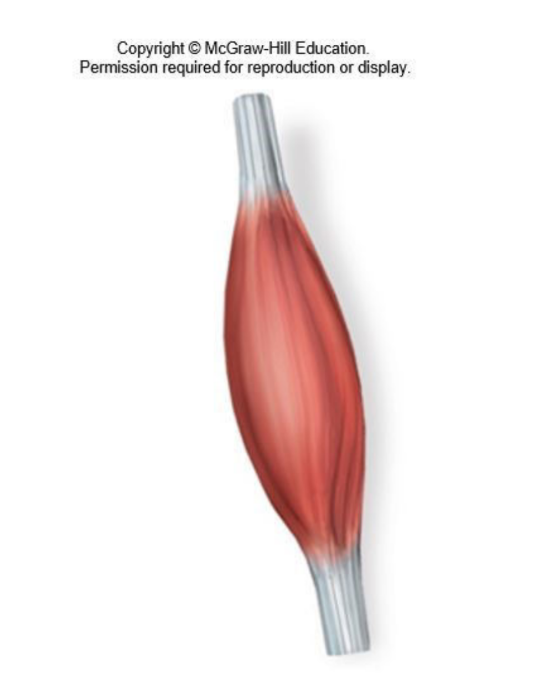
What type of muscle is this?
A) Fusiform
B) Parallel
C) Triangular
D) Bipennate
E) Multipennate
Fusiform

What type of muscle is this?
A) Fusiform
B) Parallel
C) Triangular
D) Bipennate
Parallel

What type of muscle is this?
A) Fusiform
B) Parallel
C) Triangular
D) Bipennate
E) Multipennate
Triangular

What type of muscle is this?
A) Rectus femoris
B) Biceps brachii
C) Deltoid
D) Orbicularis oris
E) Pectoralis major
Rectus femoris
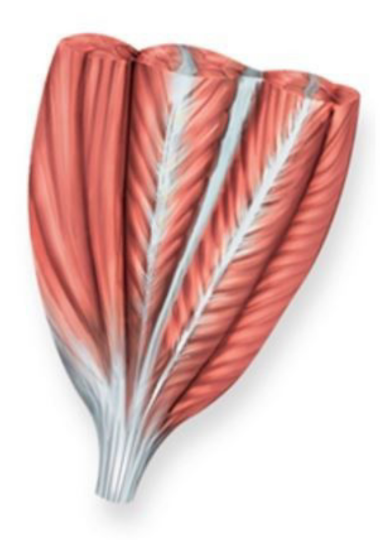
What type of muscle is this?
A) Rectus femoris
B) Biceps brachii
C) Deltoid
D) Orbicularis oris
E) Pectoralis major
Deltoid

Name the layer of connective tissue labeled 1.
A) Fascia
B) Epimysium
C) Perimysium
D) Endomysium
E) Retinaculum
Fascia

Name the layer of connective tissue labeled 2.
A) Fascia
B) Epimysium
C) Perimysium
D) Endomysium
E) Retinaculum
Epimysium

Name the layer of connective tissue labeled 3.
A) Fascia
B) Epimysium
C) Perimysium
D) Endomysium
E) Retinaculum
Perimysium
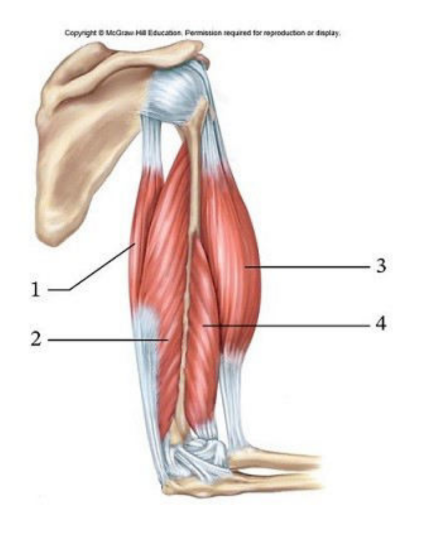
Name the arm muscle labeled 1.
A) Long head of triceps brachii
B) Lateral head of triceps brachii
C) Medial head of triceps brachii
D) Brachialis
E) Biceps brachii
Long head of triceps brachii

Name the arm muscle labeled 2.
A) Long head of triceps brachii
B) Lateral head of triceps brachii
C) Medial head of triceps brachii
D) Brachialis
E) Biceps brachii
Lateral head of triceps brachii

Name the arm muscle labeled 3.
A) Long head of triceps brachii
B) Lateral head of triceps brachii
C) Medial head of triceps brachii
D) Brachialis
E) Biceps brachii
Biceps brachii

Name the arm muscle labeled 4.
A) Long head of triceps brachii
B) Lateral head of triceps brachii
C) Medial head of triceps brachii
D) Brachialis
E) Biceps brachii
Brachialis

Name the facial muscle labeled 1.
A) Orbicularis oculi
B) Orbicularis oris
C) Levator palpebrae superioris
D) Occipitalis
E) Corrugator supercilli
Orbicularis oculi

Name the facial muscle labeled 2.
A) Zygomaticus minor
B) Zygomaticus major
C) Levator labii superioris
D) Risorius
E) Buccinator
Zygomaticus minor
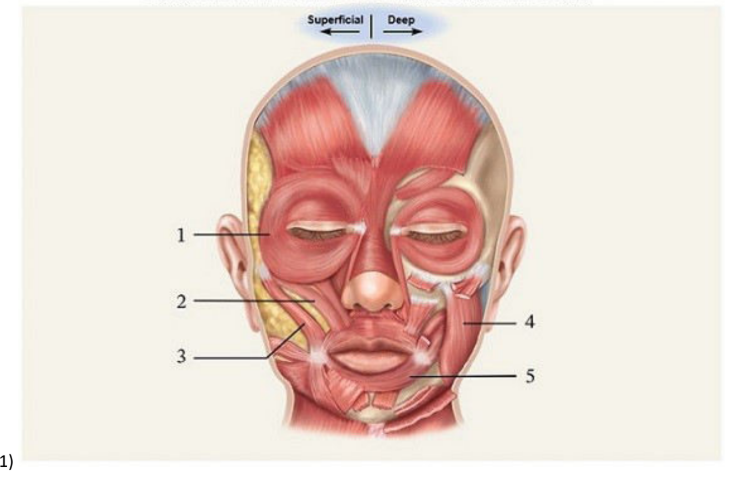
Name the facial muscle labeled 3.
A) Zygomaticus minor
B) Zygomaticus major
C) Levator labii superioris
D) Risorius
E) Buccinator
Zygomaticus major

Name the facial muscle labeled 4.
A) Zygomaticus minor
B) Zygomaticus major
C) Masseter
D) Risorius
E) Buccinator
Masseter

Name the facial muscle labeled 5.
A) Orbicularis oris
B) Orbicularis oculi
C) Masseter
D) Risorius
E) Buccinator
Orbicularis oris

Together, the group of muscles shown here is referred to as the _________.
A) Rotator cuff
B) Hamstrings
C) Quadriceps
D) Lateral rotators
E) Iliopsoas
Rotator cuff

Use your three-dimensional understanding of arm anatomy to identify the muscle
labeled 1 in this figure.
A) Biceps brachii
B) Brachialis
C) Triceps brachii
D) Brachioradialis
E) Pronator teres
Biceps brachii

Use your three-dimensional understanding of arm anatomy to identify the muscle
labeled 2 in this figure.
A) Biceps brachii
B) Brachialis
C) Triceps brachii
D) Brachioradialis
E) Pronator teres
Brachialis

Use your three-dimensional understanding of arm anatomy to identify the muscle labeled 3 in this figure.
A) Biceps brachii
B) Brachialis
C) Triceps brachii
D) Brachioradialis
E) Pronator teres
Triceps brachii
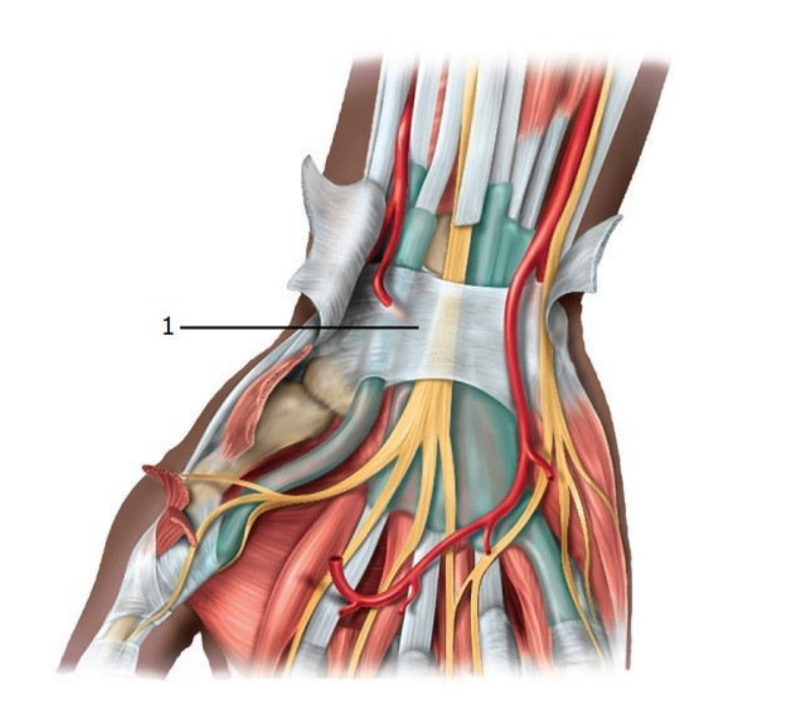
The structure labeled 1 is an example of _________.
A) a retinaculum
B) an aponeurosis
C) an interosseous membrane
D) a tendon
E) a ligament
a retinaculum

Based on their position and attachments, how would you classify the muscles shown here?
A) Adductors
B) Lateral rotators
C) Flexors
D) Extensors
E) Pronators
Adductors

What is the name of the muscle highlighted in purple?
A) Iliacus
B) Psoas major
C) Pectineus
D) Rectus femoris
E) Gluteus maximus
Iliacus

What is the name of the muscle highlighted in purple?
A) Iliacus
B) Psoas major
C) Pectineus
D) Rectus femoris
E) Gluteus maximus
Psoas major