Topic 4.2: Diabetes
0.0(0)
Studied by 0 people Call Kai
 Learn
 Practice Test
 Spaced Repetition
 Match
 Flashcards
 Knowt Play
Card Sorting
1/24

Earn XP
Description and Tags
25 Terms
1
New cards
diabetes
* a disease characterized by the %%abnormal use%% of %%carbohydrates%% by the body and %%elevated blood glucose%% levels
2
New cards
symptoms of type 1 diabetes
* increased %%frequent urination%%
* excessive %%thirst%%
* constant %%hunger%%
* unexplained %%weight loss%%
* extreme %%fatigue%%
* blurry %%vision%%
* excessive %%thirst%%
* constant %%hunger%%
* unexplained %%weight loss%%
* extreme %%fatigue%%
* blurry %%vision%%
3
New cards
symptoms of type 2 diabetes
* any %%type 1 symptoms%%
* greater %%frequency of infections%%
* sudden %%vision changes%%
* %%slow healing%% of wounds and sores
* %%tingling or numbness%% in the hands and feet
* very %%dry skin%%
* greater %%frequency of infections%%
* sudden %%vision changes%%
* %%slow healing%% of wounds and sores
* %%tingling or numbness%% in the hands and feet
* very %%dry skin%%
4
New cards
prevalence
* the proportion of a population who have a specific characteristic in a given time period
* the prevalence of diabetes has %%dramatically increased over time%%
* the prevalence of diabetes has %%dramatically increased over time%%
5
New cards
diabetes prevalence
* %%United Nations%% recognize diabetes as a global issue
* %%primary predictor%% of diabetes is %%obesity%%
* %%3.7 million deaths%% due to diabetes and high blood glucose
* %%1.5 million deaths%% caused by diabetes
* %%422 million%% adults have diabetes
* %%1 in 11%% people
* %%11 million Canadians%% living with diabetes or pre-diabetes
* %%primary predictor%% of diabetes is %%obesity%%
* %%3.7 million deaths%% due to diabetes and high blood glucose
* %%1.5 million deaths%% caused by diabetes
* %%422 million%% adults have diabetes
* %%1 in 11%% people
* %%11 million Canadians%% living with diabetes or pre-diabetes
6
New cards
normal fasting plasma glucose
* %%4 - <7%% mmol/L
7
New cards
blood glucose homeostasis
* when a person %%eats carbohydrates%%, blood glucose levels rise
* if blood glucose levels get too high, the %%pancreas is stimulated to release insulin%%
insulin stimulates:
* uptake of glucose into the cells
* storage of glucose as glycogen into the liver and muscles
* storage of excess glucose as fat
2. as the body uses glucose, %%blood levels decline%%
* if blood glucose levels get too high, the %%pancreas is stimulated to release insulin%%
insulin stimulates:
* uptake of glucose into the cells
* storage of glucose as glycogen into the liver and muscles
* storage of excess glucose as fat
2. as the body uses glucose, %%blood levels decline%%
8
New cards
blood glucose homeostasis (continued)
* low blood glucose levels stimulates the pancreas to release %%glucagon%%
* glucagon stimulates the cells to %%release breakdown glycogen stores%% and %%release glucose%% into the blood to bring blood glucose levels into homeostasis.
* glucagon stimulates the cells to %%release breakdown glycogen stores%% and %%release glucose%% into the blood to bring blood glucose levels into homeostasis.
9
New cards
%%outside normal%% blood glucose range
high blood glucose
* high blood triglycerides
* high bp
* hardening of the arteries
starved for Glucose: if insulin insufficient or cell membranes not sensitive
* cells become starved
* high blood triglycerides
* high bp
* hardening of the arteries
starved for Glucose: if insulin insufficient or cell membranes not sensitive
* cells become starved
10
New cards
classification of diabetes
__type 1 diabetes mellitus (DM)__
* %%beta cell destruction%%
* usually leading to %%absolute insulin deficiency%%
__type 2 diabetes mellitus (DM)__
* predominantly %%insulin resistance%% with relative %%insulin deficiency%%
* predominantly a %%defect insulin secretion%% with %%insulin resistance%%
__gestational diabetes mellitus (GDM)__
* %%glucose intolerance%% first recognized during %%pregnancy%%
11
New cards
diabetes type 1 and 2 compared
proportion of cases
type 1: %%5-10%%%
type 2: %%90-95%%%
type 1: %%5-10%%%
type 2: %%90-95%%%
12
New cards
health consequences of unmanaged diabetes
long-term, poorly managed blood sugar may contribute to:
* %%heart disease (#1)%%
* hypertension
* blindness
* kidney failure
* stroke
* loss of limbs due to poor circulation
* %%heart disease (#1)%%
* hypertension
* blindness
* kidney failure
* stroke
* loss of limbs due to poor circulation
13
New cards
type 1 diabetes management
medical management
* __insulin injections required for life__
lifestyle management
* adequate nutrient intake
* adequate fibre
* adequate protein
* adequate fat
moderate:
* added sugars
* total carbohydrate
physical activity!!
* __insulin injections required for life__
lifestyle management
* adequate nutrient intake
* adequate fibre
* adequate protein
* adequate fat
moderate:
* added sugars
* total carbohydrate
physical activity!!
14
New cards
type 2 diabetes management
medical management
* insulin stimulating drugs
* insulin injections
lifestyle management
* same as type 1
weight loss
physical activity!!
* insulin stimulating drugs
* insulin injections
lifestyle management
* same as type 1
weight loss
physical activity!!
15
New cards
risk factors for type 2 diabetes
1. __age__
* most common in %%individuals over 40%%
* increasing incidence in %%children%% and %%adolescents%%
2. __obesity__
3. __physical inactivity__
4. __genetics__
* familial history
* people of african, hispanic, canadian aboriginal, asian or pacific descent
16
New cards
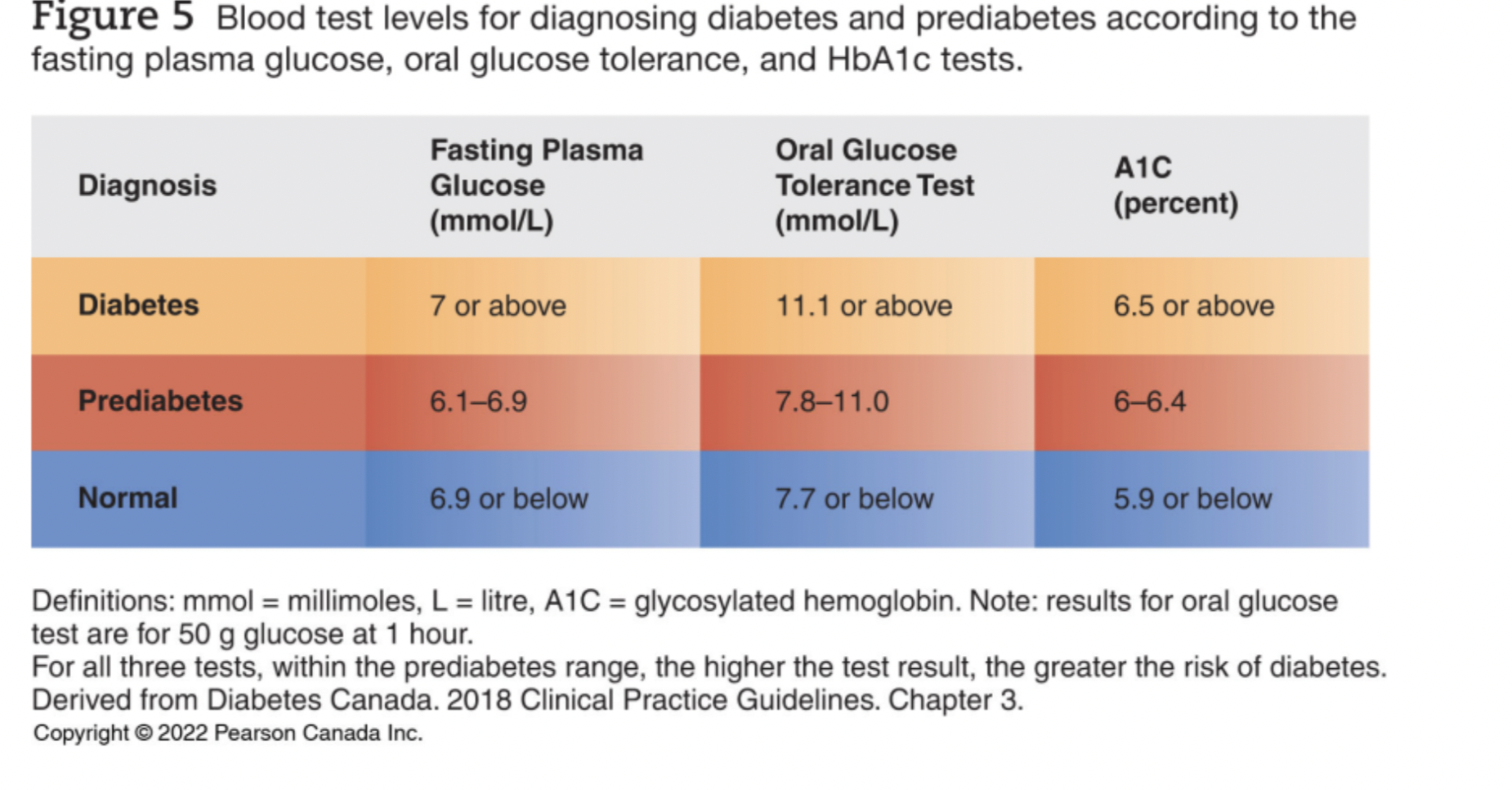
diagnosis of type 2 diabetes
* occurs at %%7 mmol/L FPG%% (fasting plasma glucose)
* ineffective %%insulin receptors%%
* %%inadequate%% amounts of insulin
* usually %%pre-diabetes comes first%%
* ineffective %%insulin receptors%%
* %%inadequate%% amounts of insulin
* usually %%pre-diabetes comes first%%
17
New cards
prediabetes
* usually people who develop type 2 diabetes have pre-diabetes first
* pre-diabetes range is %%above normal levels%% and %%below diagnosis%%
* approximately %%6.1 – 6.9 mmol/L FPG%%
* Having the condition of pre-diabetes increases risk of diabetes %%10% per year%%
* %%\~50% of people%% with pre-diabetes will develop diabetes
* most people diagnosed with pre-diabetes have a condition known as insulin resistance
18
New cards
A1C / HbA1C / glycosylated hemoglobin
* hemoglobin is part of your red blood cells that carry oxygen from your lungs to the rest of the body
* once a %%hemoglobin is glycated,%% it remains that way in the blood, until the red blood is removed
* once a %%hemoglobin is glycated,%% it remains that way in the blood, until the red blood is removed
19
New cards
A1C blood test
* A1C blood test reports the %%percentage (%) of hemoglobin%% that is %%bound to glucose%%
* A1C represents the blood glucose for the %%past 3 months%% or so
* A1C represents the blood glucose for the %%past 3 months%% or so
20
New cards
notes about Hb1AC test
1. not used for %%gestational diabetes assessment%%
2. %%less accurate%% for diagnosing diabetes for individuals who have
* anemia
* other blood disorders
* experienced a %%recent blood loss or transfusion%%
3\. individuals of %%African, Mediterranean, or Southeast Asian%% descent may have uncommon forms of hemoglobin that produce falsely high or low results
21
New cards
mechanism of insulin resistance
1. insulin binds cell membrane receptors
* Activated receptors, allow glucose into cells
* Cell membranes ‘resist’
* lower transport, increases blood glucose
2. pancreas responds by producing more insulin
* higher insulin keeps glucose levels under control for years
* %%pancreas becomes exhausted%%
* Tthe pancreas %%slows or stops%% producing insulin and glucose levels increase in the blood
22
New cards
type 1 diabetes
* 9% of all cases
* insulin is released by the 'beta cells' in the islets of Langerhans
* %%insulin deficiency%%
* diagnosis peaks \~ 10-14 years and usually occurs before age 40
* insulin deficiency from %%person’s own immune system attacking and killing pancreas%%
* destroys the portion of pancreas that produces insulin
23
New cards
how is the immune system provoked to attack?
• genetic predisposition
• viral infection
• other diseases
• toxins
• allergens
• disordered immune system
%%\*\*breastfeeding for first four months may confer protection against type 1 diabetes%%
• viral infection
• other diseases
• toxins
• allergens
• disordered immune system
%%\*\*breastfeeding for first four months may confer protection against type 1 diabetes%%
24
New cards
gestational diabetes (GDM)
* no pre-existing diabetes prior to becoming pregnant
* %%3 to 20%%% of women develop gestational diabetes
* disappears after birth but may return later in life
* prevention includes exercise, maintaining a normal weight, eating a healthy diet
* %%3 to 20%%% of women develop gestational diabetes
* disappears after birth but may return later in life
* prevention includes exercise, maintaining a normal weight, eating a healthy diet
25
New cards
gestational diabetes problems and management
infants of women with unmanaged gestational diabetes may:
* be fat at birth
* have blood glucose control problems after delivery
* have an increased risk of diabetes later on in life
management involves:
* an individualized diet with exercise
* the possibility of insulin
* be fat at birth
* have blood glucose control problems after delivery
* have an increased risk of diabetes later on in life
management involves:
* an individualized diet with exercise
* the possibility of insulin