Editar · AP ART HISTORY UNIT 5 ASIA
 Call Kai
 Learn
 Practice Test
 Spaced Repetition
 Match
 Flashcards
 Knowt Play
1/246

There's no tags or description
Looks like no tags are added yet.
247 Terms
Bahram Gur Fights the Karg
Folio from the Shahnama; Persia 1330; Was orally recited;propaganda to legitimize foreign ruler
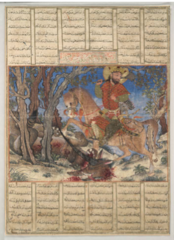
Who was Bahram Gur?
He was a descendent of Genghis Kan and an Iranian King.
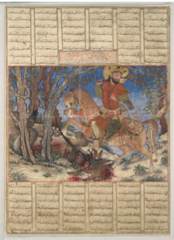
What is the Shahnama?
An epic poem that holds the royal history of Iran.
What purpose does the Shahnama serve in relation to kingship?
It serves as a manual of kingship.
How is the Shahnama used to express national pride?
It is orally recited to show country pride.
Chinese influence in Bahram Gur Fights the Karg
paper and curvilinear ink landscapes

What is the title of the artwork that features the Court of Gayumars?
Folio from Shahnama
In what year was the Court of Gayumars folio created?
1525
Who is depicted in the Court of Gayumars as the first and most ideal human on earth?
Gayumars
What was Gayumars said to be in control of?
People and nature
Implied Halo
There is space around a subject matter that makes someone important.

Goal of didactic art
To educate the viewer

Artist of Court of Gayumars
Sultan Muhammad, drew highly detailed

Patron of Court of Gayumars
Shah Tahmasp, he was commited to literacy and showcased wealth. He was the favored son prophesized to die

Chinese influence in Court of Gayumars
Twisting tree branches, stylized flowers, patterned clouds

Persian Inflience in Court of Gayumars
Flat gold sky, lavish color, individualized forces

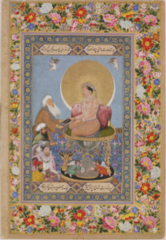
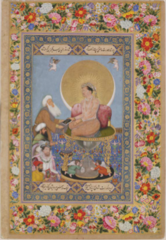
Who is the artist of 'Jahangir Preferring a Sufi Sheikh to Kings'?
Bichtir
In what year was 'Jahangir Preferring a Sufi Sheikh to Kings' created?
1620
What medium was used for 'Jahangir Preferring a Sufi Sheikh to Kings'?
Watercolor, gold, ink on paper
Who is prophesized to be king in 'Jahangir Preferring a Sufi Sheikh to Kings'?
Prince Salim
Which empire is depicted in 'Jahangir Preferring a Sufi Sheikh to Kings'?
Mughal Empire
What type of rule is the Mughal Empire under in 'Jahangir Preferring a Sufi Sheikh to Kings'?
Muslim rule
Who was Jahangir?
Mughal King in India "bringer of Life"
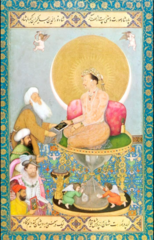
Sufi Sheikh
Islamic mystic, "religion important", spiritual master in Islam

European influence in Jahangir Preffering a Sufi Sheik to Kings
Angels and naturalistic plants
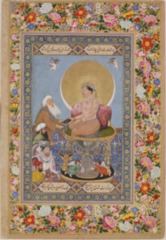
Islamic/Persian influence in Jahangir Preffers a Sufi Sheikh to Kings
The decorated border and calligraphy
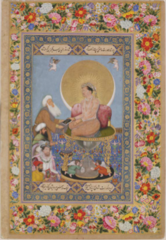
Mughal Influence in Jahangir Preffers a Sufi Sheik to Kings
Naturalistic figures, abstracted perspective
What was Bichtir (a Hindu) known for?
He was acclaimed for being able to draw hands; shows distinction between rich and poor (jewelry = "untouchable")
When was the Taj Mahal built?
1630 CE
In which country is the Taj Mahal located?
India
Which empire was the Taj Mahal built during?
Mughal Empire
Who was the imperial architect of the Taj Mahal?
Ustad Ahmad Lahori
Who commissioned the Taj Mahal?
Emperor Shah Jahan
What was the Taj Mahal built in memory of?
Shah Jahan's favored wife who died
What is the purpose of the Taj Mahal?
It serves as a mausoleum and monument for personal loss
What does the Taj Mahal symbolize?
A display of imperial authority
White in Taj Mahal
Represented the Priestly class in Hindu, it was chosen since the masoleum was build in a predominantly Hindu region

Significance of red in Muslim tombs
Typical for Muslim tombs, but because Hindu viewed it as a color for warrior, its not present in Taj Mahal

Where is Humayan's Tomb located?
Delhi
What architectural structure did Humayan's Tomb serve as a blueprint for?
Taj Mahal
What type of gardens are featured extensively in front of Humayan's Tomb?
Paradise gardens
What feature does Humayan's Tomb eliminate compared to traditional designs?
Courtyard
Which river is Humayan's Tomb built next to for visibility?
Yamuna River
What type of gardens are featured in the Taj Mahal?
Gardens of paradise that bloom year round
What is the purpose of the minarets in the Taj Mahal?
They are not for mosque function but for axis mundi
What do the precious stones in the Taj Mahal symbolize?
Imperial luxury
What architectural feature crowns the Taj Mahal?
Chattri
What influence did the Taj Mahal have on Indian palaces?
It was embellished in Indian palaces
What does the term 'Charbagh' mean in Persian?
Four gardens
What is the layout of a Charbagh garden?
A quadrilateral garden divided by water channels
What concept is the Charbagh layout based on?
The four gardens of Paradise as described in the Quran
Significance of symmetry in Taj Mahal
it is associated with paradise, abd the elevated platform and blind arcades meant it was floating, weightless.

Anamat Khan
India's foremost calligrapher

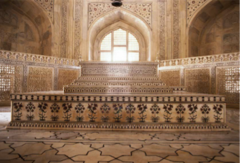
Cenotaphs
Tomb markers, but didn't actually hold the bodies. These are located under the central dome, with the Islamic oil lamp
What culture is associated with Jade Cong?
Laingzhu culture
What is the approximate date of Jade Cong artifacts?
3300 BCE
What type of evidence is lacking for the meaning of Jade Cong?
Prehistoric evidence
What was the purpose of Jade Cong in funerary rituals?
It was found in tombs and contains no ashes
Jade in Jade Cong
Represented wealth, China likes taking luxuries to the grave

Bi in Jade Cong
circle with hole = "heaven"

Cong in Jade Cong
The outter square with the rounder interior symbolises heaven within earth

Taotie (Jade Cong)
Super natural figures like deities and ancestors

Qin Dynasty
China is established with standardized currency; writing system; and measurements; united through violence through Qin Shi Huans; believed in Confucionism

Confucianism
Peace through hierarchy and social order

Mausolem of Emperor Shihuangdi
faces east (where the sun rises, it symbolises the rebirth into the after life); filled with riches; ceiling gemstones reminiscent of cosmos; Shihuangdi killed people who knew of the mausoleum so they wouldn't steal riches

What dynasty is the Terracotta Army associated with?
Qin Dynasty
In what year was the Terracotta Army created?
220 BCE
What material is the Terracotta Army made from?
Terracotta
How many life-sized soldiers are estimated to be in the Terracotta Army?
8,000+
How many horses are estimated to be in the Terracotta Army?
600+
What production technique was used to create the Terracotta Army?
Assembly line of ceramic techniques
What do the facial and clothing details of the Terracotta Army indicate?
Rank
What was the purpose of the differences in the Terracotta Army's soldiers?
To make plausible armies
Standardized crafting in Terracota Army
Indicated organized imperial power

Long arms in Terracotta Army
Indicated that the statue was a warrior

What were the years of the Han Dynasty?
205 BCE - 220 CE
What values did the Han Dynasty emphasize?
Peace, prosperity, and stability
Which philosophy had a significant influence during the Han Dynasty?
Confucianism
What are the key concepts promoted by Confucianism in the Han Dynasty?
Duty, self-discipline, relationships, and respect of authority
What was the ultimate goal of the values promoted by the Han Dynasty?
Harmony
What dynasty is the Funeral Banner of Lady Dai from?
Han Dynasty
What year was the Funeral Banner of Lady Dai created?
180 BCE
What material is the Funeral Banner of Lady Dai made from?
Painted silk
Where was the Funeral Banner of Lady Dai found?
In a tomb
Who was the tomb of Lady Dai hosted for?
The elite and civil servants
What was the tomb of Lady Dai filled with?
Riches
What three levels of the universe does the Funeral Banner of Lady Dai encompass?
Heaven, earth, and underworld
What concept does the Funeral Banner of Lady Dai represent?
Mythocentrism
Levels of the Universe
Heaven, earth, and underworld

Mythocentrism
means the close relationship between humand and supernatural realm

Heavenly realm in Funeral Banner of Lady Dai
Torch dragon was a primordial deity (man with snake tail); shows gate to heaven with guardian figures;

Lady Dai's ascent fo Heaven
had the hierarchy of the individual; emphasis is on the lady through the size and detailed outift;

HOTI
Hierarchy of the Individual
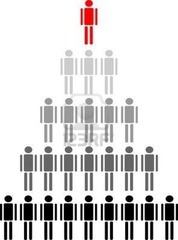
How was Lady Dai emphasized in Funeral Banner of Lady Dai?
Detailed outfit and size compared to everyone else

Earth and underworld of Funeral Banner of Lady Dai
Shows a funeral feast with ancestor offerings; fish from bi at the end

Tang Dynasty
620 - 905 CE; heigh of Buddhism; contains pagoda architecture; includes the Indian Stupa and the Chinese watch tower;

Pagoda architecture
multistoried Buddhist temple with eaves that curve up at the corners

Daoism
close relationship with nature and the balance of the universe

exoticism
Traits characteristic of a foreign country

Longmen Caves
Tang Dynasty; 675 CE; Clear ordering of Buddhas in Confucius; contains guardian figures and reliefs of court life and emperors; shown along the Yi river;
