Eletricity
 Call Kai
 Learn
Learn Practice Test
 Spaced Repetition
 Match
Match Flashcards
 Knowt Play
1/54

There's no tags or description
Looks like no tags are added yet.
Name | Mastery | Learn | Test | Matching | Spaced | Call with Kai | Chat |
|---|
No analytics yet
Send a link to your students to track their progress
55 Terms
Define electrical current
A microscopic flow of negatively charged electrons, that when comes into contact with other negatively charged electrons causes an electric shock as when same charges collide they repel from each other.
What are the main symbols that are seen in an electrical circuit?
An open switch, a close switch, a lamp, a resistor, voltmeter, ameter, LDR (light dependent resistor), thermistor, variable resistor, diode, LED (light emitting diode), fuse, cell and battery.

What is this electrical circuit symbol?
An open switch
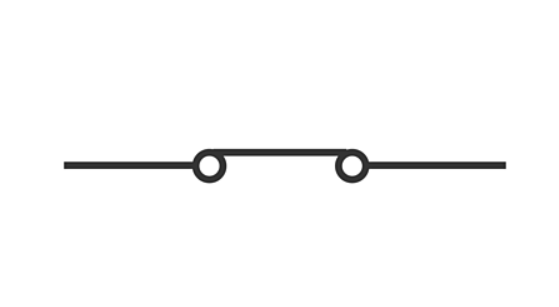
What is the electrical circuit symbol?
A closed switch

Is this electrical circuit symbol a lamp?
No, it is a resistor

What is this electrical circuit symbol?
A lamp

What is this electrical circuit symbol?
A resistor
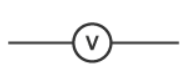
What is this electrical circuit symbol?
A voltmeter

What is this electrical circuit symbol?
An ameter

What is this electrical circuit symbol?
An LDR (light dependent resistor)

What is this electrical circuit symbol?
A thermistor

What is this electrical circuit symbol?
A variable resistor

What is this electrical circuit symbol?
An LED (light emitting diode)

What is this electrical circuit symbol?
A diode

What is this electrical circuit symbol?
A fuse

What is this electrical circuit symbol?
A cell

What is this electrical circuit symbol?
A battery
Define an open switch
This indicates that the electrical circuit has stopped, and therefore no electrical current can flow beyond this point even if the electrical circuit is still on, because the switches contacts are physically not connected.
Define a closed switch
This indicates that the electrical current of a circuit can flow beyond this point (if the circuit has been turned on), because the two contacts of the switch are physically connected.
Define a lamp in an electrical circuit
An output component- meaning it uses the flow of electricity through a circuit to output something- that converts electrical energy into light energy. Although, some electrical energy is dissipated and transferred to the surroundings as thermal energy.
Define a resistor
A passive component of an electrical circuit- meaning it does not require an external power source to function as intended- that is used to regulate an electrical current flow through an electrical circuit. It generates electrical resistance, to enable it to decrease voltage power within an electrical circuit, which is typically used to protect LED sensitive electrical components that are in the same electrical circuit.
What is the symbol/measurement of resistance?
Ω/ohms
Explain how resistance against an electrical current decreases voltage
Using a resistor component in an electrical circuit generates resistance against the flow of electrical current whilst simultaneously decreases voltage. This is because by causing electrons- negatively charged particles each with a mass of 1/1840 (what an electrical current is made up of)- to collide with other atoms in the resistor it dissipates electrical energy meaning decreasing the amount of electricity flowing through a circuit. The electrical energy is spread to the surroundings as thermal energy.
Define a variable resistor
An passive electrical component that acts as a resistor although the resistance can be increased or decreased- which is typically used in dimmer switches or volume control dials.
Define a voltmeter
An active component- meaning it requires an external power source to operate as intended- that is typically used to identify the difference in electrical potential difference between two points in an electrical circuit.
Define a diode
A passive component which is made up of three parts: the anode, cathode and the PN junction which shows the direction of electrical current flow. This component acts as a two way terminal valve for an electrical circuit. The anode is the positive terminal (the entry for electrical current) and the cathode is the negative terminal (the exit for electrical current). A diode prevents the backflow of an electrical current within an electrical circuit and is typically made of a semi-conductor material, which normally has a PN junction with is what controls the directional movement of charge carriers.
Explain what happens during reverse biased
The positive terminal of the diode connects to the p junction, and the negative terminal is connected to the n junction. The p junction is made from impurities (such as boron) which are materials that have been mixed with a foreign substance to make it contaminated or lower in quality, so then there can be a surplus of holes in the material to prevent electricity to freely flow through, as the electrons that make up electricity are stopped as they fit into the holes and become stuck. Whereas the n junction is also made from impurities (such as lead), but is especially made from a material with delocalised electrons- electrons that are not fixed to a bond- to allow electrical current to flow through.
Define a thermistor
A type of resistor that controls and regulates electrical current flow based on the temperature of the surroundings and electrical circuit (if they decrease or increase), which is essential for safety purposes. It prevents circuit overheating and translates thermal energy, voltage or current changes into digital data which is readable on a digital device such as a digital voltmeter.
Define a fuse
An essential, passive electrical component that is vital in terms of safety as it can prevent electrical fires (which useally happens when the temperature of the electrical current overheats the wires) by stopping the flow of an electrical current through a circuit. It performs its function by having a thin metal wire inside of it that melts when the currents temperatures exceeds its average temperature.
Define a cell
A single power source component, which generates electricity by transferring chemical energy- which is gained as it is stationary- into electrical potential energy. Two or more of these connected together form a battery.
Define a battery
Two of more cells connected together by wires and convert chemical energy- which is gained when it is stationary- into electrical potential energy. This is a main active power source in an electrical circuit. It also contains electrolytes that allows electricity to move through the battery (entering through the anode/ positive terminal and exiting via the cathode/ negative terminal).
What are the two types of electrical currents?
A direct current
An alternating current
Define a direct current
A flow of an electrical current (which is made up of negatively charged electrons), that maintains a consistent flow around a circuit in one direction.
Define an alternating current
A flow of an electrical current (made up of negatively charged electrons), that is characterised by going in a direction but continuously reverses as it flows through the circuit.
What energy is transferred between wires in an electrical circuit?
Electrical energy
What energy is stored in a battery?
Chemical energy
Define charge
A chemical property of matter which causes it to experience a force when entering an electrical field.
What is the symbol/measurement for charge
Q/C (Coulombs)
1 coulomb is how many electrons of charge?
6,250,000,000,000,000,000 (6.25 × 10¹⁸)
Define electrical current
The rate of electrical charge that flows within a circuit.
Give an example of when electrical work is being done
When electrical current flows through a circuit of electrical wires.
Define work
Any type of energy transferred by a force.
State the word equation for charge
Charge= Current x time
State the symbol equation for charge
Q= I x T
What is the symbol/measurement of current?
I/A (amps)
What is the rate of electrical current dependent on?
Electrical resistance.
Define electrical resistance
The measurement of how much a material or component of an electrical circuit prevents the continuous flow of an electrical current. It defines the opposing matter in an electrical circuit that weakens the movement of electrical energy.
What is the symbol/measurement of resistance?
R/ohms(Ω)
Define potential difference
Also known as voltage, it is a measurement that shows the amount of energy carried across two points in a circuit- which is typically measured by a voltmeter.
What is potential difference measured in?
Volts (V)
How would you measure the potential difference in an electrical circuit?
Aquire a voltmeter and place it paralell to the point where you want to measure the potental difference of.
State the word equation for potential differnce
Potential difference= Energy/Charge
State the symbol equation for potential differnce
V=E/Q
Explain why conductors have a low electrical resistance profile, whilst insulators have a high electrical resistance profie
This is because conductors (such as metals and alloys) have delocalised electrons- electrons not fixed to a bond- in their atomic structure. This allows an electrical current to flow through via the electrons. Although, insulators (such as wood or rubber) have a high electrical resistance,as their don’t have delocalised electrons in their atomic structure as it is very tightly compacted.