S2 - Extraoral and Intraoral Examnation
 Call Kai
 Learn
Learn Practice Test
 Spaced Repetition
 Match
Match Flashcards
 Knowt Play
1/91

There's no tags or description
Looks like no tags are added yet.
Name | Mastery | Learn | Test | Matching | Spaced | Call with Kai | Chat |
|---|
No analytics yet
Send a link to your students to track their progress
92 Terms
What are the roles of a dental hygienist?
Observe/recoginize abnormalities, record accurately, and bring to the attention of the dentist.
Direct Observation
Note visually any deviations from normal that you see, and show extreme care about minute detail.
Palpation
Feeling, sense of touch, use of fingers and hands to detect abnormalities.
Digital Palpation Technique
Use a single finger

Bidigital Palpation Technique
Use of the thumb and index finger of the same hand.

Bimanual Palpation Technique
Use of both hands in one area, with hands compressing soft tissue between them.

Bilateral Palpation Technique
Examining both sides at the same time so you can compare structures on opposite sides of the body.

Circular Compression
Applying pressure with the fingertips as they move in a circular pattern over an area.

___ tissues must be palpated against a harder structure such as the bone, other fingers, or your hands so that you can feel nodues beneath the surface.
Soft
Auscultation
Listening to sounds (unaided ear or stethoscope)

Percussion
Tapping on a structure with the fingers, hand or instrument.

How does percussion help?
It helps determine if the structure is vital and what the density is (hollow, solid, or fluid-filled).
What preliminary steps should you take?
Review the patient's medical history and record, and give head and neck examination.
What are the three components of a head and neck examination?
General appraisal, extraoral exam, and intraoral exam.
General Physical Appraisal
Findings may be indicative if systemic diseases are present. Look for body/extremeties such as symmetry, gait, coordination, mobility, cooperation, tremors, posture, etc.
Things to look for in a General Physical Appraisal for Face:
Profile (occlusion class), facial symmetry, facial expression, paralysis, injuries, amount of hair.
Things to look for in a General Physical Appraisal for Skin:
Color (red, jaundice, etc.), dry/sweaty, lesions, scarring, birthmarks, bruising, bleeding, facial moles.
Things to look for in a General Physical Appraisal for Eyes:
Size of pupil (use of drugs), color of sclera, eyeglasses, sensitivity to light, and blindless/limited vision.
Things to look for in a General Physical Appraisal for Voice/Breath:
Hoarseness, coughing, unusual breath odor, labored breathing, high-pitched (relate dto health conditions)
Preliminary procedures include explaining the procedure to the patients using the following criteria:
Explaining what you are going to be doing, asking for permission to touch them, have them remove glasses or loosen restrictive clothing around the area of operation, all while using a friendly voice and lay terminology.
In the preliminary procedures of an extraoral exam, which PPE should you don?
Mask, safety glasses, and exam gloves.
Patient position for extraoral exam is ...
Upright position
Operator position for an extraoral exam is ...
11-1 o'clock with chair lower so you can reach the mandible comfortably.

What are the major salivary glands?
Sublingual, submandibular, and parotid.

What are the functions of lymph nodes?
- Removal of foreign organisms from the body fluids
- Enlarged nodes may be present when infection or malignancy (tumor) are involved.
Which nodes should be examined?
Sublingual, submental, occipital, superficial, auricular, and deep cervical nodes

How should the sublingual and submental nodes be examined?
Use bilateral, bidigital, circular compression behind and beneath the symphysis of the mandible (from canine to canine)
Which glands should be examined?
Submandibular, parotid, and thyroid glands
How should the submandibular gland be examined?
Use bilateral, bidigital, circular compression from the canines to the angle of the mandible.
How should the parotid gland be examined?
-Use bilateral, circular compression from the cheek area to the front of the ear and inferiorly to the border of the mandible.
- Keep fingers together.
- Examine for enlargement or tenderness that may be indicative of infection or disease.
How should the auricular nodes be examined?
Using bilateral circular compression to palpate.
Preauricular nodes are located where?
In front of the ear.
Inferior auricular nodes are located where?
Below the ear.
Postauricular nodes are located where?
Behind the ear.

Occipital nodes are located where?
At the base of the skull.

How should you examine occipital nodes?
The patient's head should be forward and circular compression should be used bilaterally from the back of the neck to the sternocleidomastoid muscle.
What are you looking for when examining the occipital nodes?
Palpable lymph nodes and muscle tenderness that may be indicative of infection or disease.
How should you examine the sternocleidomastoid muscle?
Patient should turn the head to the side and lower the chin and perform bidigital compression starting from below the ear and continuing the entire length of the muscle.
What are you looking for when examining the sternocleidomastoid muscle?
Tenderness or cramping.
How should you examine for superficial and deep cervical nodes?
Use unilateral or bilateral circular compression against the anterior and the posterior portion of the sternocleidomastoid muscle.
How should you examine the thyroid gland?
Move the thyroid side to side, ask the patient to swallow, use the fingers of one hand to gently displace the thyroid tissue to the other side. Use compression with the opposite hand, examining for tumors, cysts, or goiters.

How should you examine the temporomandibular joint (TMJ)?
Position fingers over the TMJ, ask the patient to open and close and to report if there is any pain or popping. Record the presence of pain, popping (crepitus), deviations in movement or subluxation (jaw locking).

Inflamed lymph nodes indicate what?
Active infection such as colds or sore throats.
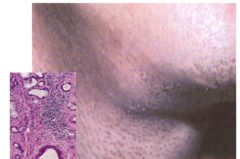
How do you recognize an inflamed lymph node?
They are soft and spongy, mobile, or tender
Sclerosed or fibrous lymph nodes indicated what?
Chronic infection (sinus/allergy)
How do you recognize a sclerosed or fibrous lymph node?
They are firm, mobile, or not tender.
How do you identify a cancerous lymph node?
They are stone hard (indurated), fixed (not mobile), and not tender initially.
What information should be recorded?
Location, consistency, mobility, tenderness, size, and history.
What are the preliminary steps for an intraoral exam?
Remove gloves, wash or gel hands, have patient use pre-rinse, put on patient safety glasses and napkin, explain procedure to patient, put patient in supine position, wash or gel hands and don new PPE
What PPE should you be wearing during an intraoral exam?
Mask, face shield, and exam gloves.
What should you do prior to the beginning of the procedure?
Visual exam of the mouth
What should NOT touch the tissues when doing the visual exam?
The mirror
What should you do to examine the lips?
Pull the lip up/down to look for sores. Use bidigital palpation and use same finger inside.

How should you examine the buccal mucosa?
Bidigital palpation and stripe buccal mucosa from back to front.
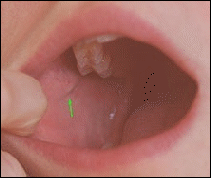
How should you examine the maxillary and mandibular vestibular area?
Digital palpation to feel for exostoses, abscesses, etc.
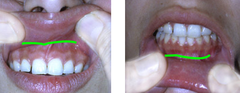
How should you examine the gingiva?
Digital palpation to feel inside and outside both arches.

How should you examine the palate?
Use digital palpation on the hard palate only to feel for things such as tori.

How should you examine the soft palate?
Via visual inspection
How should you examine the floor of the mouth?
Bimanual palpation

How should you examine the tongue?
Bidigital palpation and visual inspection of the dorsal, ventral, and lateral sides of the tongue.

How should you examine the tonsillar area?
Visual inspection only, you depress tongue with mirror and have patient say ah!

What information should be recorded for an intraoral exam?
Location, color, size, consistency, shape, and history.
Verrucous
Wart-like

Fissured
Cracked appearance

Crusted
Scab-like
Corrugated
Folded/wrinkled
Localized
Lesion limited to one area
Generalized
Involves most of an area or segment
Number of Lesions - Single
One with distinct margins
Number of Lesions - Multiple
More than one lesion
Separate Lesions
Individual lesions, not running together.
Coalescing Lesions
Close together with margins that merge.
What descriptions of a lesion should you be determining?
If it is elevated, depressed, or flat.
Elevated
Above the level of skin or mucosa.
Blisterform
Contains fluid and is soft and translucent.
In a blisterform: vesicle is less than _ in diameter.
1
Bulla is larger than _ cm.
1
Pustule contains pus less than _ mm
5
Elevated Nonblisterform
Solid does not contain fluid
Papule
Less than 5mm
Nodule
Larger than 5mm, but less than 1 cm
Tumor
2 cm or greater
Plaque
Raised lesion with broad flat to.
Sessile Base
Wide base with the same width as lesion.

Pedunculated Base
Narrow stalk or pedicle, mushroom-like.

Depressed
Below the level of the skin or mucosa
Depressed centers are what color?
Gray to yellow with a red border.
Depressed spots may be the result of the rupture of an ____ lesion.
Elevated
Flat
Same level as skin or mucosa
Macule
Circumscribed area, not elevated, and identified by their color

Warning signs of oral cancer:
-Swelling/enlargemnt
- White, scaly patches
- Red, velvety patches
- Sore that does not heal in 2 weeks.
- Repeated bleeding without any apparent cause.
- Numbness or pain in the mouth without any apparent cause.
Warning signs of cancer:
- Difficulty in chewing or swallowing
- Difficulty in moving the tongue or jaw; difficulty in opening the mouth.
- Prolonged hoarseness, sore throat, persistent coughing, feeling like a lump is in throat.
Excessive wetness or dryness in mouth.