Biology topic 1A-Biological Molecules
 Call Kai
 Learn
Learn Practice Test
 Spaced Repetition
 Match
Match Flashcards
 Knowt Play
1/66

Earn XP
Description and Tags
Vocabulary flashcards generated from lecture notes on mono and disaccharides, including carbohydrates formulas, isomers, and condensation reactions.
Name | Mastery | Learn | Test | Matching | Spaced | Call with Kai | Chat |
|---|
No analytics yet
Send a link to your students to track their progress
67 Terms
Define monosaccharides
Simple sugars that serve as the basic unit of carbohydrates.
Define Polysaccharides
Long chains of simple sugars (monosaccharides), such as cellulose and starch.
What is a Condensation Reaction
A chemical reaction in which monosaccharides combine to form polysaccharides with the release of water (H2O).
Define Hydrolysis
A chemical reaction in which polysaccharides are broken down into monosaccharides by the addition of water (H2O).
Give the General Formula for Carbohydrates
(CH2O)n, a general formula that all saccharides fit.
Give the Glucose Formula
C6H12O6, the chemical formula for glucose.
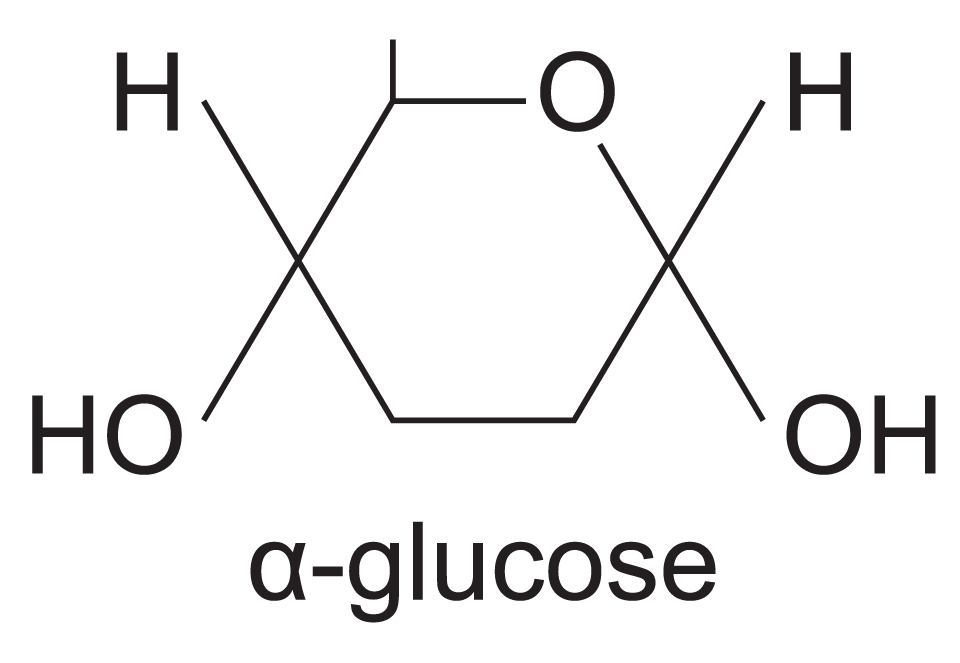
What is Alpha Glucose?
An isomer of glucose (β-glucose isomer sibling) where both hydroxyl (−OH) groups face down.
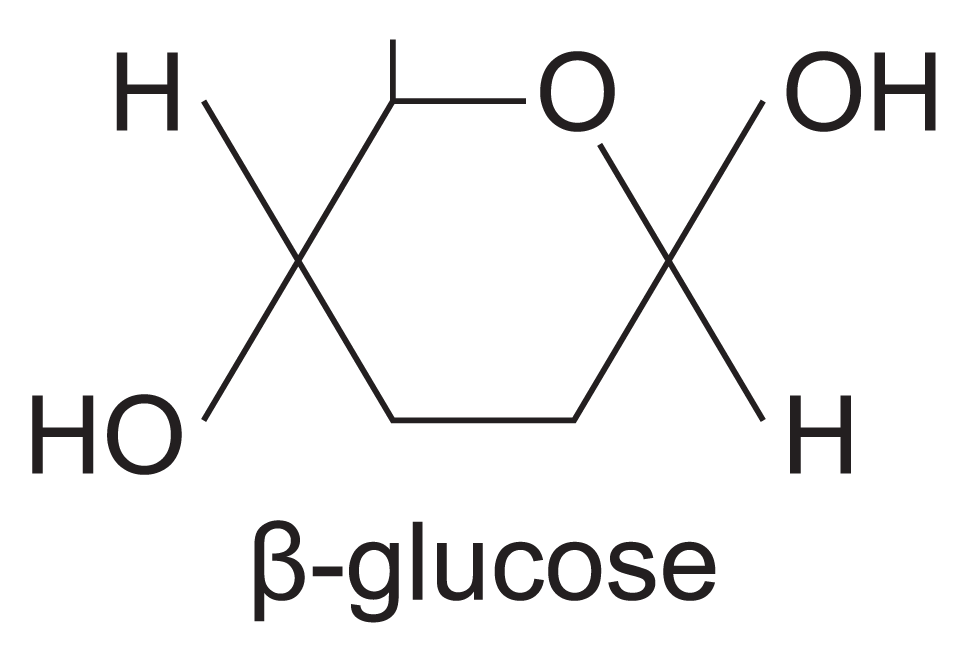
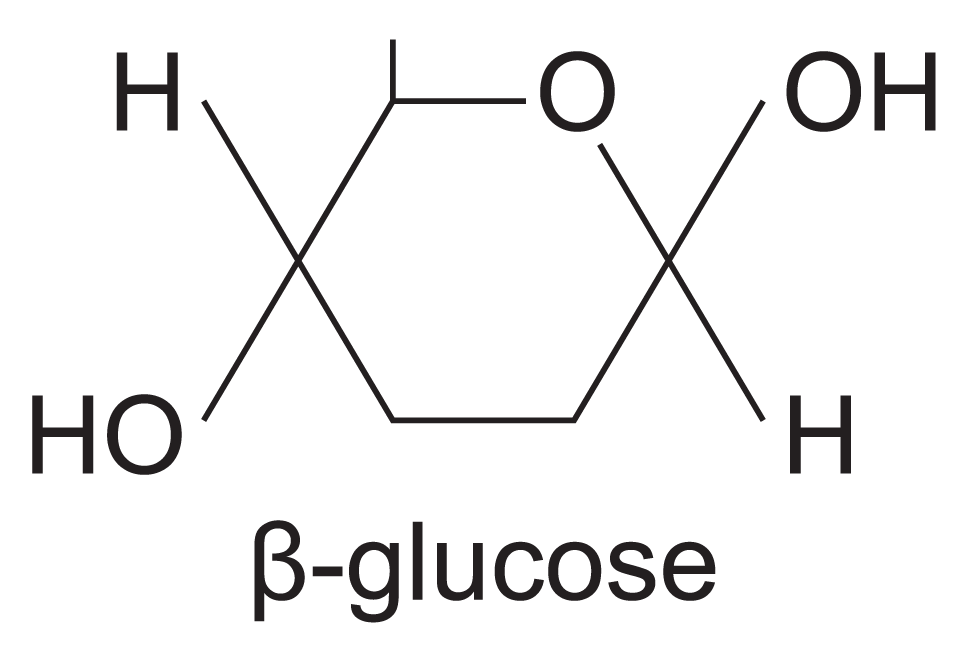
What is Beta Glucose?
An isomer of glucose where only 1 hydroxyl (−OH) group faces down because the position of the −OH group on carbon 1 is swapped upward.
What is a Glycosidic Bond?
A covalent bond formed between two monosaccharide molecules during a condensation reaction.
What does the condensation reaction, alpha glucose + alpha glucose form? What type of substance is this?
A disaccharide called maltose
Alpha Glucose Structure
Diagram depicting the chemical structure of alpha glucose showing numbered carbon atoms C1 to C6 and hydroxyl (−OH) groups.
Beta Glucose Structure
Diagram depicting the ring structure of beta glucose, illustrating the swapped position of the −OH group on carbon 1.
What is hydrogen bonding?
A strong intermolecular attraction between a δ⁺ hydrogen atom bonded to N, O or F and a lone pair of electrons on N, O or F in another molecule.
Why does hydrogen become δ⁺?
N, O and F are highly electronegative and attract the bonding pair of electrons towards themselves.
What must hydrogen be bonded to for hydrogen bonding to occur?
N, O or F
What attracts the δ⁺ hydrogen?
A lone pair of electrons on an N, O or F atom of another molecule.
Is hydrogen bonding an intermolecular or intramolecular force?
Intermolecular
How do hydrogen bonds affect boiling point & melting point?
Stronger intermolecular forces require more energy to overcome, so the boiling point annd melting point increases.
What happens to intermolecular hydrogen bonds when water boils?
They are overcome; the covalent O–H bonds are not broken.
What are monomers?
Small, basic, molecular units of life that can form a polymer
What are polymers?
Large, complex molecules composed of long chains of monomers joined together
How are most biological polymers formed?
Condensation reactions
What is a condensation reaction?
A chemical bond between monomers, releasing a H2O (water) molecule
How are polymers often broken down into monomers?
Hydrolysis
What is a hydrolysis reaction?
The breaking of chemical bonds between monomers, using a water molecule. (The H2O bonds to the single oxygen to form 2x OH).
What elements do all carbohydrates contain and what are the monomers called which make up carbohydrates?
C, H and O
Carbohydrates monomers are monosaccharides
What type of sugar is glucose? What does this mean?
A hexose sugar- six carbon atoms in each molecule
What are the 2 isomers of glucose?
Alpha and Beta
Describe the structure of alpha glucose
Both OH face down

Describe the structure of beta glucose
1 OH up, 1 OH down
What is a disaccharide and how is it formed?
Two monosaccharides joined together
Through condensation reaction
What type of bond forms between the two monosaccharides when a disaccharide is formed?
Glycosidic bond, and H2O is released
How is sucrose formed?
Condensation reaction between 1 glucose molecule and 1 fructose molecule (forming a disaccharide)
How is lactose formed?
Condensation between a glucose and galactose molecule
How is maltose formed?
Two alpha glucose
What are the two classifications of sugars? How can they be tested for?
Reducing and non-reducing
Benedict’s test
What do reducing sugars include?
ALL monosaccharides and some disaccharides (maltose and lactose)
Describe the Benedict’s test for reducing sugars
Add blue Benedict’s reagent to a sample and heat in a hot water bath brought to the boil. A positive test will form a coloured precipitate
What is the positive versus negative result for the Benedict’s test for reducing sugars
Positive- sample forms green- yellow- orange- brick red precipitate (REDUCING sugars present)
Negative- sample stays blue (no REDUCING sugars present)
How is a higher concentration of reducing sugars indicated?
By how far the colour change goes (e.g. green= low conc. / brick-red= high conc.)
What is a more accurate way to measure the concentration of reducing sugars after Benedict’s test?
1) Filter the solution and weigh the precipitate
2) Remove the precipitate and use a colorimeter to measure the absorbance of the remaining Benedict’s reagent.
If the result of the Benedict’s test is firstly negative, what could this still mean?
A non-reducing sugar could still be present.
What must you first do when testing for a non-reducing sugar, like sucrose?
Break them down into monosaccharides
How do you carry out the test for non-reducing sugars?
Gather a new sample of the test solution, and add dilute HCl. Then carefully heat at boiling point in hot water bath and neutralise using sodium hydrogencarbonate. Then carry out same Benedict’s test.

What are polysaccharides?
Carbohydrates made from large numbers of monosaccharides bonding in condensation reactions.
How are polysaccharides broken back down into monosaccharides?
By hydrolysis reactions, breaking the glycosidic bond using a H2O molecule.
What 3 polysaccharides must you know the structure and function of?
Starch
Glycogen
Cellulose
What is starch?
How plants store excess glucose to be broken back down when energy is required
What two polysaccharides is starch a mixture of?
Two polysaccharides of alpha-glucose
Amylose and Amylopectin
What is Amylose? How does its structure support its function?
A long, unbranched chain of alpha glucose.
The angles of the glycosidic bonds give it a coiled structure, making it compact so that it is good for storage (can fit more into a small space)

What is Amylopectin? How does its structure support its function?
A long, branched chain of alpha glucose
Side branches allow the enzymes that break down the molecule to access the glycosidic bonds easily, meaning the glucose can be released quickly

Why is starch good for storage as well?
It is insoluble in water and doesn’t affect water potential, so doesn’t cause water to enter cells by osmosis (which would make them swell).
What is glycogen used for?
Storing glucose in animal cells (and bacteria)
What is the structure of glycogen?
Polysaccharide of alpha glucose, very similar to amylopectin, but has loads more sides branches
How does glycogens many branched structure relate to its function?
Stored glucose can be quickly released by hydrolysis (by enzymes), for quick energy release in animals
Also very compact, so is able to store a lot of glucose in a small space
What is cellulose made of? Describe its structure in a chain
Long, unbranched chain of beta-glucose, bonded by condensation to form glycosidic bonds. Each beta glucose molecule in the chain has an alternating orientation
How are cellulose chains linked together? Why is this useful?
Many hydrogen bonds, forming strong fibres called microfibrils.
This high tensile strength provides structural support for cells- e.g. stops plant cell wall from bursting

Describe the test for starch
Iodine test
Add iodine dissolved in potassium iodide to the test sample
Browny-orange= starch present
Dark blue-black=NO starch present
What are lipids made from? What do they all contain?
Proteins and carbohydrates
ALL contain hydrocarbons
What are the 2 types of lipids?
Triglycerides and Phospholipids
Describe the structure of Triglycerides
One molecule of glycerol with 3 fatty acids attached to it
