atomic structure, ionisation energy, metallic bonding, ionic bonding, covalent bonding, properites of covalent substances
 Call Kai
 Learn
 Practice Test
 Spaced Repetition
 Match
 Flashcards
 Knowt Play
1/50

There's no tags or description
Looks like no tags are added yet.
51 Terms
Isotopes
all atoms of an element have the same number of protons in their nucleus
isotopes of an element have different numbers of neutrons
different isotopes of an element therefore have the same atomic number, but different mass numbers. They have the same chemical propertites because they have the same number of electrons in their atoms
Ions
are charged particles formed when atoms gain or lose electrons. Ions are:
negatively charged if atoms gain electrons
positively charged if atoms lose electrons
the number of charges on an ion is equal to the number of electrons gained or lost by the atom
Ions
are charged particles formed when atoms gain or lose electrons. Ions are:
negatively charged if atoms gain electrons
positively charged if atoms lose electrons
the number of charges on an ion is equal to the number of electrons gained or lost by the atom
what is the atomic number?
protons
what is the relative mass of a proton?
1
what is the relative charge of a proton?
1+
what is the relative mass of a neutron?
1
what is the relative charge of a neutron?
0
what is the relative mass of an electron?
1/1836
what is the relative mass of an electron?
1-
where is the proton located in an atom?
nucleus
where is the neutron located in an atom?
nucleus
where is an electron located in an atom?
energy level (shell)
Ionisation energy
is the energy needed to remove an electron from an atom or ion in the gas state. Ionisation is endothermic (energy is transferred in) so ionisation energies have positive values
what is first ionisation energy chemical equation?
M(g) = M^+(g) + e^-
what is the second ionisation energy chemical equation?
M^+(g) = M2^+(g) + e^-
what is third ionisation chemical equation?
M2^+(g) + M3^+(g) + e^-
First ionisation energy?
the amount of energy required to remove 1 mole of electrons from 1 mole of gaseous atoms (to form 1 mole of gaseous positive ions with +1 charge) under standard conditions
successive ionisation energy
the amount of energy required to remove an electron will increase with each successive electron that is removed as the ion becomes increasingly positive
first ionisation energy in a group
first ionisation energy decreases down a group
outer electrons are increasingly shielded by inner electrons, and further away from the nucleus as atomic radius increases. This reduces the effective strength of attraction between outer electrons and the nucleus
first ionisation energy in a period
Across the period the number of protons in the nucleus increases, so the attraction between the nucleus and electrons increases. The increase in sheilding is negligible because each successive electron enters the same shell
what is third ionisation energy?
is the amount of energy required to remove 1 mole of electrons from 1 mole of gaseous positive ions with +2 charge (to form 1 mole of gaseous positive ions with +3 charge).
what are factors affecting ionisation energy?
nuclear charge
number of shells
sheilding of the outer shell from the nucleus
factors affecting ionisation energy down a group?
number of protons in nucleus increases
atomic radius and shielding increases
electrostatic attraction for outer shell electrons decreases
ionistation energy decreases
factors affecting ionisation energy across a period?
number of protons in nucleus increases
shielding remains the same (and atomic radius decreases)
electrostatic attraction for outer shell electrons increases
ionisation energy increases
define fourth ionisation energy. Include a chemical equation in your answer.
the energy needed, in the gas state, to remove an electron from an ion with three positive charges to form an ion with four positive charges.
M³+(g) = M^4+(g) +e-
Metallic bonding
Is the strong electrostatic force of attraction between delocalised electrons and positive metal ions
Electrostatic attraction between the ‘sea’of delocalised electrons and the positive metal ions that remain is referred to as metallic bonding and a giant metallic structure.
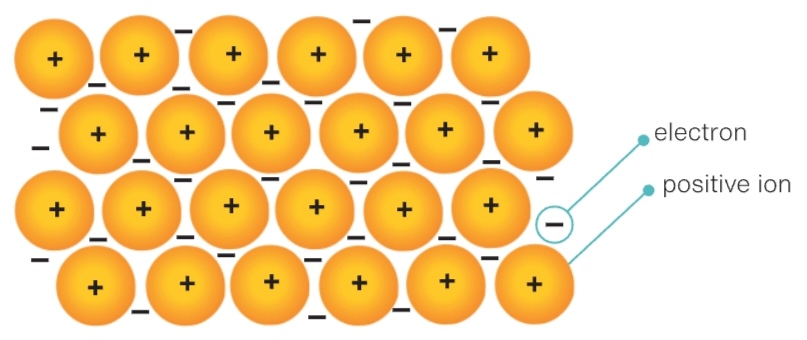
delocalised electrons
are electrons that are not confined to any particular atom or bond. They come from the outer shell of atoms and can move freely throughout the metal
modelling metallic bonding
Metal elements have a regular arrangement of atoms in a lattice. The outer shell electrons of the atoms are only weakly attracted to the nucleus and so are able to move away (delocalisation).
in metals, the atoms are regularly arranged in three-dimensional lattices, described as giant metallic structures
delocalised electrons do not leave the metal, so the overall charge on the metal is till zero. This is why sodium is written as Na in chemical equations, rather than as Na^+
physical properites of metals
are good electrical conductors - delocalised electrons move through the lattice in response to a potential difference
are good thermal conductors- delocalised electrons collide with metal ions, transferring energy through the metal
have high melting points and boiling points - metallic bonding is strong
are malleable (they can be shaped without shattering) and ductile (they can be pulled into wires) - delocalised electrons move with layers of metal ions as they slide over each other in response to external forces
Melting points in group 1
melting points decrease down the group:
the atomic radius increases
the outer electrons are further from the nucleus and more shielded from its attraction by more inner shells of electrons, so
the metallic bonding becomes weaker
how do metals form alloys?
metals form alloys with other metals and with other non-metals. These are mixtures, not compounds
chemical properities of metals
metals react with non-metals to form ionic compounds of positive metal ions and negative non-metal ions. For example, sodium and chlorine react to form sodium chloride: 2Na(s) +Cl2(g) = 2NaCl(s)
explain why boiling points decrease down group 1
the atomic radius increases down the group. This means that the outer electrons are further from the nucleus and more shielded from its attraction by more inner shells of electrons. The strength of the metallic bonding decreases so less energy is needed to overcome it
Ionic bonding
is the strong electrostatic force of attraction between oppositely charged ions
Ionic bonding and giant ionic structure
when metals and non-metals bond (ionic bonding), they tend to form giant ionic structures. The metal atom loses its outer shell electrons and forms a positive ion (cation). The non-metal atom gains the metal’s electrons and forms a negative ion (anion). The cations and anions are held together by electrostatic attraction in a lattice of many charged ions
Cations (+ charge)
generally form from metal atoms
number of charges is equal to the group number if formed from group 1,2 or 3 metals
many d-block form ions with different charges, e.g. Fe²^+ and Fe³^+
Anions (-charge)
generally form from non-metal atoms
number of charges is equal to 8 minus the group number if formed from group 5, 6 or 7 non-metals
polyatomic ions contain two or more elements, e.g. OH^-, NO3^-, HCO3^-, CO3²^-, SO4²-
Giant ionic lattices
in the solid state, the ions in an ionic compund are arranged in three-dimensional structures called giant ionic lattices. For example, in solid sodium chloride each ion is surrounded by six ions with opposite charge
physical properties of ionic compunds
good electrical conductors in the liquid state and in solution - ions can move in response to a potential difference, carrying charge
brittle - shatter under external forces
high melting and boiling points - a lot of energy is needed to overcome ionic bonding
read this information, then answer the question.
‘ the charge/size ratio of an ion is its charge divided by its ionic radius. For a given arrangement in a giant ionic lattice , the greater the charge/size ratios of the ions involved, the stronger the ionic bonding’
suggest why potassium iodine has a lower melting point than sodium iodide
(potassium is further down in the periodic tablt than sodium and thus its atoms and ions are larger than those of sodium.) The charge/size ratio of potassium ions must be less than the charge/size ratio of sodium ions, so the ionic bonding in potassium iodide is weaker than the ionic bonding in sodium iodide. Less energy is needed to overcome the ionic bonding in potassium iodide
what is a covalent bond?
the strong electrostatic force of attraction between two nuclei and a shared pair of electrons between them
Covalent bonding
When non-metals bond, they form molecules with covalent bonds. Two atoms share pairs of electrons, and are held between the two nuclei of the atoms by electrostatic forces of attraction. The length and strength of a covalent bond depends upon the size of the atomic radisu of the atoms involved, the number of covalent bonds between the atom and the strength of the electrostatic attraction between the nuclei and the shared pair of electrons
pairs of electrons
usually, the two atoms involved in a covalet bond each contribute one electron, forming a bond pair of electrons
dative covalent bonds (coordinate bonds) can form when:
one atom has a vacant orbital in its outer shell
the other atom has a vacant orbital in is outer shell
the other atom contributes both electrons
non-bonding electron pairs are called lone pairs
simple molecular substances
simple molecules contain small numbers of atoms joined together by covalent bonds
the covalent bonding in a simple molecule is strong, but the intermolecular forces between molcules are weak in comparison
Giant molecular substances
giant molecules consist of very large numbers of atoms joined together by covalent bonds. For example, silica has a giant molecular structure madeof a complex lattice of silicon and oxygen atoms. As this structure consists of very many atoms, silica is referred to by its empirical formula, SiO2.
properties of simple molecular substances
poor electrical conductors - molecules carry no net electrical charge, so they do not move in response to a potential difference
brittle in the solid state - shatter under external forces
low melting and boiling points - relatively little energy is needed to overcome intermolecular forces
many simple molecular substances are in the liquid or gas state at room temperature. Iodine and glucose are examples that are solid instead. (State changes in simple molecular substances do not involve the strong covalent bonds)
properties of giant molecular substances
like simple molecular substances, they are usually poor electrical conductors and are brittle. However, they have very high melting and boiling points, because a lot of energy is needed to break the many covalent bonds in the giant lattice
Diamond and graphite
These are allotropes of carbon (different forms of the same element in the same physical state). Diamond has the same lattice structure as silica and has properties typical of giant molecular substances. Graphite has a different structure
explain why graphite can conduct electricity
Graphite has delocalised electrons, which are free to move/carry electric charge through the lattice