Red meat inspection practical 1
 Call Kai
 Learn
 Practice Test
 Spaced Repetition
 Match
 Flashcards
 Knowt Play
1/16

There's no tags or description
Looks like no tags are added yet.
17 Terms
If a pregnant animal is towards the end of her term, is she fit for transport?
No —> must be killed on farm as “emergency slaughter”
What would need to be done if the pregnant animal was fit for slaughter and what examinations should you carry out ante-mortem?
If animal just heavily pregnant = no action needed
If heavily pregnant & heavy injury = emergency slaughter on welfare grounds
If assumed to be fit for human consumption —> next steps to check animal free of neuro & resp symptoms, GI tract problems, gait changes, any external abnormalities that could be leading to suspicion animal is ill
OV to check animal has adequate FCI doc —> dx status, residues & any poss movement restrictions
Examination must occur within 24hrs of slughter
Which documents should be included for an animal that is going to be “emergency slaughtered”?
After ante-mortem inspection:
OV must issue official health certificate —> should record outcome of ante-mortem inspection, date, time & reason for emergency slaughter & any tx administered
OV must be present at time of slaughter to certify date, time & slaughter & bleeding have been performed correctly
Other docs —> FCI & identity docs (ear tags & passport)
What are the signs seen after successful captive bolt & stunning?
Animal collapses immediately
HLs retracted under body
FLs extended
Tonic & clonic phases of kicking
No rhythmic breathing
No corneal reflex
Relaxed jaw
Poss tongue hanging out
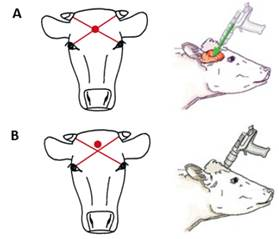
How would you place the captive bolt if you were stunning beef cattle?
Ideal is in middle of forehead —> @ crossing point of 2 imaginary lines drawn between eyes & centre of base of opposite horns
~70mm ± 10mm, above line drawn across forhead @ back of eyes
Muzzle of stunner should be held @ right angle to skull —> bolt directed through upper brain towards brainstem
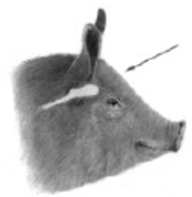
How would you need to place the captive bolt if you were stunning a pig?
20mm above eye-level on mid-line of forehead, aiming towards tail
Muzzle of stunner firmly placed against head
Which LNs should you routinely incise if you were inspecting a bovine head in an animal >8 months old?
Retropharyngeal LN
Which LNs would you need to incise on a bovine head if there were indications of poss risk to human health, animal health or welfare?
What dxs would you expect to detect?
Retropharyngeal, submax, parotid LNs
Dxs —> TB, actinomycosis, actinobacillosis, enzootic bovine leukosis, (EBL), caseous lymphadenitis & any other notifiable dxs affecting head (FMD, bluetongue, etc,)
If you were doing bovine head inspection for a bovine >8 months, which muscles should you incise and why?
Masseters, w/ 2 parallel incisions to the mandible & internal masseters.
For detection of cysticercosis (cysticercus bovis) —> larval stage of Taenia saginata
What are the LNs of interest for visual inspection of sheep?
Retropharyngeal LN —> if <12 months, otherwise should be palpated
Parotid LN
Which anatomical structures should be inspected on sheep heads?
Visual inspection of throat, mouth, tongue, parotid & retropharyngeal LNs
Is it mandatory to incise retropharyngeal LNs in sheep?
What are the differences in mandatory requirements for insepction of these LNs between younger & older sheep (>12 months old)?
Not mandatory to incise retropharyngeal LN
Should be visually inspected if <12 months old, otherwise should be palpated
Procedures only needed if head is to go for human consumption
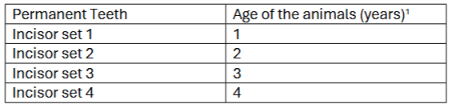
How are sheep aged by their teeth?
Sets of incisors present:
Does a sheep between the age of 1-1.5yo have SRM?
Sheep >12 months do have SRM —> skull incl brain, eyes, spinal cord
If a bovine was between 1-1.5yo, would it have SRM?
If >12 months old —> skull incl. brain, eyes & spinal cord (same as sheep), but excl. mandible & tongue.
What would be observed in a lamb carcass if it had signs of septicaemia?
What would your differentials be?
PM findings could be decr onset of rigor mortis esp when animal was fevered when alive & deficient exsanguination evident by diffuse congestion by SC BVs.
DDX could be hypostatic congestion if animal died prior to exsanguination.
What would be observed if a carass was emaciated?
What would be you ddxs?
PM findings:
diffuse skeletal m. atrophy → prominent bones such as vertebral column
poor onset of rigor mortis & serous atrophy of adipose tissue w/ fat deposits being inconspicuous & replaced by clear to yellow gelatinous material
DDX could be age related m. atrophy