Chapter 14 Photosynthesis, calvin benson cycle)
 Call Kai
 Learn
 Practice Test
 Spaced Repetition
 Match
 Flashcards
 Knowt Play
1/69

There's no tags or description
Looks like no tags are added yet.
70 Terms
Electron transport chain
A series of membrane-embedded electron carrier molecules that facilitate the movement of electrons from a higher to a lower energy level, as in oxidative phosphorylation and photosynthesis.

Chemiosmotic coupling
Mechanism that uses the energy stored in a transmembrane proton gradient to drive an energy-requiring process, such as the synthesis of ATP by ATP synthase or the transport of a molecule across a membrane.

Mitochondria role in ATP production
Oxidative phosphorylation in mitochondria produces most of the ATP used in eukaryotic cells
Mitochondria role in NAD+ regeneration
NAD+ is required for glycolysis to take place and NAD+ is regenerated when NADH donates electrons to the ETC
Mitochondrial matrix
Large internal compartment within a mitochondrion. Only lets small molecules pass through due to inner mitochondria membrane impermeability. Where the citric acid cycle takes place
Cristae
Folds within the inner mitochondrial matrix that increases its surface area
Inner mitochondrial membrane
Folded into numerous cristae, contains most of the proteins that carry out oxidative phosphorylation and transport molecules that move selected molecules in and out of matrix. Where the electron transport chain takes place
Outer mitochondrial membrane
Contains large channel forming proteins called porins and is located on the outside of the mitochondria
Intermembrane space
Space between the inner and outer mitochondrial membranes where enzymes use ATP to move nucleotides and proteins
Respiratory enzyme complexes
Set of 3 proteins in the inner mitochondrial membrane that facilitates the transfer of electrons from NADH to oxygen while pumping protons into the intermembrane space in the electron transport chain
NADH dehydrogenase
First complex in the ETC which accepts electrons from NADH to convert into a proton and 2 high energy electrons for mobile electron carriers to move onto he next complex
Ubiquinone (Q)
Hydrophobic, lipid soluble molecules embedded within the inter mitochondrial membrane that can accept or donate electrons from complexes in the electron transport chain
Cytochrome C
A small water-soluble hemoprotein that can carry one electron at a time
pH gradient in electron transport chain
Pumping of electrons into the matrix increases its pH than the intermembrane space
Voltage gradient in electron transport chain
Pumping protons makes the matrix more negative while the intermembrane space becomes more positive
ATP synthase
Abundant membrane associated enzyme complex that catalyzes the formation of ATP from ADP and inorganic phosphate during oxidative phosphorylation and photosynthesis through H+ movement from matrix to intermembrane space by moving through pump and pushing carrying motor
Rotary motor (c-ring)
Protons move through this structure causing a conformation change where each proton that goes through rotates it 1/12th round. Releases all protons when it has moved all the way around. Rotation causes conformation changes in parts of the ATP synthases complex allowing 3ATP to be synthesized from 3ADP and 3Pi
ADP/ATP translocase
A protein that acts as an antiporter, pumping one molecule of ATP out of the matrix while importing one molecule of ADP in to transport the ATP formed by ATP synthase.
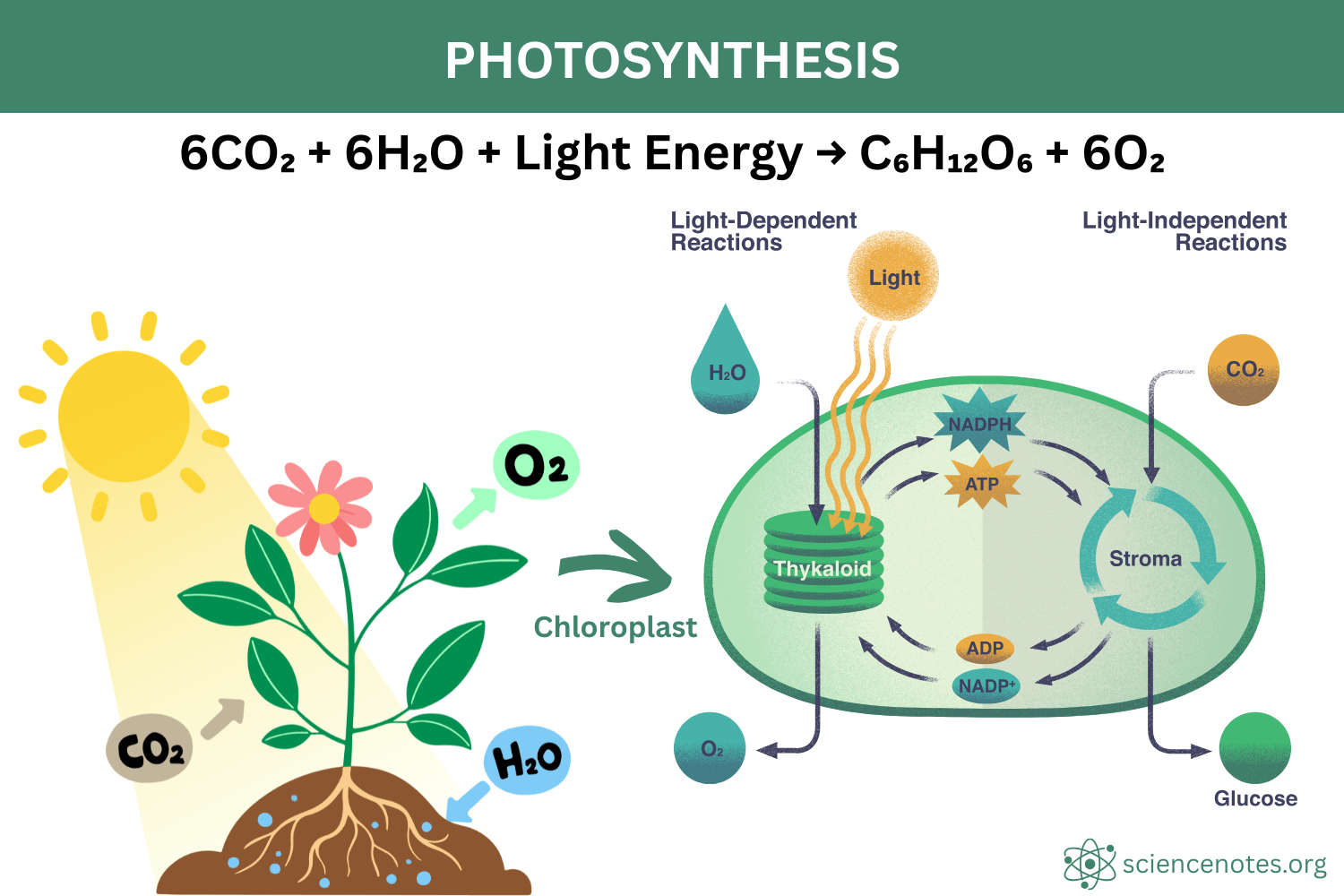
Photosynthesis
The process by which plants, algae, and some bacteria use the energy of sunlight to drive the synthesis of organic molecules from carbon dioxide and water
Stroma
In a chloroplast, the large interior space that contains the enzymes needed to incorporate CO2 into sugars during the carbon-fixation stage of photosynthesis, equivalent to the matrix of a mitochondrion. Location of the Calvin-Benson cycle and carbon fixation.
Thylakoid
In a chloroplast, the flattened, disc like sac whose membranes contain the proteins and pigments that convert light energy into chemical bond energy during photosynthesis C
Thylakoid lumen
The fluid-filled interior enclosed by the thylakoid membrane in a chloroplast where protons are pumped into during the light dependent photosynthesis reactions

Thylakoid membrane
The site of light reactions which encloses a space known as the thylakoid lumen. This is where all the light dependent reactions occur.

Chlorophyll
Light-absorbing green pigment that plays a central part in photosynthesis
Light reactions
In photosynthesis, the set off reactions that converts the energy of sunlight into chemical energy in the form of ATP and NADPH (stage 1 of photosynthesis)
Photosystem
Large multiprotein complex containing chlorophyll that captures light energy and converts it into chemical bond energy; consists of a set of antenna complexes and a reaction center
Antenna complex
In chloroplasts and photosynthetic bacteria, the part of the membrane bound photosystem that captures energy from sunlight; contains an array of proteins that bind hundreds of chlorophyll molecule and other photosensitive pigments
Reaction center
In photosynthetic membranes, a protein complex that contains a special pair of chlorophyll molecules; it performs the photochemical reactions that convert the energy of photons (light) into high-energy electrons for transport down the photosynthetic electron transport chain
Carbon fixation
Process by which green plants and other photosynthetic organisms incorporate carbon atoms from atmospheric carbon dioxide into sugars. The second stage of photosynthesis
Photosystem II
First photosystem center in light dependent reactions found in the thylakoid membrane. Uses light energy to oxidize water molecules to release O2, H+ ions into thylakoid lumen and electrons. Energizes electrons with a special chlorophyll pair at reaction center after jumping from other chlorophylls. and passes it to electron carrier plastoquinone.
Photosystem I
Second photosystem in light dependent reactions found in the thylakoid membrane. Oxidizes plastocyanin using light energy which brings electrons to reaction center to be reenergized which then leaves to primary electron acceptor. Electron then goes from acceptor to short ETC and NADP+ reduces it into NADPH which gets accumulated in the stroma
ATP synthase in thylakoid
Located in the thylakoid membrane, it uses the H+ from the transfer of electrons with plastoquinone in PS1 and uses the gradient to create ATP from ADP which accumulates in the stroma.
Carbon fixation formula
CO2 + NADPH + ADP → CH2O + NADP+ + ADP + Pi
RuBisCo
Super slow enzyme that catalyzes reaction 3 times a second only and is therefore extremely abundant in the cell to fix CO2 into a 6 carbon intermediate to be able to split into two 3 carbons to regenerate RuBP
Carbon fixation reaction with RuBisCo enzyme
Ribulose 1,5 bisphosphate (RuBP, C5) + CO2 → C6 intermediate
C6 is split → 2 molecules 3-phosphoglycerate (C3)
What occurs in the stroma?
ADP + Pi → ATP (Via ATP synthase) (at outer face of thylakoid membrane
CO2 fixed into carbohydrate (via rubisco)
NADPH → NADP+
Synthesis of glucose (and cytoplasm)
What occurs within the thykaloid membrane?
Photons absorbed and funneled
Electrons are excited and transported
What occurs at the thylakoid lumen
Oxygen generated and H+ accumulates
Water is split into oxygen, 2H+ and 2 electrons (at inner face of thylakoid membrane)
What occurs across the thylakoid membrane
H+ is pumped (from stroma into lumen)
H+ flows through ATP synthase (from lumen to stroma)
Inputs and outputs of light dependent interactions
Inputs: 2 H2O, 2NADP+ , (3ADP + Pi)
Outputs: 1 O2, 2NADPH, 3ATP
Inputs and outputs of light independent reaction
Inputs: 1 CO2, 3 ATP, 2 NADPH
Outputs: 2 molecules of 3-PGA (phosphoglycerate), (3 ADP + Pi), 2NADP+
Chloroplast
Double-membrane organelle in plant cells where photosynthesis occurs; converts light energy into chemical energy stored in carbohydrates.
Chloroplast envelope
Two membranes surrounding the chloroplast: a permeable outer membrane containing porins and an impermeable inner membrane containing specific transporters.
Thylakoid
Flattened membranous sac inside chloroplasts containing the machinery for light-dependent reactions.
Thylakoid membrane
Membrane containing photosystems, electron transport proteins, and ATP synthase; site of light absorption, electron transport, and proton pumping.
Thylakoid lumen
Innermost compartment enclosed by the thylakoid membrane where oxygen is produced and protons accumulate during light-dependent reactions.
Grana
Stacks of thylakoid sacs inside chloroplasts; their lumens are connected to form one continuous thylakoid compartment.

Chloroplast endosymbiotic theory
Theory that chloroplasts evolved from photosynthetic bacteria engulfed by an early eukaryotic cell.
Light-dependent reactions
Reactions occurring in the thylakoid membrane that use light energy to split water, generate oxygen, create a proton gradient, and produce ATP and NADPH.
Photosystem
Functional unit of pigment molecules and proteins in the thylakoid membrane that absorbs light energy and uses it to excite electrons
Antenna complex
Collection of pigment molecules, including chlorophylls and carotenoids, that absorb photons and transfer the energy to a photosystem's reaction center.
Reaction center
Region of a photosystem where absorbed light energy drives electron excitation and transfer.
Carotenoids
Accessory photosynthetic pigments that absorb light and transfer energy to reaction centers.
Photolysis of water
Light-driven splitting of water into electrons, protons (H+), and oxygen; supplies electrons to photosystem II and contributes protons to the thylakoid lumen.
NADP+
Oxidized electron carrier that accepts high-energy electrons and H+ at the end of the light-dependent reactions to become NADPH.
NADPH
Reduced electron carrier produced during light-dependent reactions that provides high-energy electrons for CO2 reduction during the Calvin-Benson cycle.
Light-dependent proton gradient
Difference in H+ concentration across the thylakoid membrane; created by water splitting and proton pumping from the stroma into the lumen, driving ATP synthesis.
Light-independent reactions
Reactions occurring in the chloroplast stroma that use ATP and NADPH from light-dependent reactions to fix CO2 into carbohydrates.

Calvin-Benson cycle (Calvin cycle)
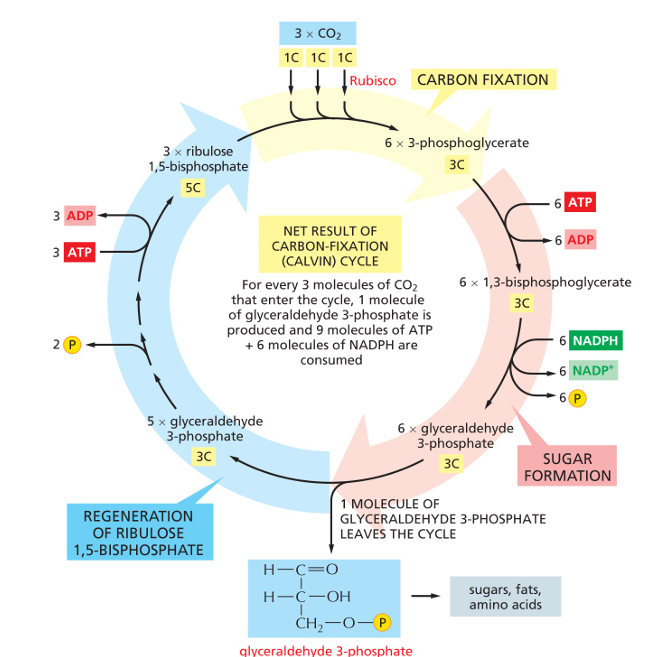
Cyclic series of reactions in the stroma that uses ATP and NADPH to convert CO2 into carbohydrate while regenerating RuBP.

Carbon fixation
Process of incorporating inorganic CO2 into an organic carbon molecule, beginning carbohydrate synthesis during the Calvin-Benson cycle.
RuBP (ribulose-1,5-bisphosphate)
Five-carbon molecule that combines with CO2 during the Calvin-Benson cycle to form an unstable six-carbon intermediate.
3-PGA (3-phosphoglycerate)
Three-carbon molecule produced when the unstable six-carbon product of carbon fixation splits; converted into carbohydrate using ATP and NADPH.
Glyceraldehyde-3-phosphate (G3P)
Three-carbon sugar produced during the Calvin-Benson cycle; one of the 6 formed leaves the cycle and is used to synthesize larger carbohydrates such as fructose and sucrose.
RuBP regeneration
Process in the Calvin-Benson cycle that uses ATP to regenerate RuBP so the cycle can continue fixing CO2.
Photosynthesis vs. cellular respiration
Cellular respiration breaks down glucose using oxygen to release energy, producing CO2 and H2O; photosynthesis uses light energy to convert CO2 and H2O into carbohydrates and oxygen.
Mitochondria vs. Chloroplast
Similarities: Contains inner and outer membranes, both has DNA and ribosomes
Differences: Inside of mitochondria is matrix, inside of chloroplast is stroma. Chloroplasts have thylakoids which have membrane. Chloroplasts are much larger than mitochondria.
Calvin-Benson cycle step 1
Rubisco attaches 3 inorganic CO2 molecule to ribulose 1,5- biphosphate (RuBP) which creates unstable 6 carbon intermediate which is split into 2 molecules of 3-phosphoglycerate (3-PGA). This makes 6 molecules of 3-PGA.
Calvin-Benson cycle step 2
ATP is used to convert the 6 molecules of 3-phosphoglycerate (3-PGA) into 1,3 biphosphoglycerate. This turns 6 ATP into 6 ADP.

Calvin-Benson cycle step 3
6 NADPH donates electrons for reducing power to 6 1,3 biphosphoglycerate which forms 6 glyceraldehyde 3- phosphate (G3P) One of these G3P leaves to form other macromolecules. The NADPH turns into NADP+

Calvin-Benson cycle step 4
The 5 glycerladehyde 3-phosphate (G3P) are phosphorylated to form 3 molecules of ribulose 1,5 bisphosphate (RuBP) which uses 3 ATP that turns into ADP.
