Somatic Innervation (Spinal Cord and Spinal Nerves)
 Call Kai
 Learn
Learn Practice Test
 Spaced Repetition
 Match
Match Flashcards
 Knowt Play
1/9

There's no tags or description
Looks like no tags are added yet.
Name | Mastery | Learn | Test | Matching | Spaced | Call with Kai | Chat |
|---|
No analytics yet
Send a link to your students to track their progress
10 Terms
What is Somatic Innervation?
Somatic Innervation is the innervation of voluntary structures such as muscles
Structure of a Nerve
A nerve is a collection of neurons, forming an 'electric cable' structure. Soem nerves are exclusively sensory or motor (bringing information in or out) but there are mixed nerves which include both divisions.

Spinal Nerves
Spinal nerves are part of the peripheral nervous system (outside of brain/spinal cord) and are mixed, so they contain both motor and sensory fibres. There are 31 pairs of spinal nerves
Bony Framework (Housing for Spinal Cord/Nerves)
The vertebrae surrounding the spinal cord have foramina (gaps between the bones) that allow spinal nerves to exit the spinal cord and innervate the muscles. The spinal cord travels through holes (foramina) in the vertebrae vertically, and spinal nerves exit through foramina from the sides (left right).

Vertebral Column (Cervical, Thoracic, Lumbar, Saccryl, Coccyx)
There are 7 cervical vertebrae (neck region), 12 thoracic vertebrae (mid-body), 5 lumbar vertebrae (lower back), 5 sacral vertebrae, and 1 coccygeal.

Spinal Cord
The spinal cord travels down through the vertebral foramina and ends at the lumbar ½ vertebrae (spinal nerves continue to emerge from lower vertebrae)
Conus Medullaris = cone-shaped lower end of the spinal cord (tapering off of spinal cord to an end)
Cauda equina = ‘Horse Tail’ (spinl nerves that continue down to come out of corresponding foramen)
Filum Terminale = one single strand from the spinal cord that anchors the spinal cord in place (lowest part of the spinal cord, anchoring it in place (everything is floating in fluid, so needs to be secured))

Spinal Nerve Nomenclature
Cervical nerves exit above the first C1 vertebra, and accordingly, other cervical nerves exit above the corresponding vertebrae
Thoracic nerves therefore exit below their corresponding vertebrae (thoracic nerves begin underneath T1 → nerve above T1 is Cervical 8 spinal nerve)
C8 is the transition in nomenclature (C1-C7 nerves are above, C8 is below, then Thoracic nerves are also below)

Spinal Nerve Components
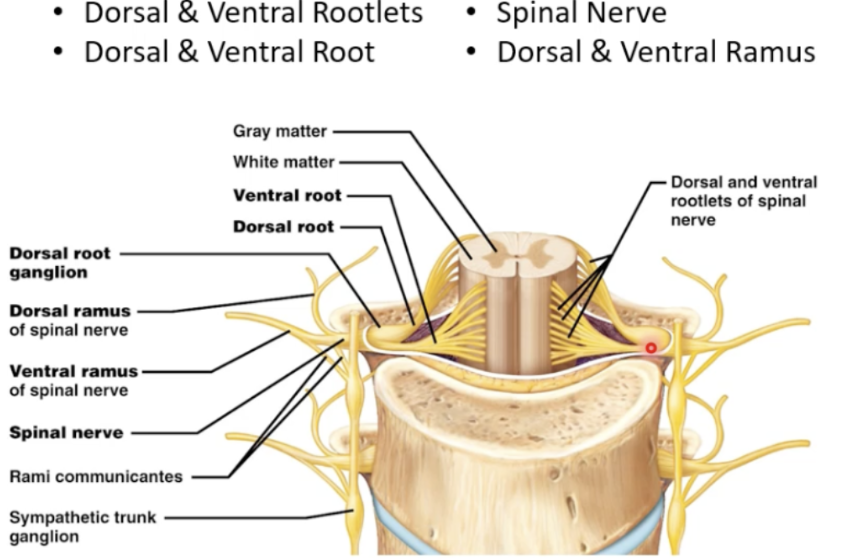
Dorsal (Sensory) Roots become Rootlets, Ventral (Motor) Roots become Rootlets, and Dorsal/Ventral rootlets fuse to become the spinal nerve (mixed nerve).
The Spinal nerves split into Rami (branches of spinal nerve that are still mixed) and the Dorsal Rami head backwards/posteriorly to supply muscles and joints at the back while Ventral Rami go forwards/anteriorly to supply muscles and joints at the front.
*Do not confuse Dorsal Roots/Rootlets with Dorsal Rami (With rami, dorsal does not mean sensory, it means posterior) and vise versa for ventral rami/roots
Loss of Sensory or Motor Functions
Paresthesia is damage to sensory nerves (tingling/burning/pins and needles sensations from crushing the nerves) and Numbness is a complete split of the nerve, not just damage.
Paresthesia —> Numbness
Paresis is damage to motor nerves resulting in incomplete/partial paralysis through damage and Paralysis is complete absence of function in motor nerves.
Paresis —> Paralysis

Dermatomes
The map of how spinal nerves wrap around the body and provide sensory innervation to their corresponding region of the body.
Area of skin innervated by the sensory fibres of a single spinal nerve
Motor map is not as clean/neat
Ex. Shingles —> region of skin impacted follows the pattern of the spinal nerve affected