Exam 1 Kines 202 Kramer
 Call Kai
 Learn
Learn Practice Test
 Spaced Repetition
 Match
Match Flashcards
 Knowt Play
 Podcast
1/153

There's no tags or description
Looks like no tags are added yet.
Name | Mastery | Learn | Test | Matching | Spaced | Call with Kai | Chat |
|---|
No analytics yet
Send a link to your students to track their progress
154 Terms
anatomy
the study of structure
physiology
the study of function
embryology
the study of humans from conception to birth
histology
the study of tissue under a microscope
surface anatomy
anything that you can identify on a human by look to touch
-->what we see on the outside
gross anatomy
the study of anatomy through human dissection
systemic anatomy
looks at all 11 systems of the body and how they work together
systems of the body
how many? 11
-respiratory
-digestive
-urinary
-reproductive
-endocrine
-lymphatic/immune
-integumentary
-skeletal
-muscular
-cardiovascular
-nervous
dorsal body cavities
cranial: found in the head; contains the brain
spinal/vertebral: contains spinal cord made up of vertebrae
ventral body cavities
thoracic: pleural(contains lungs); pericardial(contains heart)
abdominopelvic: abdominal(contains stomach, small intestine, large intestine, kidney, liver, spleen, gallbladder, pancreas); pelvic(contains uterus, Fallopian tubes, bladder, ovaries)
abdominopelvic regions
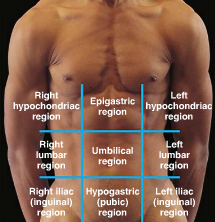
abdominopelvic quadrants
right upper(liver, gallbladder), left upper(spleen, transverse color, some one descending colon), right lower(scum, appendix, female reproductive organs), left lower(sigmoid colon, female reproductive organs)
anatomical position
person is standing with feet forward and shoulder width apart, palms facing forward, and looking straight ahead
ventral
bottom of the tummy(4 legged animals)
paired with: dorsal
dorsal
top of back(4 legged animals)
paired with: ventral
caudal
tail(4 legged animals)
paired with: cranial
cranial
head(4 legged animal)
paired with: caudal
anterior
front
equal to: ventral
paired with: posterior
posterior
back
equal to: dorsal
paired with: anterior
longitudinal axis
vertically oriented
perpendicular to transverse plane
plane: transverse plane
frontal plane
splits body into front and back halves
axis: anteroposterior axis
anteroposterior axis
horizontally oriented
perpendicular to the frontal plane
plane: frontal plane
sagittal plane motions
axis occurred in: medio-lateral axis
motions: flexion/extension, dorsiflexion(toes up), plantar flexion(gas peddle), running
frontal plane motions
axis occurred in: anteroposterior axis
motions: adduction/abduction, inversion/eversion, elevation/depression, radial deviation, lateral flexion, ulnar deviation, jumping jacks
transverse plane motion
axis occurred in: longitudinal axis
motions: internal/external rotation, supination/pronation, horizontal adduction/abduction, pirouette
proximal
closer to the trunk
paired with: distal
distal
further from the trunk
paired with: proximal
medial
closer to the midline
paired with: lateral
lateral
further from the midline
superior
towards the head
paired with: inferior
inferior
towards the feet
paired with: superior
superficial
outside of the body
paired with: deep
deep
inside of the body
paired with: superficial
plantar/dorsal
bottom to top of foot
palmer/dorsal
palm to back of hand
ipsilateral
same side of the body
contralateral
opposite sides of the body
varus
distal segment of foot deviates towards the midline relative to the proximal segment
-bowed knees
valgus
distal segment of foot deviates away from the midline relative to the proximal segment
-knocked knees
retroverted hips
feet are turned to the outside
-walk like a duck
introverted hips
feet turn to the inside
-pigeon toed
sagittal plane
splits body into a right and a left half
axis: medio-lateral axis
movements: flexion/extension of knee(running)
medio-lateral axis
horizontally oriented
perpendicular to sagittal plane
plane: sagittal plane
transverse plane
splits body into a top and bottom half
axis: longitudinal axis
movements: head/neck rotation
total bones in adult body
206 bones
axial skeleton
80 bones
skull, trunk, pelvis
appendicular skeleton
126 bones
bone composition
30% mineral
30% collagen
10% water
30% void space
contains 98% of body's calcium and 73% of the body's phosphorus
composed of: calcium carbonate, calcium phosphate, collagen, water
bone weight
70% comes from minerals
30% comes from water
osteoarthritis
Inflammation of the bone and joint
get from overuse
Clinical degeneration of bone at the joint that causes pain and dysfunction
Treatment: usually leads to total joint replacement
Rx: NSAID's glucosamine, chondroitin
Common with aging
cortical bone
Low porosity
up to 30% non-mineralized tissue
Dense
80% of weight of skeleton
osteon
Cylindrical substructure of compact bone
Composed of concentric lamellae, houses Haversian canals(vessels, nerve passages)
cancellous bone
Trabecular or spongy bone
High porosity
up to 70% non-mineralized tissue
Wolff's Law
Bones reshape themselves based upon stress
Stress fractures are a failure of Wolff's Law
skeletal functions
-Protection of heart, lungs, brain, etc.
-Support to maintain posture
-Movement by serving as points of attachment for muscles and acting as levers
-Mineral storage such as calcium and phosphorus
-Hemopoiesis
hemopoiesis
Process of blood cell formation in the red bone marrow
long bone
Primarily found in the appendicular skeleton
Composed of long cylindrical shaft with relatively wide, protruding ends
Shaft contains the medullary canal
Where hemopoiesis takes place
short bone
Small, cubical shaped, solid bones that usually have proportionally large articular surface in order to articulate with more than one bone
Not broken very often
In wrists, hands, feet, ankles
flat bone
Usually a curved surface and vary from thick where tendons attack to very thin
Ex. parietal bone of skill, ribs, ilium, sternum, clavicle, scapula
irregular bone
Includes bones through the entire spine, ischium pubis, and maxilla
Found in different spots of the body
Ex. vertebrae
sesamoid bone
Lies entirely in a tendon
In knees and 2 in each thumb and 2 in each first toe
Biggest one is the patella
projections
Something that sticks off of a bone
Ex. condyle, epicondyle, crest, head, neck, facet*, spine, process, line, tubercle, trochanter, suture
depressions
Ex. fossa, fovea, sulcus(groove), sinus, foramen, meatus, facet*
diaphysis
long, cylindrical shaft of the bone
epiphysis
Most proximal and most distal aspects of a long bone
Regions of articulation(ends of the bone)
metaphysis
Brief section between the epiphysis and diaphysis
Smallest section
Region containing epiphyseal line, growth plate
medullary canal
Hollow, cylindrical space of diaphysis
Contains fatty yellow bone marrow
endosteum
Thin membrane lining the medullary canal
Inside of bone
periosteum
Outer sheath surrounding bone except where articular cartilage resides
articular(hyaline) cartilage
Covering the epiphysis to provide cushioning effect and reduce friction
Surrounds the ends of all of our long bones
Provides push-in between bones
osteoblasts
responsible for bone formation/building
osteoclasts
responsible for bone removal or resorption
osteocytes
Mature bone cells
Most abundant cell type in bone tissue
Maintain metabolism of bone
bone modeling
New bone growth
Initial process of laying down new bone
Osteoblasts presents
bone remodeling
Resorption of old bone and laying down of new bone
Happens throughout our entire adult life
Osteoblasts and osteoclasts present
Occurs at different rates in different people and depending on age
fracture
A break in the continuity of bone
Diagnosed with a radiograph
Treatment: immobilization for 6-8 weeks, ORIF
ORIF
open reduction with internal fixation
FOOSH
Fall on outstretched hand
Causes a clavicle break
open fracture
Bone comes through the skin
Aka. compound fracture
closed fracture
Does not come through the skin
The majority fractures seen in sports medicine setting
avulsion fracture
A fragment of bone tears away from the main bone mass
Injury to a ligament or tendon that pulls a piece of the bone off
Diagnosed by a radiograph
Treatment: 6-8 weeks off, ORIF
stress fracture
Microfracture in bone due to overuse
Wolff's Law
Diagnosed through radiograph or scintigraphy
Treatment: immobilization 6-8 weeks
periostitis
precursor to osteoarthritis
osteoporosis
Decrease in bone mineral density
Typically seen in women going through menopause
Diagnosed through radiograph or DEXA scan
Treatment: exercise to increase BMD
Rx: Boniva, Fosamax, Multivitamin(C and D)
Common to slouch
cartilage
Dense network of collagen and/or elastin fibers
Highly resilient and flexible
Can withstand considerable stress or loading without being damaged
Avascular
80% water
chondrocytes
The cells of mature cartilage
Scattered in the extracellular matrix
hyaline(articular) cartilage
Found at the end of all of our long bones
Shiny bluish-white appearance
Most numerous
Provides flexibility and support and reduces friction and absorbs shock in joints
Found in: articular surfaces of synovial joints, growth plates, nose, trachea, larynx
fibrocartilage
Found in knee(meniscus)
Between the articular cartilage on your femur and tibia
Less firm than hyaline cartilage
Much thicker than articular cartilage
Responds better to a tensile/stretching force
Found in: menisci, intervertebral disks, pubic symphysis
elastic cartilage
Lines respiratory system
Contains thin elastic fibers
Maintains shape of certain structures: external ear, epiglottis, eustachian tubes(connects middle ear to the throat)
adipose tissue
Loose connective tissue
Contains densely packed fat cells called adipocytes
Found under skin, around eyes, around kidneys, within bone(yellow marrow), abdomen, and breast
Born with the same number of adipose cells that we will die with
Function: energy stores, insulation, and protection
blood
Liquid extracellular matrix called plasma(55% of blood)
Manufactured in the bone marrow
white blood cell
Leukocyte
Immunity or allergy response
Granulocytes: neutrophil(fight infection), eosinophil(allergic reaction), basophil(allergic reaction)
Agranulocytes: monocyte(fight infection), lymphocyte(fight infection)
red blood cell
Erythrocyte
Carry oxygen
Most numerous
thrombocyte
Platelet
Smallest blood cell
Look like stars
Blood coagulation
joints
Junction or articulation between 2 or more bones
Function: allow functional movement of bones, force dispersion between bones
fibrous joints
Usually synarthroidal
Immovable
No joint capsule
Bones are joined by thick fibrous connective tissue
Subclasses: sutures, gomphosis, syndesmosis
sutures
joint found in skull
gomphosis
tooth sockets
syndesmosis
Connection of 2 long bones of the body and those bones are held together by an interosseous membrane(fibrous tissue)
Long bones held together by interosseous membrane
cartilaginous joints
No joint capsule or space
Bones joined by cartilage
Either hyaline or fibrocartilage
Subclasses: synchondrosis, symphysis