Chapter 9: Membranes and Membrane Transport
 Call Kai
 Learn
 Practice Test
 Spaced Repetition
 Match
 Flashcards
 Knowt Play
1/77

There's no tags or description
Looks like no tags are added yet.
78 Terms
Passive diffusion is slow because…
ions and polar molecules do not readily cross the nonpolar part of the lipid bilayer
Passive diffusion must be…
facilitated by protein transporters
Lateral asymmetry
protein/lipid clusters in plane of membrane
Tranverse asymmetry
Difference in inner versus outer leaflet of membrane
Protein asymmetry is essential for function because:
Transporters must orient correct way
Receptor binding sites must orient to outside
Glycoproteins AND glycolipids (cell-cell recognition, immune response)
must face outside
Lipids are distributed asymmetrically because it is…
Important for correct protein-lipid interactions in asymmetrically-oriented protein
Movement of phosphatidylserine (PS) to the outer leaflet signals
Apopotosis
Aging erythrocytes move PS to outer leaflet leading to them being
engulfed by macrophages
Lateral lipid motion is
fast (exchange places at a rate of 107/s)
Transverse or flip-flop motion is
Slower than lateral lipid motion (1/s or 1/day)
Flippase
Outer to inner leaflet (PS, in particular)
Floppase
Inner to outer leaflet
Flippase and Floppase
both are ATP dependent and are important to generate/maintain membrane asymmetry
Scramblase
Bidirectional, Ca2+-dependent
Destroy membrane asymmetry
Membrane protein lateral motion
Slower (few micron/s to 10 nm/s)
Association with other proteins or with cytoskeleton slows protein motion
Proteins do not flip-flop
Solid ordered or gel state, So (Low temperatures)
Alkyl chains fully extended (all anti)
Minimum surface area/lipid (head groups tightly packed)
Maximum bilayer thickness
Liquid crystalline state, Ld (High temperatures)
Alkyl chains more disordered (gauche conformers, causes kinks in alkyl chains)
Surface area/lipid increases
Bilayer thickness decreases (kinks = chains less extended)
So to Ld transition
True phase transition with a well-defined enthalpy
Sharp, i.e. all-or-none
Always endothermic
Characteristic melting temp. Tm
Tm increases
with chain length (more van der Waals)
Tm decreases
with unsaturation (poorer van der Waals)
Pre-transitions in membranes are observed due to
tilting of hydrocarbon chains
E. coli adjust lipid composition in response
to temperature change
How does E. coli respond to temperature change
sat./unsat. ratio from 1.6 to 1.0 causes temperature drops from 42 oC to 25 oC
Prevents membrane becoming too rigid
Natural membranes with a mix of lipids have
broader transitions
Cholesterol broadens transition/keeps Tm the same, which…
Allows eukaryotic membranes to function over broader temp range without changing lipid composition
Lo (liquid-ordered) phase observed in presence of cholesterol
-rigid cholesterol fused ring system sterically enforces order on nearby alkyl chains
-but poorer van der Waals so, still get good lateral motion
Regions of Lo phase occur in natural membranes are lipid rafts
Aggregates of cholesterol/ceramides and gangliosides/GPI-anchored proteins
In natural membranes lipids/proteins undergo
hop diffusion
Hop diffusion for lipids
15 ms
Hop diffusion for proteins
50 ms
Cytoskeleton (actin/spectrin filaments)
create compartments on inner membrane
(Fast diffusion on surface within compartment)
Membranes can be highly curved, for example
Cristae of inner mitochondrial membrane
Lipid composition can cause curvature through
-difference in number of lipids outer vs inner leaflet
-lipid shape (acyl chain/head group variation)
Proteins can cause curvature through
-conically shaped integral membrane proteins
-interaction with cytoskeleton proteins
-scaffolding proteins
BAR domains – dimeric banana-shaped proteins
Scaffolding proteins
Induce curvature when bound to plasma membrane
N-BAR
Insert N-terminal amphipathic helix causing curvature
Passive diffusion is slow because
ions and polar molecules do not readily cross the nonpolar part of the lipid bilayer
Properties of Facilitated Diffusion
1. Transport only in thermodynamically favorable direction
2. Specificity for a particular ion or molecule
K+ channels
Regulate cell volume, nerve impulses, hormone secretion
Typically very selective for K+ over Na+
KcsA, K+ channel from Streptococcus lividans
Has 4 identical subunits each has two TM helices (inner and outer) + 3rd short helix (C- term – negative end helix dipole - ends at selectivity filter)
Water-filled pore on extracellular side ends at selectivity filter
KcsA selectivity filter
Pentapeptide (TVGYG) on interhelical loop from each subunit
Thr side chain –OH and backbone carbonyls first 4 residues
KcsA Binding Site
4 K+ binding sites – each provide 8 O-atoms to coordinate to K+
Replaces hydration sphere of K+ in H2O
distance to O-atoms fits ionic radius K+
K+ ionic radius
1.33 Å
Na+ ionic radius
0.95 Å
High conduction despite high selectivity in KcsA is due to
1. Repulsion closely spaced K+
2. At high K+ conformational change = more symmetrical pore
KcsA is channel gated by pH
Closed at neutral pH opens at low pH
Long inner helix bends at a conserved glycine opens pore on intracellular side
Some channels have pore within each subunit
Cl- (dimer), NH3 (trimer), glycerol, (tetramer)
NH3 channel is hydrophobic
lowers pKa of NH4+ to allow transport as NH3
Glycerol channel is
amphipathic interact methylenes of glycerol one side, -OH’s on other
primary active transport
generates ion or H+ gradients using energy derived from ATP hydrolysis or light
secondary active transport
using ion or H+ gradient to drive transport of nutrients/waste
electrogenic active transport
leads to a net transport of charge across a membrane
P-type ATPase common features
-E1 form open to one side
-E2-P form open to other
-E2-P has phosphorylation at a specific Asp by ATP that drives a
conformational change (converts chemical energy of ATP to
mechanical energy of conformational change)
Na+,K+-ATPase
keeps Na+ low and K+ high in cytoplasm (gradients used in excitation
of neurons/muscle cells, control of cell volume, transport sugars and a.a.’s)
Ca2+-ATPase
keeps [Ca2+] at 0.1 microM in cytoplasm, 1.5 mM in sarcoplasmic reticulum
(SR) of muscle cells. Gradient used in muscle contraction
Gastric H+,K+-ATPase
keeps pH gradient across mucosal membrane of 6.6 pH units
Ca2+-ATPase cytoplasmic domains
N, binds ATP
P, site of Asp 351 that phosphorylated by ATP
A, actuator domain, transmits conformational changes in cytoplasmic domains to M domain
Ca2+-ATPase Transmembrane Domain
M domain – 10 TM α-helices, two Ca2+ sites provide 7 O-atoms to each (Asp, Asn, Glu, Thr, H2O, main chain C=O)
Ca2+-ATPase Catalytic cycle:
1. Ca2+ binds from cytoplasmic side
2. ATP binds, N and A domains close around P domain – M domain unaffected
3. ATP transfers phosphate to Asp351
4. ADP dissociates: E2-P conformer now stabilized, Ca2+ binding sites disrupted transporter open to SR – 2 Ca2+ enter SR
5. Asp-CO-O-PO3 hydrolyzed, Pi released
6. E2 returns to E1 conformer
Bacteriorhodopsin, bR, from Halobacterium halobium
7 TM helices
Color from retinal cofactor attached as a Schiff’s base to Lys216 middle of membrane
when shine light on retinal: trans to cis isomerization
bR conformational change caused in protein favors
Transfer H+ from protonated Shiff base to Asp85 (to extracellular medium)
cis-retinal reverts to trans oriented to
pull H+ off Asp 96 (Asp96 then reprotonated from cytoplasm)
symports
-H+/Na+ transported in same direction as transported nutrient
-typically for sugar and a.a transport
antiports
-H+/Na+ move in opposite direction of species transported
-Na+-Ca2+ antiporter supplements Ca2+-ATPase
Cytosine

Uracil

Thymine

Adenine

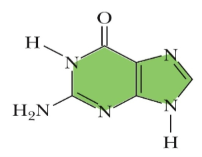
Guanine
Uracil keto-enol tautomerization

For uracil and thymine the ____ is favored at neutral pH
keto form
pKa’s of N-1 and N-3 > ___ for uracil
8
pKa(N-3) = ___ for uracil
9.5
Cytosine enol form (-NH2 at C4, not an imine C=NH) predominates
neutral pH (pKa(N-3) = 4.5, deprotonated at neutral pH)
keto-enol tautomerization for guanine

For guanine ___ tautomer predominates
keto
pKa(N-1) = 9.4
pKa(N-3) < 5
pyrimidine

purine
