L2/3 Entrepreneurs and theories
 Call Kai
 Learn
 Practice Test
 Spaced Repetition
 Match
 Flashcards
 Knowt Play
1/25

There's no tags or description
Looks like no tags are added yet.
26 Terms
Stam et al. 2012 entrepreneur lifestyle and ambitous
2 types
lifestyle entrepreneurs = self-employed, generate jobs for themselves
ambitious entrepreneurs = aspire to create large-scale business that impact local region and may grow further
other entrepreneur definitions
Cambridge dictionary: someone who makes money by starting their own business
Bygrave and Zacharakis 2011: anyone who starts a business by perceiving an opportunity and creating an organisation to pursue it
Schumpeter creative destruction theory
entrepreneurs are ‘special/exceptional’ individuals who create new industries while destroying existing markets (contrasts the idea that anyone can be an entrepreneur
They’re motivated by a drive to conquer and a need to prove superiority
e.g. Steve Jobs Apple redefined phones and computing and rendered Blackberry and Nokia obsolete
Kirzner Market Equilibriator and Alertness
view entrepreneurs as OPPORTUNITY SPOTTERS
who are alert to market disequilibriums and can identify gaps where supply and demand mismatch
instead of DISRUPTING markets (Schumpeter) they RESTORE market balance
e.g.Richard Harpin HomeServe identified unmet needs in emergency repairs and insurance
Knight: Bearing Knight uncertainty
views entrepreneurs as CALCULATED RISK TAKERS who gain reward for bearing uncertainty
uncertainty can’t be calculated/insured against so entrepreneurs judge based on experience, intuition, experimentation etc. to risk bearing uncertainty
e.g. Jeff Bezos left Wall Street to sell books online (no stats on e-commerce, no established digital payment)but succeeded with Amazon
Saravathy Causation and effectuation
2 opposing entrepreneurial types:
causation: when entrepreneur sets a goal and actively works towards achieving this
effectuation: not driven by goal but allows outcomes to emerge naturally and adpats
Casson economist judgement theory
entrepreneurs access and organise resources and their key trait is to have judgment in decision making = be able to make good decisions with incomplete data
Drucker economist transient not stable theory
entrepreneurship is a transient NOT stable trait
it involved a team of people with different skills contributing to the SME rather than one person and one trait or personality
Extra: Cantillon Risk and Arbitrage
entrepreneurs risks purchasing goods at known fixed price today to resell at uncertain (hopefully higher) price in future
Jean-Baptise Say Resource Allocation
views entrepreneurs as catalysts shifting economic resources into areas of higher productivity and yield
= use stagnant resources in a more productive and profitable way
Baumol productive, unproductive and destructive
argued institutional and legal frameworks determine the type of entrepreneurial drive
productive wealth creation
unproductive rent seeking
destructive criminal jobs
whatever gives higher payoff - if laws reward innovation will do this over rent seeking e.g. Intellectual property/patents encourages innovation VS excessive occupational licensing which prevent competition and encourages rent seeking or destructive entrepreneurship
McCrae and Costa The big 5
entrepreneurs usually exhibit:
high openness
high conscientiousness (organisation)
high extraversion
low neuroticism (are emotionally stable)
low agreeableness (as need to make decisions or challenge status quo even if unpopular, make negotiations)
risk taking propensity and tolerance for ambiguity - Cromie
have higher risk and ambiguity tolerance
willing to take necessary risk and comfortable making decisions under vague circumstances (links to Knight uncertainty and Casson)
Innovation and creativity traits Mueller and Thomas
Entrepreneurs have psychological traits related to creative problem solving, cognitive flexibility and the drive to introduce novel (new and creative) methods and products
Extraversion and social optimism Gunaratne and Koggelage
sociability, gregariousness and optimism seen as central psychological drivers in entrepreneurial behaviour
McClelland Need for achievement
individuals driven by a STRONG DESIRE for personal accomplishment are drawn to entrepreneurial roles (realistically people don’t become entrepreneurs for the money but want to achieve or contribute something and have a passion/desire for it)
Rotter Locus of control and self efficacy
entrepreneurs rely on an INTERNAL locus of control = belief that they directly control their destiny and future with their actions and decisions
have self-efficacy = confidence in their ability
extra Proactive personality scale Bateman and Grant
an individuals tendency to take proactive initiative = more likely to identify environmental opportunities and persist in entrepreneurship till meaningful environmental change occurs
extra Grit and Perseverance Duckworth
long term resilience, perseverance and sustained passion for long term goals = key personality driver for success as an entrepreneur
(even above intelligence and talent)
Culture influences
culture - values, social norms, access to capital/economic freedom (impacted by government)
Family background influences
generational entrepreneurship where parents had business so children are encouraged to as well → stats show students whose parents owned a small business demonstrated higher preference for self employment
parents play a large role in shaping the credibility of an entrepreneurial career (may be encouraged or discouraged accordingly)
role in family e.g. first born, caregiver may influence ability to be an entrepreneur (acquire necessary skills)
parents pass on capital - could be advice and resources, could be financial, could pass on family business
Minorities influences + Santos 2024
minorities - necessity entrepreneurs (mainstream employment more difficult so turn to self employment)
Santos 2024 entrepreneurs create products and services for racially similar customers (leverage their identity as an asset e.g. selling black hair care or African food)
Women - work-life balance can be hard as entrepreneurs can control their schedule better
education influences + Gieure Sastre 2022 POV
positive:
can network, build skills build knowledgem, find interest
negative:
can limit creativity and encourage structured path to employment, doesn’t reward you for thinking different, ability measured via exams
Gieure Sastre 2022 - said entrepreneurial skills are commonly acquired from the university environment as well as social, personal and other professional skills (ANALYSE THIS - costs money, why go to uni to gain these skills when i could start earning money?)
Attitudes and theory of planned behavior Ajzen 1991
a learned pre-disposition to respond in a consistently favorable or unfavorable wat to something
unlike personalities attitudes can be change and influenced e.g. by mentors, our environemnt etc.
Theory:
Attitudes, subjective norms and perceived behavioral control (which are all influenced by your immediate environment) impacts you r intention which then impacts your behavior
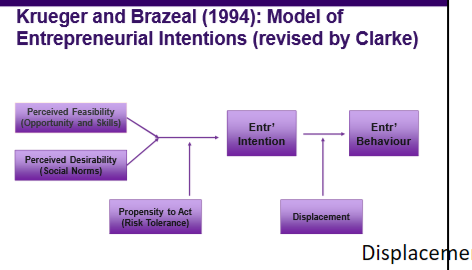
Krueger and Brazeal model of entrepreneurial intentions
a persons perceived feasibility (skills, self-efficacy) and perceived desirability (attitudes towards entrepreneurship) contribute to the entrepreneur INTENTION
Propensity to ACT (take risks, face uncertainty), followed by DISPLACEMENT (an event that triggers something by addressing whatever was holding you back e.g. finances) turns the intention into ACTION resulting in entrepreneurial behavior
Intrapreneurship
developing products, services and innovations WITHIN an existing organization
less risky as risks partially absorbed by employer and resources are already provided