Ashlyns quizlet CHAPTER 5 EXAM REVIEW (forearm, elbow, humerus)
 Call Kai
 Learn
Learn Practice Test
 Spaced Repetition
 Match
Match Flashcards
 Knowt Play
1/96

There's no tags or description
Looks like no tags are added yet.
Name | Mastery | Learn | Test | Matching | Spaced | Call with Kai | Chat |
|---|
No analytics yet
Send a link to your students to track their progress
97 Terms
What are the 2 long bones that make up the forearm?
Radius and Ulna
The buckle fracture is common in what type of people?
Children
What is the Monteggia fracture?
Proximal ulna fracture with radial head dislocation
What is the Buckle fracture?
An incomplete bone fracture in childhood
What is the Greenstick fracture?
When a bone breaks on the outside but not all the way through
What is the Torus fracture also referred to as?
Buckle Fracture
Is the radius medial or lateral?
lateral
Is the ulna medial or lateral?
Medial
The anatomic neck is on ____ of the surgical neck
top
Capitulum is always on the ______ side.
Lateral
Trochlea is always on the ______ side.
Medial
What type of joint is the elbow?
Synovial hinge joint (only allows flexion and extension)
The Intertubercular groove is also known as the...
Bicipital Groove
Where is most common for shoulder injuries?
Surgical neck
What 3 joints are enclosed in a common capsule?
Proximal radioulnar joint, humeroradial joint, humeroulnar joint
What does the Sail sign show?
fat pad on the anterior side
The head of the humerus articulates with the _______.
Scapula
Which portion of the humerus articulates with the radial head?
Capitulum
What are the breathing instructions for a humerus exam?
Suspend Respiration
What are the two projections for the forearm?
AP and Lateral
Where does the CR enter in the forearm?
Midpoint
Is the CR perpendicular or parallel to the IR for an AP forearm?
perpendicular
For Lateral forearm, the long axis aligned with the IR is _______.
Parallel
The elbow needs to be flexed at ?
90 degrees
What is the projection for a lateral forearm?
Lateromedial
What are the 4 projections of the elbow?
AP
Lateral
Medial rotation (AP oblique)
Lateral rotation (AP oblique)
What is the Axiolateral coyle method? (Page 204 in textbook)
Useful in traume to show radial head and coronoid process
Radial Head, What is the position of the elbow and the CR?
Elbow flexed at 90 degrees
CR at 45 degrees toward the shoulder
Coronoid process, What is the position of the elbow and the CR?
Elbow flexed at 80 degrees
CR at 45 degrees away from shoulder

Radial Head or Coronoid process? (Coyle)
Radial Head

Radial Head or Coronoid process? (Coyle)
Coronoid Process

Which coyle is this xray showing?
Coronoid Process

Which coyle is this xray showing?
Radial head
What is the collimated field size of the elbow?
3 inches proximal and distal, 1 inch on all sides
For an AP elbow, the _______ surface is in contact with the IR
Posterior
Is the CR perpendicular or parallel for an AP elbow?
perpendicular
Are the elbow joints open or closed for an AP elbow?
Open
What is the image representing?
Evaluation Criteria of the humerus
Which fat pad do we NOT want to see?
Posterior
The lateral oblique is done to demonstrate what?
Radial Head, Neck and Tuberosity (free of superimposition of the ulna)
The Medial oblique is done to demonstrate what?
Coronoid process (free of superimposition)
Medial Rotation can also be referred to as?
Internal Rotation

What position and Projection?
AP (Elbow)

What position and Projection?
Lateral Oblique (Elbow)

What position and Projection?
AP oblique (Elbow)
What are the 2 projections for the Humerus?
AP and Lateral
What is the collimated field size for the humerus?
2 inches distal to the elbow, 1 inch on all sides
What 2 joints do we need to make sure are shown in a humerus x-ray?
Shoulder and Elbow
For an AP humerus, the IR should be how many inches above the shoulder?
1.5
What is the AC joint?
Acromioclavicular joint
Where is the AC joint located?
Where the clavicle meets the shoulder blade (Acromion)
What are the 3 fat pads>
Posterior, Anterior, and Supinator
What are the 3 fossas?
coronoid, radial, olecranon??
The head of the humerus lies in a _______ plane
Oblique
In the ulnar anatomy of the forearm, the Olecranon process is
proximal and posterior
In the ulnar anatomy of the forearm, the coronoid process is
Proximal and anterior
In the ulnar anatomy of the forearm, the styloid process is
distal
In the Radial anatomy of the forearm, the Radial tuberosity is
proximal
In the radial anatomy of the forearm, the radial head is
proximal
Which of the following require the humeral epicondyles to be positioned parallel with the IR?
1. AP forearm
2.AP elbow
3.PA wrist
1 and 2
What fat pad SHOULD we see when imaging?
Anterior

Projection and position?
AP oblique elbow, Medial rotation

Projection and position?
AP oblique elbow, lateral rotation

Projection and position?
AP Distal Humerus, Elbow in partial flexion
What projection of the elbow demonstrates the olecranon process in profile?
Lateral
What is going to be in profile for the medial humerus?
Lesser Tubercle
What is going to be in profile for the lateral humerus?
Greater Tubercle

Projection? Anatomy?
AP oblique lateral rotation

Projection? Anatomy?
AP Humerus

Projection? Anatomy?
Lateral (Lateromedial) Elbow

Projection? Anatomy?
Coyle (radial head)
What forms the humeroulnar joint?
Trochlear and trochlear notch
What is the most difficult fracture to see in the elbow?
Radial Head
For the lateral elbow projection, the soft tissue that is most important to see is the
fat pads
What type of joint is the radioulnar joint?
Synovial pivot
What do your forearm bones do when hand is supinated vs pronated?
Supinated: Radius and ulna are parallel to eachother in anatomic position
Pronated: The radius rotates medially and crosses over the ulna
The coracoid process is part of the?
Shoulder
The coronoid process is part of the?
elbow and forearm (or distal humerus)
If you are looking for a specific report or body part in an x-ray, it is known as?
In profile
In AP projection (Humerus, elbow, forearm), what plane is parallel/perpendicular to the IR?
MCP - Parallel
MSP - Perpendicular
The ulna is large and presents two beaklike processes and concave depressions
true
The humerus consists of a ______ and two___________ ends.
Body, articular
The entire distal end of the humerus is called?
Humeral Condyle
The medial and lateral epicondyles are superior or inferior to the condyle?
superior
The olecranon fossa is found directly behind the?
Coronoid fossa
The lesser tubercle is situation on the ______ side. (Anterior or posterior)
anterior
The greater tubercle is situation on the _______ surface. (Lateral or medial)
Lateral
What site is most common for fractures in the humerus?
Surgical Neck
Pivot Joints are:
Joints that only allow rotation around a single axis
Hinge joints are:
Joints that only permit flexion or extension
Synarthroses are __________ joints.
immoveable
Amphiarthroses are ____________ joints.
slightly moveable
Diarthroses are ________ joints.
freely moveable
The proximal and distal radioulnar joints are what type of joints?
Synovial, pivot, freely moveable
The humeroulnar and humeroradial joints are what type of joints?
Synovial, hinge, freely movable
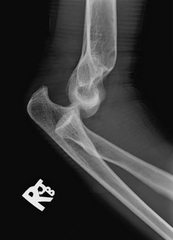
What is this image showing?
Elbow dislocation
What is dislocation?
When the bone is displaced from the joint space