Old English
 Call Kai
 Learn
Learn Practice Test
 Spaced Repetition
 Match
Match Flashcards
 Knowt Play
1/39

There's no tags or description
Looks like no tags are added yet.
Name | Mastery | Learn | Test | Matching | Spaced | Call with Kai | Chat |
|---|
No analytics yet
Send a link to your students to track their progress
40 Terms
What people were living in “Britannia” before the 5th century CE?
speakers of a number of Celtic langs
Romans named the island Britannia after the Britons, one of these Celtic-speaking pples
“Roman Britain” = 1st century BCE to c. 410 CE (far away from political center Rome).
Roman empire threatened by Germanic pples + internal problems, withdrew troops from colonial outposts like Roman Britain.
Withdrawal of Roman troops from colonial outposts like Roman Britain = important for hist of engl lang bc it helped create the political and economic conditions which made possible the large-scale migration and settlement of Germanic pples in what had been Roman Britain.
how was Roman Britain 6h century onward?
now lacking protection of Roman army it was besieged by a number of diff pples.
Pressure from the north: Picts, Scots
Pressure from the east: Angles, Saxons, Frisians, Jutes…
Christian conversion: Gregory the Great sends Augustine (c. 600) (then areas become Christian again).
*note on terminology:
“Great Britain” (vs. “Britannia minor,” i.e., continental Brittany/Bretagne)
“Anglo-Saxons” (vs. “mainland Saxons”)

what were the langs in mid-first-millennium Britain?
English, Welsh, Scottish, Pictish, and Latin
Limited lexical borrowings between Celtic and Germanic languages
Under-recognized but important grammatical influences from Celtic? (E.g., auxiliary “DO”)
Some borrowings from Latin, but also translated equivalents (E.g., “godspell,” “eorþcræft”
who leaves the records?
*it’s biased
In Roman Britain: the Roman conquerors, in Latin
In the Germanic period: some runic inscriptions, but before re-introduction of Latin and increased literacy
In 8th c. Britain: Bede’s Ecclesiastical History (Latin)—Bede is a Saxon man, but also a Christian monk
In 9th c. Britain: the Anglo-Saxon Chronicle (OE) begins
How about Beowulf? Probably composed in the 8th c., written down c. 1000
what is the significance of the the Viking Age to OE’s beginnings?
793 CE: Lindisfarne is sacked by the Vikings
Marks the beginning of a period of conflict between the (now native-identifying!) “Anglo-Saxons” (cover term for Germanic tribes) and the encroaching “Danes” (cover term for Scandinavian tribes)
Has a consolidating effect on the Anglo-Saxon kingdoms, growing sense of “Englishness”
Seven Anglo-Saxon mini-kingdoms (=“heptarchy”)
Northumbria, Mercia, Essex, Wessex, Sussex, East Anglia, Kent
Only Wessex, under Alfred the Great, survives by 878
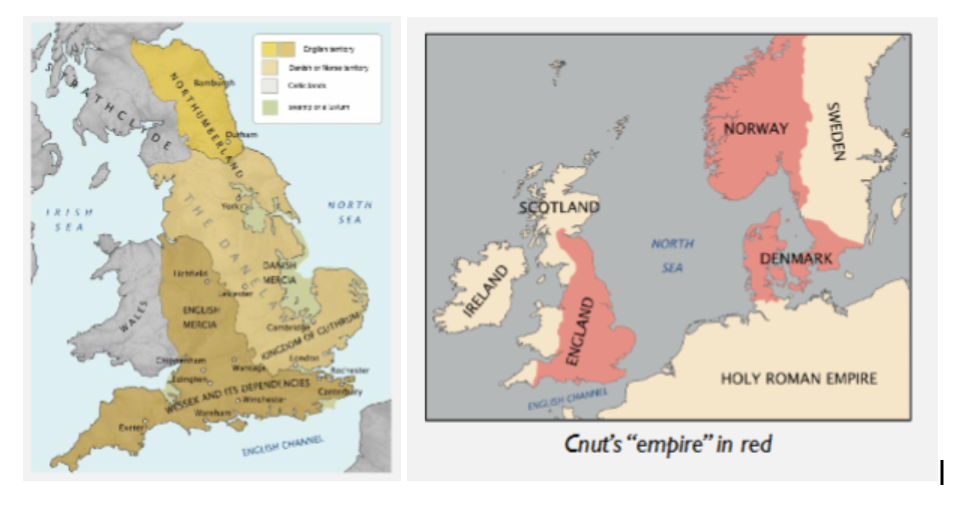
“Danelaw” and later reclamation of Anglo-Saxon territory…now all under Wessex rule
Pastoral Care and King Alfred’s big OE translation project
Old Norse leaves a lot of influence on OE
OE has elegiac quality + immersed in warrior culture (pagan but later becomes immersed in Christianity aka Jesus as a warrior)

what is the effect of King Alfred the Great on english (big OE translation project)?
Wessex survived under Alfred the Great → gave Vikings land in the East
+ he wanted to produce learning in his area, wanted Latin as the end goal but first they need to read+write engl so had a bunch of latin texts translated into OE
langs are like species = important to preserve them bc it’s the histories/identities of people
History of British + Irish langs Maps:

what is phonology?
the way we say/sound out words
what is morphology?
word-level stuff
if heavily inflected lang then have complex morphology
orthography
how we write/spell out words
orthography moves a lot slower than phonology which evolves all the time ~ every year
syntax
phrase/sentence-level
how you put words together
OE Orthography
OE has long-short vowel distinctions, though it does not show up in written texts.
Most friendly editions will mark the difference with a ¯ (‘macron’) over long vowels.
OE god (PDE ‘god’) vs. OE gōd (PDE ‘good’)
Later OE and ME scribes decided to write the same vowel 2 times to mark length—hence our modern spelling of ‘good’, though the vowel sound itself has shifted in the meantime.

OE Consonants

what is assimilation + deletion?
Assimilation
Intervocalic voicing (= if a usually voiceless fricative occurs between 2 vowels, it takes the voiced sound from around).
happens mostly w: f-v / θ-ð / s-z
Palatalization of [x], velarization of [n]
Deletion
“in many West Germanic varieties, /n/ is lost between a short vowel and voiceless fricative (and the vowel undergoes compensatory lengthening)…”
munþs – mūþ, gans – gōs . . . finf – fīf?
case study: “hlaf”
![<p>Assimilation</p><ul><li><p>Intervocalic voicing (= if a usually voiceless fricative occurs between 2 vowels, it takes the voiced sound from around).</p><ul><li><p>happens mostly w: f-v / θ-ð / s-z</p></li></ul></li><li><p>Palatalization of [x], velarization of [n]</p></li></ul><p>Deletion</p><ul><li><p>“in many West Germanic varieties, /n/ is lost between a short vowel and voiceless fricative (and the vowel undergoes compensatory lengthening)…”</p></li><li><p>munþs – mūþ, gans – gōs . . . finf – fīf?</p></li><li><p>case study: “hlaf”</p></li></ul><p></p>](https://assets.knowt.com/user-attachments/0afb1a82-e692-49f4-81d0-81e59abb62c7.png)
which is the most dominant OE dialect at this time?
West Saxon (bc Alfred the Great) so dominant/prestige dialect
Explain OE strong + weak verbs?
***Ablaut!! (vowel gradation)
Some VERB STEMS in Germanic languages have inherent quirks in how they are inflected.
“Strong” snazzy verbs change the vowel in their stem to make past tense forms.
PDE example: I sing today – I sang yesterday – I had sung by then
“Weak” plain verbs keep the stem as-is and add a suffix (“-ed”).
PDE example: I work today – I worked yesterday – I had worked all day
“strong” verb conjugations are based on vowel gradation, or ablaut (inflect by changing vowels/vowel stem change)
synthetic forms:
tense: past/present
mood: indicative/subjunctive/imperative
periphrastic forms:
voice: passive (“beon + past participle”)
aspect: progressive (“beon + pres. participle”) perfect (“habban/beon + past participle”)

beon/wesan paradigms

explain OE auxiliaries?
Allows for rich periphrastic formulations
OE had inbuilt conjugations for present/past tense and indicative/subjunctive/imperative moods, but much other verb work was already being done through periphrasis!
beon (passive voice, progressive aspect, sometimes perfect aspect)
habban (perfect aspect)
willan, sculan (future tense)
cunnan, magan, motan, etc
***grammaticalization
what are OE i-mutations?
I-umlaut
A sound change in which the first vowel in a word is influenced by the vowel in the next syllable (as the mouth “prepares” to pronounce it).
If the next syllable has /i/, /ī/, or /j/ (all high/close!), the preceding vowel becomes pushed up and forward—fronted (if back) or raised (if low/open).
happened to some nouns that once took the plural suffix *–iz
ex. plurals for mann, bōc, fōt, gōs, mūs, tōþ
also happened to some nouns when verb-ified with the suffix –(j)an
ex. full-jan, fōd-jan, mōt-jan, hāl-jan…
also happened to some adjectives when noun-ified with the suffix –(i)θu
ex. lɑŋ-iθu, strɑŋ-iθu, *fūl-iθu…

Explain OE preps
Most prepositions take their nouns (“object of the preposition”) in the dative case.
A few prepositions take their nouns in the accusative (or, rarely, the genitive).
Prepositions taking the accusative often involve motion or time.
ex) geond (through), oð (until), þurh (through), ymb (surrounding)
andlang (alongside, by the side of) takes the genitive. (“andlang þǣre Norðsǣs”)
Watch out for these:
æt means “from,” not “at.”
wiþ means “against,” not “with.” mid (cf. German mit) is the OE for PDE “with.”
on is an all-purpose preposition, often covering ground for PDE “in.”
***change meaning depending on which case they’re in
what is the word order in OE?
Conspicuous case markings provide flexibility in ordering sentence components.
BUT OE does have certain ordering patterns and tendencies. (This is what makes pattern breaks so impactful in poetic language!)
Deep-past syntactic structure: Subject – Object – Verb (SOV)
Late OE structure: slowly trending toward Subject – Verb – Object (SVO)
“OK, let’s generally do SOV, but we want one verb to come take V2 position in the main clause.”
what is McWhorter trying to show abt engl?
individual word histories vs syntax (McW saying we should focus on the syntax changing happening)
use of “do” auxiliary
explain OE syntax?
ways of combining clauses:
parataxis / coordination
**prefered by OE + works more orally
hypotaxis / subordination
can’t stand alone since sentences need to be subordinated into one another
like latin
**no intellectual difference, just how much grammar does for you / no diff in communicative value

crystal on the origins of OE

names of the tribes/groups at this time?
Angles? Saxons? Angles & Saxons? (Frisians? Jutes?)
Lat. Angli Saxones (vs. continental Saxons); exonym, but revived 16c and after
Britannia; Englisc (vs. Danes); angelcynn (vs. Celts); “on Englisc” (vs. other languages)
“Danes”? “Scandinavians”? “Vikings”?
Why not Saxonland?
“on Engla lande” (9c trans. of “region of the Angles”; arises as country-name after 11c)
what caused the OE-ON merger?
Most likely: continual migration and intermarriage between “English” and “Norse,” with very blurry ethnic lines
Archaeologist John Hines, quoted in Smithsonian Magazine, “Archaeologists Uncover…”
“it’s easy to imagine people in the same family speaking bits of the Celtic tongue they’d learned from a grandmother, the Germanic dialect of their spouses or in-laws and other variants from neighbors. They certainly needed to communicate with each other, but . . . they also craved a shared identity—one they achieved, in part, by creating, together, the rudiments of modern English.”
**pple speaking this prolly didn’t realize they were speaking diffrently.
Describe ON contact?
The kingdom of Wessex becomes de facto “England” by mid-10c.
Scandinavian populations and linguistic influence remain throughout, especially in the northeast.
Proper names: -throp, -by, -son (scandi. way of marking descendants). . .
patronymics
A strange cultural situation:
Shared cultural heritage (warrior society, “paganism”…)
Old Norse speakers are powerful and relatively numerous, but also willing to “pick up” the local language and assimilate to it.
diff image of domination…just give us land and we’ll assimilate. ON pple didn’t have huge attachment to own land.
Scandinavian attacks from varied sources keep happening throughout the 9th and 10th centuries!
Æthelred the Unready (979-1016)
“Rex Etheldredus dictus Unredi, quod Latine sonat Inconsultus…”
Alliance: Emma of Normandy
Tribute: Danegeld
Swein Forkbeard > Cnut > Cnut’s two sons
> Edward the Confessor (son of Æthelred and Emma; dies 1066)
didn’t have a son, leads to big shift in OE
OE in Normandy?
normandy ruled by Viking king
pple speaking a dialect of French a bit influenced by Germanic lang

what are the language contacts in OE?
Language influences:
Latin
“offshore” impact, limited to religious and literate (“high”) culture
mægester, nunne, relic, segn (early OE); scol, alter, grammatic, creda, philosoph (late OE)
Celtic
Old Norse
changes happening weirdly close to home, everyday words being replaced or coexisting
describe ON contact to OE?
King Alfred’s West Saxon OE dialect was the literary/bureaucratic standard for ~200 years.
Little evidence of Norse influence in written OE for many years…
…but a “sudden explosion” of Norse-influenced written forms in the 1200s and after
Grammatical:
pronouns! (þ-initial 3rd-person plurals creeping in throughout late OE & ME)
conjugation of wesan (to-be verb)
Lexical: OE shows “drift” from typical West Germanic forms to North Germanic forms
æġ (later ey; most West Germanic languages) – egg (most North Germanic languages)
ġietan – getan (ON geta)
niman – tacan (ON taka)
hatan – ċeallian (ON kalla)
Sometimes both OE and ON forms survived when their meanings or usage diverged:

what is McWhorter’s rhetoric doing?
makes subject more approachable
way to set apart his writing from others
violent metaphors help you think about lang as more fragile
language = always getting “beat up” ~ change
using rhetoric of fake emergency of 21st century → why be alarmist now when all of these changes happened in the past to the lang you know + love
changes just happen, outside influence happen, not always “invasive”
what disappeared from OE? and the culprit?
most inflections (case, gender, verb conjugations…)
most reflexive verb formulations
cf. “behave yourself,” “perjure yourself,” “pride yourself in…”
directional demonstratives (hither, thither…)
the generalized pronoun “mann/mon”
the be-perfect (haban/wesan to create perfect then drops off)
V2 reinforcement (verb as 2nd component of sentence…not super strict in engl)
…a cumulative and also gradual (centuries-long!) effect
Old Norse!
what is Norman French?
used to be French speaking
that’s the french brought to England in Norman Conquest
what is the Celtic Language puzzle?
Crystal poses a puzzle; McWhorter poses a solution
Methodological takeaways:
Lexical histories do not give a complete picture of language change.
Tracking grammatical impact does a better job of indexing long-term, intimate language interaction, though such relations are more difficult to prove.
Linguistic “evidence” in written form will be belated, biased, and sometimes nil.
what is the significance of the Kirkdale Sundial (1055)?
shows lang is shifting
“Eadward” for “Edwards day” should have an “s” to be in gen
shows that case marking system is going away
significance of manuscript culture to OE?
Remember, writing was still a strange, special, quasi-magical technology!
parchment/vellum
animality; “hair side” and “flesh side”
“palimpsest” = layers of writing
codex = standard book-looking (bound) form
no line breaks to save paper space
punctuation? where to take a breath (bc oral form = main way text is being consumed)
spacing? no spaces between words sometimes
what are the features of OE lit?
orality as the default
written culture (“literacy”) as an up-and-coming cultural “issue”
literacy has undue authority over illiterate peasants to make them work.
largely Christian, but intermixed with “warrior values”
Jesus takes on warrior figure
prose: religious texts, chronicles, legal docs, recipes, herbals, “leechbooks”…
poetry: elegies, epics, wisdom verses, charms, riddles…
scop = “maker” (cf. OE scyppan, ModE shape
derived from gk poie (to shape) // creator God
significance of alliteration in OE?
From M. H. Abrams’ Glossary of Literary Terms:
“In Old English alliterative meter, alliteration is the principal organizing device of the verse line:
the verse is unrhymed;
each line is divided into two half-lines of two strong stresses by a decisive pause or caesura;
and at least one, and usually both, of the two stressed syllables of the first half-line alliterate with the first stressed syllable of the second half-line.”
aligns sounds in word- or syllable-initial position rather than final sounds (‘tails’ as in rhyme)
• involves some thinking about where stress goes in the poetic line, but not in terms of strictly repeated patterns or tightly measured types of feet (e.g., iambic pentameter)
significance of CÆDMON’S HYMN
Earliest extant OE poem (if we believe Bede’s dating; c. 650-700)
First recorded by Bede only in a Latin paraphrase; OE scribes added “glosses” in the margins containing the orally transmitted original, or in some rare cases, interpolated the OE poem in place of Bede’s Latin.
Cædmon was a lowly cowherd who was “inspired” in a dream to sing Christian poetry; he reported the “miracle” to an abbess, was later educated, became a monk, and created (not “wrote”!) more poetry.
he content may feel banal or repetitive to us now, but considering that this may well be the first cases of English “experimentation” with expressing Christian conceits and images, Cædmon might really be an original genius!
*ex of alliteration in poetry + needs many synonyms for God
*rhythm = relatively new, it’s a development of OE, not “native” to it
what is the significance of the Exeter book?
One of four major codices holding OE poetry!
In case you’re curious, the others are: the Junius MS (biblical poems), the Vercelli Book (sermons and saints’ lives, Dream of the Rood), the Nowell Codex (Beowulf and Judith).
Produced in the late 10th century, but the works themselves could be older.
Extremely diverse anthology/collection! Almost every genre is attested