L07 Suicide :)
 Call Kai
 Learn
 Practice Test
 Spaced Repetition
 Match
 Flashcards
 Knowt Play
1/23

There's no tags or description
Looks like no tags are added yet.
24 Terms
Suicude ideation
thoughts of killing oneself (9% lifetime prevalence)
suicide attempt
behavior intended to kill self (2.5% lifetime)
non-suicidal self-injury
behaviors intended to injure onself-without intent to kill oneself
(10-25% of ados)
how many people die by suicide every year according WHO 2023
over 700k, highest in Russia, lowest in Caribbean
general trend of suicide rates in past 2 decades?
decreasing globally
but in US: increase
france/ireland: decrease
suicide by age
varies by age
older people at higher risk
suicide and sex
females: more suicidal ideation & attempts
males die by suicide more frequently
global pattern: men more likely to use lethal means vs women pills
Suicide and Psychological Disorders
- 9/10 of people who die of suicide have a diagnosable psychological disorder.
- 1/2 of those who try to kill themselves are clinically depressed at time of act
- people w MDD, BD, Schiz higher risk suicide
BUT HIGH MAJORITY of ppl w psych disorders do not die by suicide
Suicide Risk Factors: social and envmtal factors
- psych disorders
- econ events: (recession//suicide rates+)
- suicide contagion: celebrity suicides ==> suicide rate+
- marital status: divorcees => suicide rate+
- social isolation / lack of social belonging: strong predictor
- individuals report: sexual/gender-minority orientation => risk+ for suicidal ideation/attemps
Suicide Etiology
- genetics => heritability of suicide behavior is high (30-50%)
- NTs & neuroendocrine system
- cognition
- psychological:
suicide etiology: NT & neuroendocrine system
HPA axis dysregulation
+
serotonin dysfunciton
=> important predictors of suicidality
suicide etiology: cognition
-impaired emotional regulation
-reactive aggressive traits
-impaired pb solving
-impulsivity
suicide etiology: psychological
interpersonal theory of suicide : feeling like a burde, low belonging, capacity for suicide

required Reading for suicide
lol soz
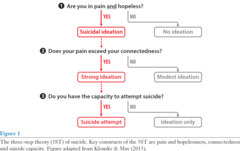
suicide prevention: three-step theory of suicide
1. Pain and hopelessness
2. Connectedness to life/relationships => as buffer (if exceeded then...)
3. Suicide capacity => transition from ideation to action
suicide prevention: 5 steps/ways
1. "means restriction"
2. reduce stigma
3. public awareness campaigns
4. gatekeeper training
5. improve access to mental health screening & risk assessment
suicide prevention: 1/ means restriction
addresses suicidal CAPACITY
- US firearms: high risk => counselling involve store elsewhere
- other means but less lethal => fewer deaths
suicide prevention: 2/reduce stigma
destigmatise help-seeking + normalise experience of distress
//to drop in rates
suicide prevention: 3/ public awareness campaigns
- improve general public's knowledge of suicide / depression
- difficult to establish if programs are effective
suicide prevention: 4/ gatekeeper training
training individuals who are likely to be in context with those at risk: recognize signs + make referrals
GPs => first line of defense
suicide prevention: 5/ improve access to mental health screening risk assessment
frequently experience undiagnosed, undertreated or untreated depression:
==> medications and CBT reduce suicide rate
READING: risk factors for suicide: what its about/method
Topic: risk factors for suicide (adults)
Method: systematic review + meta-analysis
Data: 37 psychological autopsy studies (cases vs controls)
Looks at 40 risk factors across domains (clinical, social, etc.)
READING: suicide risk factors: findings/conclusions
- Strongest risks = clinical factors
>mental disorder (~13x risk)
> self-harm (~10x)
- Other factors (social, family, life events) = smaller effects (2-5x)
- Recent life events (esp. last month) = very high risk
==> Suicide = multiple interacting factors (not just one cause)
READING suicide risk factors: limitations
- Uses psychological autopsy → recall bias (family reports)
- High heterogeneity between studies
- Mostly crude estimates (confounding not controlled well)
- Only adults → not generalisable to all ages