PERSONALITY DISORDERS
 Call Kai
 Learn
 Practice Test
 Spaced Repetition
 Match
 Flashcards
 Knowt Play
1/22

There's no tags or description
Looks like no tags are added yet.
23 Terms
Personality Disorders
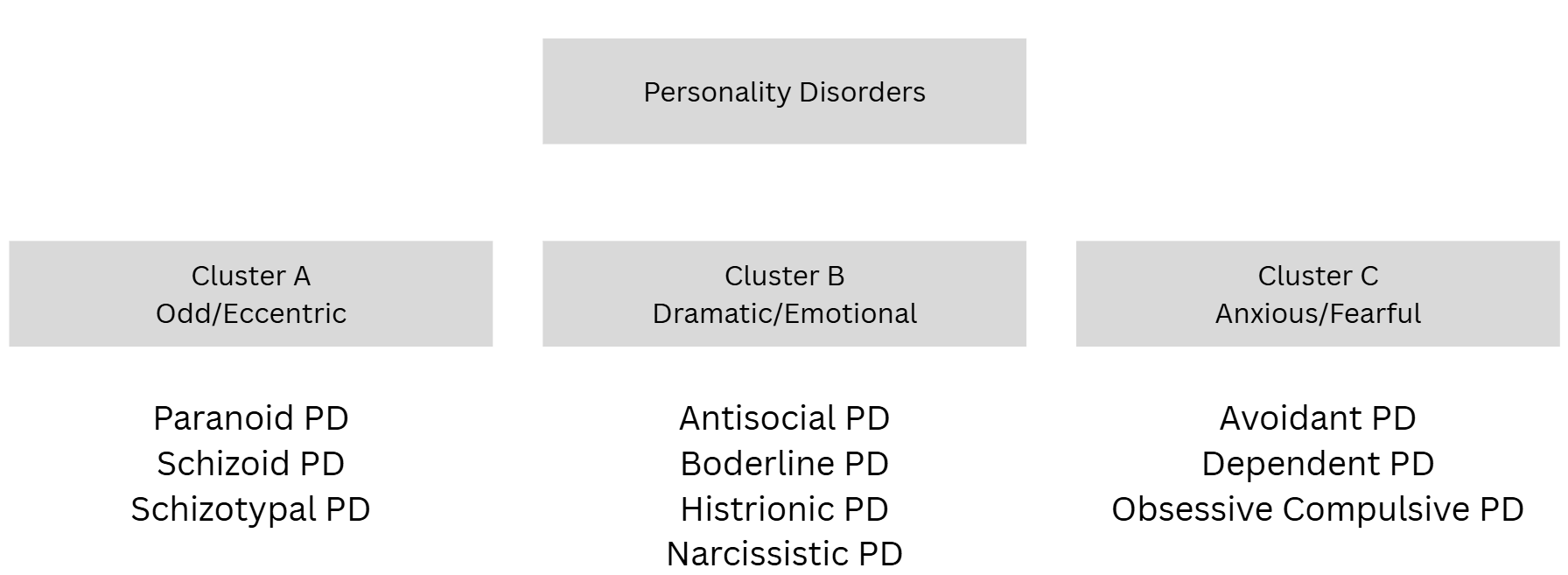
Cluster A: Odd/Eccentric
Odd, eccentric, socially awkward, and socially isolated behaviors, impaired social relationships, suspicious/mistrust.
Shared biological risk factors w/ schizophrenia.
50% of indiv. diagnosed with schizoid also meet criteria for schizotypal PD.
Paranoid PD
Primary feature is suspicion and hostility—believing others have malevolent intent, fear of betrayal.
Cluster A
Treatment: Therapy establishing a trusting atmosphere and challenging irrational/paranoid thoughts.
Schizoid PD
Primary feature is indifference and solitude—has zero desire for social or romantic connection. Shows anhedonia, flat affect.
Cluster A
Treatment: Social skills training
Schizotypal PD
Primary feature is cognitive/perceptual eccentricity—odd beliefs, magical thinking, ideas of reference, and peculiar behavior/speech. Interpersonal deficits, disorganized features.
Cluster A
Treatment: Low-dose antipsychotic medication, CBT, social skills training, and family therapy
Cluster B: Dramatic/Emotional/Erratic
Dramatic, highly emotional, erratic, impulse-driven, and disruptive interpersonal behavior.
High overlap across all four disorders, co-occurring with substance abuse and mood disruption.
Antisocial PD
Manipulates and exploits others for personal/material gain or thrill; lack of remorse and disregard for social/legal rules.
Cluster B
Treatment: Behavioral change, control, and rehabilitation
Borderline PD
Manipulates/acts out for emotional reassurance due to terror of abandonment; characterized by severe self-harm, emotional instability, and “splitting.”
Cluster B
Treatment: Dialectical Behavior Therapy (DBT), tranquilizers/antidepressants
Histrionic PD
Seeks to be the center of attention through theatricality, physical appearance, and dramatic/provocative emotional displays.
Cluster B
Treatment: CBT targeting attention-seeking behaviors & emotional depth
Narcissistic PD
Seeks admiration and status due to grandiosity and entitlement; marked by a total lack of empathy.
Cluster B
Treatment: Psychotherapy challenging distorted beliefs about self-worth
Cluster C: Anxious/Fearful
Pervasive anxiety, fearfulness, social inhibition, or rigid self-control.
Fear of loss of control.
Low to moderate diagnostic overlap
Avoidant PD
Reacts to fear of rejection by withdrawing completely from social situations (despite wanting connection) unless certain of being liked. Views self as inferior.
Cluster C
Treatment: Best treated PD, CBT techniques and graded group therapy.
Dependent PD
Reacts to fear of abandonment by clinging submissively to others and surrendering all autonomy. Difficulty making everyday decisions without advice.
Cluster C
Treatment: Time-limited short-term therapy to avoid falling into a “nurturer” role
Obsessive-Compulsive PD
Reacts to anxiety/uncertainty by exerting rigid control, perfectionism, and orderliness over their environment. Essential drivers are a need for control and intolerance of uncertainty.
Cluster C
Treatment: Cognitive & behavioral strategies to stop need for control, develop tolerance for uncertainty.
Egosyntonic Symptoms
Symptoms feel like an acceptable, natural part of the self.
Usually don’t seek treatment.
Syn: with/same
Egodystonic Symptoms
Symptoms feel alien, unwanted, intrusive, and distressing.
Individuals are aware of problem and seek relief.
Dys: Abnormal
Alternative Model of Personality Disorders (AMPD)
Dimensional proposal in the back of the DSM-5 evaluating continuum traits rather than binary (Yes/No) categories.
Criterion A: Personality Functioning
Self: Identity/Self-direction
Interpersonal: Empathy/Intimacy
Criterion B: 5 Pathological Personality Traits mapped onto the OCEAN Big-5 model:
Negative Affectivity (vs. Emotional Stability)
Detachment (vs. Extraversion)
PROS of AMPD
Reduces artificial comorbidity
Eliminates arbitrary cutoffs
Openness VS Closedness
High: Creative, curious, tolerant
Low; Down to earth, conservative, straightforward
Conscientiousness vs carelessness
High: Organized, reliable, consistent, enjoy planning
Low: Content, bold, carefree, easy going, creative
Extraversion vs Introversion
High: Outgoing, sociable, friendly, talkative
Low: Solitary, reserved, relaxed, serious
Agreeableness vs Antagonism
High: Friendly, compassionate, gullible, cooperative, trusting
Low: Assertive, skeptical, devious, indifferent, uncompromising
Neuroticism vs Emotional stability
High: Anxious, pensive, impulsive, self-conscious
Low: Calm, self-confident, bold, emotionally stable, carefree