Lecture 3: B cell development 1
 Call Kai
 Learn
 Practice Test
 Spaced Repetition
 Match
 Flashcards
 Knowt Play
1/36

There's no tags or description
Looks like no tags are added yet.
37 Terms

B-cells develop in the _____ ______ and engage foreign Ag in ______ ___________ _______
B cells develop in the bone marrow and engage foreign Ag in peripheral lymphoid organs
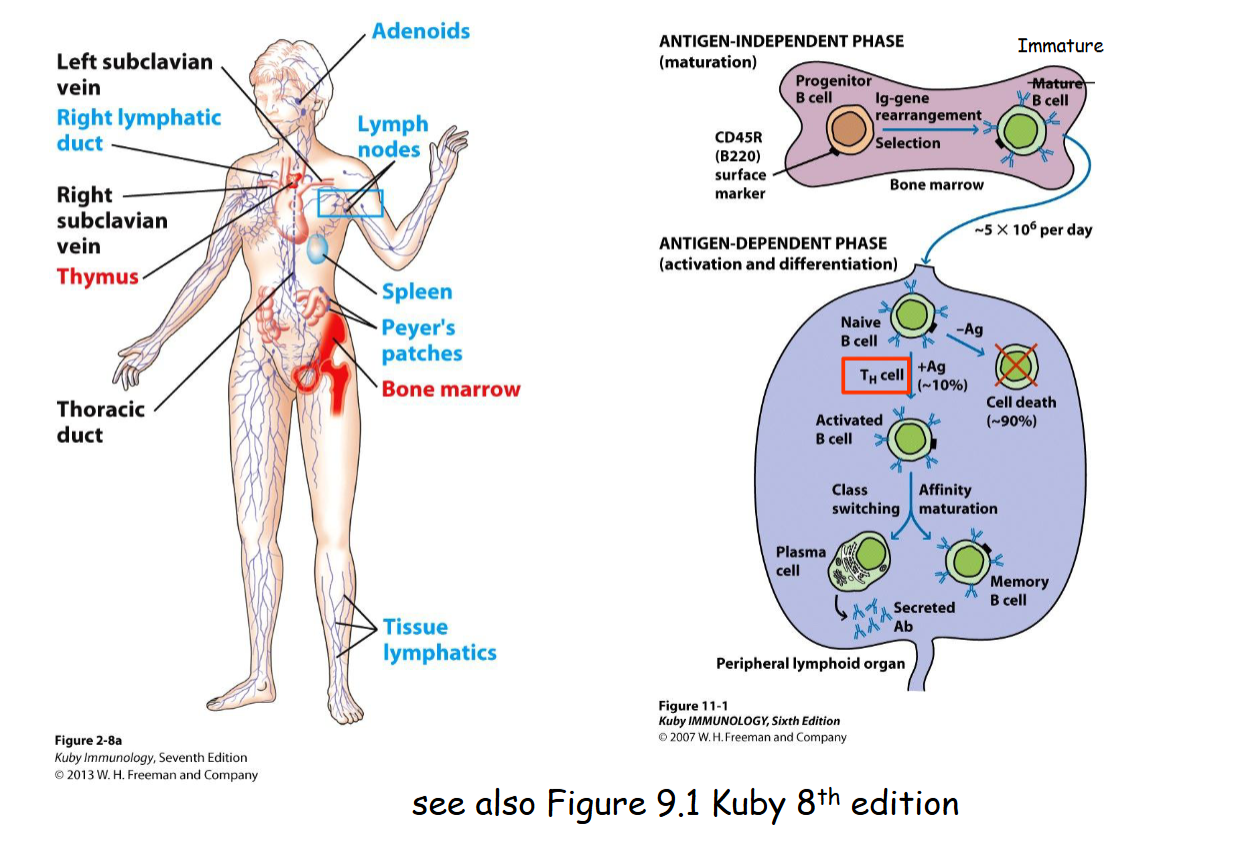
****B-cell development can be divided into stages. What are 2 ways these stages can be distinguished?
Rearrangement status of heavy and light chain genes
Cell surface markers
• B cell antigen receptor (BCR)
• others (lambda 5, VpreB, BAFFR, etc.)
****What are the different stages of B cell development and where do they occur?
hint: 7 stages

****What is the PRO B cell?
****What occurs during the pro B cell stage?
aka. Progenitor B cell stage: in the bone marrow
This is where the cell has become committed to becoming a B cell
Turn on B cell genes via Transcription factors (like: E2A, EBF-early B cell factor) + Pax5
Turn off/repress genes important for other lineages of cells
Start rearranging Ig heavy chain gene
receive signals from bone marrow stromal cells that promote proliferation and further development
What does Pax5 transcription factor specifically do in terms of turning off genes?
Pax5 turns off expression of T cell lineage transcription factor Notch
*******What Genes are involved to start heavy chain rearrangment?
Rag-1/2 genes are turned on at pro B cells stage to start heavy chain rearrangement
D to J followed by V to DJ rearrangement
B cells lacking Rag 1 or 2 don’t get past the pro-B cell stage of development (note: the same occurs for T cells)
*****What phenotype does a Rag deficiency result in?
SCID - Severe combined immunodeficiency
*****SCID
what is it?
How can it be treated? (3)
Severe Combined Immunodeficiency
Defect in BOTH B + T cell function
severely impaired adaptive immunity
Severely immunocompromised
Treatments?
live in sterile environment (“bubble boy”)
bone marrow transplant
gene therapy
How can Rag deficiency be studied and potential treatments be tested?
use a Mouse model
***What makes a mice a good model system to study human biology
Very similar genetics + lots of similar genes (think genet 302 with Harrington)
Mice are mammals thus they have an immune system that is very similar to ours = Similar physiology and biology
Genetic abnormalities that cause disease in humans cause similar disease in mice
What are the 3 possible ways to genetically manipulate mice
generate mice with heritable genetic changes to their germline DNA
Transgenic
Knock out - alter gene so protein or mRNA is no longer functional
Know in - replace gene with a copy with specific mut.
Define Transgenics
The addition of DNA
How can Rag deficiency be modeled in mice?
Generate mice with a KNOCK OUT of the Rag 1 gene
What is flow cytometry
A technique to measure the expression of specific proteins on the surface/inside individual cells
uses cells stained with fluorescently labeled antibodies to detect presence of specific proteins (eg. receptors)

****What are the 2 ways to plot flow cytometry results
compare and contrast between the 2
HISTOGRAM = uni variable
displays a single parameter on the x-axis and the number of cell events on the y-axis.
DOT PLOT = bi variate
displays two different parameters simultaneously—one on the x-axis and one on the y-axis

What are 2 things that can indicate that a cell is a B cell?
Flow cytometry
B220 = CD45 (marks all leukocytes)
IgM + IgD = Co-expression on Naïve Mature B Cells (not yet encountered Ag)

*****What can be concluded from this Flow cytometry plot?
Drastically reduced Mature B + T cell numbers in Loss of Rag 1
*******Pre-B cell
What is it Characterized by?
What is a defining feature of this stage?
Precursor (Pre) B cell
characterized by rearranged heavy chain Aka. The heavy chain is expressed
DEFINING FEATURE = Pre-B cell receptor (Pre-BCR)
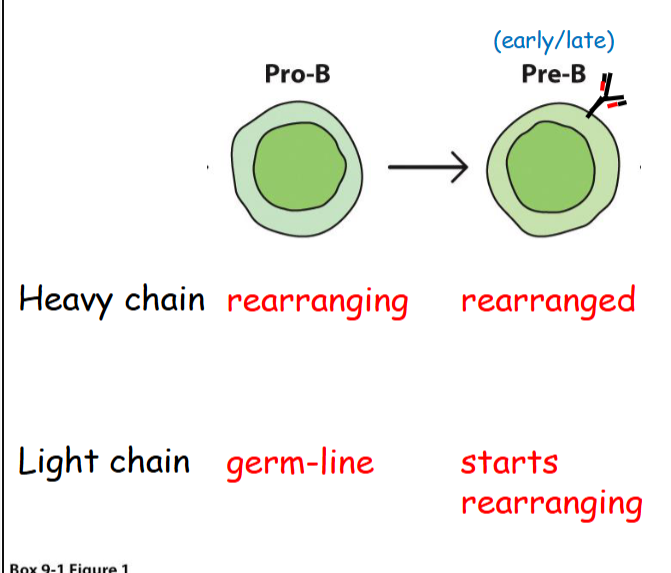
*****What are the 2 substages of the Pre-B cell?
Early/LARGE pre B cell
Late/SMALL pre B cell
**True or false: There are several rounds of proliferation in the Pre B cell stage?
True
specifically in the EARLY pre-B cell stage

********Heavy chain transcription: What does the IgH (heavy chain ) locus look like?
What are some key components to know? and where are they located?
PROMOTER upstream of each V segment (red circles P)
Where RNA poly 2 binds + STARTS TRANSCRIPTION
ENHANCERS = Intron between variable and constant regions (E mu) + 3’ of alpha constant region (3’alpha E). Aka flanking the constant region
bind transcriptional activators that promote transcription from promoters

****Distinguish between the state/activity of the IgH gene in NON-B cells + early Hematopoietic progenitors vs. the EARLY PRO-B cell
Non-B cells + early hematopoietic progenitors
located in inactive chromatin
not accessible to RNA polymerase II and transcriptional activators
EARLY PRO-B CELLS
chromatin becomes accessible
B cell specific gene regulatory proteins (e.g. those encoded by the E2A gene) are expressed and bind to enhancer elements
Transcription factors bind to promoters
NOT MUCH transcription from the PROMOTERS in the V segment (b/c enhancers = too far away)
VDJ recombination is on the way
***********What TRANSCRIPTION FACTOR binds to the PROMOTER in B cells?
B cell specific transcription factor, Oct-2, binds promoter
****What does it mean by Heavy chain transcription is Linked to VDJ recombination?
in other words, how does VDJ recombination affect heavy chain transcription?
Rearrangements bring enhancers closer to V segment promoters
efficient transcription of heavy chain gene
10^4 increase in transcription over non-rearranged locus

***Rearrangements bring Promoters how many kb within the enhancers?
within 2 kb of E mu(the one between the variable + constant region)
******What is a PRE-BCR?
What are the different components?
Rearranged heavy chain that is paired with a surrogate light chain= Pre-BCR (DEFINING FEATURE of Pre-B cells)
Surrogate light chain has 2 components (proteins)
VpreB (like variable light chain)
Lambda 5 (like constant light chain)
Surrogate light chain expressed by ALL pre-B cells

********HOW is SIGNALLING INITIATED via Pre-BCRs?
Self-aggregation of Pre-BCRs
******How do Pre-BCRs self aggregate?
VpreB has an extra C-terminal acidic residue
Lamda 5 has an extra N-termial Basic residue
These have OPPOSITE CHARGES = allow multiple pre-BCRs to self-aggregate with NO LIGAND NEEDED
******What is Btk?
Bruton's tyrosine kinase (BTK) is a crucial non-receptor tyrosine kinase that transmits signals from the pre-B cell receptor (pre-BCR) during early B-cell development
****What is Pre-BCR signaling important for?
CRITICAL DEVELOPMENTAL CHECKPOINT
tests whether a developing cell has successfully produced a functional immunoglobulin μ heavy chain before allowing it to mature further
proves the heavy chain can properly pair with a light chain,
It triggers rapid cell division (proliferation) of B-cells
It shuts down further heavy-chain gene rearrangement so that the B-cell only expresses one type of heavy chain (allelic exclusion)
It down-regulates the RAG (recombination-activating) enzymes to pause heavy-chain editing and transition the cell toward light-chain rearrangement
What is the Ig-α / Ig-β Heterodimer again in a B cell?
WHY IS IT NEEDED?
Signal transduction subunit of BCR that has an ITAM (immunoreceptor tyrosine based activation motif)
Because BCR has a small cytosolic segment (only 3 a.a.) = cannot transmit any signal on its own

*******What is XLA?
what are the symptoms
X-linked Agammaglobulinemia (RECESSIVE DISEASE)
Patients have a BLOCK in B cell development at the pre-B cell stage
NO mature B cells = No Abs = NO HUMMORAL IMMUNITY
T cell development is normal
can mount an effective immune response against most viruses
******What Patients with XLA particularly susceptible to? and WHY?
EXTRACELLULAR bacterial infections because they need Ab to combat (humoral immunity = targets external antigens)
H. influenzae
S. pneumoniae
S aureus
******What causes XLA?
Mutation in BKT gene (located on the X chr)
Non receptor tyrosine kinase
No critical signal/checkpoint for Pre-B cells = no further development

******How are XLA patients treated?
Reintroducing Ab (rather than correcting defect in B cells)
patients receive weekly gammaglobulin injections
Pooled IgG from many blood donors = restores some humoral immunity
Patients are treated more liberally with Antibiotics
****Summary
At what stage of B cell development is the cell committed to the B cell lineage?
What genes are critical for B + T cell development?
How do VDJ and IgH transcription relate?
XLA is caused by what?
Pre-B cell + Pre BCR
