CELL 201 Lecture 17 - DNA, Chromosomes, and the Nucleus
 Call Kai
 Learn
 Practice Test
 Spaced Repetition
 Match
 Flashcards
 Knowt Play
1/43

There's no tags or description
Looks like no tags are added yet.
44 Terms
What do genomes consist?
All the DNA making up one complete (haploid) copy of an organism's genetic information.
How many chromosome sets do Haploid and diploids contain respectively?
Haploid sets contain one chromosome of each type
diploid sets contain two of each

How did early cytologists visualize genomes?
stained metaphase chromosomes with Giemsa stain
showed patterns of banding
G-C (light bands)
A-T (dark bands)

Fluorescence in situ hybridization (FISH) steps/process
prepare dna probe w/fluorescent label
hybridize labeled probe to denatured sample DNA
visualize dat fluorescence ouuu


What can the probes be used for in FISH + analogy/example
used to ‘paint’ different parts of chromosomes in a sequence-specific manner
taken two sentences and you've got the end of one sentence and beginning of another one- doesn’t make any sense
for the abnormal picture, the cell put the broken chromosomes back together incorrectly
How many protein-coding genes does the human genome have? and what percentage do they compose of the 3 billion bp (haploid) genome?
~ 20,000-25,000
<2%
How many non coding genes are there?
5000-100,000
Protein-coding DNA in humans
Protein-coding genes comprise less than 2% of the three-billion-base-pair haploid genome.
Tandem repeats
Adjacent DNA copies that account for 10-15% of a typical mammalian genome.
Centromeres and telomeres
Chromosome regions rich in simple-sequence repeats.
Triplet repeat amplification
Excessive triplet repeats are associated with diseases such as Huntington's disease.
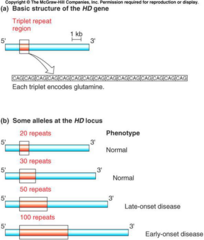
Interspersed repeated DNA
Similar but nonidentical DNA copies scattered throughout the genome.
Transposable elements
DNA elements that can move around the genome and leave copies behind.
LINEs
Long interspersed nuclear elements capable of making copies of themselves.
SINEs
Short interspersed nuclear elements that cannot move on their own.
DNA sequencing
Determination of the linear order of bases in DNA.
Maxam-Gilbert sequencing
A chemical sequencing method that cleaves DNA at particular bases.
Sanger sequencing
A chain-termination method using dideoxynucleotides to stop DNA synthesis.

Sequence assembly
Computers combine sequences of short fragments into longer DNA stretches.
Human Genome Project
Ran from 1987 to 2001 and found approximately 20,000 genes.
Bioinformatics
Combines computer science and biology to investigate genomes and gene products.
Synteny
The arrangement of genes relative to one another on chromosomes.
Gene expression and cell identity
Cell identity is defined by which genes are being transcribed.
Human genome variation
Two people's genomes match at 99.7% of bases on average.
Single nucleotide polymorphism
A single-base difference between individuals.
Haplotypes
Blocks of nearby chromosome variants that tend to be inherited together.
Chromatin
Eukaryotic DNA bound and packaged with protein.
Nucleosome
The repeating particle forming the basic structural unit of chromatin.
Histones
Small basic proteins rich in lysine and arginine that bind negatively charged DNA.
Heterochromatin
Tightly packed chromatin containing transcriptionally inactive DNA.
Euchromatin
Loosely packed chromatin associated with actively transcribed DNA.
Nucleus
Eukaryotic compartment where chromosomes are located, replicated, and transcribed.
Nuclear envelope
A double membrane separated by a perinuclear space; its outer membrane continues with the ER.
Nuclear matrix
An insoluble fibrous network that helps maintain nuclear shape.
Nuclear lamina
A lamin-based intermediate filament meshwork lining the inner nuclear membrane.
Nuclear pores
Channels where inner and outer nuclear membranes fuse, connecting cytosol and nucleoplasm.
Nuclear pore complex
An eightfold-symmetric channel built from approximately 30 nucleoporins and over 400 proteins.
Small-particle passage through nuclear pores
Particles under 5 nm in diameter pass through by simple diffusion.
Nuclear localization signal
A protein signal recognized by transport factors for nuclear import.
Nuclear export signal
A cargo signal recognized by transport factors for nuclear export.
Importin
Binds nuclear localization signals and carries cargo through the nuclear pore.
Ran-GTP in nuclear import
Binds importin in the nucleus, causing cargo release.
Exportin
Binds export cargo and Ran-GTP for transport to the cytoplasm.
Ran-GTP gradient
Nuclear GEF and cytosolic GAP maintain the gradient that directs nuclear transport.