bones of axial skeleton
 Call Kai
 Learn
 Practice Test
 Spaced Repetition
 Match
 Flashcards
 Knowt Play
1/38

There's no tags or description
Looks like no tags are added yet.
Name | Mastery | Learn | Test | Matching | Spaced | Call with Kai | Chat |
|---|
No analytics yet
Send a link to your students to track their progress
39 Terms
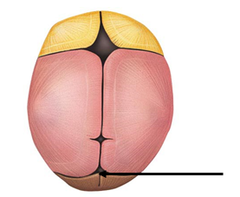
anterior fontanel (fetal)

posterior fontanel (fetal)
frontal bone

parietal bone

occipital bone

foramen magnum
in occipital bone

occipital condyles
in occiptal bone

temporal bone

temporal-mandibular joint (TMJ)
part of temporal bone
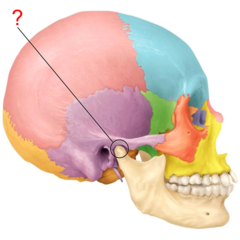
mastoid process
part of temporal bone

styloid process
part of temporal bone

zygomatic process
part of temporal bone

external auditory meatus
part of temporal bone -- auditory canal travels through this

sphenoid bone

ethmoid bone

maxillary bone
forms upper jaw

palatine bone
together with the maxillary bone makes up the hard palate i.e. roof of mouth

zygomatic bone
forming prominence of the cheek

zygomatic arch
part of zygomatic bone

lacrimal bone
forms the medial wall of each "orbit" i.e. each eye socket

nasal bone
forms the bridge of the nose

vomer
forms inferior portion of the nasal septum

inferior nasal conchae
bony ridges that project medially from lateral walls of the nasal cavity-they support the nasal mucosa

mandible
articulates with the temporal bone at the TMJ
- only movable bone of the skull

bone descrption of vertebral column
- 7 cervical vertebrae (C1 through C7)
- 12 cervical vertebrae (T1 through T12)
- 5 lumbar vertebrae (L1 through L5)
- 5 sacral vertebrae ( fused together to form sacrum
- 4 coccygeal vertebrae (fused together to form the coccyx or tailbone)
what is the first cervical vertebra known as
atlas
what is the second vertebra known as
axis
what are the parts of a typical vertebral bone?
- body
- pedicles
- laminae
- transverse processes
- vertebral ("neural") arch
- intervertebral foramen
- vertebral foramen
what is the intervertebral foramen?
- hole formed by two adjacent vertebral bones
- actually formed by the lower surface of the pedicle of the upper vertebral bone and the upper surface of the pedicle of the lower vertebral bone
- spinal nerves pass through these holes

What is the vertebral foramen?
the spinal cord passes though this hole

intervertebral disks
made up fibrocartilage --- serve as shock absorbers

what does the rib cage consist of?
ribs, sternum, and thoracic vertebrae
what are true ribs?
first 7 thoracic ribs articulate with the first 7 vertebrae
what are false ribs?
the last 5 ribs articulating with last 5 vertebrae
what are floating ribs?
the last 2-3 ribs
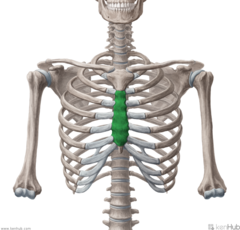
sternum
consists of
- manubrium
- middle body
- xiphoid process

manubrium
articulates with clavicles

middle body
site commonly used for bone marrow sampling
xiphoid process
important landmark used for CPR
