Cleft Lip, Cleft Palate, and Velopharyngeal Dysfunction Review
 Call Kai
 Learn
 Practice Test
 Spaced Repetition
 Match
 Flashcards
 Knowt Play
 Podcast
1/34

Earn XP
Description and Tags
Vocabulary flashcards covering embryology, surgical management, velopharyngeal dysfunction, resonance disorders, and associated craniofacial syndromes based on the lecture notes.
35 Terms
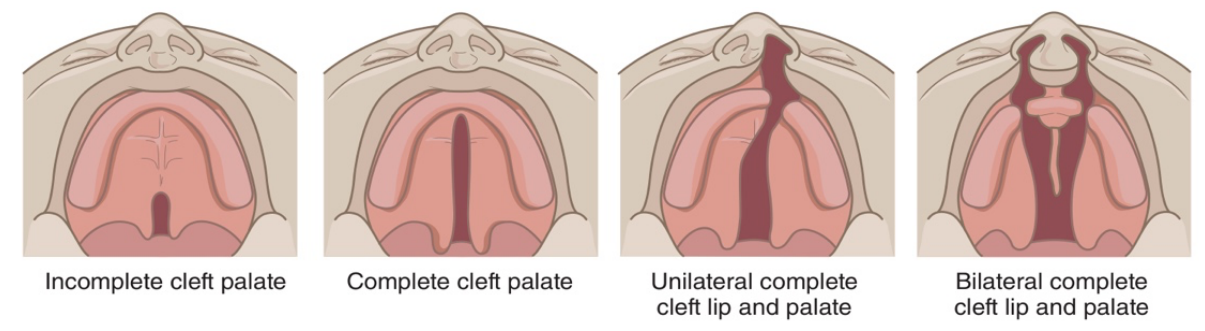
Primary Palate
Anatomic structures located anterior to the incisive foramen, including the lip and alveolar ridge, which fuse during embryonic development around week 7.
Secondary Palate
Anatomic structures located posterior to the incisive foramen, including the hard palate, velum, and uvula, which fuse during embryonic development around week 9.
Submucous Cleft Palate
A congenital defect in which the oral surface mucosa of the secondary palate remains intact, but the underlying muscular structure is incompletely developed or improperly attached.
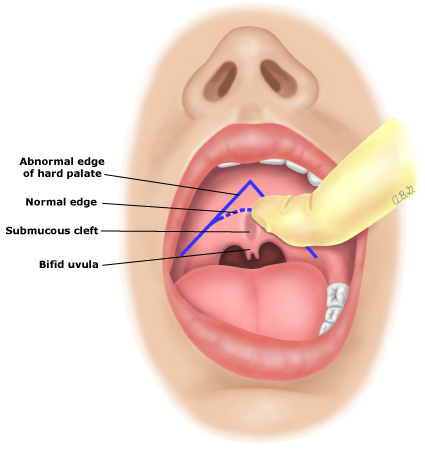
Overt Submucous Cleft
A visibly identifiable submucous cleft characterized by intraoral signs such as a bifid or hypoplastic uvula, a zona pellucida, tenting of the velum during phonation, and a palpable bony notch at the edge of the hard palate.
Occult Submucous Cleft
A hidden muscular defect in the velum that shows no visible abnormality on the oral surface and can only be detected by observing the nasal surface via nasopharyngoscopy.
Zona Pellucida
A bluish region visible in the midline of the soft palate on intraoral inspection, indicating thin mucosal tissue and muscle separation associated with an overt submucous cleft.
Levator Veli Palatini
The main muscle responsible for soft palate elevation, functioning to lift the velum upward and backward toward the posterior pharyngeal wall to achieve velopharyngeal closure.
Tensor Veli Palatini
A muscle that opens the Eustachian tube during swallowing for middle ear drainage; it is not involved in velopharyngeal closure but is frequently misinserted in children with cleft palate.
Musculus Uvulae
An intrinsic muscle of the soft palate that contracts during phonation to create a central bulge on the nasal surface of the velum, adding stiffness to facilitate VP closure.
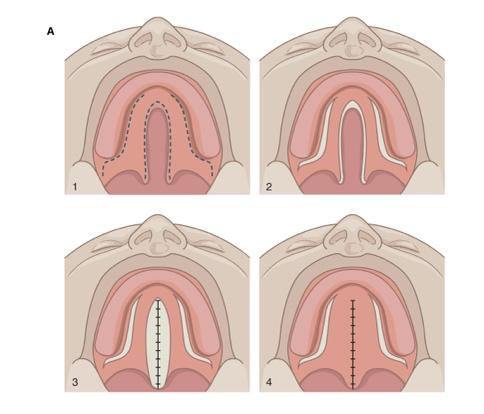
Wardill-Kilner Repair
A surgical procedure for cleft palate repair using single flaps raised on either side of the cleft brought back together, which lengthens the palate and improves velopharyngeal approximation.
Von Lagenbeck Repair
A surgical method for cleft palate repair that raises two flaps and brings them together at the midline without lengthening the palate, associated with a higher incidence of postoperative velopharyngeal insufficiency.
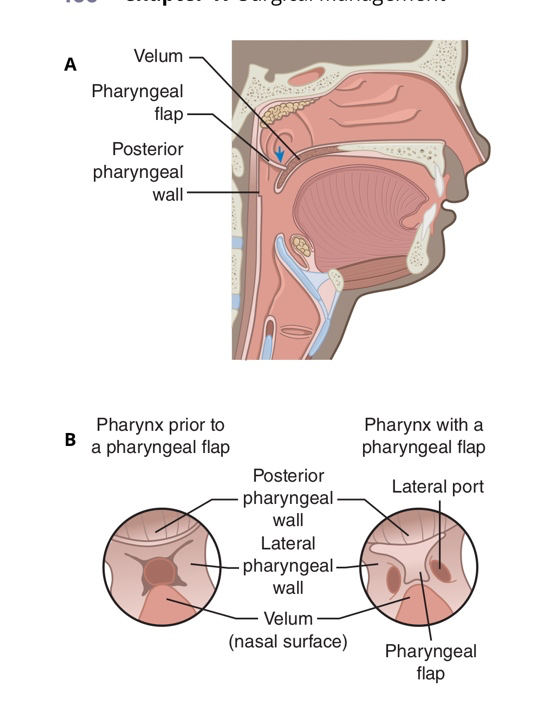
Pharyngeal Flap
A secondary surgical procedure for velopharyngeal insufficiency in which a muscular flap is cut from the posterior pharyngeal wall, raised, and attached to the velum, creating lateral ports for nasal breathing.
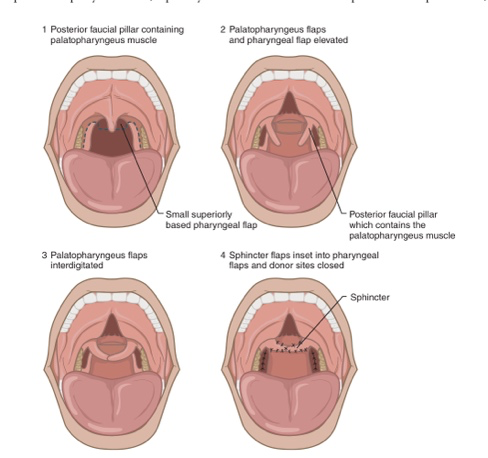
Sphincter Pharyngoplasty
A secondary surgical technique that elevates the posterior faucial pillars containing the palatopharyngeus muscle and attaches them to the posterior pharyngeal wall to narrow the lateral borders of the velopharyngeal port.
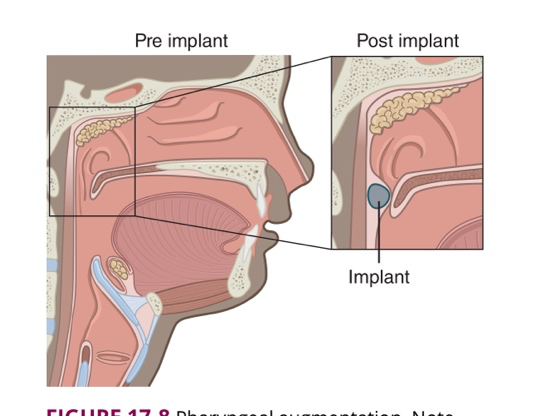
Pharyngeal Wall Augmentation
A surgical procedure for small, localized velopharyngeal openings involving the injection or implantation of a substance into the posterior pharyngeal wall.
Hypernasality
The most common resonance disorder, characterized by excessive sound resonating in the nasal cavity during speech production because the velopharyngeal port fails to close during oral sounds.
Hyponasality
A resonance disorder characterized by a lack of normal nasal resonance on nasal consonants (m, n, η) due to physical blockage or obstruction in the nasal cavity or pharynx.
Cul-de-Sac Resonance
A resonance disorder occurring when acoustic sound energy enters a vocal cavity but is blocked from exiting by a structural obstruction, causing the voice to sound muffled or hollow.
Assimilative Nasality
A resonance defect where nasal resonance inappropriately carries over to adjacent vowels because velar opening begins too early or lasts too long during speech.
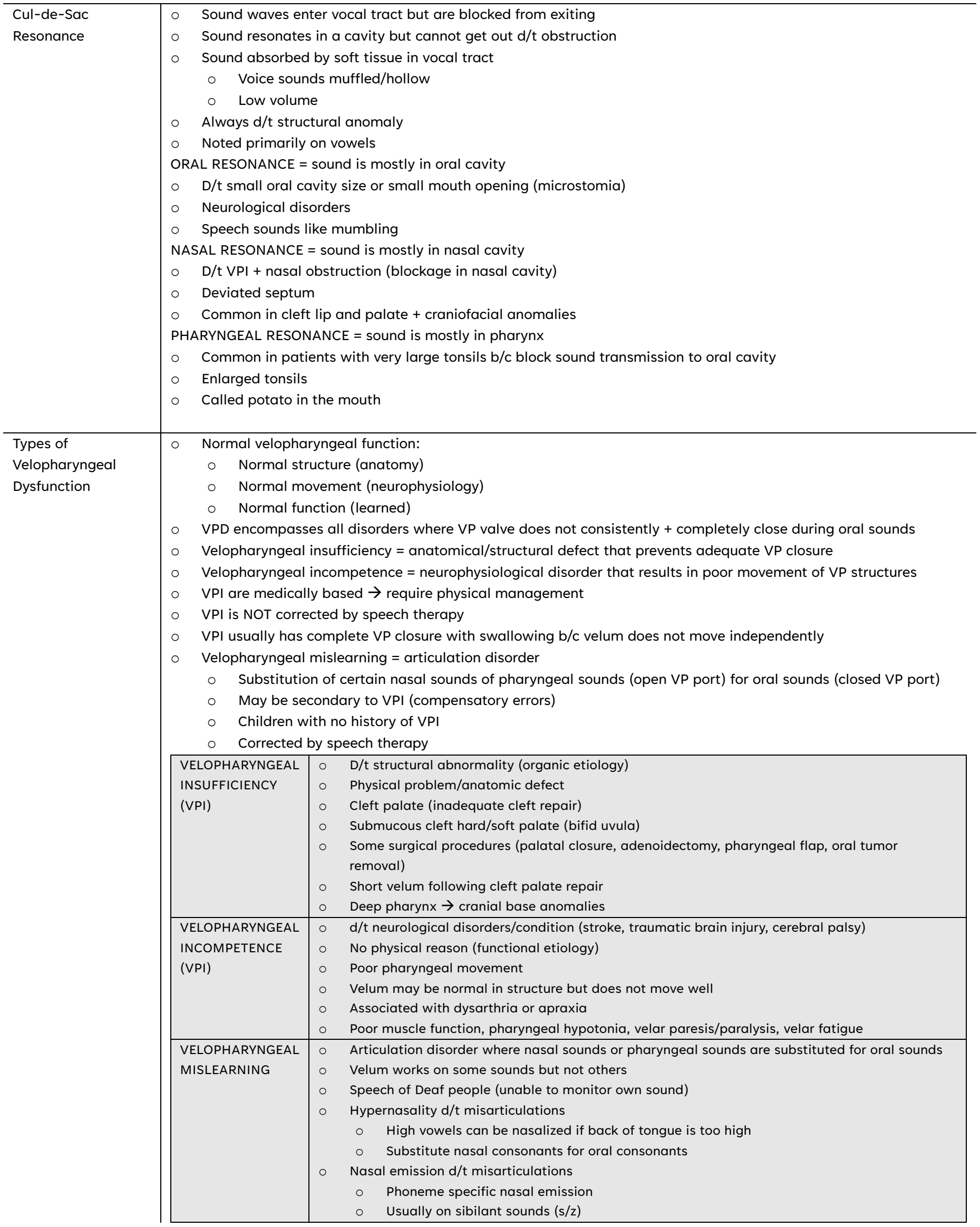
Velopharyngeal Dysfunction (VPD)
An umbrella term encompassing all conditions in which the velopharyngeal valve does not consistently and completely close during oral speech sounds.
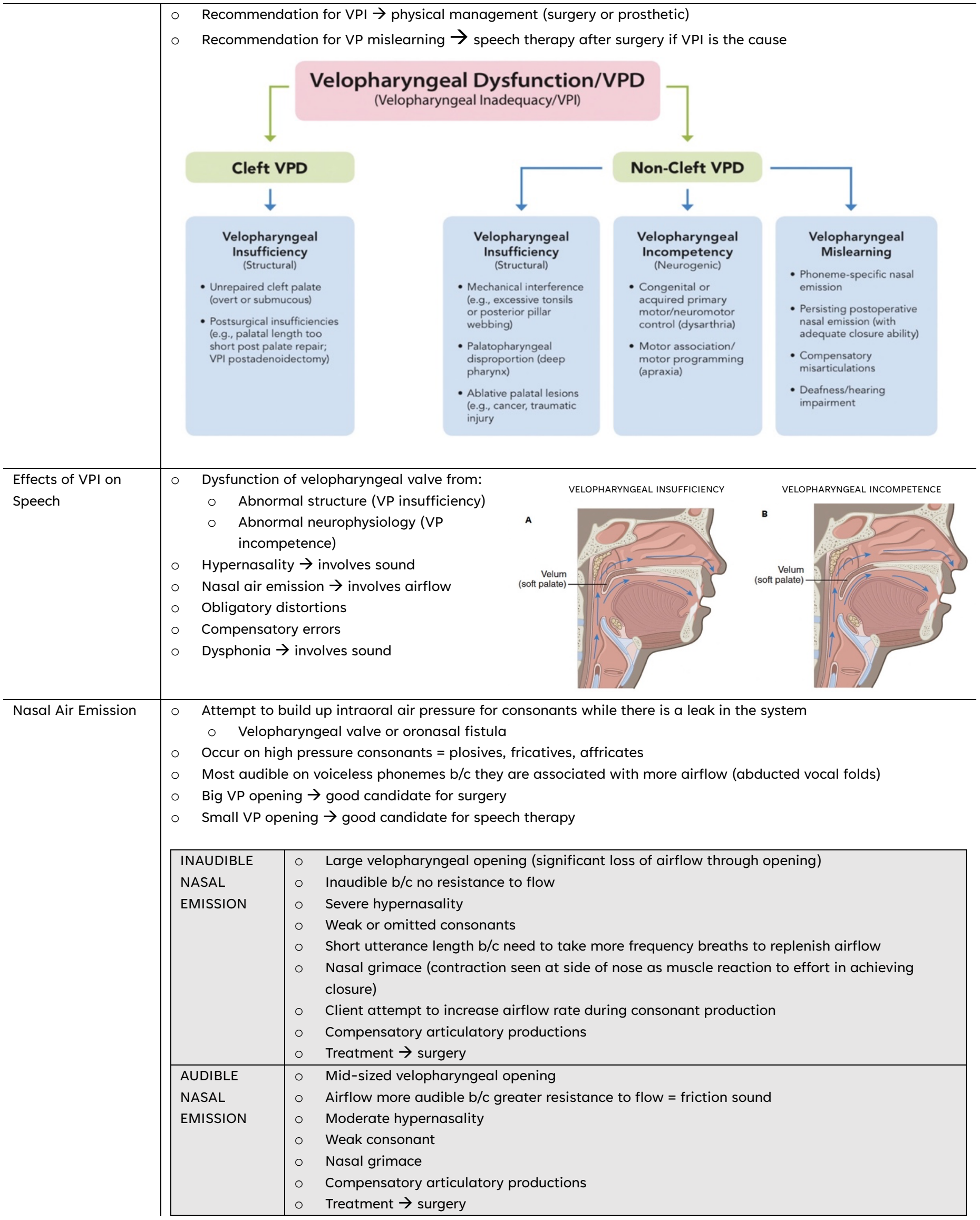
Velopharyngeal Insufficiency (VPI)
A type of velopharyngeal dysfunction caused by an anatomical or structural defect (organic etiology), such as an unrepaired or short velum, that prevents adequate closure.
Velopharyngeal Incompetence (VPI)
A type of velopharyngeal dysfunction caused by a neurophysiological or motor control deficit (neurogenic etiology), where structures are anatomically adequate but exhibit poor movement.
Velopharyngeal Mislearning
An articulation disorder in which nasal or pharyngeal sounds are substituted for oral pressure sounds despite normal or remediated velopharyngeal anatomy.
Nasal Air Emission
The inappropriate leakage of airflow through the nasal cavity during the attempt to build up intraoral air pressure for high-pressure oral consonants (plosives, fricatives, affricates).
Nasal Rustle
An audible nasal distortion (also called turbulence) caused by airflow forced through a very small velopharyngeal opening, producing friction and bubbling of secretions.
Obligatory Distortions
Passive speech errors resulting directly from structural abnormalities, which cannot be corrected by speech therapy alone and require surgical or physical management.
Compensatory Errors
Active speech errors in which a speaker alters articulation placement (e.g., using glottal stops or pharyngeal fricatives) to compensate for loss of airflow, requiring speech therapy for correction.
Nasometry
An indirect instrumental assessment method measuring nasalence using the formula Nasalence Score=oral sound pressure level+nasal sound pressure levelnasal sound pressure level×100.
Nasopharyngoscopy
A direct instrumental technique utilizing a flexible endoscope passed through the middle meatus to view the velopharyngeal mechanism and port closure from above during speech.
Palatal Obturator
A removable prosthetic appliance designed to seal defects or fistulas of the hard palate or velum to allow impounding of intraoral air pressure for speech.
Speech Bulb
A removable prosthetic device featuring a posterior bulb that fills a nasopharyngeal gap to eliminate hypernasality in patients with velopharyngeal insufficiency.
Palatal Lift
A removable prosthetic appliance that physically elevates a paretic or paralyzed soft palate toward the posterior pharyngeal wall to treat velopharyngeal incompetence.
Pierre Robin Syndrome
A congenital craniofacial condition characterized by micrognathia, glossoptosis, soft palate clefting, and early respiratory and feeding difficulties.
Velocardiofacial Syndrome (22q11)
An autosomal disorder representing the most common syndrome associated with cleft palate, featuring cleft palate/VPI, facial anomalies, middle ear infections, and learning difficulties.
Treacher Collins Syndrome
A craniofacial disorder marked by hypoplasia of the maxilla and mandible, slanting eye orbits, coloboma of the lower eyelid, ear malformations, and conductive hearing loss.
Moebius Syndrome
A congenital neurological condition involving aplasia of cranial nerves VI and VII, leading to bilateral facial paralysis, absence of facial expressions, and articulation errors on labial phonemes.