Biochemistry - ATP Synthesis (Ch.21)
 Call Kai
 Learn
 Practice Test
 Spaced Repetition
 Match
 Flashcards
 Knowt Play
1/22

There's no tags or description
Looks like no tags are added yet.
Name | Mastery | Learn | Test | Matching | Spaced | Call with Kai | Chat |
|---|
No analytics yet
Send a link to your students to track their progress
23 Terms
List the process that generates NADH
Glycolysis
Pyruvate dehydrogenase complex
TCA cycle
Fatty acid degradation
Amino acid degradation (some)
List the processes that generate FADH2
TCA cycle
Fatty acid degradation
Amino acid degradation (some)
Define the proton-motive force. Define it’s two components
The unequal distribution of protons is called the proton motive force and it;s composed of two components
A chemical (pH) gradient for the protons
A charge gradient due to the unequally distributed, positively charged protons
Define the chemiosmotic hypothesis. Who what it proposed by?
Chemiosmotic hypothesis: Electron transport and ATP synthesis are coupled by a proton gradient across the inner mitochondrial membrane
Proposed by Peter Mitchell
Describe the chemiosmotic hypothesis in the mitochondria
Protons are pumped across this membrane as electrons flow through the respiratory chain
pH outside the matrix is 1.4 pH units lower
Corresponds to a 0.14V membrane potential
Corresponding free energy is 21.8 kJ/mol of protons
Describe the structure and function of the F0 subunit of ATP Synthase
F0 is composed of 3 different polypeptides: a,b, and c
F0 is the proton channel of the complex
in the membrane

Describe the function and structure of the F1 subunit of ATP synthase
F1 is composed of 5 different polypeptides: alpha, beta, epsilon, sigma, and y
F1 subunit contains catalytic activity
The a and B subunits (three of each) are homologous, but the symmetry of the hexamer is broken in the way each B subunit interacts with a different face of the y chain
Y,E, and c rotate (rotor), other portions of the molecule are stationary (stator)

Does ATP formation occur in the absence of the proton-motive force?
Yes - ATP formation occurs readily in the absence of proton-motive force
The role of the proton gradient is actually to release ATP from the synthase
Describe the loose state of ATP synthase
Loose: binds ADP and Pi

Describe the tight state of ATP synthase
high affinity for ligands - binds ATP with very high avidity, such that ADP and Pi are converted to ATP

Describe the Open state of ATP synthase
almost no affinity for ligands - releases bound nucleotide

What are the roles of the a (alpha) subunits?
The a subunits bind ATP, but appear to be non-catalytic and are generally involved in supporting the structure and ATP binding of the B subunits
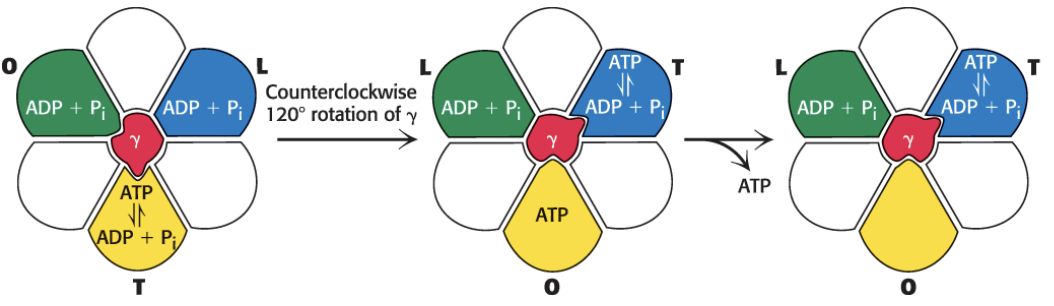
What is the first step of ATP synthase moving from one configuration to another?
ADP and Pi are transiently combining at the T-form site to form ATP, but the ATP can’t be released

Describe the second step of the ATP synthase
A 120 degree rotation of subunit y converts the T-form site into an O-form site

Describe step 3 of the ATP synthase mechanism
ATP at the O-form site can now depart
Describe the fourth step of the ATP synthase mechanism
The ATP at the O-form site is replaced by ADP and Pi

How does the proton flow drive the y subunit?
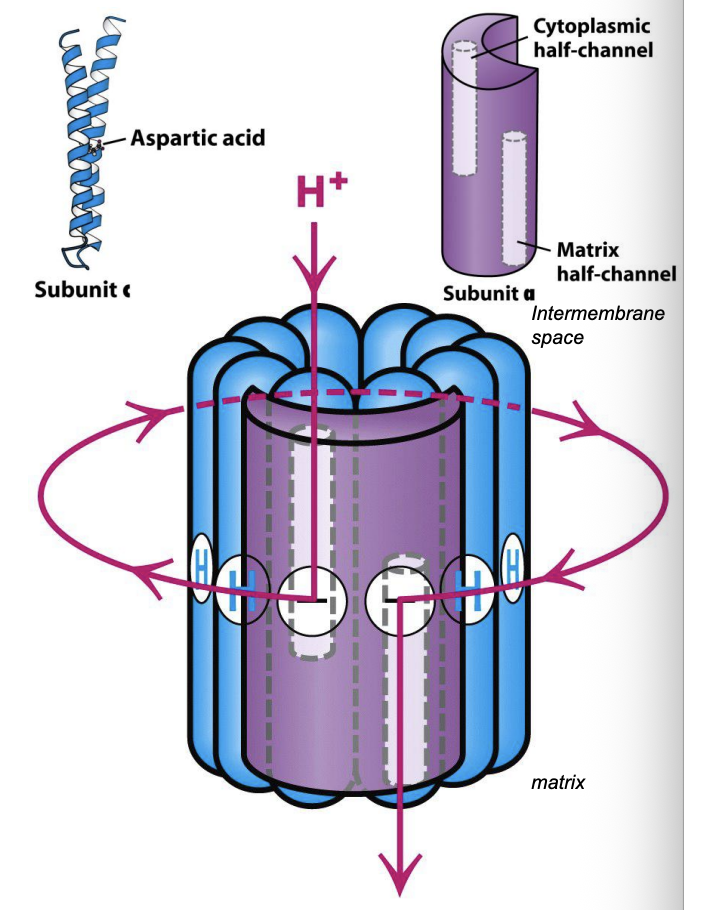
The subunit abuts the membrane-spanning c units, and apears to contain two hydrophilic half channels where protons can enter, but cannot pass through the entire membrane
A proton eneters the a subunit from the intermembrane space (high H+) of the membrane and binds a specific ASP (or GLU) residue on the associated c subunit
The c subunit rotates to a more hydrophobic environment with its now uncharged Asp (of Glu), rotating all the other c subunits with it
The c subunit that has rotated all the way around to exposure with the matrix half channel, can release its proton to the proton deficient matrix - deprotonated Asp is regenerated

Understand the coordination between the ETC and ATP Synthase

What is required for the transport of electrons through the electron-transport chain
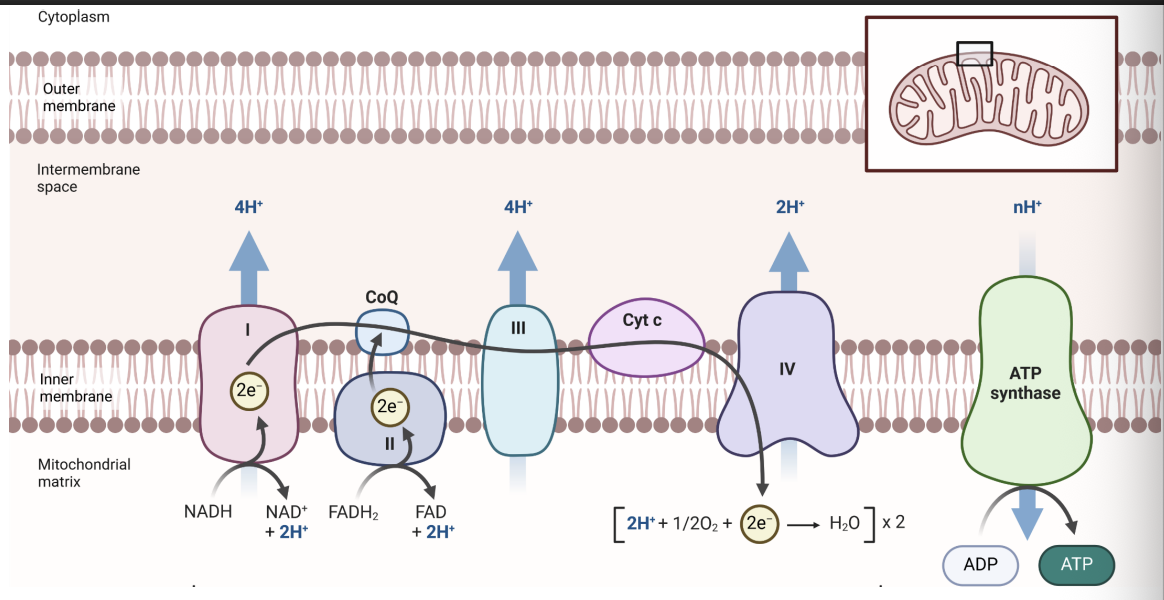
Electrons do not flow through the electron-transport chain unless ADP is available to be converted into ATP (shuttle: ATP-ADP translocase)
Define the process of Oxidative phosphorylation (OXPHOS). Can it be regulated?
Overall, the process of Oxidative phosphorylation is the process of oxidizing nutrients to release energy, which is used generate ATP from ADP and Pi
The regulation of oxidative phosphorylation by ADP is called acceptor or respiratory control
What does the drug retenone do?
Blocks the transfer of electrons from Complex I to CoQ
ETC is partially blocked - No ATP synthesis from NADH

What does the drug Antimycin A do?
Blocks the transfer of electrons from cytochrome b to cytochrome c1
Block the ETC - No ATP synthesis
What does the drug oligomycin do?
Block the proton channel (F0) subunit
No proton translocation back to the matrix - No ATP synthesis - slow down the ETC