CH3G9 Catalysis
 Call Kai
 Learn
 Practice Test
 Spaced Repetition
 Match
 Flashcards
 Knowt Play
1/107

There's no tags or description
Looks like no tags are added yet.
108 Terms
what does a catalyst do and how
a catalyst increases the rate of a chemical reaction without being consumed by lowering the effective activation energy of a reaction
can do this by either modifying the slowest step in the reaction or by providing an alternative pathway that bypasses this rate determining step
give comparisons of homogenous, heterogenous and biocatalysts

do catalysts appear in the overall rate equation and rate law
not in rate equation but can appear in the rate law
how do catalysts affect thermodynamics
they don’t - only changes the kinetics not the amount of product formed
what is an elementary reaction
a single step reaction, with no intermediates and involving one or two reactants (3 in rare occasions)
what is a complex reaction
a series of elementary reactions connected together to represent the overall reaction outcome
how to determine the rate equation of elementary reactions
the chemical equation can be directly used to write the rate equation as the rate equation directly represents the change occurring at the molecular level
what determines which elementary reactions form part of the overall rate equation
the rate determining step
what factors influence kinetics
concentration
temperature
solvent
catalysis
how do you determine the rate of reaction at a given time point
the gradient of the line at that point (the derivative)
what are the 3 types of rate equations and give examples of types of reactions
first order reaction - v = k [reactant]
monomolecular reactions - SN1, rearrangements
spontaneous change
second order reaction - v = k [reactant1][reactant2]
most fundamental reactions - carbonyl chemistry, SN2, eliminations
zeroth order reaction - v = k
catalytic reactions - heterogenous metal catalysis, enzymes
(no reaction is true zeroth order in all reactants/catalysts/reagents)
what is the Arrhenius equation
k = Ae-Ea/RT
A = pre-exponential factor
Ea = activation energy (J/mol)
R = molar gas constant
T = temperature (K)
what is the Eyring equation
k = (κkBT / h) exp(-∆G‡ / RT)
∆G‡ = Gibbs free energy of activation
κ = transmission coefficient
kB = Boltzmann constant
h = planck constant
R = molar gas constant
T = temperature
when is the Eyring equation more useful than the Arrhenius equation
when rigorous kinetic theory is needed
i.e. to determine activation parameters such as enthalpy and entropy of activation
what is a reaction profile
a plot showing how potential energy changes during each step of the reaction
the progress of the reaction (reaction coordinates) is plotted on x axis and the potential energy of the system is plotted on the y axis
what is an energy barrier
the minimum energy required for a reaction to occur
what is the rate-determining step
the slowest elementary step in a complex reaction sequence
the step with the highest energy barrier
what is a substrate
the starting material used in a catalytic reaction
what is catalyst stability
the performance of a catalyst over time
what is the turn over number (TON)
the number of substrates that a catalyst can convert before becoming inactivated
what is the turn over frequency (TOF)
the number of substrate molecules converted to product per active site per unit of time
what determines the overall turnover frequency
the rate determining step
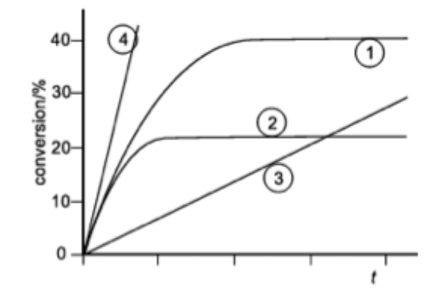
fill in the blanks:
catalysts 1 and 2 are of similar initial __(1)__ but of very different __(2)__
the order of initial activity is __(3)__
what can we say about the comparative productivity of 3 and 4? __(4)__ because __(5)__
activity
stability
4 > 1,2 > 3
nothing
the graph doesn’t show the full reaction

fill in the blank
catalyst 4’ has an _____
induction period
what are the two major working modes for catalysis and give examples
transition state stabilisation
most of biocatalysts
general acid catalysis
lewis acid catalysis
new mechanistic pathways
heterogenous catalysis
transition metal catalysis
covalent catalysis/organocatalysis
what determines the observed rate law for a generic catalytic mechanism
the events between the resting state up to and including the transition state (TS) of the rate determining step (RDS)

what is the rate law and RDS of this reaction profile
2nd step has the highest energy barrier so is the RDS
rate law:
d[P] / dt = k [S1-cat] [S2] = k [S1] [cat] [S2] = k’ [S1] [S2]
k’ = k [cat]
in a catalytic cycle, what is the rate of product formation determined by?
the activation energy of the cycle as a whole, ∆G‡cycle
what is the resting state in a reaction coordinate diagram
the lowest energy combination of catalyst and reaction components
what is ∆G‡cycle
the energy difference between resting state and TS of the RDS
i.e. highest energy combination of catalyst and reaction components

in these two reaction profiles, what are the resting states
top reaction profile: [cat]
bottom reaction profile: I1

which of these has a new mechanism that is catalytic
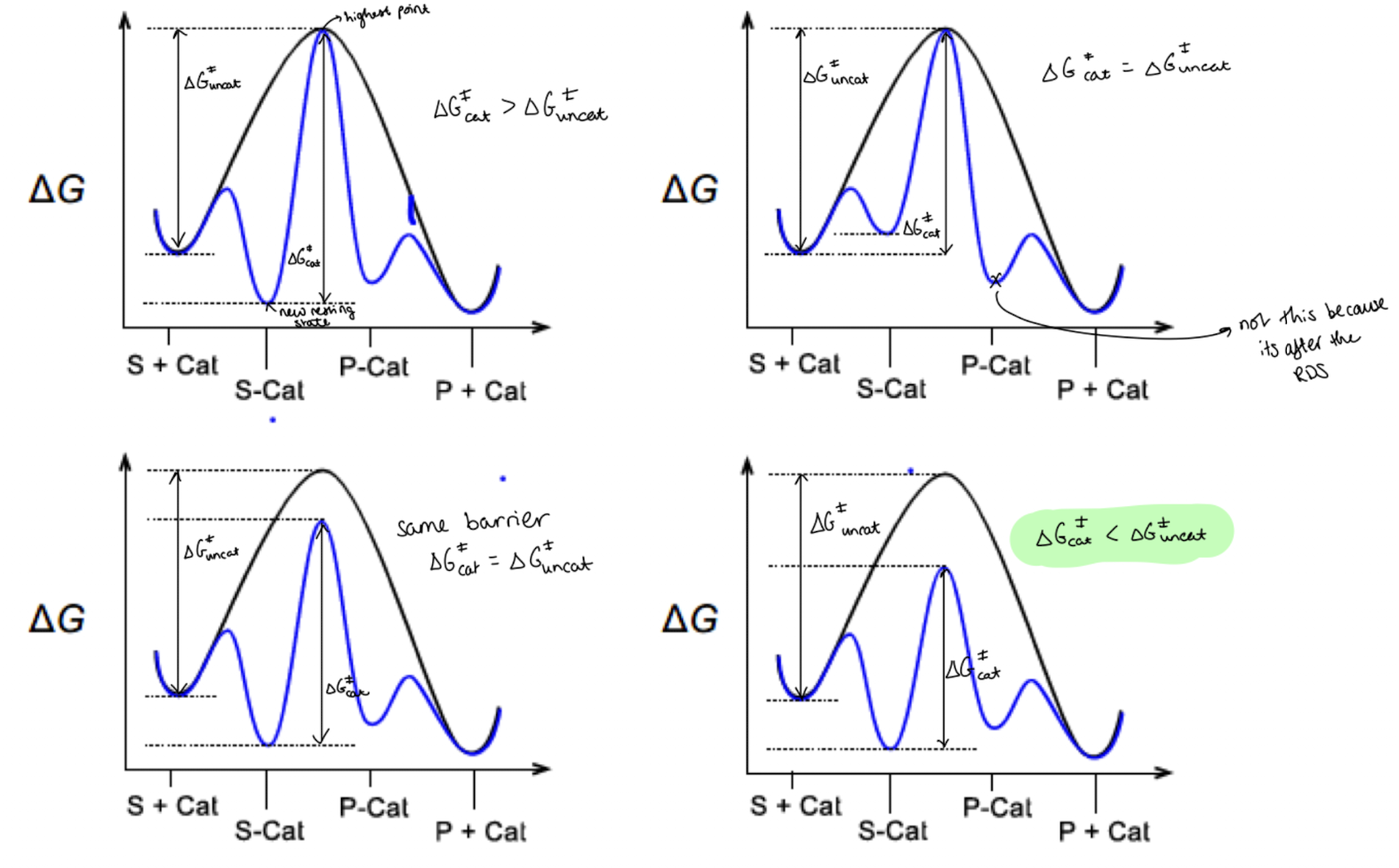
what is a precatalyst
a stable compound from which a “catalytically active” species is generated - often irreversibly
can occur using an activator or by reaction with a substrate → induction period
what is an off-cycle species
compounds generated from catalytic intermediates not directly implicated in the productive cycle

what is the true catalyst in a catalytic cycle
any intermediate with a catalytic cycle can be considered a viable catalyst
precatalyst
a species obtained when the product is released
the product itself
an off cycle species, that forms reversible
draw a conversion-time graph to show what happens when you have an irreversible vs reversible off-cycle reaction

what is chemo and regional selectivity
selectivity determined as ratio between products (or yields)
what is stereoselectivity
selectivity often determined by the excess
enantio- and diastereoselectivity
what is enantiomeric excess (ee)
the absolute difference between the mole fractions of each enantiomer
what is the equation to calculate enantiomeric excess
ee = | xR - xS|
xR + xS = 1
what is enantiomeric ratio (er)
the ratio between the mole fractions of each enantiomer
er = xR / xS
how do you calculate an enantiomeric ratio (er) from the enantiomeric excess (ee)
use an R enantiomer being preferred with a 76 % ee
0.76 = xR - xS = (1 - xS) - xS = 1 - 2xS
xS = (1 - 0.76) / 2 = 0.12
er = xR / xS = 88 / 12 = 7.3

for this reaction profile, what product is preferred and what does the ratio of the product depend on and why
selective for blue product
selectivity-determining step and RDS coincides
ratio of product depends on RDS
prospects for selective catalysis are high

for this reaction profile, what product is preferred and what does the ratio of the product depend on and why
selectivity-determining step happens after RDS
ratio of product depends on barrier with lower energy than RDS
not selective
after going over RDS, it will be random as it has enough energy for both

for this reaction profile, how do you determine which product is formed. what kind of selectivity is this
A is the predominant adduct at equilibrium but the major product does not have to come from the major species
conversion of B so reaction prefers pathway 2
chemoselectivity
how can you decrease the activation barrier ∆G‡cycle for the RDS of the reaction cycle. give an example
stabilise the ground state more than the ground state
or
destabilise the ground state more than the transition state
solvation - in polar vs apolar solvents, transition states can (de)stabilise
what are the 7 forms of catalysis
proximity enforcement
electrophilic catalysis
nucleophilic catalysis
strain and distortion
acid-base catalysis
covalent catalysis
phase transfer catalysis
what happens in proximity enforcement catalysis
when reactions happen through collisions between tow molecules, the reaction will be faster if the molecules are held closely together in space
some catalysts bind two substrates and bring them close together, forcing rate acceleration due to entropic cost of reaction already paid through binding
what is effective molarity
the concentration a second reactant would need to have to obtain the same rate constant as the equivalent intramolecular reaction
i.e. the ratio between the intra and intermolecular rate constant
effective molarity equation
EM = k1 / k2
k1 = rate constant for intramolecular reaction
k2 = rate constant for intermolecular reaction
how much can a reaction be accelerated solely due to proximity effects
>108

what are the chemical modifications that could be made to this molecule to increase rate of reaction due to proximity effects

what are lewis acids
chemical species which can accept electron pairs from lewis bases into empty orbitals
give examples of molecules that can be lewis acids
boron based
BF3
BR3
BH3
aluminium based
AlCl3
AlR3
silicon
SiR4
sulphur
SO3
what metals are good Lewis acid catalysts
alkali/alkaline earth metals
K+, Ca2+, Mg2+
transition metals
Fe3+, Ti4+, Sc3+, Zn2+
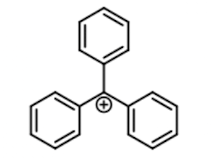
carbocations
positively charged carbons (e.g. trityl ion shown)
proton
what type of synthesis are lewis acid catalysts important for and why
asymmetric synthesis/catalysis
generally simple to equip lewis acids like transition metal ions with chiral ligands
what is lewis base catalysis
catalysis via nucleophilic binding to a reactant, with subsequent enhancement of reaction rate
draw the catalysed reaction between a generic acid chloride, alcohol and pyridine

when doing lewis base catalysis, what is important about the reactants/catalyst
the catalyst must be a better nucleophile and leaving group than the reaction nucleophile
what are good catalysts for lewis base catalysis
pyridine or more electron rich pyridines like DMAP

what is catalysis by strain or distortion
destabilisation of the ground state, rather than stabilisation of the TS, often done by inducing strain or distortion
give examples of catalysis by strain or distortion
lysozyme - strain induced biocatalysis
molecular cage catalysis - strain by confinement

what is specific bronsted acid catalysis
a process where the reaction rate only depends on the specific acid, not other acids in solution (vice versa for specific base catalysis)
what is a specific acid (bronsted acid-base catalysis)
the protonated form of the solvent in which the reaction is being performed
what is the specific base (bronsted acid-base catalysis)
the conjugate base of the solvent
what are the two main forms of bronsted acid-base catalysis
general and specific
write a generic chemical equation for a strong acid in water in specific acid base catalysis
R + H3O+ ←> RH+ —-slow→ PH+ —fast—> P + H3O+
derive a generic rate equation for a strong acid in water in specific acid base catalysis
R + H3O+ ←> RH+ —-slow→ PH+ —fast—> P + H3O+
d[P] / dt = k [RH+]
Ka,RH+ = [H3O+] [R] / [RH+] => [RH+] = [H3O+] [R] / Ka,RH+
∴ d[P] / dt = k [H3O+] [R] / Ka,RH+
write a generic chemical equation for a weak acid in water in specific acid base catalysis
R + HA ←> RH+ + A- —-slow→ PH+ + A- —fast—> P + HA
derive a generic rate equation for a strong acid in water in specific acid base catalysis
R + HA ←> RH+ + A- —-slow→ PH+ + A- —fast—> P + HA
d[P] / dt = k[RH+]
Ka = [RH+] [A-] / [R] [HA] => [RH+] = Ka [HA] [R] / [A-]
Ka’ = [H3O+] [A-] / [HA] => [HA] / [A-] = [H3O+] / Ka’
[RH+] = Ka / Ka’ [H3O+] [R] = Ka’’ [H3O+] [R]
∴ d[P] / dt = k Ka’’ [H3O+] [R] = k’ [ H3O+] [R]
write a generic chemical equation for when an acid is in the RDS in general acid base catalysis
R + HA ←slow→ RH+ —fast→ PH+ → P + HA
derive a generic rate equation for an acid in the RDS in general acid base catalysis
R + HA ←slow→ RH+ —fast→ PH+ → P + HA
d[P] / dt = k [HA] [R] = k[H3O+] [A-] [R] / Ka’
as Ka’ = [H3O+] [A-] / [HA] so [HA] = [H3O+] [A-] / Ka’
what is in all acid-base catalysis rate equations
HA or A-
what do general and specific refer to for acid-base catalysis
general - any acid/base added to solution will affect the rate of reaction
specific - just one acid/base (that from the solvent) will affect the rate
when does the proton transfer happen for general vs specific acid-base catalysis
general
proton transfer occurs during RDS
specific
proton transfer occurs before RDS
what do the kinetics of general vs specific acid base catalysis depend on
general
kinetics depend directly on catalyst concentration
specific
kinetics only depend on solution pH, not catalyst concentration
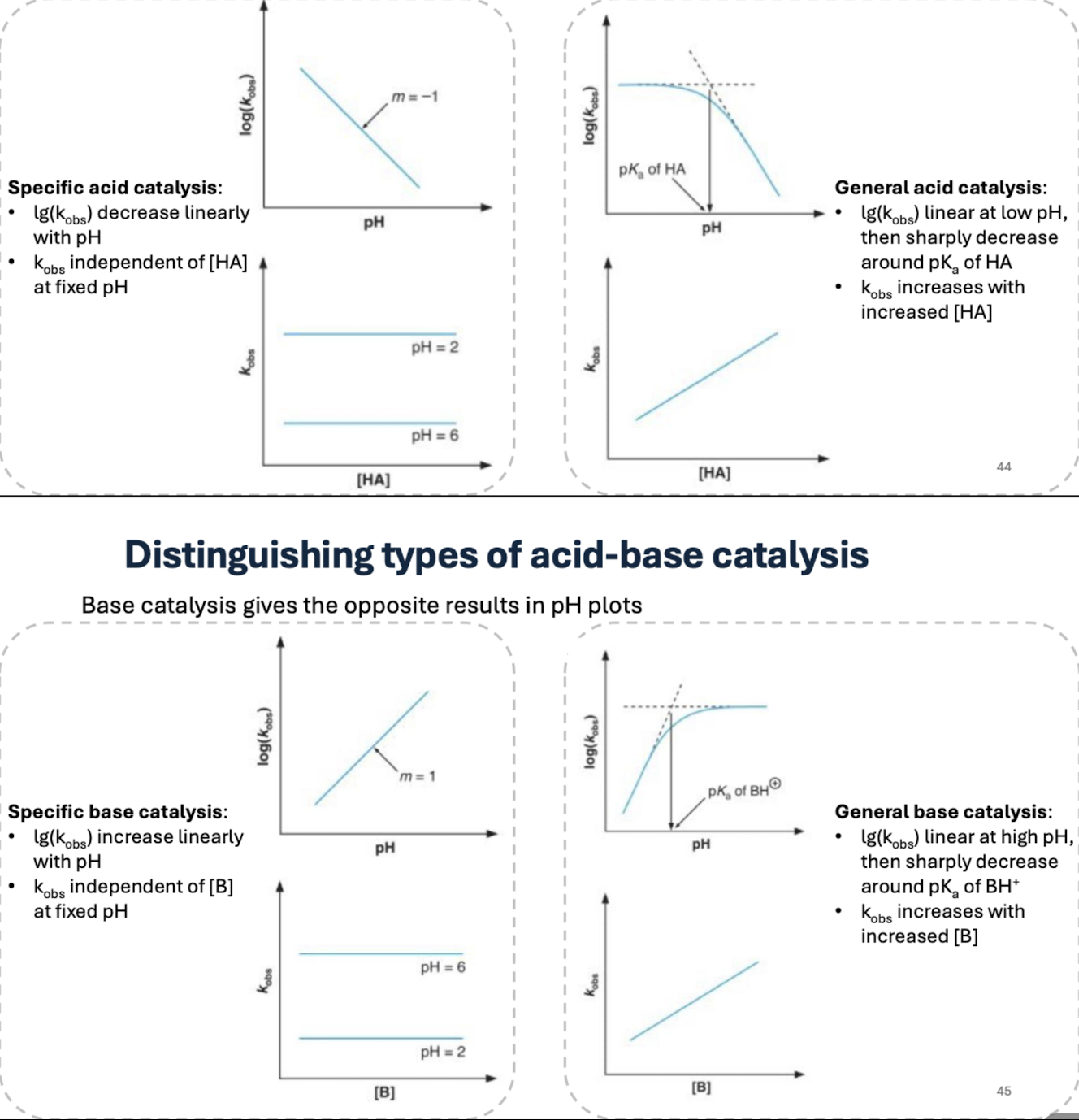
draw the kobs vs pH and [HA] graphs for specific acid catalysis
log(kobs) decreases linearly with pH
kobs is independent of [HA] at fixed pH

draw the kobs vs pH and [HA] graphs for general acid catalysis
log(kobs) linear at low pH then sharply decrease around the pKa of HA
kobs increases with increased [HA]
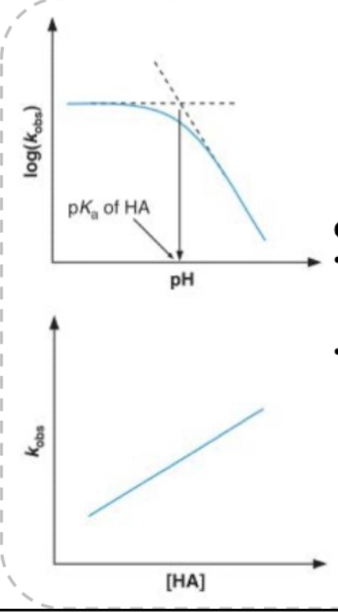
draw the kobs vs pH and [HA] graphs for specific base catalysis
log(kobs) increase linearly with pH
kobs independent of [B]

draw the kobs vs pH and [HA] graphs for general base catalysis
log(kobs) linear at high pH, then sharply decrease around pKa of BH+
kobs increases with increased [B]

what method can you use to distinguish specific and general acid/base catalysis
pH plots:
log(kobs) vs pH
kobs vs [HA] or [B]
how do the pH plots of acid catalysis relate to base catalysis
they are the inverse (except general acid/base catalysis kobs vs [HA]/[B] plot)
what is the libido rule
general-acid or general-base catalysis will occur when a thermodynamically unfavourable proton transfer in the ground state is converted to a thermodynamically favourable transfer in the transition state
when will general-acid or general-base catalysis occur
when a thermodynamically unfavourable proton transfer in the ground state is converted to a thermodynamically favourable transfer in the transition state

what potential energy surface belongs to which type of acid-base catalysis
A. specific - no proton transfer in RDS
B. general - proton transfer in RDS
C. general - goes through one TS
D. specific - proton transfer in RDS
what should you look for to determine if an acid/base catalysis is general or specific
if proton transfer happens in RDS then it is general, if not then specific