BIOC221 - Mod 3, Eukaryotic transcription, pre-mRNA splicing and gene expression
 Call Kai
 Learn
Learn Practice Test
 Spaced Repetition
 Match
Match Flashcards
 Knowt Play
1/45

There's no tags or description
Looks like no tags are added yet.
Name | Mastery | Learn | Test | Matching | Spaced | Call with Kai | Chat |
|---|
No analytics yet
Send a link to your students to track their progress
46 Terms
Define CTD
C-terminal Domain. It’s super important in RNAP II as it is the first part of RNAP that is recruited for intiation of transcription.
What does TSS, CP and CRE stand for
Transcription start site, Core Promoter and Cis-regulatory element. (cis-regulatory element means elements on DNA that effect its gene expression, elements of the DNA strand on the strand that control its expression.
What are the main types of non-coding genes in eukaryotes
Non-coding genes generally produce functional RNA products that can do:
protein translation: ribosomal (rRNA), transfer RNA (tRNA)
RNA-processing: small nuclear RNA (snRNA), small nucleolar RNA (snoRNA)*
regulation of gene expression: microRNAs (miRNA) and long non-coding RNA (lncRNA)
Describe the stages at which gene expression can be controlled.
• Transcription: whether a gene is copied into mRNA (or ncRNA)
• Co-transcription/mRNA processing – E.g. alternative splicing giving different forms of a protein
• Post-transcription: mRNA stability and translation efficiency determines how much protein is made from each mRNA – E.g. miRNAs (microRNAs)
• Post-translational (protein-coding genes): covalent modifications, localization and degradation alter protein function or abundance (Liz Ledgerwood)
lnc-RNAs can affect gene expression at multiple stages
What are the products of the nuclear polymerases in eukaryotes?
RNA Polymerase I makes: Most rRNA, located in the Nucleolus
RNA Polymerase II makes: mRNA, snoRNA, some snRNA, miRNAs, and lncRNA, located in the Nucleoplasm
RNA Polymerase III makes: tRNA, 5s rRNA, some snRNA, and other small ncRNAs. Located in the Nucleoplasm
What are the different subunits of a DNA-based RNAP called?
(called Rpb#), e.g. Rpb3 or Rpb11
Describe the CTD of the RBP1 subunit of the eukaryotic RNA Polymerase II and how it changes during transcription.
Not structured, not catalytic. (multiple copies of the same seven amino acid sequence).
The CTD is reversibly phosphorylated during transcription - Ser 2 and Ser 5 are the main residues that get phosphorylated - Kinases add phosphate groups - Phosphatases remove phosphate groups - Different phosphorylation patterns alters RNA Pol II interactions with other proteins/factors
What part of Transcription Initiation does RNAP need help with?
RNAP requires additional assistance to find the correct start codon to start transcribing the reading frame. It is very important that it finds the correct AUG start codon as incorrect starts will cause a frameshift.
What part of histones make histone tail modifications and therefore gene expression regulation possible?
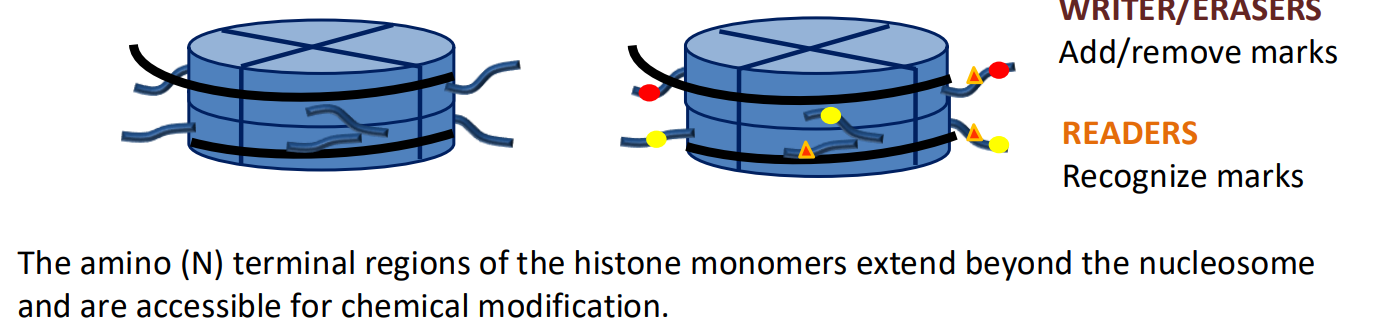
The N-terminal of histone monomers. They are modified by HAT’s and HMT’s to add acetyl and methyl groups respectively. These HTM’s can affect RNAP binding affinity, signalling when or if the gene should be expressed
Break down the events preceding RNAP II binding to a gene.
Transcription Factors bind to the cis-regulatory elements (CRE’s) of a specific gene in an enhancer region next to a promoter, which is upstream of its exxons and the core promoter. These transcription factors are transcription activators, after the activators bind they recuits co-activators.
Co-activators acetylate histone H3 and histone H4 Co-activators may also make other histone-tail modifications (e.g. methylation)
Nucleosome remodelers - Part of, or recruited by, co-activators - Reads histone tail modifications and slides or evict nucleosomes - often partially by removing H2A/H2B dimers, leaves H3/H4 dimers with tail modifications - helped by DNA-histone interactions being a little bit looser
What are the two domains of a transcription factor?
Typical activators consist of two domains
Activation domain (AD): Protein-protein interactions - Other activators (complex) - Co-activators
DNA binding domain (DBD): Binds an enhancer Hold the activation domain in the vicinity of the promoter
After activator/co-activator recruitment, how is RNAP guided to the TSS?
Activators/co-activators recruit RNAPII and form to pre-initiation complex (PIC). This contains many general transcription factors (GTF), TFIIA to TFIIH, which have different roles in helping RNAPII reach the TSS, by the ordering of their recruitment, the GTF’s can help recruit RNAPII to the TSS.
Which GTF is recuited first to form the pre-initiation complex and how is this done?
TFIID is a protein complex.
TFIID is recruited to the core promoter by a combination of:
1. TFIID binding to DNA sequences (motifs) in the core promoter e.g. TATA box
2. Interactions with co-activators (multiple GTFs)
3. Histone-tail modifications - TFIID has reader proteins - H3 and H4 acetylation, methylation of specific residues
Describe the events associated with the initiation of transcription, getting to the unstable, abortive transcription stage
Once the PIC has been formed, RNAP has been recruited to the TSS to start transcription. GTR TFIIH has helicase activity so can unwind the DNA, forming a transcription buble inside the PIC. The GTF’s help load the template strand onto the cleft of RNA polymerase II
Once RNAP has bound to the TSS, what steps must the GTF’s take to stabilise RNAP so it can begin transcription
To become more stable RNA polymerase II must adapt an active conformation with the clamp close to hold onto the DNA and form the stabilising DNA-RNA hybrid helix. RNAPII also needs to break contacts with the GTFs that are anchored to the core promoter so RNAPII can move along the template strand. The contacts are broken by TFIIH kinase activity, it adds phospates to serines at position 5 (Ser 5) of the heptapepetide repeats of the CTD, changing the proteins the CTD interacts with. The DNA/RNA hybrid helix helps remove the stabilising GTFs (mainly TFIIB) that are attached to the PIC from the RNAPII, so RNAPII can move forward and transcribe the whole gene.
Describe the addition of the 5’cap, including when capping occurs and how this relates to the CTD
The addition of the 5’ Cap is a PTM that happens while transcription is taking place.
The mRNA Capping enzyme (CE) is recruited by Ser5 P of CTD but performs its job on the 5’ RNA strand being transcribed. Triphosphatase activity cleaves 5’ phosphate - guanylyltransferase activity uses GTP (energy) to add an inverted guanine (G) (GMP added) - stable but poor translational efficiency
RNA methyltransferase (RNMT) recruited by Ser5 P of CTD - methylates nitrogen 7 of the guanine base (m7) - stable and high translation efficiency
What does PTEF-b complex do to promote productive elongation during transcription?
Positive Transcription Elongation Factor b (P-TEFb) complex. It does:
phosphorylation of Ser 2 of the CTD recruits a range of Elongation Factors (EF) that help RNA Pol II:
reach full processivity/ stability
transcribe DNA in chromatin
elongation factors have similar roles to co-activators at the core promoter - HAT activity: H3/H4 acetylation (loosen/ recruit readers)
Nucleosome remodelers (NR) evict (full or partial) nucleosomes in front of RNA Pol II and replace them after transcription.
What is the basic structure and function of the spliceosome?
• Complex of splicing factors (U#) which consist of snRNAs and proteins
• Some splicing factors recruited by RNA Pol II with Ser2 P on CTD
• Splicing factors are small nuclear ribonucleoproteins; snRNPs or “SNERPS” – RNA molecules form complex shapes – Catalytic site of the spliceosome largely formed by RNA molecules • Ribozyme - ribonucleic acid enzymes The spliceosome U1 snRNP snRNA
Its function is to remove introns from transcribed RNA via transesterification reactions: - the breaking of one phosphodiester bond is coupled with the creation of another (Requires ATP)
Describe the process of RNA splicing by the spliceosome
Some splicing factors associate with Ser2 P on CTD of RNA Pol II
Recognize consensus sequences (base pairing) in the pre-mRNA as it exits RNA Pol II. Transfer onto pre-mRNA.
There are three sites recognized: 5’ splice site, Branch point/branch site (A), 3’ splice site
First, the Splicing factors bind to an A site, which is just upstream of the 3’ end of the intron to be deleted, and bind to the 5’ end of the intron. Then they catalyse a transesterification to move that bond so the 5’ end bonds to the A site, forming a lariat (lasso shape).
Splicing factors change out
A second transesterification reaction occurs, the 5’ intron site to the A site bond is switched to a bond between the 3’ and 5’ ends of the exons flanking the intron lariat. This removes the intron successfully.

How does the CTD of RNAPII change during productive elongation?
- a phosphatase removes P from Ser 5 in heptapeptide repeats
- P-TEFb continues to add P to Ser2 in heptapeptide repeats
What phosphorylation state of the CTD causes termination and adenylation of transcription
Low Ser 5/ high Ser 2 on the CTD recruits:
CPSF (cleavage and polyadenylation specificity factor)
CstF (cleavage stimulation factor)
Describe the process of termination and adenylation of mRNA transcription
CPSF (cleavage and polyadenylation specificity factor)
CstF (cleavage stimulation factor)
These factors are recruited when the cleavage signal in mRNA exists RNA Pol II, they recruit more CF’s, and they cleave the mRNA
PAP (poly-A polymerase) recruited by CPSF
PAP adds multiple As (polyA) to 3’ end of mRNA (no template, uses ATP)
Poly-A binding proteins (PABP)bind to provide protection and translation efficiency
What happens downstream of the cleavage site after transcriptional termination?
Downstream of cut site:
termination 5’ end of cleaved mRNA no longer protected by 7mG-cap
Exonuclease degrades mRNA that is still associated with Pol II
DNA/RNA hybrid helix is disturbed
Pol II stops transcription and dissociates from the DNA CTD dephosphorylated
Explain what is meant by activator “activity”.
Typical activators consist of two domains:
DNA Binding domain (DBD): Binds an enhancer, holds the activation domain in the vicinity of the promoter. “Activity”: ability to bind an enhancer.
Activation domain (AD) Protein-protein interactions - Other activators (complex) - Co-activators. “Activity” ability to recruit co-activators.
Describe how activator “activity” is regulated
1. Presence/absence Gene expression and degradation
2. Conformation Ligand binding Post-translational modifications
3. Complex that activator binds to changing formation
4. Inhibitors, repressors that bind the promoter or to the activator, changing its form.
5. Nuclear localisation. (if in nucleus to transcribe genes or not)
What techniques would we use to measure the activity of an activator
RT-qPCR to make cDNA from mRNA transcripts in cell conditions. We can use poly-T primers to bind to the poly-A tail of mRNAs so we only read mRNA transcripts, and design more specific primers to measure mRNA expression of one gene.
RNA-Seq can tell us about the expression of all the genes in a cell. These expression measurement techniques allow us to measure the effect of activators on gene expression, or you could directly measure the expression of activator genes.
How can some activator genes end up creating multiple different functional activators?
Activators usually bind their Activator domains to form heterodimers or larger complexes with other proteins, so there may be multiple forms that a single activator monomer could end up in, each with a different function.
How does euchromatin conformation affect transcription?
Even within euchromatin which is most protein-coding genes are, Chromatin can be tightly packed, “closed”, with activators unable to bind to its CRE’s, or it can be open with space for activator binding and then RNAP II binding
What are the two types of proteins that facilitate the histone code?
Writers/ erasers: proteins that add/remove specific modifications, write the code Examples: HATs, HDACs, HMTases, histone kinases
Readers: recognize specific histone modifications and can alter chromatin structure
Examples: nucleosome remodelers, chromatin compaction proteins/ structural proteins, DNA methyltransferase
What can different histone tail modifications be read as?
- acetylated histone tails recruit readers associated with open chromatin
- methylated histones can recruit readers associated with open or closed chromatin depending on the histone, the residue and the number of methyl groups added
Describe how to perform a chromatin immunoprecipitation (ChIP)
Formaldehyde treatment forms covalent bonds between DNA and proteins and between close (interacting) proteins: crosslinks
Purify the chromatin (still cross linked)
Fragment DNA into pieces (200-1000 bp) (sonication)
Incubate cross-linked DNA with antibody that is specific for the protein-of-interest
Antibodies are usually attached to a column or bead so they be isolated from solution with the bound cross-linked DNA.
Stop antibody binding and separate from protein/DNA
Reverse cross link, separate and analyses the DNA

Why would you perform a Chromatin Immunoprecipitation?
Used to detect interactions between proteins and genomic DNA within cells
A. Which genes are currently being transcribed?
B. Where does an activator bind to genomic DNA?
C. Which regions of the genomic DNA have a specific histone-tail modification?
D. Where in the genomic DNA are histone tails being modified?
Once you have isolated DNA and proteins from chromatin immuno precipitation, how do you analyse the DNA?
- Sequence the immunoprecipitated DNA and map reads to the genome (like with RNA-Seq data)
- Find which regions of the genome, and how much of each region, were immunoprecipitated
What is the CRE on mRNA that allows for post-translational modifications?
sequence motifs
- bound by RNA biding factors (proteins, RNPs, non-coding RNAs)
- role in alternative splicing, post-transcriptional regulation
Explain how alternative splicing can produce different functional proteins and how this could alter a protein and protein function.
The spliceosome somewhat randomly splices introns out so can produce a wide range of proteins with slightly different AA patterns and therefore structure.
What is the regulation mechanism to control intron splicing?
The sequence motifs in the mRNA and how well they recruit splicing factors is a big determinant in an introns chance of being spliced from the mRNA.
This is also affected by proteins, ribonuclearproteins, lncRNA’s binding to CRE’s on the mRNA and affected SF binding affinity
How does the length of the poly-A tail of an mRNA affect its transcription?
mRNAs are often circular with the 5’ and 3’ ends held together by interactions between 5’ cap, eukaryotic translation initiation factors and poly-A-binding proteins (PABP) - protected from exonucleases (stable) and efficient translation. If poly-A tail is short (<25 As), PABP stop binding - Not circular - RNA will be degraded and difficult to translate.
Length of the poly-A tail can be used to alter mRNA half-life and translation
How are CRE’s often made of double-stranded RNA?
Complementary base pairs on RNA’s in different parts of the sequence can bond together, forming secondary structures on the RNA and folding the RNA into a certain shape, this forms a CRE which can be bound to to control gene expression.
What is RNAi?
A process in which RNA molecules inhibit gene expression by altering mRNA stability or translation efficiency. Triggered by a double-stranded RNA molecule (dsRNA) in the cytoplasm
How are miRNA produced endogenously?
miRNA production - Transcription from a miRNA gene (non-coding) in the nucleus, usually by RNA Pol II (regulated). Folded into a pri-miRNA (primary miRNA; forms a stem-loop). A ribonuclease (RNase; Drosha) cleaves ssRNA and exports pre-miRNA (preliminary miRNA) cytoplasm (mostly) - RNase Dicer processes it to miRNA duplex (21-23 nts, still dsRNA)
How do miRNA contribute to gene expression?
Regulates gene expression by binding a cis-regulatory element in mRNA, usually in non-coding regions
Once passed into the cytoplasm, what happens to the ds mi/siRNA?
One strand can base pair with the Agonaut protein, which has complementary base pairs with either the strand or its antisense pair. The other strand is released and degraded. The Agonaut protein with the mi/siRNA binds to the RISC, the RNA-Induced Silencing Complex.

What does the RISC do?
RISC binds to mRNA leading to either
- mRNA degradation (RNase/ slicer) or prevents translation - common in plants
- Inhibition of the ribosome (blocks translation) - common in animals

Describe the characteristics of lncRNAs including how they are generated.
RNA transcripts not from protein-coding genes or known noncoding genes (rRNA, tRNA, etc)
LncRNA can be transcribed in many ways from DNA:
- antisense (opposite direction to an mRNA)
- bidirectional (opposite direction from a promoter)
- intergenic (between protein-coding genes)
- intronic (from an intron of a protein-coding gene)
(Mainly) transcribed by RNA Pol II - processed like an mRNA - 5’ 7mG cap, spliced, poly-A tail
What are the mechanisms through which lncRNAs can influence gene expression?
lncRNA can: base pair with complementary DNA and other RNAs and form complex shapes (base pairs within lncRNA): It can do lots of regulatory roles
i) Direct regulator - promote/ inhibit processes
ii) Guide - recruit a protein (proteins) to a nucleic acid sequence or another protein
iii) Scaffold - bind multiple proteins/other RNA to form a complex
iv) Decoy or sponge - binds another molecule (protein or RNA) that prevents the molecule binding elsewhere
v) Source of dsRNA (antisense transcript)
Come up with three examples of how lncRNA can regulate different stages of gene expression
Three of these from different levels:
Transcription
- activators:
- direct regulator: plays the role of an activator (binds Co-activators to core promoter)
- decoy: activator binds lncRNA instead of DNA (sequence matches enhancer sequence)
- guide: helps bring an activator to an enhancer
- scaffold: help bring activators and co-activators together
Transcription – chromatin:
- guide: recruit writers and readers to certain genes to open/close chromatin
- scaffold: help range of proteins interact/ remain associated Co-transcriptional
- direct regulator: help or inhibit recruitment of first splicing factors to RNA consensus sequences
Post-transcriptional
- direct regulator: influence the competition between extension and shortening of the poly-A tail
- direct regulator: inhibit the ribosome or promote translation
- decoy/sponge: provides miRNA binding sites, bind to lncRNA instead of mRNA
- other: source of dsRNA to trigger RNA interference (RNAi)