A&P CH. 10 Part A
 Call Kai
 Learn
 Practice Test
 Spaced Repetition
 Match
 Flashcards
 Knowt Play
1/73

There's no tags or description
Looks like no tags are added yet.
74 Terms
What are the two components of skeletal muscle?
Active component: Uses ATP to slide filaments and produce contraction.
Passive component: Connective tissues (CT) that support the muscle and transfer force
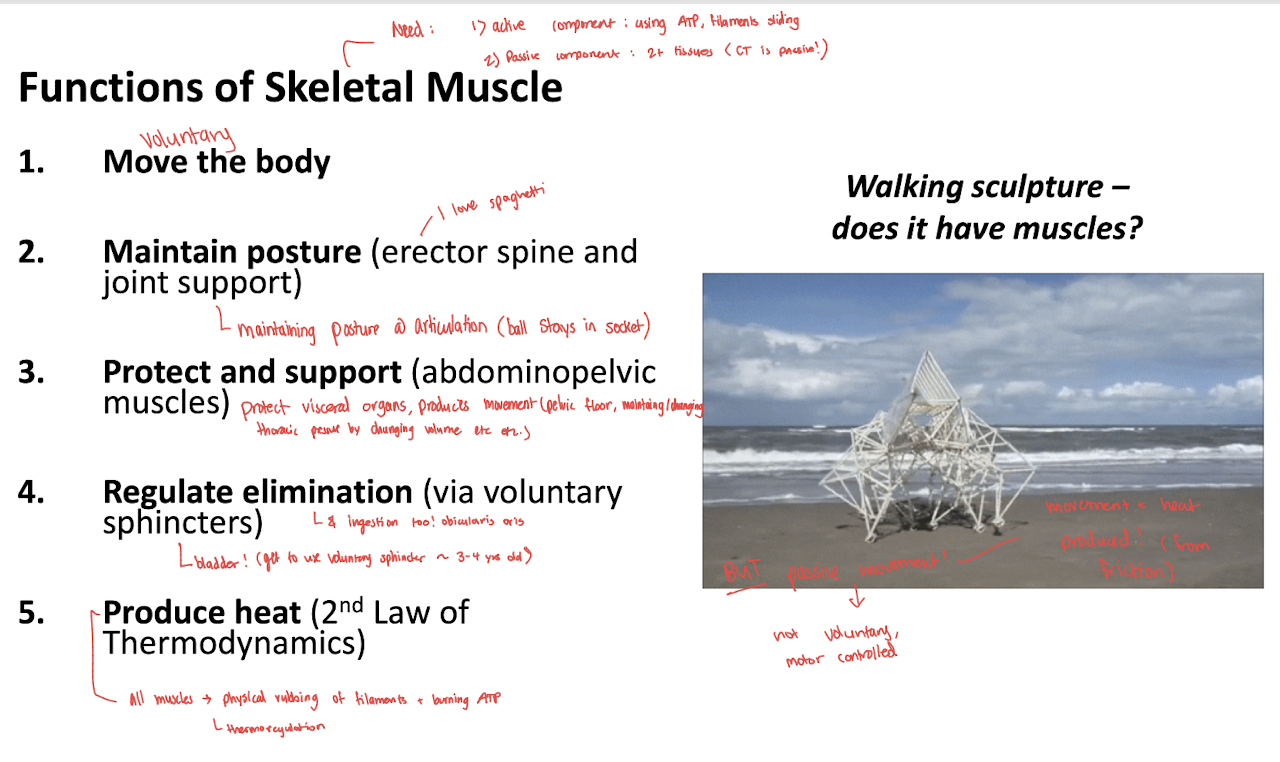
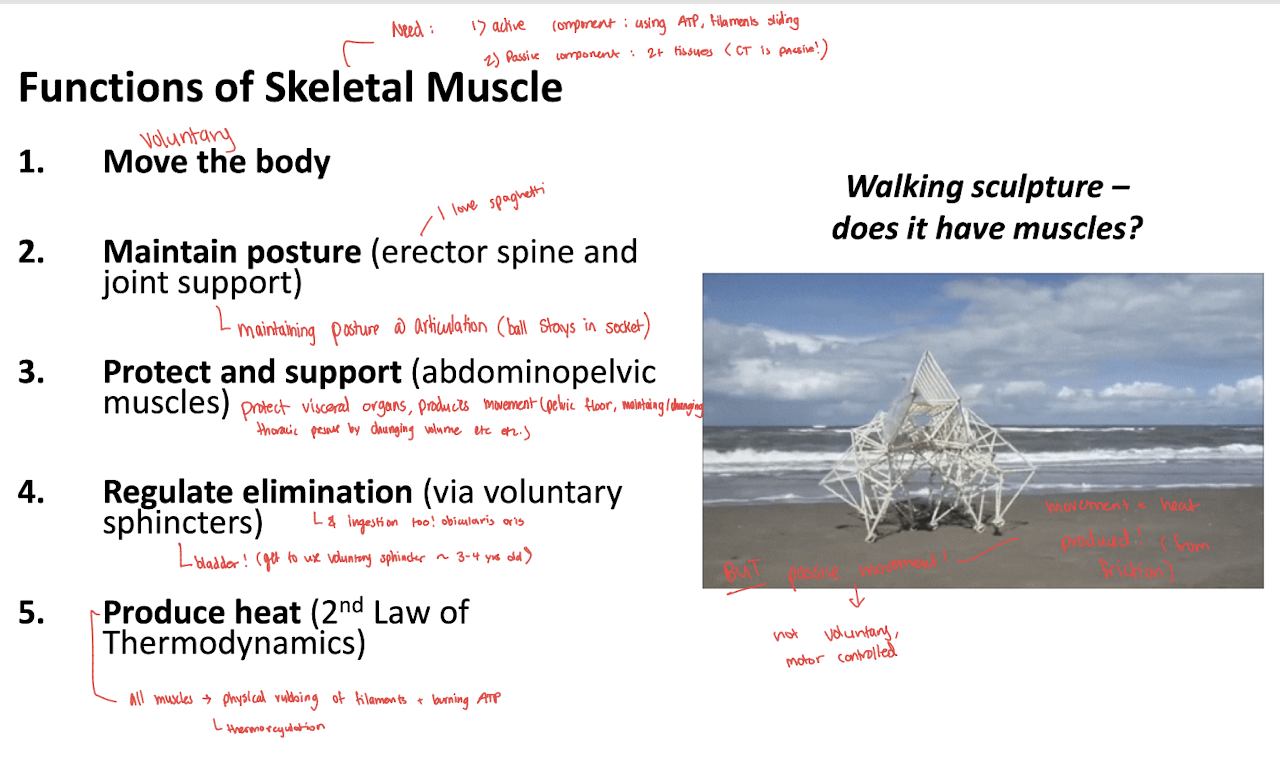
What are the five general functions of skeletal muscle?
Move the body.
Maintain posture and joint support.
Protect and support internal organs.
Regulate elimination through voluntary sphincters.
Produce heat for thermoregulation
How do skeletal muscles produce body movement?
Muscle contraction pulls on bones, producing voluntary movement

How do skeletal muscles maintain posture?
They stabilize joints and maintain body positioning against gravity
erector spinae & joint support

Which muscles help protect and support visceral organs?
Abdominopelvic muscles, which protect internal organs and help maintain pelvic floor support
protect & support

How do skeletal muscles regulate elimination?
Through voluntary sphincters that control the release of substances, such as urine from the bladder

How do skeletal muscles produce heat?
Friction from sliding filaments.
ATP breakdown and metabolic activity.
Heat production contributes to thermoregulation.
2nd law of thermodynamics = Muscles convert chemical energy into movement, inevitably losing most of that energy as heat to increase overall disorder (entropy)
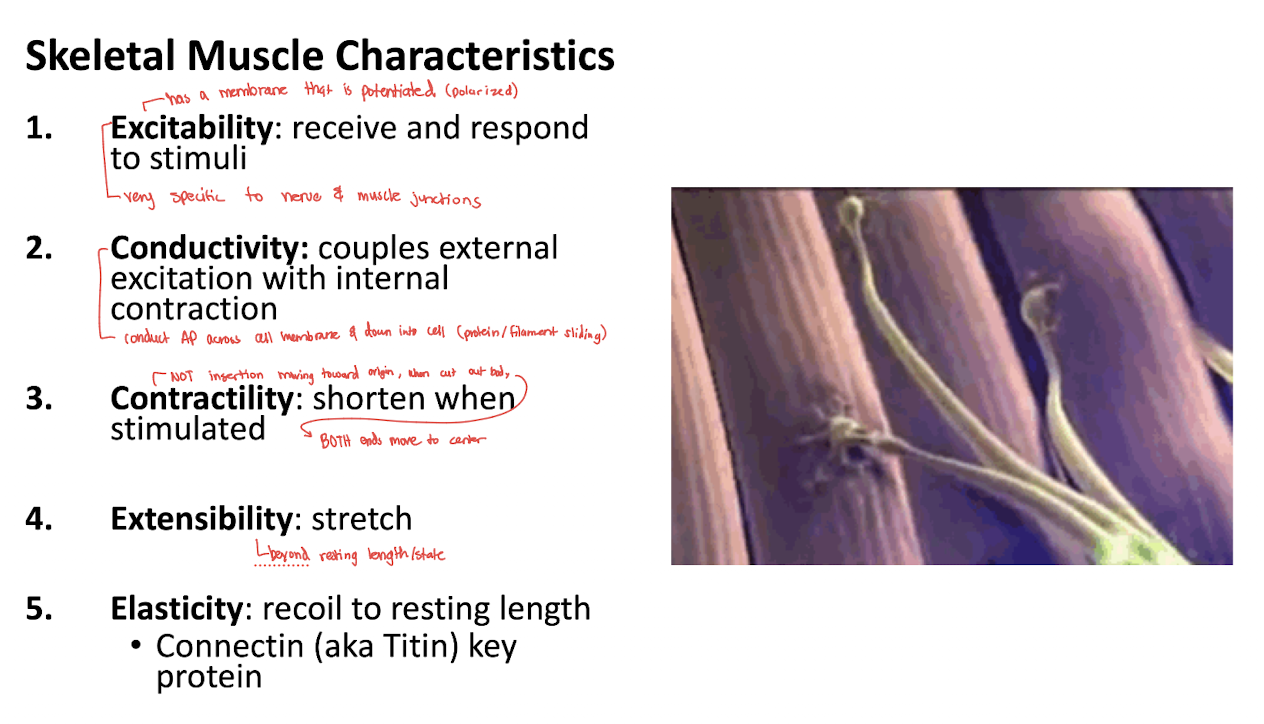
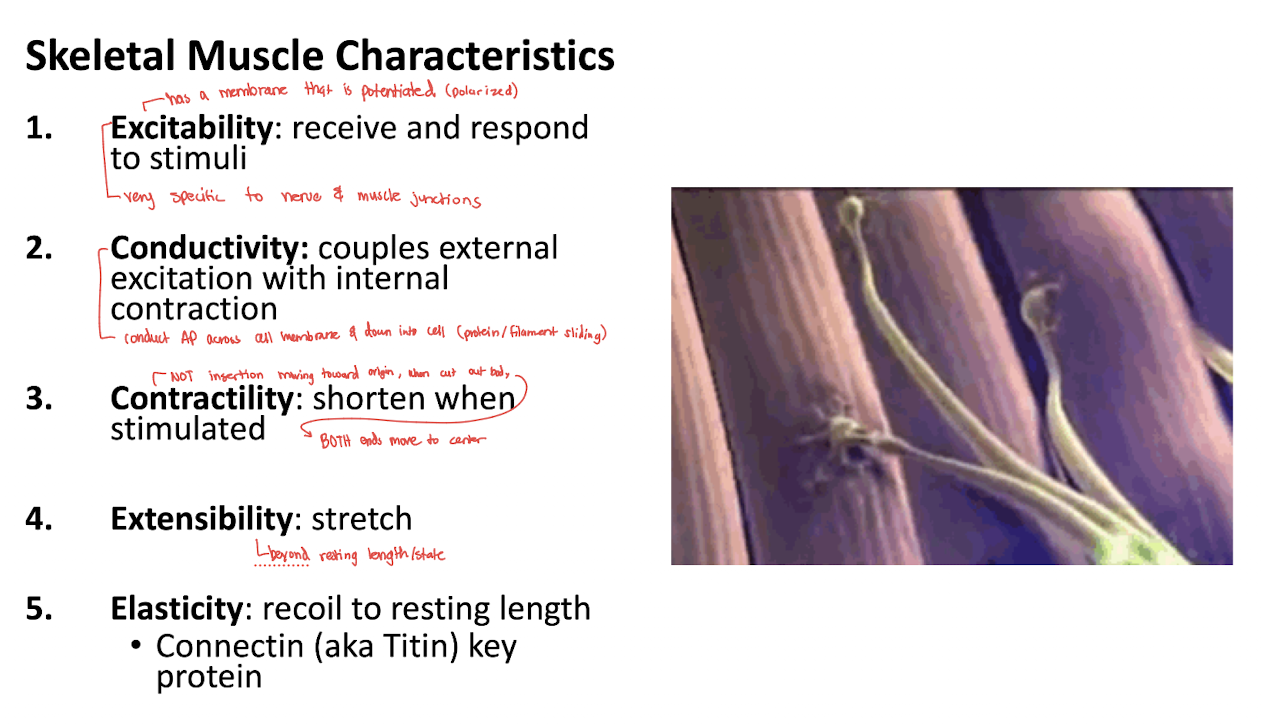
What are the five characteristics of skeletal muscle?
Excitability.
Conductivity.
Contractility.
Extensibility.
Elasticity.
Define excitability
The ability to receive and respond to stimuli
has a membrane that is potentiated (polarized)
very specific to nerve & muscle junctions

Define conductivity
The ability to conduct an action potential across the cell membrane and into the cell, coupling external excitation with internal contraction
conduct AP across all membrane & down into cell
Define contractility
The ability to shorten when stimulated, pulling both ends toward the center

Define extensibility
The ability to stretch beyond its resting length
beyond resting length/state

Define elasticity
The ability to recoil and return to its resting length after being stretched
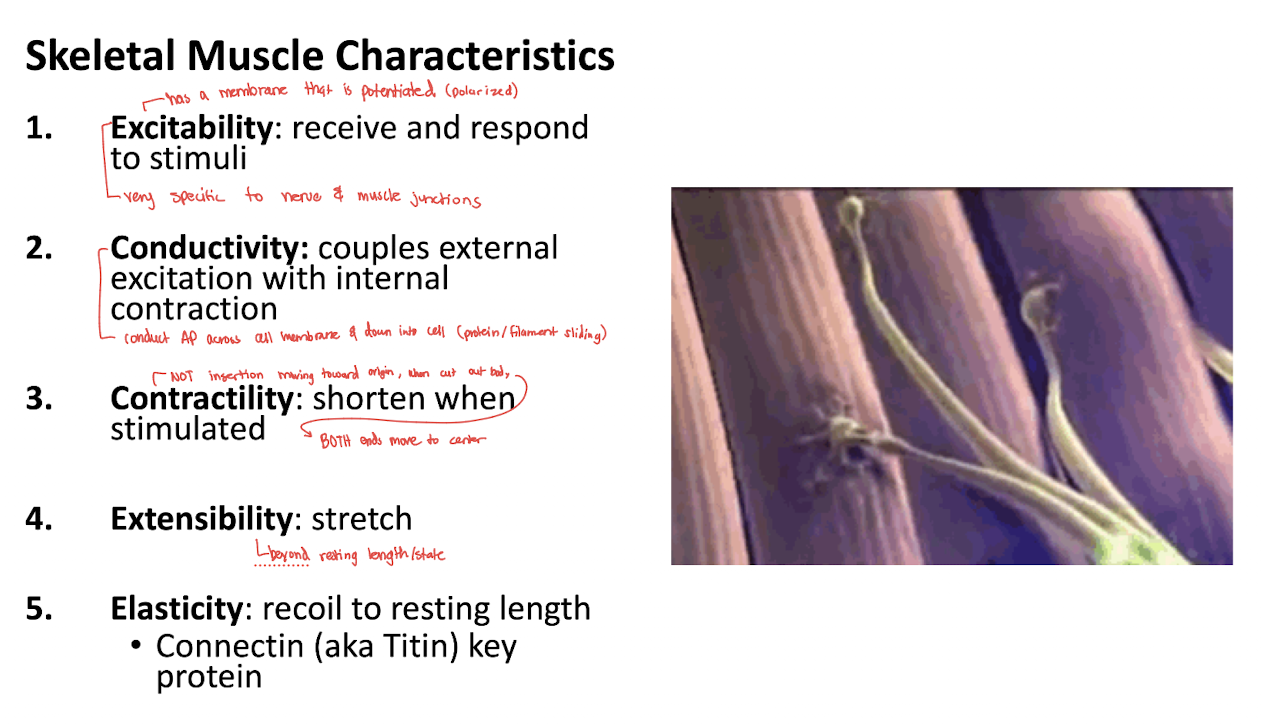
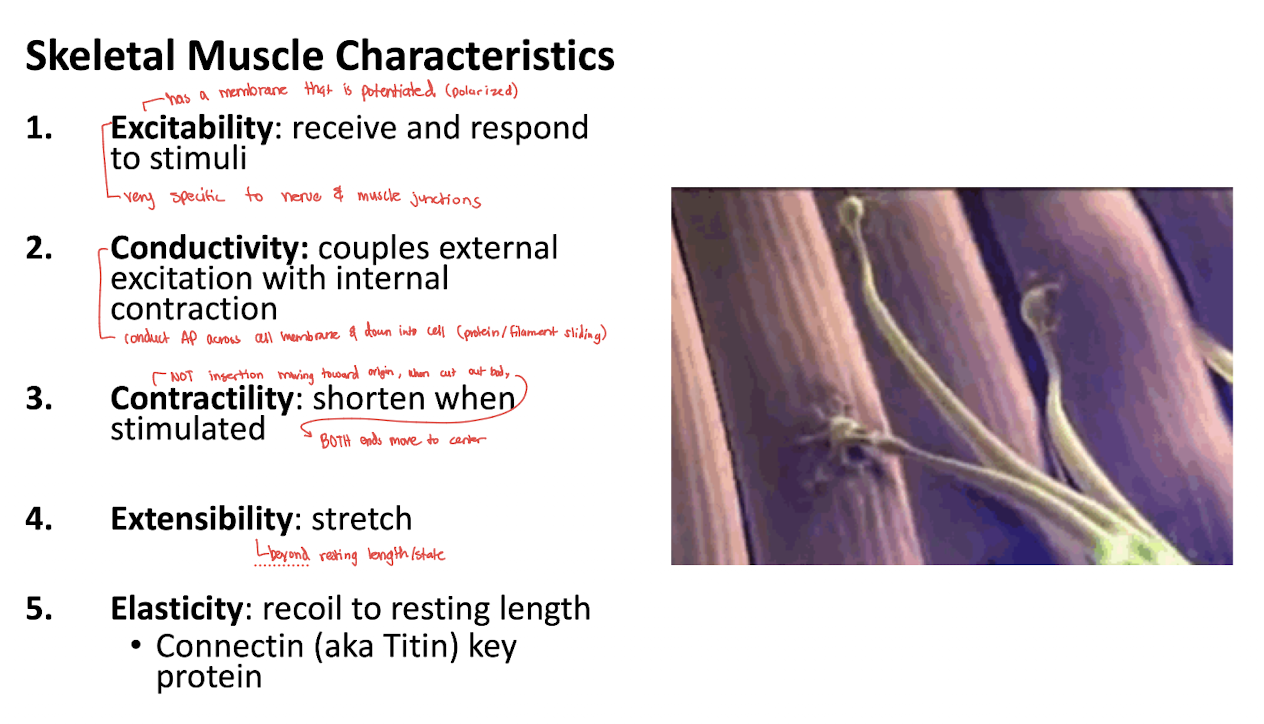
Which protein is particularly important for muscle elasticity?
Connectin (also called titin)
What are skeletal muscles composed of?
Myocytes (muscle cells/fibers).
Layers of connective tissue proper.
Neurovascular bundles (nerves and blood vessels)

What is the organizational hierarchy of skeletal muscle from largest to smallest?
Muscle → Fascicle → Muscle fiber (myocyte) → Myofibril → Myofilament

What is a muscle?
An organ consisting of bundles of fascicles surrounded by epimysium

What is a fascicle?
A bundle of muscle fibers (myocytes) surrounded by perimysium
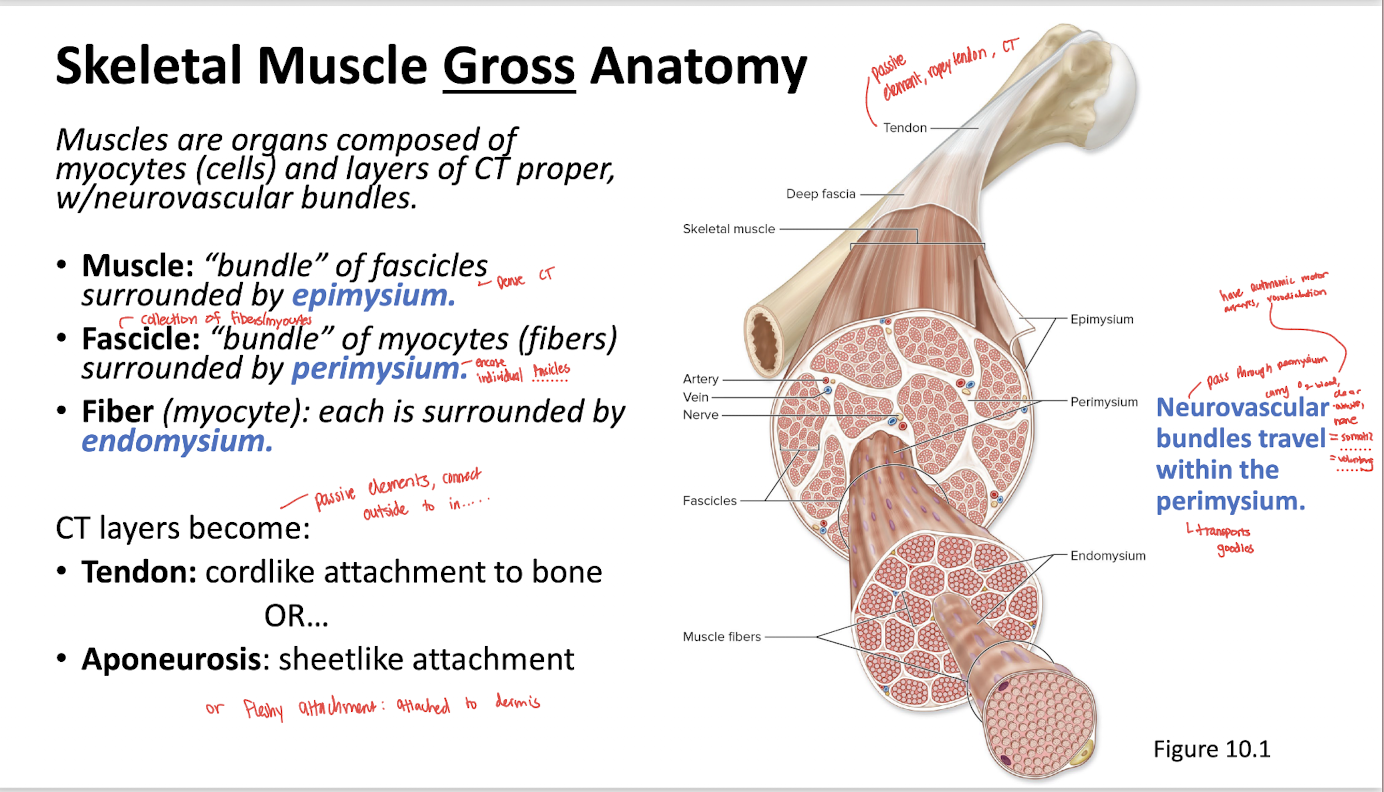
What is a muscle fiber?
An individual muscle cell (myocyte) surrounded by endomysium
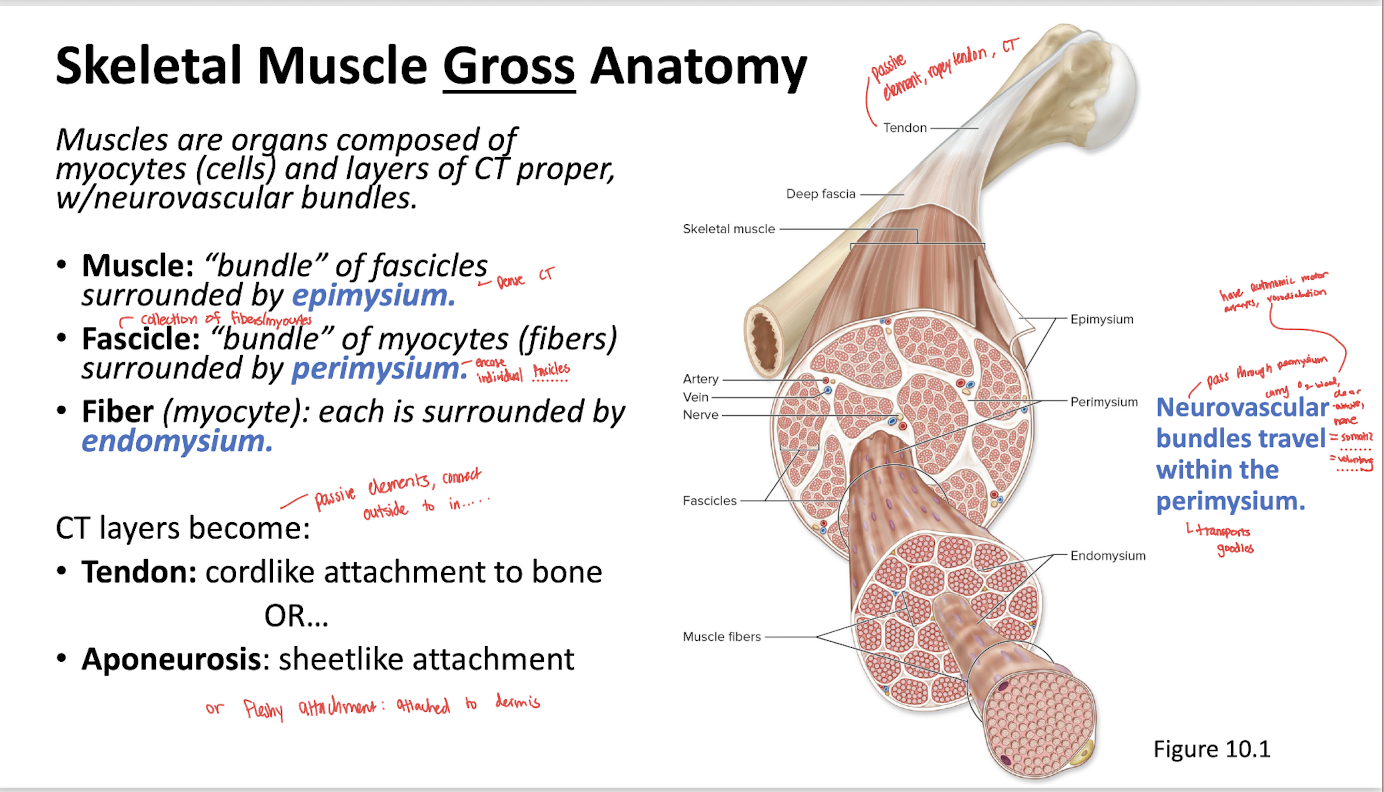
What does the epimysium surround?
The entire muscle organ
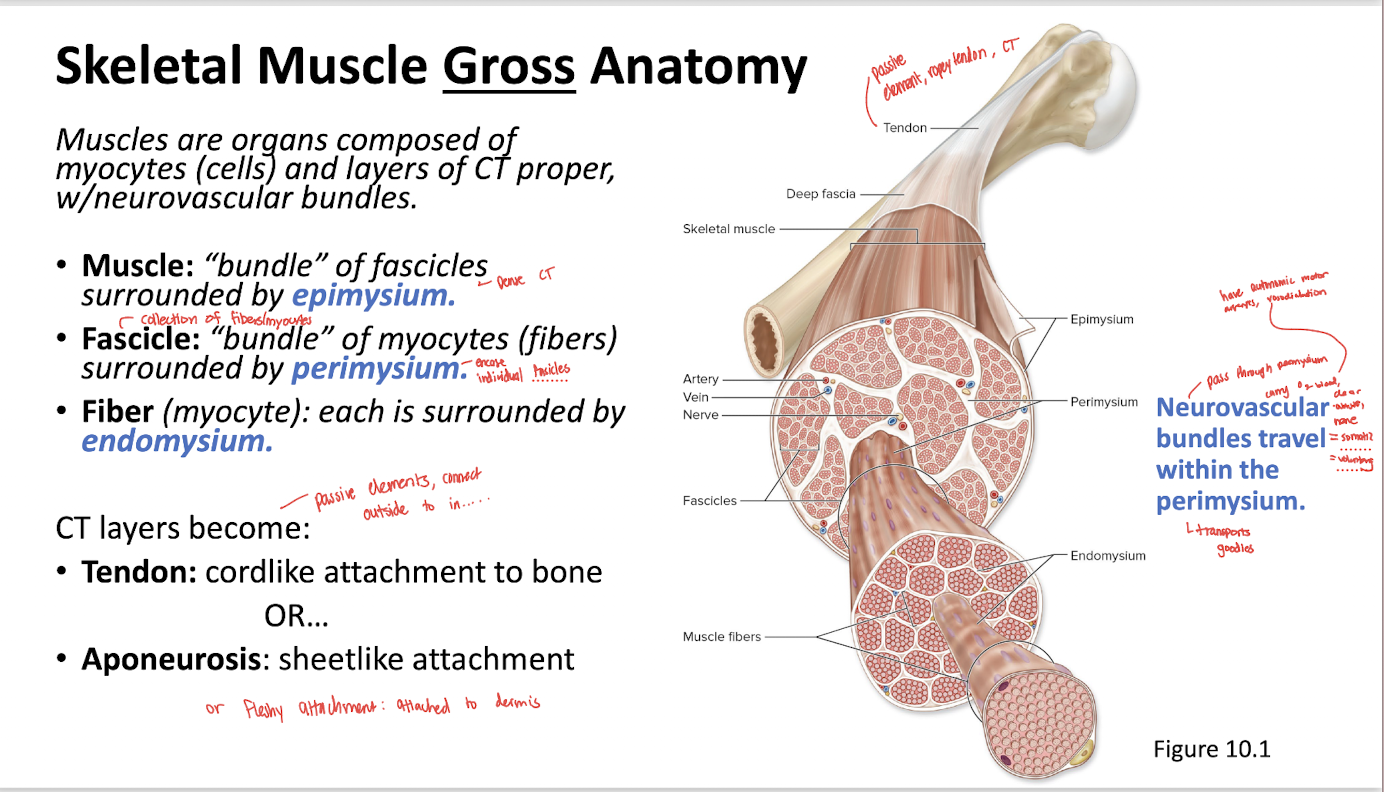
What does the perimysium surround?
Individual fascicles (bundles of muscle fibers)

What does the endomysium surround?
Individual muscle fibers (myocytes)

How do the three connective tissue layers contribute to force transfer?
connect the internal structures of the muscle to one another
transmit force from individual muscle fibers outward
ultimately transferring force to the attachment through tendons or aponeuroses
Endomysium → Perimysium → Epimysium

Where do neurovascular bundles travel within skeletal muscle?
Within the perimysium, supplying nerves and blood vessels to the muscle

What is a tendon?
A cordlike extension of connective tissue that attaches muscle to bone

What is an aponeurosis?
A flat, sheetlike extension of connective tissue that distributes muscle attachment over a broader area

Which connective tissue layer do tendons and aponeuroses extend from?
The epimysium, with the connective tissue layers continuous with one another

What is a muscle belly?
The central, bulky portion of a muscle
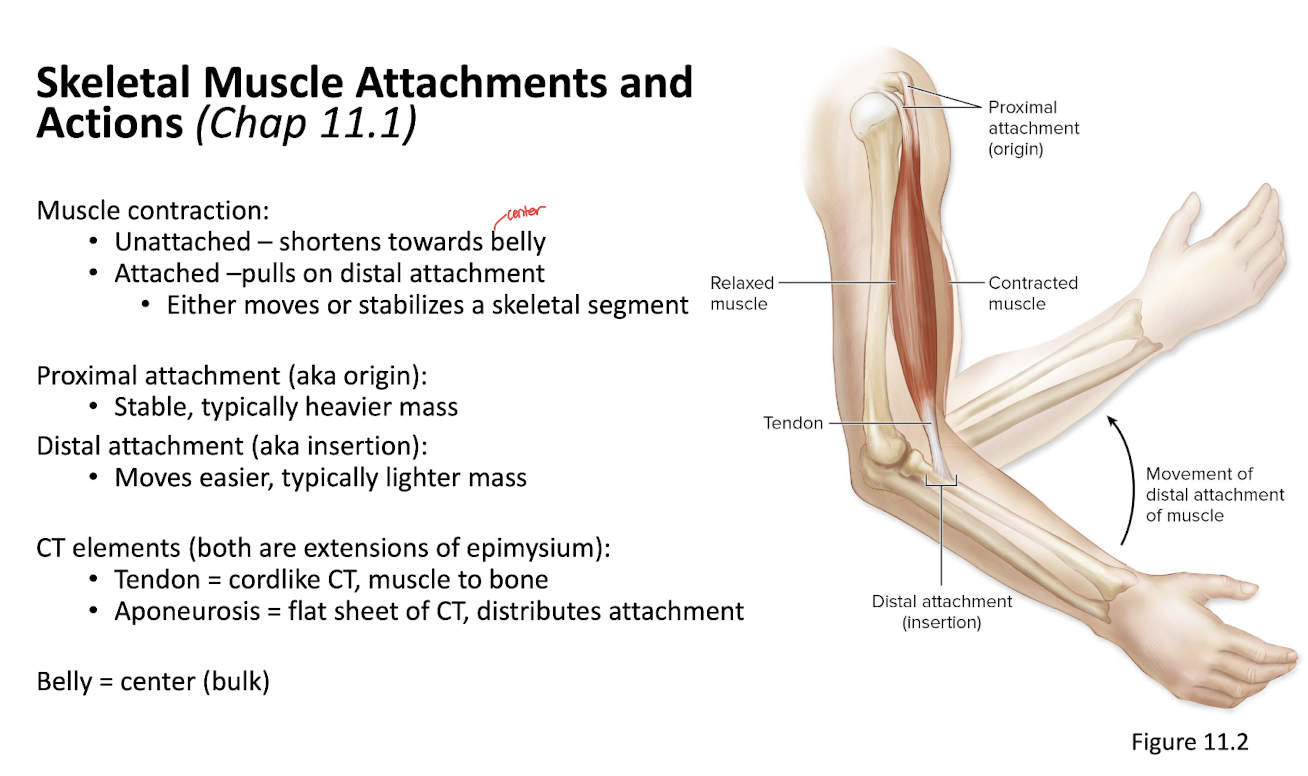
What is a proximal attachment (origin)?
The attachment that is typically more stable and associated with the heavier mass

What is a distal attachment (insertion)?
The attachment that typically moves more easily and is associated with the lighter mass

What happens when a muscle contracts if it is unattached?
It shortens toward its belly
What happens when a muscle contracts if it is attached to bones?
It pulls on its distal attachment, either moving or stabilizing a skeletal segment

Aponeurosis for attachments & actions
distributes attachment

What is an agonist?
A muscle that produces a particular movement

What is an antagonist?
A muscle that opposes the action of the agonist.
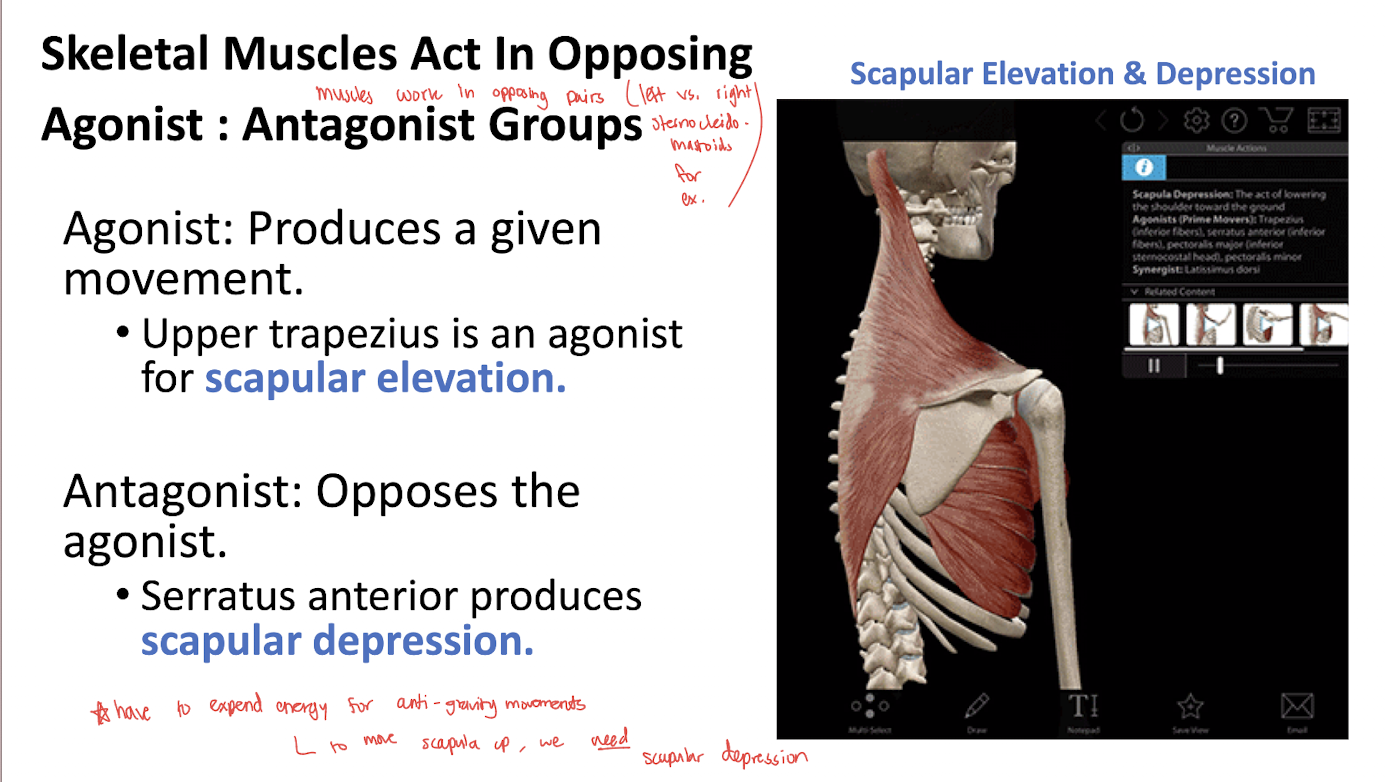
Give an example of an agonist
The upper trapezius is an agonist for scapular elevation

Give an example of an antagonist.
The serratus anterior produces scapular depression, opposing the upper trapezius during scapular elevation

Why do muscles often work in opposing pairs?
To produce opposing movements and allow controlled movement of skeletal segments
left & right sternocleidomastoid for example

What is a lever system in the human body?
A rigid body (bone) that moves around a fulcrum (joint) through the application of effort (muscle force)

What is the difference between mechanical advantage and biological advantage?
Mechanical advantage: How efficiently a lever produces force or moves a load.
Biological advantage: How effectively a lever supports body movement and function (e.g., ROM and speed)
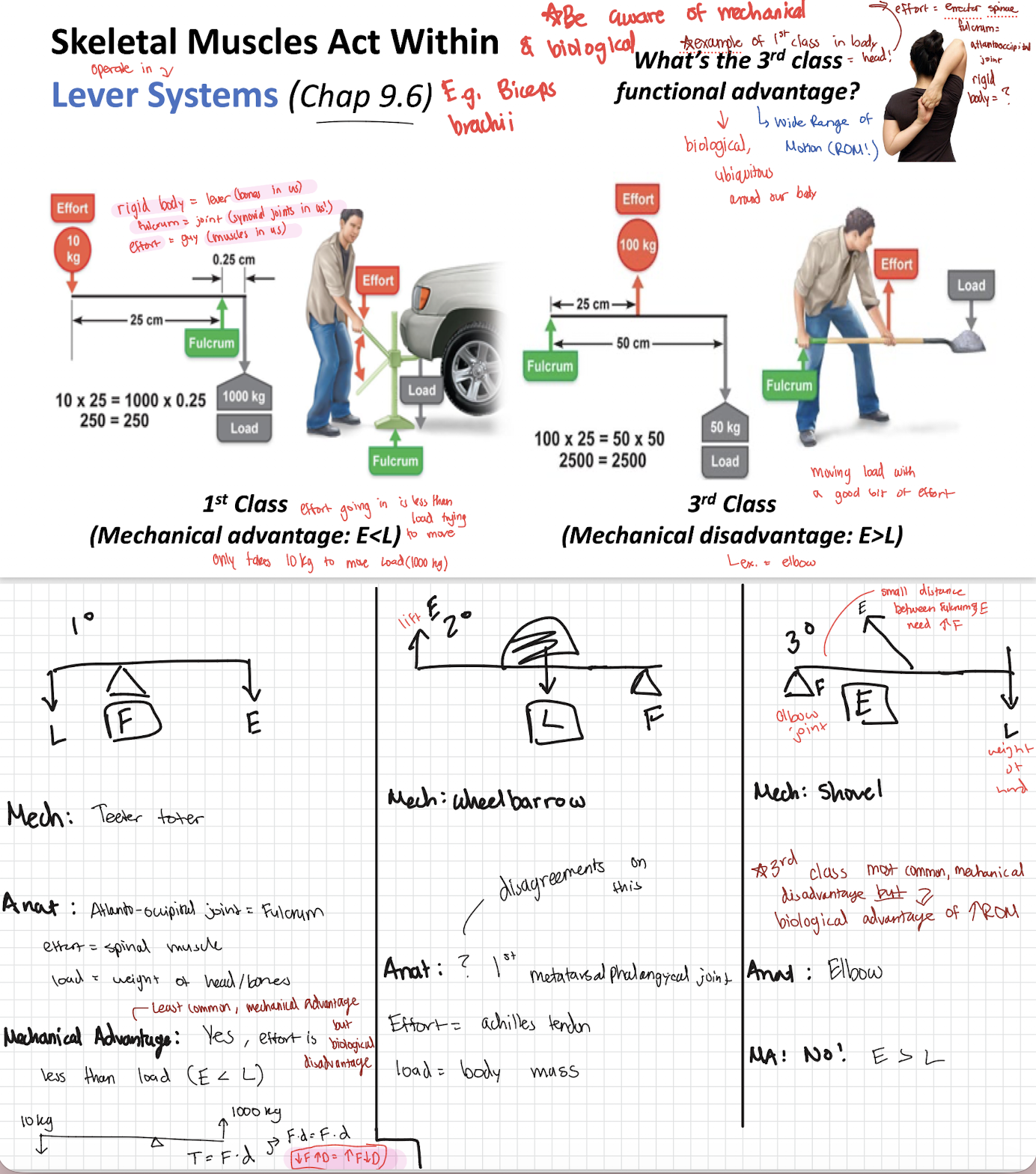
What are the three components of a lever system?
Lever: Bone.
Fulcrum: Joint.
Effort: Muscle force

What characterizes a first-class lever?
The fulcrum is positioned between the effort and load

What is the mechanical advantage of a first-class lever?
Mechanical advantage: Effort is less than load (E < L).
can move a greater load with less effort (greater force advantage)

What is an anatomical example of a first-class lever?
The atlanto-occipital joint, where spinal muscles produce effort to balance/move the weight of the head

In the atlanto-occipital lever system, what are the fulcrum, effort, and load?
Fulcrum: Atlanto-occipital joint.
Effort: Spinal muscles.
Load: Weight of the head and bones
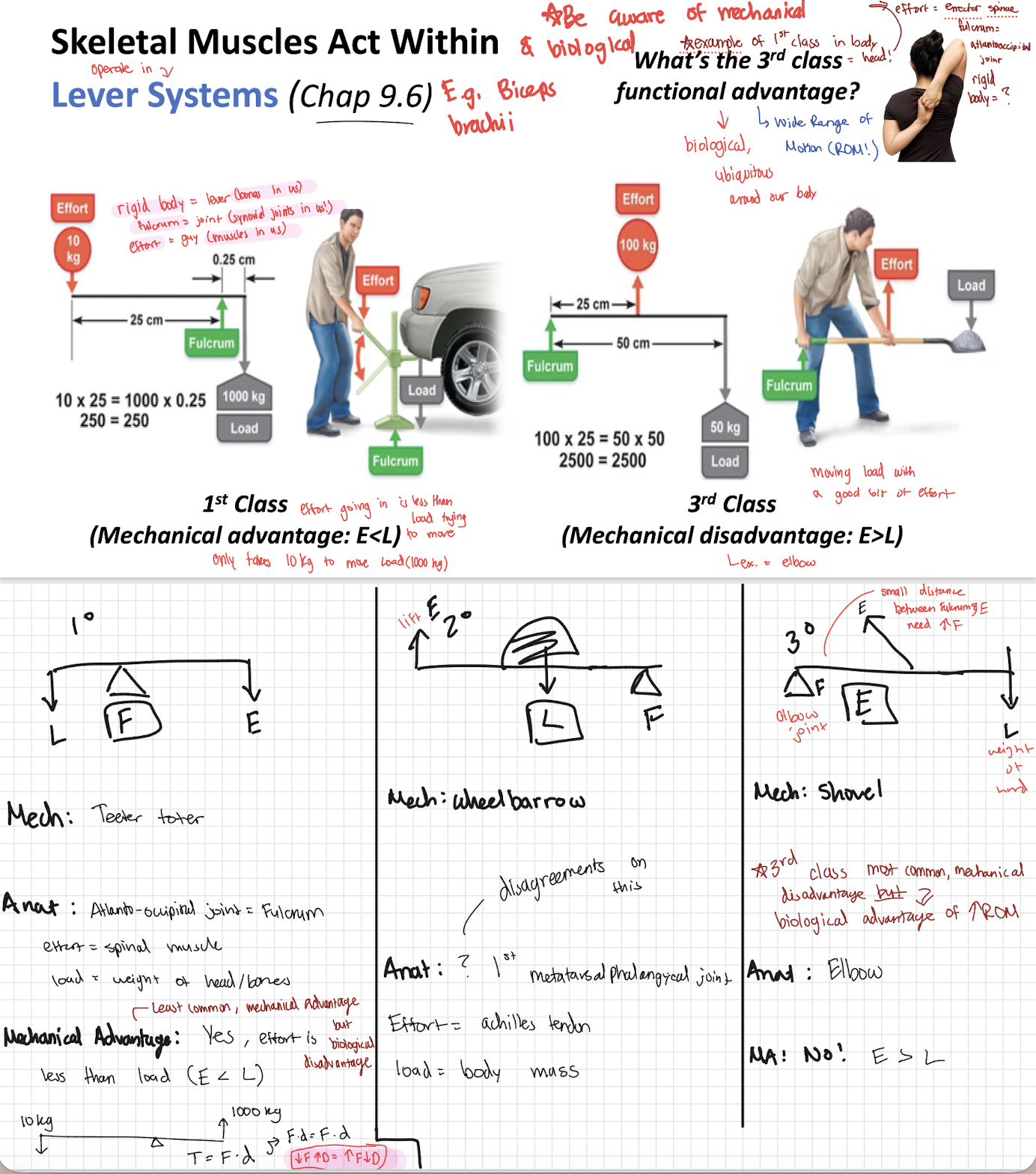
What is a mechanical example of a first-class lever?
A teeter-totter

What is the disadvantage of a first-class lever biologically?
Despite its potential mechanical advantage, it has a biological disadvantage compared with lever arrangements that provide greater ROM
larger distance between fulcrum & effort = less effort needed
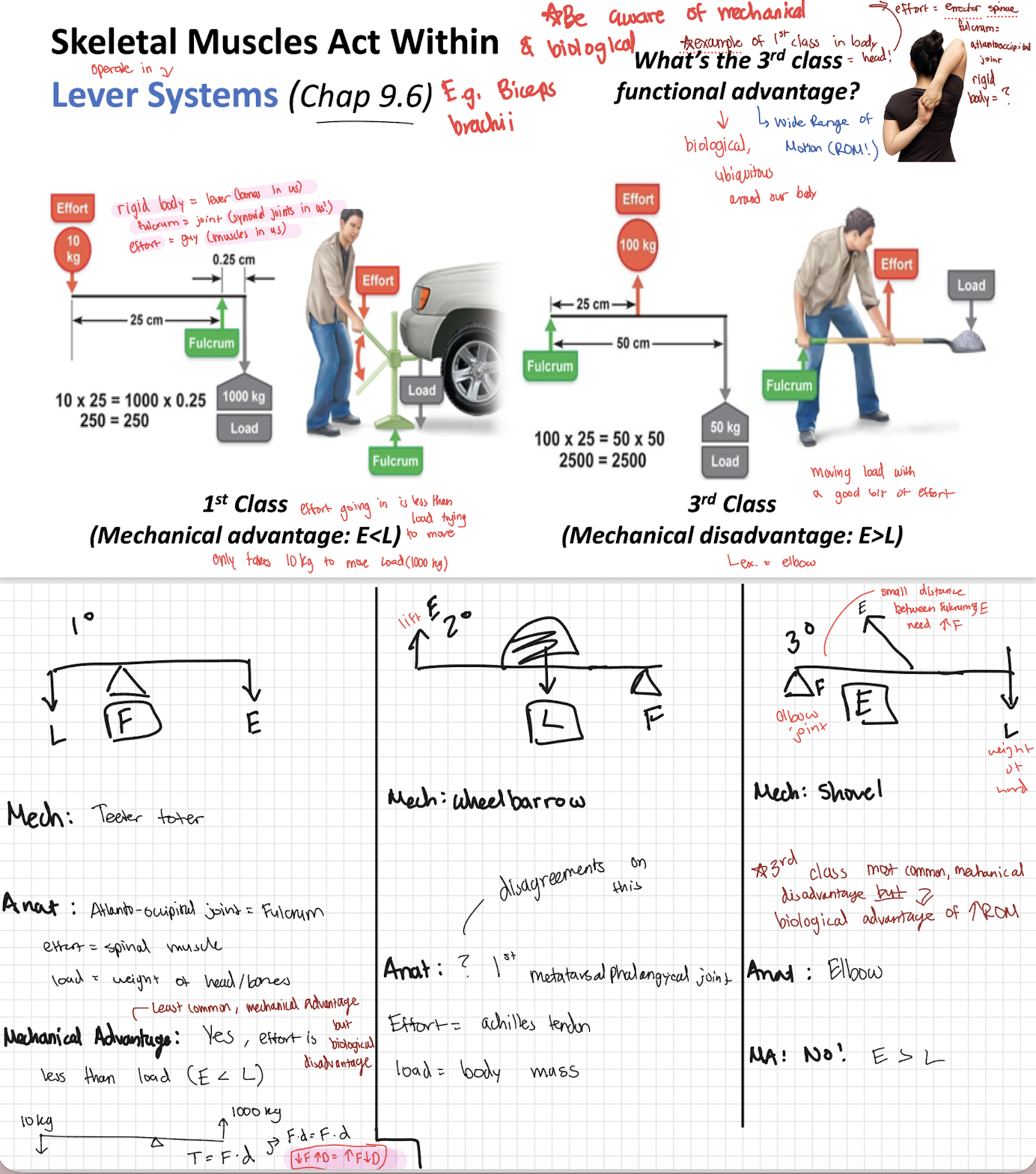
What characterizes a second-class lever?
The load is positioned between the fulcrum and effort

What is the mechanical advantage of a second-class lever?
Mechanical advantage: Effort is less than load (E less than L)
It allows a relatively small effort to move a larger load
can move the greatest load with the least effort

What is a mechanical example of a second-class lever?
A wheelbarrow

What is an anatomical example of a second-class lever?
Standing on your tiptoes (plantarflexion)

In the second-class lever used when standing on tiptoes, what are the fulcrum, effort, and load?
Fulcrum: First metatarsophalangeal joint (ball of the foot).
Effort: Achilles tendon (gastrocnemius and soleus).
Load: Body mass

Why does standing on tiptoes represent a second-class lever?
The body weight (load) is between the fulcrum at the ball of the foot and the effort applied through the Achilles tendon

What characterizes a third-class lever?
The effort is positioned between the fulcrum and load

What is the mechanical advantage of a third-class lever?
Mechanical disadvantage: Effort is greater than load (E > L).

What is the mechanical disadvantage of a third-class lever?
It requires more effort to move a load because the effort is applied closer to the fulcrum
small distance between fulcrum & effort, need greater force

What is the biological advantage of a third-class lever?
Greater range of motion (ROM) and movement speed at the distal end

What is an anatomical example of a third-class lever?
The elbow joint during biceps brachii contraction

In the elbow third-class lever system, what are the fulcrum, effort, and load?
Fulcrum: Elbow joint.
Effort: Biceps brachii.
Load: Weight of the forearm and anything held in the hand

What is a mechanical example of a third-class lever?
A shovel

Why are third-class levers so common in the human body despite their mechanical disadvantage?
Their biological advantage is greater ROM and speed, which are important for producing efficient body movements

What is a myocyte?
A muscle cell, also called a muscle fiber

What are the general characteristics of a skeletal muscle fiber?
Long, cylindrical cells that can reach up to 30 cm in length

What is a myoblast?
An embryonic muscle precursor cell that develops into skeletal muscle fibers
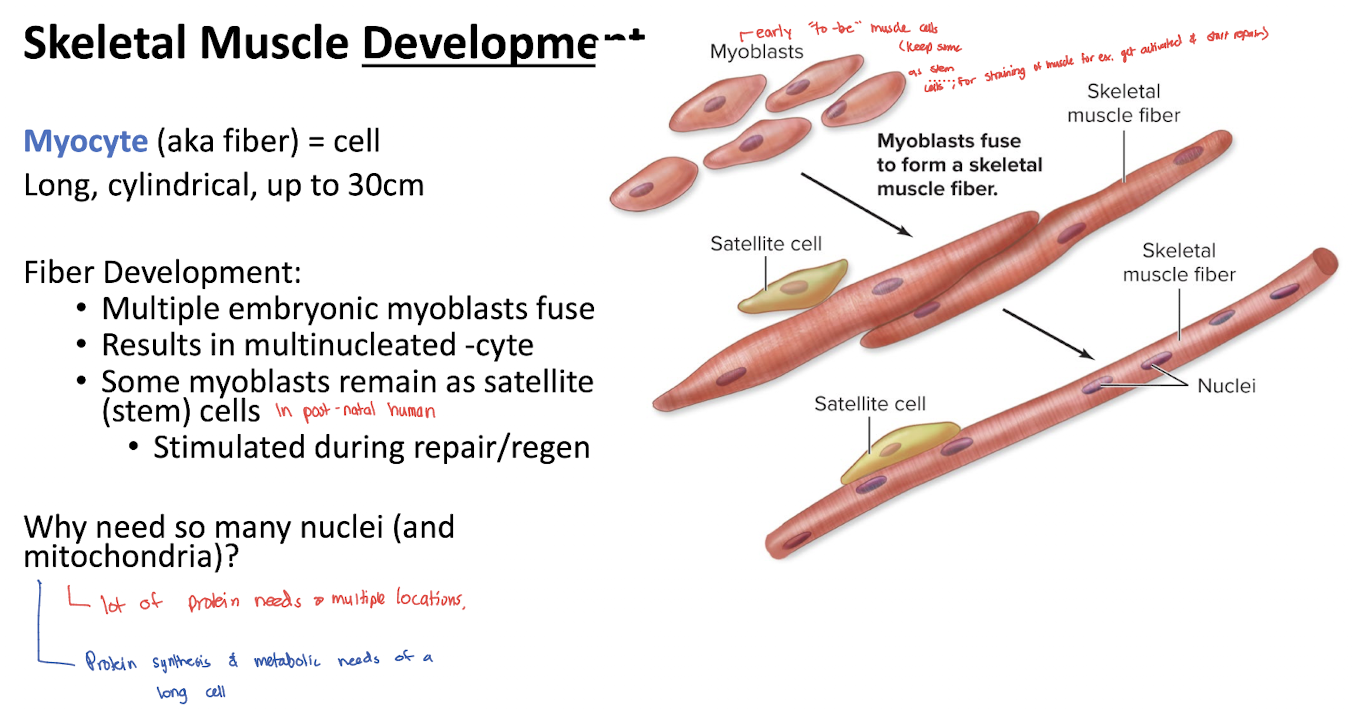
How does a skeletal muscle fiber develop?
Multiple embryonic myoblasts fuse together to form one long, multinucleated muscle fiber
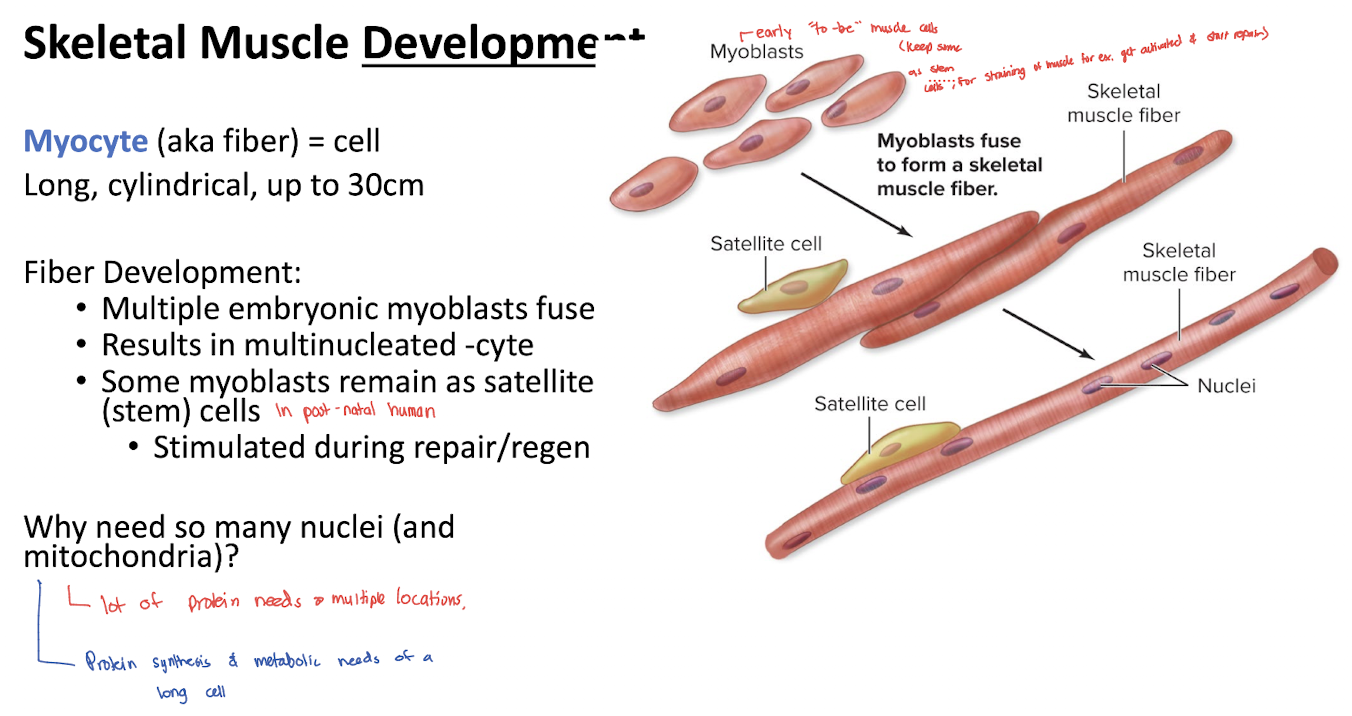
Why are skeletal muscle fibers multinucleated?
Because multiple embryonic myoblasts fuse together during development, contributing their nuclei to one cell

What are satellite cells?
Myoblasts that remain after development as postnatal stem cells associated with skeletal muscle
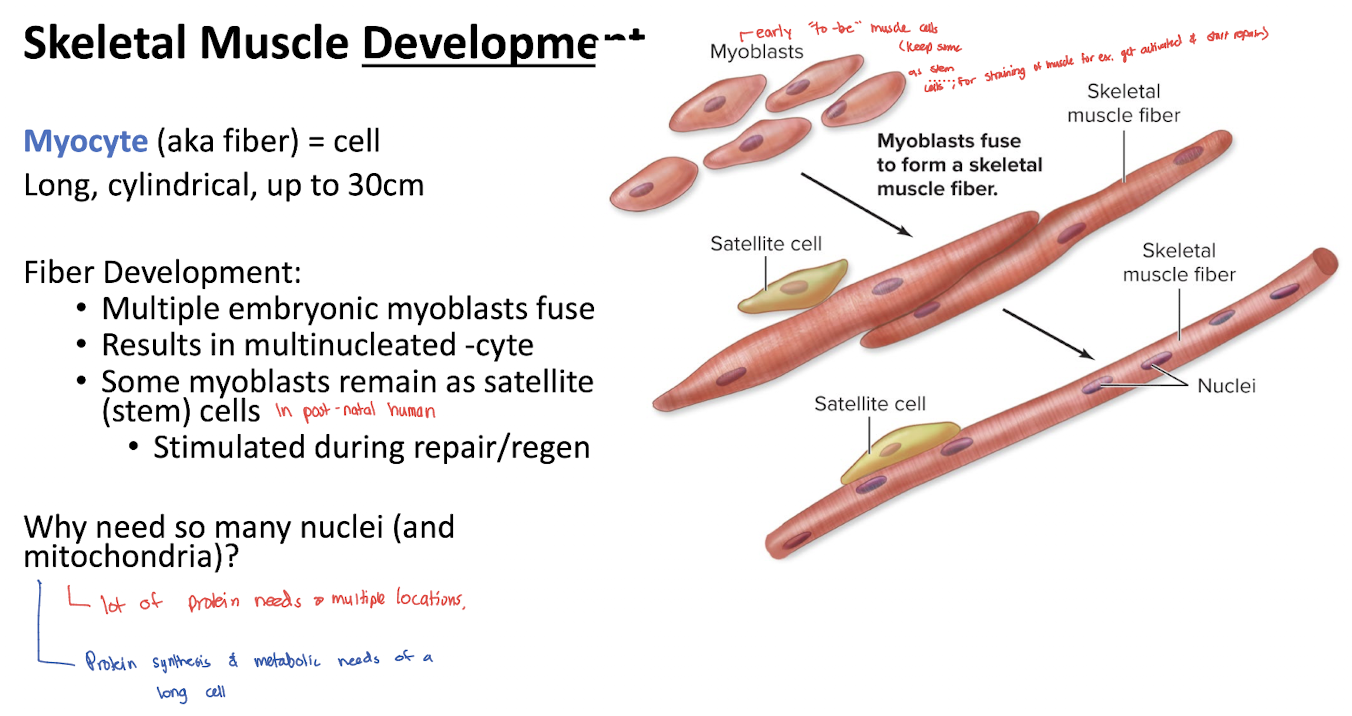
What is the function of satellite cells in adults?
They can become activated during muscle repair and regeneration
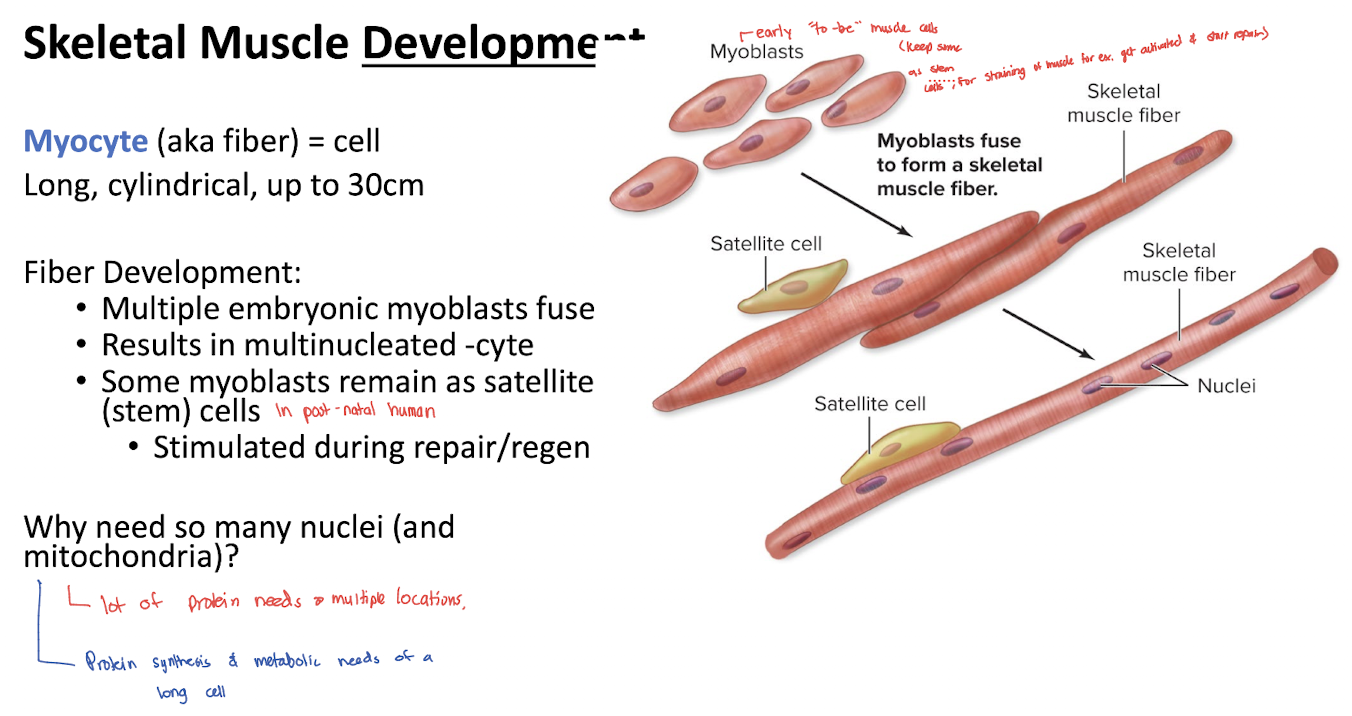
Why do skeletal muscle fibers contain many nuclei?
Their large size and extensive protein synthesis requirements require multiple nuclei to support cellular activities throughout the long cell

Why do skeletal muscle fibers contain many mitochondria?
To support their high metabolic demands and ATP requirements for muscle activity

What is the difference between a muscle fiber, myofibril, and myofilament?
Muscle fiber: Entire muscle cell.
Myofibril: Organized bundle of contractile proteins inside a muscle fiber.
Myofilament: Individual thick or thin contractile protein filament

What is found inside muscle fibers?
Organized bundles of myofibrils

What are myofibrils composed of?
Thick and thin myofilaments

What are the terminal cisternae?
Swollen, enlarged ends of the sarcoplasmic reticulum that store calcium ions
