Economics term 4 unit 3
 Call Kai
 Learn
 Practice Test
 Spaced Repetition
 Match
 Flashcards
 Knowt Play
1/133

There's no tags or description
Looks like no tags are added yet.
134 Terms
what is the circular flow of income and explain how imports and exports impact the external sector of the model
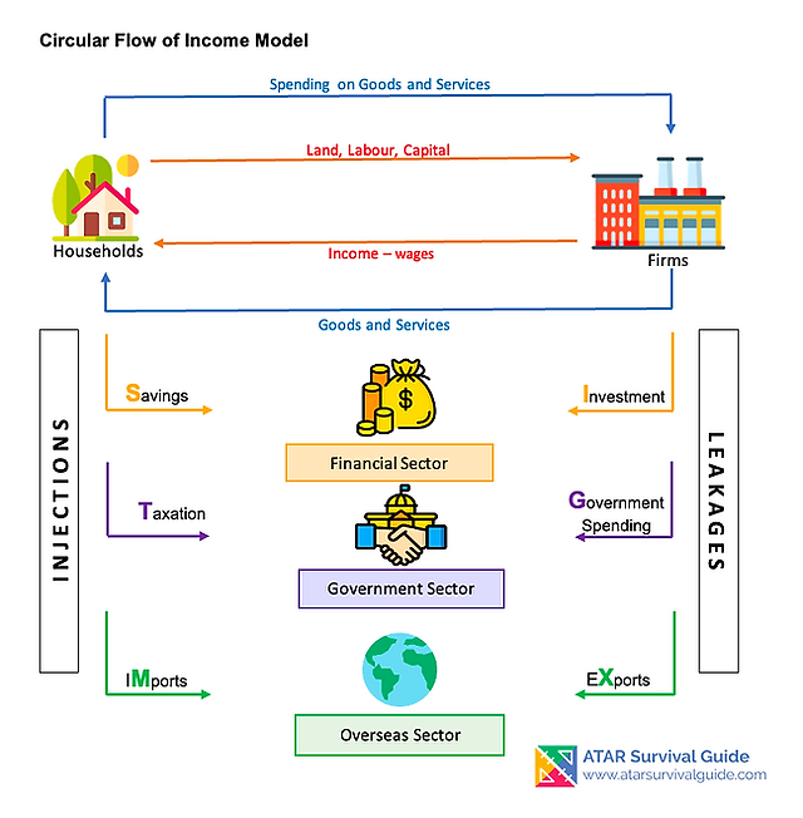
Imports cause leakages in the economy due to expenditure on imported commodities by residents, domestic businesses and governments. Exports act as injections into the circular flow due to income received by residents from goods and services exported to other nations.
What are the motivations for international trade
Differences in technology
Differences in factor endowments
The presence of economies of scale
The presence of government policies
How do differences in technology motivate international trade
Advantageous trade can occur between countries if they differ in their technological abilities to produce goods and services. Technology refers to the techniques used to turn resources (e.g. labour, capital, land) into outputs (goods and services). The basis for trade in the Ricardian model of comparative advantage is differences in technology.
How do differences in resource endowments motivate international trade
Advantageous trade can occur between countries if the countries differ in their endowments of resources. Factor endowments refer to the skills and abilities of a country’s workforce, the natural resources available within its borders (minerals, farmland, etc.) and the sophistication of capital stock (machinery, infrastructure, communications systems).
How does the presence of economies of scale motivate international trade?
The existence of economies of scale in production is sufficient to generate advantageous trade between two countries. Economies of scale refer to a production process in which production costs fall as the scale of production rises.
How does the presence of government policies motivate international trade?
Government tax and subsidy programs alter the prices charged for goods and services. These changes can be sufficient to generate advantages in production of certain products. In these circumstances, advantageous trade may arise solely due to differences in government policies across countries.
what are the advantages of international trade
improvements in productive efficiency
improved price and availability of goods
structural change and specialisation
how are improvements in productive efficiency and advantage of international trade
Producers benefit from improvements in productive efficiency – domestic firms have new competition which drives innovation in technology and processes to lower the cost of production and prices allowing them to compete.
how are improved price and availability of goods an advantage of international trade
Consumers benefit from improved price and availability of goods – Which improves wellbeing and standards of living.
how is structural change and specilaisation an advantage of international trade
Structural change and specialisation – The economy benefits overall from improved allocative efficiency and flow on effects to the economy. When resources are allocated in a way that reflects demand and makes the best use of them -> change in the size and composition of industries within the economy -> when a good gets cheaper to make as a firm/economy specialises and makes more of it
what are the disadvantages of international trade
1. Inequitable distribution of income and wealth within economies – those who can and cannot compete
2. Loss of some industries and possible increase in unemployment – least efficient industries will close as they cannot compete with cheaper imports, and potentially low factor mobility/transferability
3. Increase in unemployment if multinational corporations (MNC’s) may outsource labour to other countries
4. Loss of culture and national sovereignty
5. Environmental insecurity – tragedy of ‘global’ commons
6. Overdependence and exposure to external shocks – economic events and performance elsewhere can impact domestically
What do Australia’s imports reflect in our economy?
The structural composition of the Australian economy
What are Australia’s main imports
Australia is reliant on overseas sources for many of the manufactured items that we use in our day-to-day living – consumption goods and services and intermediate goods (semi-finished products) e.g. motor vehicles, clothing, refined petroleum and fuel and machinery
Where do most of our imports come from and what is their total value ?
Since the start of 2000, at least half of our total imports have come from economies of Asia. The total value of Australian imports rose by 6.5% to $421.4 billion in 2018-19.
What is Australia’s largest export sector?
The minerals and fuels sector
What is the second largest export sector and how much of our economy does it make up?
Services. It accounts for nearly three quarters of our economy and more than four out of fiver Australian jobs
Why does an account go into surplus?
Mainly due to a very large trade surplus, meaning that the value of Australian exports exceeded imports. This occurred in both 1975 and mid-2019 and was driven by high prices for resource commodities, especially iron ore.
What are the directions of Australia’s trade?
For much of Australia’s history, its main trading partner was the UK. In more recent times, however, Australia’s trade has had an increasingly Asian focus, starting with Japan, and more recently with China, India and other Asian nations. Given that our exports are primarily to nation that manufacture elaborately transformed manufactured goods. Four Asian nations are among the top five – China, Japan, Republic of Korea (South Korea) and India, with the USA being the other top 5 destination for Australian exports.
What is absolute advantage?
When a country can produce a product (e.g. machinery) more efficiently than the other country.
What is the theory behind absolute advantage?
That a country should specialise in those products, which it can produce efficiently using a set amount of resources (factors of production) compared to another country. This is because if another country can supply us with a commodity cheaper than you can make it yourself, and we have a commodity that we can supply to them for cheaper as well it would be beneficial for both countries.
What is double absolute advantage?
If a country has an absolute advantage in both items they produce
What are the model assumptions taken under Smith’s theory of absolute advantage?
a) There are two countries producing goods
b) The size of economies of these countries is equal
c) There are constant returns to scale (i.e. doubling inputs leads to double the output)
d) No trade barriers
e) Transportation cost is ignored
What is comparative advantage?
When a country can produce a product at a lower opportunity cost of production than another country.
What is the theory behind comparative advantage?
The theory uses opportunity cost as a factor in deciding between different options for production. It suggests that countries will engage in trade with one another, exporting the goods that they have a comparative advantage in.
When does comparative advantage exist?
When a country has a lower opportunity cost (i.e. it gives up less of one product to obtain more of another product).
How can comparative advantage result in a nation gaining from trade?
If they export the goods or services in which it has the greatest comparative advantage, imports those in which it has the least comparative advantage and/or specialises in products in which they have a comparative advantage.
What are the model assumptions taken under Ricardo’s theory of comparative advantage?
a) There are two countries producing goods
b) The size of economies of these countries is equal
c) There are constant returns to scale (i.e. doubling inputs leads to double the output)
d) No trade barriers
e) Transportation cost is ignored
f) Before specialisation (closed economy), country’s resources are equally divided to produce each good
How do you find the opportunity cost of making one product instead of another?
You divide the product you could be making by the product you are making instead. For example, if Australia could make 15 apples and 5 pears the opportunity cost of every apple Australia makes is 0.33 pears and for every pear it makes it has the opportunity cost of 3 apples.
When a country specialises in a product what does that mean for how much of it it is able to produce?
It is putting all of its resources into that product therefore the amount it could make doubles.
What is specialisation?
The process of concentrating on a specific area rather than trying to do multiple things at once
Explain the importance of specialisation in trade to comparative advantage models
- It promotes a higher output of goods and services with reduced costs given an amount of scarce resources
- It results in a more efficient outcome in trade
- Consumers have improved access to a greater variety of higher quality products, with the market offering economies of scale and increased competition
What is competitive advantage?
The ability of a nation to trade at a higher level than others by improving its attributes and resources.
What does the theory of competitive advantage suggest?
That countries and businesses pursue ways to achieve competitive advantage over its rivals by focusing on cost and differentiation. Porter argues that a nation’s prosperity relies on the ability of its industry to be innovative and to adopt technology.
What is cost advantage?
When a business provides the same products and services as its competitors albeit at a lesser cost.
What is differentiation advantage?
When a business provides better products and services to its competitors.
What are the diamond model factors?
Chance
Firm strategy, structure and rivalry
Factor conditions
Demand conditions
Related and supporting industries
Government
What is meant by chance in the diamond model?
-random events
-natural disasters
-scientific breakthroughs
-terrorist attacks
What is meant by Firm strategy, structure and rivalry in the diamond model?
- Company strategies
- Structure of the organisation
- Managerial system
- Intense competition between local rivals
What is meant by factor conditions in the diamond model?
- Natural resources
- Human resources
- Capital resources
- Infrastructure
- Scientific knowledge
- Technological innovation
What is meant by demand conditions in the diamond model?
- Size of the domestic market
- Sophisticated and demanding domestic customers
- Customer needs that anticipate those elsewhere
What is meant by related and supporting industries in the diamond model?
- Presence of competitive related and supporting industries
- Domestic suppliers that are strong global players themselves
What is meant by government in the diamond model?
-government policies
-industry regulation
-government role as a catalyst and a challenger
Define exchange rate
The price of one country’s currency in terms of another. Australia can’t trade with other countries if we can’t purchase their currency (using exchange rates).
Why are exchange rates important?
They allow countries to be involved in international trade of goods and services and international investment as it gives them access to other currencies.
What happens in foreign exchange markets?
The sale and purchase of foreign currencies. It allows for the movement of large volume of funds for investment purposes around the world.
How are exchange rates measured?
Bilateral measure and trade weighted index (TWI)
How does the bilateral measure, measure the exchange rates?
It compares the value of currencies of two economies. Each rate depends on economic conditions in the two countries.
How does the trade weighted index measure exchange rates?
A single number representing the strength of the AUD compared to our major trading partners à weighted according to significance of trade partner
How can currency move?
It can appreciate or depreciate.
What is currency appreciation?
An increase in the value of a currency relative to other currencies under a floating exchange system. I.e. to buy 1 unit of one currency, it takes more of a different currency than before
What is currency depreciation?
A decrease in the value of a currency relative to other currencies under a floating exchange system. I.e. To buy 1 unit of one currency, it takes less of a different currency than before.
Why is appreciation bad for Australian exporters and the tourism industry?
The goods and services they are exporting have just become more expensive for foreign buyers to purchase. This would reduce international competitiveness and export demand. For the tourism industry, this appreciation means foreign tourists need more of their own currency to buy the same amount of AUD. This means there is reduced demand for travel in Aus as customers will look for cheaper countries to travel to.
Why is appreciation good for Australians travelling overseas and importing goods?
They have higher purchasing power because AUD will convert into a larger amount of a foreign currency and makes travelling expenses such as eating, transport and shopping cheaper. It is better for importing goods as it increases our currency’s purchasing power abroad because the price of imports will be cheaper when converted to AUD.
Why is depreciation good for Australian exporters and the tourism industry?
The goods and services they are exporting become cheaper for foreign buyers to purchase. This increases international competitiveness and export demand. This also makes travelling to Australia cheaper for tourist making a more attractive holiday location due to the increase foreign purchasing power.
Why is depreciation bad for Australians travelling overseas and importing goods?
Travelling becomes more expensive due to lower purchasing power making expenses higher. Imported goods also become expensive due to decreased purchasing power abroad when converted to AUD.
What is the two-way relationship between appreciation and depreciation?
When the AUD appreciates against another country’s income, this automatically means that that countries currency has depreciated against the AUD and the opposite if flipped. It is impossible for one to change without affecting the other and this is why economists always specify “against which currency” because it might appreciate against one and depreciate against another.
Why do exchange rates matter?
Any changes in exchange rates are important because of the effect they have on the prices we pay for imports (M), the prices we receive for our exports (X) and the amount of money flowing into (injection) and out of (leakage) the economy.
What happens to the price of imports and exports when the Australian dollar appreciates?
Exports become more expensive and overseas customers have to find more Australia dollars to buy the same volume of exports. On the other hand, imported goods become cheaper for Australian consumers and producers.
What happens to the price of imports and exports when the Australian dollar depreciates?
Australian exports become cheaper and imports are more expensive. This helps to improve our international competitiveness and has an expansionary effect on the economy. Rising import prices, however, can lead to inflation and also increase the costs to businesses of imported inputs.
What does it mean by supply of AUD?
Supply of a currency is based only on the quantity of currency looking to be sold.
What causes an increase in those wanting to sell the AUD?
- Increase in imports
- Increase in investment outflows
- Increase inflation – making domestic goods more expensive
What does an increase in supply mean?
- Supply of AUD in the market increase, curve shifts right
- Price of the Australian dollar decreases (weaker) = depreciation of AUD relative to another currency
What does it mean by demand of AUD?
Demand of a currency is based only on the degree of the demand to buy the currency.
What causes a decrease in those wanting to sell the AUD?
- Decrease in import from foreign markets
- Decrease in investment outflows to foreign economies
- Decrease inflation- making domestic goods cheaper
What does decrease in supply of AUD mean?
- Supply of AUD in the market decrease, curve shift left
- Price of AUD increases (stronger) = appreciation of AUD relative to another country
What causes an increase in those wanting to buy AUD?
- increase in exports of Australian goods/services
- Increase in investment inflows into Australian economy
- Increase in interest rates – enhancing profitability of Australian investment opportunities
What does an increase in demand mean?
- Demand to buy AUD increases, in Demand curve shifts right
- Price of $A increases (stronger)- appreciation of AUD relative to another currency
What causes a decrease in demand of AUD
- Decrease in exports of Australian goods/services
- Decrease in investment inflows into Australian economy
- Decrease in interest rates – reducing profitability of Australian investment opportunities
What does a decrease in demand for AUD mean?
- Demand to buy AUD decrease, demand curve shifts to the left
- Price of $A decreases (weaker) – depreciation of AUD relative to another currency
What are the factors affecting the demand for AUD
Demand for Australian exports
Capital inflow
Speculation
What is meant by demand for Australian exports and how does it affect demand?
When Australian goods and services are bought by overseas consumers, they need to convert their currency into Australian dollars to pay the exporters. Therefore, any increase in demand for Australian exports, should increase the value of the Australian dollar.
How does capital inflow affect demand?
Foreign investors wishing to invest in Australia must exchange their own currency for Australian dollars. Consider – if Australian interest rates are relatively higher compared to overseas interest rates, this will increase capital inflow and therefore the demand for Australian dollars.
How does speculation affect demand?
When currencies are bought and cold by foreign investors for the purpose of making a profit. If foreign investors expect the value of Australian dollars to increase in the future, they may sell other currencies and buy Australian dollars. This increases the demand for Australian dollars and appreciates the currency.
What are factors that affect the supply of AUD?
- Demand for imports
- Capital outflow
- Inflation rates
How do demand for imports affect the supply of AUD?
Just as foreigners must pay for our exports with Australian dollars, we must pay overseas producers foreign currency from imported goods. If the demand for imported goods and services increase, so does the supply of Australian dollars. Increase in supply, depreciates the value of the Australian dollar.
How does capital outflow affect the supply of AUD?
Increased demand for foreign assets by domestic Australians or an increase in repayments on overseas loans mean investors need to sell Australian dollars (increasing supply) to obtain other currencies. Increase in supply of Australian dollars causes a depreciation in the value of the Australian dollar.
How do inflation rates affect the supply of AUD?
If inflation rates were high in Australia, imported goods and services would be cheaper relative to domestically produced products. Therefore, consumers will buy from overseas, increasing the amount of imported goods and services causing the supply of Australian dollars to increase (causing a depreciation in the value of the Australian dollar)
What is a floating exchange rate system?
An exchange rate determined by supply and demand within the foreign exchange market
What are the characteristics of a floating exchange rate system?
- Currency value is set purely by market forces (invisible hand)
- There is not intervention by the central bank – Central bank allows currency to find its own equilibrium
What are the advantages of a floating exchange rate system?
- Reflects market demand and supply
- Helps the economy adjust to undesirable trends or shocks
What are the disadvantages of a floating exchange rate system?
- Currency is vulnerable to speculators
- No guarantee that floating exchange rates will be stable
- Volatility in a floating currency might be detrimental to attracting foreign capital inflow/investment
What is a fixed exchange system?
When the value of a country’s currency is determined by the government fixing it to the value of another currency – usually the USD. Its purpose is to keep a currency’s value within a narrow band.
How is a fixed exchange rate maintained?
The central bank buys and sells its own currency on the foreign exchange market in return for the currency to which it is fixed.
What are the characteristics of a fixed exchange system?
- Government/central bank fixes currency value – normally to USD or Euro
- The central bank hold sufficient foreign currency reserves in order to intervene in currency markets to maintain the fixed rate
- More commonly used by less stable, low-socioeconomic countries requiring stability e.g. Panama and Qatar
What are the advantages of a fixed exchange system?
- The stability and predictability of the exchange rate encourages growth of international trade and enables easier long- term planning for industry
What are the disadvantages of a fixed exchange system?
- A stock of international reserves and gold is required to maintain the artificially high or low value
- It is open to speculation
- Changes tend to occur in large steps, so they have large impacts on the economy
What is the managed exchange system?
When the value of a country’s currency is determined some by intervention from a central bank. It allows a country’s central bank to intervene regularly in foreign exchange markets to change the direction of the country’s float and/or reduce the amount of currency volatility
What are the characteristics of a managed exchange system and examples?
- Currency usually set by market forces (demand and supply)
- Central bank may intervene occasionally by buying to support a currency, or selling to weaken a currency
- Currency becomes a key target of monetary policy
- E.g. Ukraine and Croatia
What are the advantages of a managed exchange system?
- Attempts to overcome the disadvantages of a floating exchange system to manage shocks to exchange rate and position country as more competitive
What are the disadvantages of a managed exchange system?
- Currency becomes a key focus for monetary policy with manipulation of currency not approved by international trading partners
Why do major movements (appreciation or depreciation) in the exchange rate impact the performance of the economy?
The exchange rate affects the price of the goods and services traded
What are other factors that may impact trade?
- The degree buyers react to changes in prices caused by exchange rates (i.e. the elasticity of demand for particular goods and services)
- How quickly producers can adapt to changing economic conditions
- Whether producers in an industry are both importers and exporters (i.e. they need to import raw components before they can produce their exports)
What happens when the $AUD depreciates against our trading partners?
- It makes Australian import prices RISE (the amount Australians have to pay for goods we by FROM overseas and bring INTO Australia)
- It makes Australian export prices FALL (the amount overseas customers have to pay for goods they buy FROM Australia and take OUT OF Australia)
How does a depreciation affect sales of imports and exports?
- Import sales should contract depending on price elasticity of demand
- Exports sales should expand depending on price elasticity of demand
What is the effect on economic factors and how does it create winners and losers in a depreciation?
The exchange rate decreases, exports prices decrease, import prices increase, export volumes increase, import volumes increase, domestic demand increases, unemployment decreases and inflation increases, GDP increases.
What is the balance of trade (BOT)?
The difference between the value of a country’s exports and the value of a country’s imports for a given period (exports less imports)
What happens to the balance of trade in a depreciation?
- Exports are encouraged as they become cheaper for overseas buyers
- Imports are discouraged as they become more expensive
- This can result in a balance of trade surplus as exports could exceed imports
What are the positive impacts on producers of a currency depreciation?
- Australian goods and services become cheaper on world markets – increases international competitiveness
- Export prices decrease causing demand for exports to increase
- Increases in exports creates more domestic production causing GDP to rise
- Increases in exports stimulates economic growth and investment from overseas investors – injection to CFI
- Improves profitability of Australian firms that operate overseas
- Purchasing power increases for overseas tourists/students causing more to visit Australia
What are the negative impacts on producers of a currency depreciation?
- Risk of higher costs of production from importing components, raw materials or capital technologies
- Major commodity imports (e.g. petrol) become more expensive for firms
What are the positive impacts on consumers of a currency depreciation?
- Increased domestic production causes more employment and disposable income, propensity to spend and quality of life