Chapter 7, 9, 12 Stress, Mutations, Genetic Engineering
 Call Kai
 Learn
 Practice Test
 Spaced Repetition
 Match
 Flashcards
 Knowt Play
1/57

There's no tags or description
Looks like no tags are added yet.
58 Terms
Stringent response
Bacterial cell's response to starvation or energy deprivation. It decreases rRNA and tRNA production and increases amino acid biosynthesis pathways.

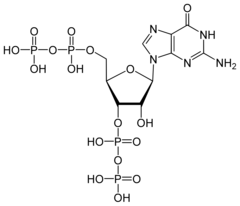
alarmones
ppGpp and pppGpp : these are the signals that trigger a stringent response.
attenuation
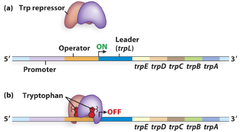
mechanism of control in some bacterial operons that causes transcription to stop prematurely. it's impossible in eukaryotes because it's based on the fact that prokaryotes have transcription and translation occurring simultaneously

trp operon
operon of genes related to tryptophan synthesis,
leader sequence
a portion of mRNA that contains the attenuator region. during attenuation, ribosome stalls here and will either proceed or terminate depending on metabolic conditions

RelA
protein that is associated with the 50s subunit of the ribosome. During translation, if it encounters uncharged tRNAs, it will trigger a stringent response by creating alarmones.

persister cells
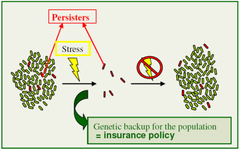
dormant versions of regular cells that are very tolerant of antibiotics. particularly problematic in instances of tuberculosis infections. patient noncompliance to antibiotic plan can allow them to develop antibiotic resistance.
two component system
a regulatory system in which there is both a sensor kinase and a response regulator

heat shock proteins
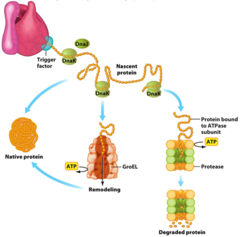
well-conserved, ancient proteins that respond to heat, UV radiation, or exposure to ethanol. they are triggered by the denaturation of proteins.

DnaK
protein involved in heat shock response. it does two major things: 1) uses energy to refold denatured proteins and 2) binds RpoH sigma factor, inactivating it after heat shock response has been completed
RpoH
sigma factor that allows for the transcription of heat shock genes. blocked by DnaK once heat shock has been 'dealt with.'

virulence genes
genes that allow bacteria to cause disease. often turned on in response to environment.
quorum sensing
bacteria's way of determining how many cells are present in their environment

autoinducer
small molecule produced by bacteria to allow other bacteria to detect their presence

signal blind mutants
mutant strain that can produce autoinducers but lacks receptors for them, preventing them from receiving the signal.
interspecific quorum sensing
type of quorum sensing. all species make the same molecule and same receptor. less specific, more universal form of sensing.

intraspecific quorum sensing
type of quorum sensing. each species synthesizes its own autoinducer and has receptors specific for itself. more specific, less universal form of sensing.

Autoinducer mutants
mutant strain that is able to sense autoinducers of other bacteria but lack the ability (lack genes) to synthesize their own autoinducers.
Super-mutator
Bacterial strain that lacks one or more DNA repair mechanism and thus accrues more mutations than typical
LexA
A repressor protein which represses transcription of SOS response genes. Once it is cleaved (RecA action), it stops repressing these genes and SOS response begins.

Mutation
Occurs when there is a structural change of a gene.

Induced mutation
A type of mutation that is human made, not occurring randomly/naturally.

Spontaneous mutation
A type of mutation that occurs without human interventions.
Point mutation
A type of mutation that occurs when one base pair of DNA is changed

Loss of function mutation
A class of mutation that results in the inactivation of a protein.
Gain of function mutation
A class of mutation that activates a protein or proteins. Potentially conferring new functionality to the cell.

Auxotroph
Term to describe a cell/organism that lacks the gene or genes to synthesize a specific amino acid

Prototroph
Term to describe a cell/organism that can synthesize all essential amino acids and do not need them supplied by outside sources.

Transgenic
An organism that has genetic material of its own and that of another organism given artificially.

Selectable mutation
A mutation that gives an organism an selective advantage

Nonselectable mutation
A mutation that does not give a organism an advantage, but can still result in a phenotypic change.

Frameshift mutation
A mutation caused by the insertion or deletion of nucleotides in a DNA sequence that changes the reading frame. results in loss of function.

Nonsense mutation
A mutation in a codon that originally encoded an amino acid which changes the codon to a stop codon.
Mis-sense mutation
A type of point mutation in which the nucleotide changed results in a change in which amino acid is specified by the codon

Reversions
A mutation that restores function lost in a previous mutation

SOS response
Response that occurs in bacterial cells when DNA damage is detected. Cell growth is halted and DNA repair is induced. Involves the RecA protein.

RecA
A DNA maintenance and repair protein that recognizes ssDNA, activates upon binding to 1) cleave LexA 2) mediate strand exchange to fill in gaps in the DNA.

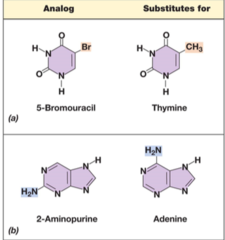
Base analogs
Molecules that are structurally similar to the nitrogenous bases in DNA and RNA which, due to the similarity, can be incorporated into nucleic acids. Their presence can increase the incidence of mutation.
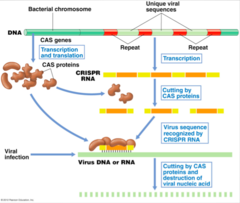
CRISPR/cas
A prokaryotic immune defense against viral DNA that has been modified to act as a method of editing DNA. The system can be used to cut a cell's genome in a specified spot, enabling removal of genes and/or insertion of new genes.
qualitative PCR
Type of PCR that allows detection of the *presence* of a target segment, but not the *amount* . This is the first type of PCR designed.

annealing
phase of PCR where primers bind to their target sequence.

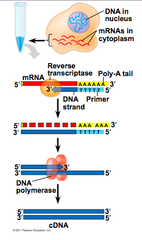
Reverse Transcription PCR (RT-PCR)
A type of PCR that is used to qualitatively detect *expression* of a gene in a cell by creating cDNA transcripts from RNA present in the cell.
genetic engineering
Artificial modification of an organism by changing its genetic information.

gel electrophoresis
Technique that puts DNA through an electrical current to show the relative size of a specific DNA fragment.

nucleic acid probes
Segments of single stranded DNA that are known and are used in nucleic acid hybridization.
heterologous expression
Expression of a gene in an organism that does not naturally have that specific gene or gene fragment.

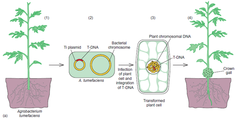
Agrobacterium tumefaciens
A plant pathogen that has a Ti plasmid that gives it its virulence.
Knockout organism
An organism that has an single gene inactivated.

subunit vaccine
A type of vaccine that has a certain protein or proteins unique to to a pathogen.

type strain
Strain that is used to describe a species for the first time and is the reference point for all other strains of that species.
intercalating agent
Chemical that can be inserted in between bases that could result in a frameshift mutation in the DNA.

ligase
Enzyme that is used to catalyze the joining of two DNA fragments. Important in ligation.

reporter gene fusions
Coding sequence of a reporter gene is combined with the regulatory region from some where different.

restriction enzyme
Enzymes that cut DNA at specific palindromic sequences.
Quantitative PCR (Real Time PCR) (qPCR)
A type of PCR that allows target DNA amplification to be monitored while PCR is taking place (in contrast to conventional PCR, which detects this amplification after reaction is complete). This allows gene expression to be measured quantitatively.

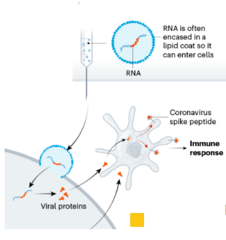
Moderna and Pfizer
COVID-19 vaccines that use spike protein mRNA to immunize
transgenic animals
animals that have a target gene inserted into their genome.

neutralizing antibody
antibodies that block the binding of a virus to the host cell, preventing infection
