Claude MCQs
 Call Kai
 Learn
 Practice Test
 Spaced Repetition
 Match
 Flashcards
 Knowt Play
1/13

There's no tags or description
Looks like no tags are added yet.
14 Terms
A 74-year-old man has 24 hours of fever, confusion and neck stiffness. CT brain is normal. The CSF is turbid, with a large rise in neutrophils, very high protein and low glucose. The Gram stain shows no organisms. Which empirical regimen is most appropriate?
A. IV ceftriaxone alone
B. IV benzylpenicillin plus gentamicin
C. IV meropenem plus metronidazole
D. IV ceftriaxone plus IV ampicillin
E. IV vancomycin alone

D. Ceftriaxone covers N. meningitidis and most S. pneumoniae. In elderly patients you add ampicillin for Listeria.

A 3-year-old girl won't put weight on her right leg and has a hot, swollen knee. Synovial fluid has a raised neutrophil count, but the Gram stain is negative and routine culture shows no growth at 48 hours. She has no animal bites. What is the most likely organism?
A. Staphylococcus aureus
B. Neisseria gonorrhoeae
C. Kingella kingae
D. Pasteurella multocida
E. Brucella spp.
C. K. kingae affects children aged 6 months to 4 years and often doesn't grow on routine culture. Pasteurella would need a cat or dog bite.

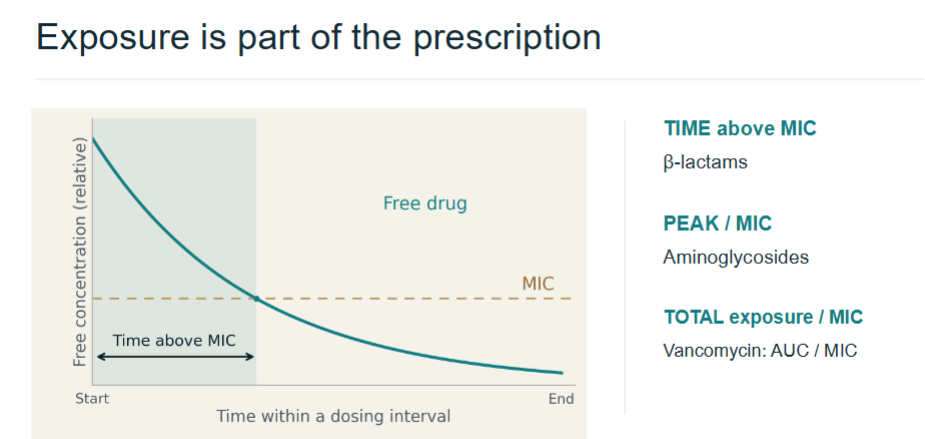
An ICU consultant asks for meropenem as an extended infusion and gentamicin as a single high daily dose. Which pairing of each drug with the PK/PD measure that predicts its effect is correct?
A. Meropenem: peak/MIC; gentamicin: time above MIC
B. Meropenem: time above MIC; gentamicin: peak/MIC
C. Meropenem: AUC/MIC; gentamicin: time above MIC
D. Meropenem: time above MIC; gentamicin: AUC/MIC
E. Both: AUC/MIC
B. β-lactams depend on time above MIC, aminoglycosides on peak/MIC, and vancomycin on AUC/MIC.
(Meropenem a Carbapenem which is a B lactam. Gentamicin is an aminoglycoside)
A 40-year-old man with chronic sinusitis has had a worsening headache for a week. He now has left-sided weakness and papilloedema. Contrast CT shows a ring-enhancing lesion in the right frontal lobe. Which organisms are most likely?
A. S. aureus and Clostridium spp.
B. Staphylococci and Gram-negative bacilli
C. Streptococci (especially the milleri group) and anaerobes
D. Viridans streptococci alone
E. Listeria monocytogenes
C. Abscesses from the sinuses or middle ear are usually streptococci (milleri) plus anaerobes.

A patient has bacteraemia with an ESBL-producing E. coli. Which agent is most likely to stay reliably active?
A. Cefotaxime
B. Ceftazidime
C. Co-amoxiclav
D. Meropenem
E. Trimethoprim
D. ESBLs break down penicillins (including co-amoxiclav) and broad-spectrum cephalosporins, and these isolates are often trimethoprim-resistant. Carbapenems are used to treat them.

A 38-year-old man with advanced HIV has 3 weeks of headache and lethargy and a new right sixth cranial nerve palsy. The CSF shows a raised lymphocyte count, raised protein and low glucose. The Gram stain is negative. Which extra CSF test is the most useful to request next?
A. Ziehl–Neelsen stain
B. India ink stain
C. HSV PCR
D. Repeat Gram stain
E. Polarising microscopy

B. In an immunocompromised patient, a subacute onset with cranial nerve palsies suggests cryptococcal meningitis, so request an India ink stain.

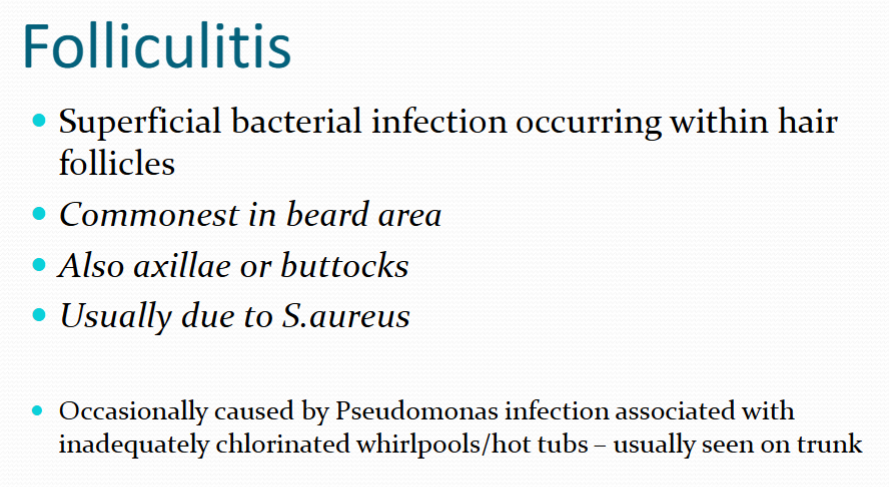
A 28-year-old man comes back from a resort holiday where he used the hot tub every day. He now has numerous itchy follicular pustules spread across his trunk. What is the most likely organism?
A. Staphylococcus aureus
B. Streptococcus pyogenes
C. Pseudomonas spp.
D. Malassezia furfur
E. Candida albicans
C. Inadequately chlorinated whirlpools and hot tubs cause Pseudomonas folliculitis, usually on the trunk. S. aureus folliculitis is usually in the beard area.
A 45-year-old woman on the ward has a temperature of 38.2 °C and a heart rate of 102. Her BP is 128/78 and she has no signs of shock. Infection is possible but there is no obvious source. Under the adult SSC 2026 framework in your lecture, what is the most appropriate approach?
A. Start antibiotics immediately, ideally within 1 hour
B. Do a rapid assessment, and give antibiotics within 3 hours if concern for infection persists
C. No antibiotics; reassess in 24 hours
D. Start antibiotics only once blood cultures are positive
E. Give antibiotics within 6 hours whatever the assessment shows
B. Possible sepsis without shock calls for rapid assessment, with antibiotics within 3 hours if concern for infection persists.

A 23-year-old man has well-demarcated, slightly scaly, hypopigmented patches that run together across his upper trunk and shoulders. They became noticeable after a summer in the sun. Under Wood's light they fluoresce pale blue. What is the most appropriate first-line treatment?
A. Oral griseofulvin
B. Topical fusidic acid
C. Topical terbinafine
D. Oral flucloxacillin
E. Topical nystatin
C. This is pityriasis versicolor, caused by Malassezia furfur. Treat with topical terbinafine or an azole.

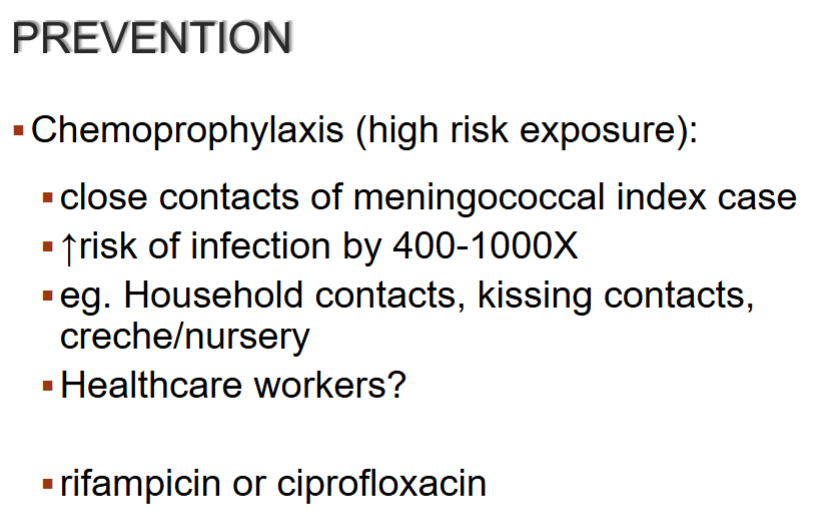
A college student is confirmed to have invasive meningococcal disease. His housemate is well. What is the most appropriate step for the housemate?
A. Oral amoxicillin
B. Oral ciprofloxacin
C. No action unless symptoms develop
D. Oral clarithromycin
E. Oral doxycycline
B. Close contacts get rifampicin or ciprofloxacin. Their risk is 400–1000x higher.
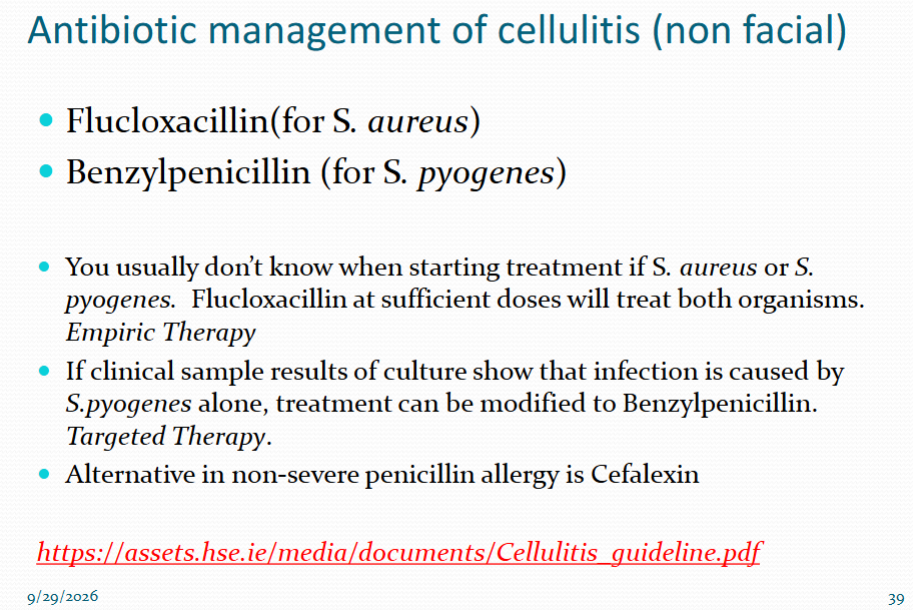
A 60-year-old man with lower-leg cellulitis has been started empirically on IV flucloxacillin. Blood cultures grow S. pyogenes only. He is improving. What is the best change to his treatment?
A. Continue flucloxacillin unchanged
B. Switch to IV benzylpenicillin
C. Switch to oral phenoxymethylpenicillin
D. Add clindamycin
E. Switch to clarithromycin
B. Once the cause is S. pyogenes alone, narrow to benzylpenicillin. Oral phenoxymethylpenicillin is poorly absorbed.
A 78-year-old man with CKD takes ramipril and spironolactone. He needs treatment for an infection. Which antibiotic most needs close potassium monitoring?
A. Doxycycline
B. Co-trimoxazole
C. Clarithromycin
D. Linezolid
E. Amoxicillin
B. Co-trimoxazole causes hyperkalaemia and renal issues. Linezolid's main cautions are blood counts and serotonergic drugs.

A GP is reviewing five adult patients who are each due a live attenuated vaccine (MMR or varicella). Each is currently taking prednisolone, as listed below. Which patient meets the threshold for immunosuppression, meaning the live vaccine may be contraindicated?
A. A 34-year-old man taking prednisolone 40 mg/day for an asthma exacerbation, completed 7 days
B. A 51-year-old woman taking prednisolone 30 mg/day for 10 days for a gout flare
C. A 45-year-old man taking prednisolone 20 mg/day, now on day 15, for polymyalgia rheumatica
D. A 67-year-old woman taking prednisolone 10 mg/day for 8 months for rheumatoid arthritis
E. A 29-year-old woman taking prednisolone 35 mg/day for 12 days for an IBD flare
C. The slide threshold is prednisolone ≥40 mg/day for more than 1 week, or ≥20 mg/day for at least 2 weeks. Patient C is on 20 mg/day at day 15, so they qualify.
A: 40 mg/day for exactly 7 days is not more than 1 week.
B and E: both doses are below 40 mg/day and neither course has reached 2 weeks.
D: 10 mg/day is below the 20 mg/day threshold.

A 58-year-old woman with rheumatoid arthritis was started on a new biologic agent 4 months ago because methotrexate was not controlling her disease. She now has 6 weeks of night sweats, weight loss and a productive cough. Her chest X-ray shows right upper lobe cavitation. Sputum is positive for acid-fast bacilli. She had no symptoms before starting the new drug. Which agent was she most likely started on?
A. Rituximab
B. Infliximab
C. Alemtuzumab
D. Tacrolimus
E. Azathioprine
B (Infliximab). Anti-TNF-α biologics are linked to reactivation of TB and hepatitis B. Rituximab is the main distractor because it is also used in RA. However, it is an anti-CD20 drug that causes B-cell dysfunction and mainly raises the risk of bacterial infections. Tacrolimus is a transplant immunosuppressant and isn't used here.
