Year 9 science: WAVES
 Call Kai
 Learn
 Practice Test
 Spaced Repetition
 Match
 Flashcards
 Knowt Play
1/27

There's no tags or description
Looks like no tags are added yet.
28 Terms
Transverse wave
A wave in which the particles of the medium move perpendicularly to the direction the wave is traveling.

Compression wave (Longitudinal wave)
Wave that the particles move backwards and forwards in the same direction as the energy transfer.

Medium
Material through which a wave travels.
Vibration
A repeated back-and-forth or up-and-down motion
Compression
The part of a longitudinal wave where the particles of the medium are close together.
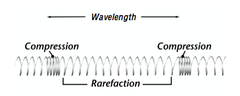
Rarefaction
A part in a longitudinal wave where the particles are spread apart

Frequency
The number of sound wave cycles per second, measured in Hertz (Hz).

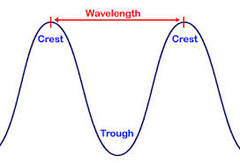
Wavelength
Horizontal distance between the crests or between the troughs of two adjacent waves.
Hertz
Unit of frequency

Pitch
How high or low a sound is

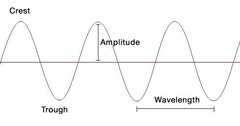
Amplitude
Height of a wave, loudness of sound.
Beam
A ray of light.
Transparent
A material that allows light to pass through.

Translucent
A material that allows some light to pass through.

Opaque
A material that prevents the passage of light.
Reflection
The bouncing back of a wave when it hits a surface through which it cannot pass.

Angle of incidence
The angle between the incident ray and the normal

Angle of reflection
The angle between the reflected ray and the normal.

Law of reflection
The angle of incidence is equal to the angle of reflection.

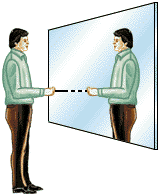
Plane mirror
A mirror with a flat surface.
Concave mirror
A mirror with a surface that curves inward like the inside of a bowl.

Convex mirror
A mirror that is curved outward like the back of a spoon.

Radio waves
Electromagnetic waves with the longest wavelengths and lowest frequencies.

Visible light
Electromagnetic radiation that can be seen with the unaided human eye.
Electromagnetic wave
A form of energy that can move through the vacuum of space.
Refraction
The bending of light as it passes at an angle from one medium to another.

Normal
A line perpendicular to the surface of the mirror.

Velocity of a wave=
frequency x wavelength