End of Year Exam
 Call Kai
 Learn
 Practice Test
 Spaced Repetition
 Match
 Flashcards
 Knowt Play
1/74

There's no tags or description
Looks like no tags are added yet.
75 Terms
Primary Adrenal insufficiency Investigation
Short Synacthen test This test helps diagnose adrenal insufficiency by determining whether the adrenal glands can produce cortisol adequately in response to ACTH. Short Synacthen (cosyntropin) stimulation test, which assesses the adrenal cortex response by measuring serum cortisol levels before and 30 to 60 minutes following the administration of synthetic ACTH.
Primary Adrenal Insufficiency Symptoms
a failure of serum cortisol to rise after synthetic ACTH shows the adrenals cannot respond. This woman has hyponatraemia, hyperkalaemia, postural hypotension, pigmentation of the palmar creases and buccal mucosa, and falling insulin requirements with hypoglycaemia, and she has other autoimmune disease and no glucocorticoid exposure
Definition: Clinical presentation resulting from combined glucocorticoid, mineralocorticoid, and adrenal androgen deficiency:
Constitutional: Chronic fatigue, progressive generalized muscle weakness, anorexia, and unintentional weight loss.
Hemodynamic & Cardiovascular: Postural (orthostatic) hypotension, lightheadedness, and syncope secondary to hypovolemia and aldosterone deficiency.
Dermatologic: Hyperpigmentation of palmar creases, buccal mucosa, friction points, extensor surfaces, and recent scars (caused by elevated ACTH and co-secreted melanocyte-stimulating hormone).
Gastrointestinal: Nausea, vomiting, persistent abdominal pain, and diarrhea.
Metabolic & Electrolyte: Hyponatremia, hyperkalemia, hypoglycemia, and unexplained reduced insulin requirements in diabetic individuals.
Musculoskeletal & Other: Intense salt craving, diffuse myalgias, arthralgias, and reduced body hair in females.
Lead time bias
Lead-time bias arises when screening brings the date of diagnosis forward without changing the date of death. Survival is counted from diagnosis, so it looks longer even though the person dies at the same age. An equal age at death with a longer survival from diagnosis is the pattern it produces.
Vitamin K deficiency investigation results
INR prolonged, APTT normal, PT prolonged, platlets normal
Methotrexate side effects
Methotrexate suppresses the bone marrow and injures the liver, so the full blood examination and liver function tests are repeated at set intervals and compared with her normal baseline haemoglobin, white cell count and ALT. This is the standard toxicity monitoring pair. Methotrexate can also cause pneumonitis
Full blood examination and ivermectin function tests are used to monitor.
Hep B surface Antigen
If positive: active infection
If negative: no active infection
Hep B surfacce Antibody
if positive: Protective antibodies against Hep B (vaccination or previous infection)
If negative: no protective antibodies
Hep B core total antibody
+: evidence of previous natural infection
-: no evidence of natural exposure
Only arises from natural infection!
Hep B core IgM antibody
+: acute or recent hep B infection
-: Chronic Hep B or no infection
Hep B IgG antibody
+: previous Hep infection or current infection
-: no previous infection
A 29-year-old man presents with two days of dark urine and puffiness around his eyes. Blood pressure is 156/96 mmHg and he is afebrile. Urine dipstick shows blood 3+ and protein 2+, with no leucocytes or nitrites. Urine microscopy shows dysmorphic red cells and red cell casts. Serum creatinine is 148 µmol/L(60 - 110). which condition does he have?
Glomerulonephritis is correct: blood and protein on dipstick together with dysmorphic red cells and red cell casts show that the red cells have come through damaged glomeruli, and the hypertension, periorbital puffiness and raised creatinine fit a nephritic picture.
Acute interstitial nephritis causes and investigation results
an inflammatory condition affecting the renal interstitium and tubules of the kidneys, leading to an acute or subacute decrease in kidney function
Haematuria, proteinuria, increased creatinine
Usually due to new drug exposure, infection of autoimmune causes
Glomerulonephritis causes
Often triggered by the immune system attacking the glomeruli.
SLE, IgA nephropathy, Anti-GBM and vasculitis
Guillain- Barre Syndrome Investigation
nerve conduction studies
Investigation for suspected melanoma
Excisional biopsy, full depth, 2mm margins
Investigation for suspected SCC
Shave/ Punch - will be used first to make a diagnosis, before definitive surgical removal,Superficial BCCs; SCC in situ; seborrheic keratoses. Differentiating inflammatory conditions; large BCCs/SCCs; suspected lentigo maligna prior to wide mapping.
Excisional

What is this skin lesion?
Actinic keratosis - a precancerous skin lesion caused by UV exposure generally

What is this skin lesion
Lentigo maligna: Slow growing melanoma in situ

Explain Paget’s disease of the bone and its management
PDB is characterised by a marked increase in activity of both osteoclasts and osteoblasts. Bone remodelling is increased and disorganised, with persistence of woven bone at pagetic sites, resulting in bone which is structurally impaired and prone to deformity and fracture.
he most common metabolic bone disease after osteoporosis, affecting 2–4% of adults over 55 years of age. The treatment of choice is a single infusion of zoledronic acid; courses of oral alendronate (3–6 months) or risedronate (2 months) are also effective.
Diagnosis is made via:
Plasma alkaline phosphatase
Liver function tests
Vitamin D levels
Isotope bone scan
Radiography of affected bones
What is the investigation of choice for following up idiopathic pulmonary fibrosis?
Full lung function tests with gas transfer
What is a cross-sectional study
A cross-sectional study is an observational research design that analyzes data from a population or a representative subset at a single point in time. Testing a random sample of 1500 residents once shows what proportion currently have diabetes, which is the prevalence, and finds undiagnosed cases as well as known ones.
Case-control study
A case-control study chooses people because they do or do not have the disease and looks back for exposures. Because the researchers fix the number of cases and controls, it cannot show how common the disease is. It would be the right design if the question were whether a past exposure is linked to a rare disease.
Cohort study
A cohort study is an observational research design where a defined group of people (a cohort) is followed over time to see how certain exposures or risk factors affect health outcomes
Investigation of choice for fluctuant mass in a lactating woman
Breast Ultrasound
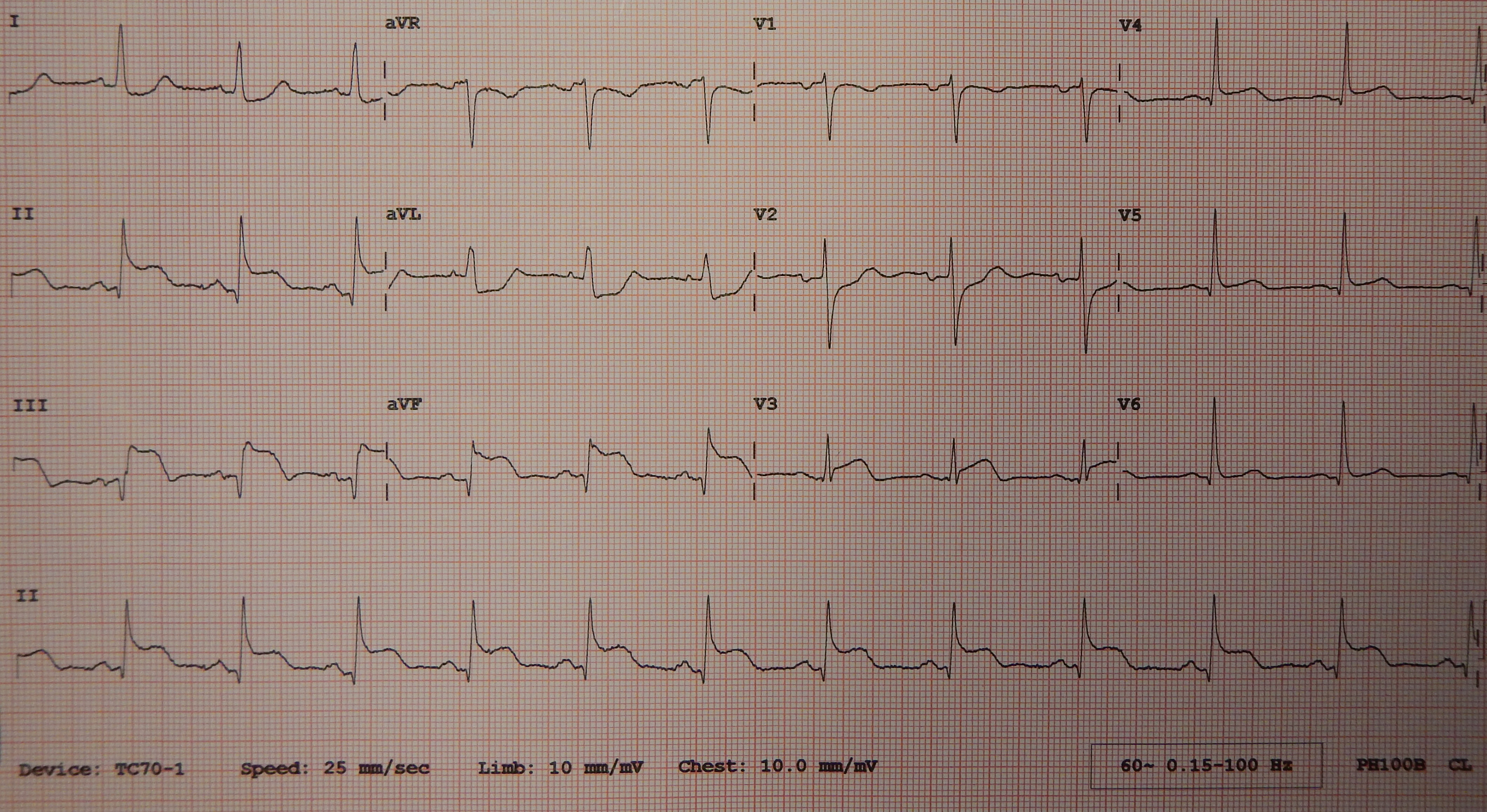
Inferior STEMI Criteria
ST elevation in II, III and aVF, most marked in III, with reciprocal ST depression and T-wave inversion in aVL
Surveillance test for breast cancer
Annual mammography is the recommended surveillance test after breast-conserving surgery and radiotherapy; it detects local recurrence in the treated breast and a new primary in either breast, which is the aim in this asymptomatic woman with a normal examination.
Investigation to monitor response to HIV treatment
Plasma HIV RNA viral load is the primary measure of treatment response: it should fall to undetectable on effective therapy, and a failure to fall would point to poor adherence or resistance despite his reported full adherence
Which test is MOST APPROPRIATE for routine surveillance for hepatocellular carcinoma?
Abdominal Ultrasound
Specificity
Specificity is the proportion of people without the disease who test negative. The 400 patients without a myocardial infarction are the denominator and the 320 with a negative result are the true negatives, so the figure describes specificity, here 80%.
Sensitivity
Sensitivity is the proportion of people with the disease who test positive. It is described by the other figure in the stem: 95 of the 100 patients with a myocardial infarction had a positive result.
Negative predictive value
Negative predictive value is the proportion of people with a negative test who do not have the disease.
Positive Predicitve value
Positive predictive value is the proportion of people with a positive test who have the disease
Positive likelihood ratio
The positive likelihood ratio is sensitivity divided by one minus specificity. It is a ratio that says how much more often a positive result occurs in people with the disease than in people without it, not a proportion of one group of patients.
What is a positive mono spot test suggestive of
EBV
relative risk definition
Relative risk is the risk of the outcome in exposed people divided by the risk in unexposed people
Absolute risk reduction
Absolute risk reduction is the risk in the control group minus the risk in the treated group. It needs the risk of the outcome in each group, and it describes the benefit of an intervention. It would be the answer in a randomised trial of a treatment that reports the event rate in each arm.
relative risk reduction
Relative risk reduction is the proportional fall in risk produced by an intervention. It needs the risk in each group and applies to a treatment that lowers risk. It would be the answer in a randomised trial reporting that a drug lowered the event rate by a stated fraction.
Odds ratio
An odds ratio (OR) measures the strength of association between an exposure and an outcome
What is pheochromocytoma?
a rare, usually noncancerous (benign) tumor that grows in the inner part of an adrenal gland (the adrenal medulla). release of excess catecholamines occurs: adrenaline and noradrenaline. Headaches, tachycardia and heavy sweating occurs. And palpitations often.
Monitoring test for hepatocellular carcinoma
Alpha-fetoprotein is used for hepatocellular carcinoma and germ cell tumours. It would be monitored if he had been treated for a primary liver cancer rather than sigmoid adenocarcinoma
Monitoring test for resected colorectal adenocarcinoma
CEA
TB treatment side effects
Hepatoxicity so LFTs need to be monitored
First line imaging for new lump in a young woman
Breast Ultrasonography
Hyperkalemia ECG changes
Peaked T waves, flattened or no P waves
a

Carbimazole Side effet and monitoring test
Agranulocytosis, typically within the first weeks to months, and fever with a sore throat is its classic presentation. The neutrophil count on the differential determines whether the drug must be stopped and urgent neutropenic management started. Full blood examination with differential is needed

What is this?
extradural/epidural haematoma

Subdural haematoma
Hypocalemia symptoms
Perioral tingling,
hand cramps and a
spasm provoked by cuff inflation (Trousseau sign) indicate hypocalcaemia.
Prolonged QT interval
In a young woman with a repaired congenital heart defect, cleft palate and learning difficulties, hypoparathyroidism due to 22q11 deletion is the likely cause. Hypocalcaemia prolongs the ST segment and therefore the QT interval, whereas hypercalcaemia shortens it
What is asteatotic eczema
Asteatotic eczema (eczema craquelé) affects the shins of older people in winter, driven by dry skin and frequent hot showers, and shows the fine polygonal cracking described. The bilateral shin distribution, winter onset and absence of venous signs fit
What is a classic ECG sign in PE?
The S1Q3T3 pattern (also known as the McGinn-White sign) is a classic electrocardiogram (ECG) finding characterized by: [1]
S1: A prominent or deep S wave in Lead I.
Q3: A Q wave in Lead III.
T3: An inverted T wave in Lead III
Treatment for bradycardia hyperkalemia
Intravenous calcium gluconate is the immediate treatment because missed dialysis with absent P waves, a widened QRS complex and peaked T waves indicates hyperkalaemic bradycardia with haemodynamic compromise. Calcium stabilises the myocardial membrane within minutes and protects the heart while the potassium is lowered
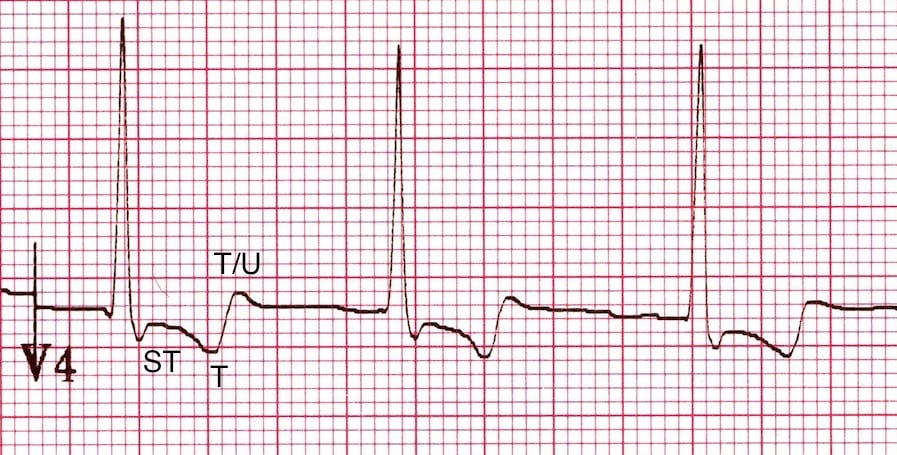
What does this ECG show?
Digoxin Effect : Widespread T wave inversion with sloping depression of the ST segment, and QTc 380ms.

Pericarditis Widespread concave (saddle-shaped) ST elevation with PR depression

Inferior STEMI: ST elevation in leads II, III and aVF, reciprocal ST depression in leads aVL Hyperacute T waves may precede these changes
What is a phaeochromocytoma?
It is a usually benign neuroendocrine tumor of the adrenal medulla that secretes excessive amounts of catecholamines (adrenaline and noradrenaline)
what is primary hyperaldosteronism?
It is also known as Conn’s disease and it is caused by a disorder where the adrenal glands produce too much of the hormone aldosterone independently of the body's normal regulatory systems. Causes hypertension and hypokalaemia
What is the most important/high risk side effect of carbimazole?
Agranulocytosis- which is a drastically low level of neutrophils - may present with fever and sore throat or other infective signs
Which condition causes a tender/painful thyroid?
Thyroiditis -
Tender, firm, diffusely enlarged thyroid + fever + thyrotoxic symptoms = subacute (de Quervain) thyroiditis: high ESR, low uptake; treat with NSAIDs.
what is Sjögren's syndrome
is a chronic autoimmune condition where the immune system mistakenly attacks the body's moisture-producing exocrine glands—specifically the tear (lacrimal) and saliva (salivary) glands.
Primary Biliary Cholangitis Symptoms and +ve investigations
Middle-aged woman + itch + raised ALP + xanthomas + Anti-mitochondrial antibody positive + high cholesterol = primary biliary cholangitis; treat with ursodeoxycholic acid.
Renal Cell Carcinoma Signs
A high haemoglobin (190 g/L) with haematuria in an older man points to renal cell carcinoma - EPO is made by the tumour
Haemarturia
Fatigue
RCC paraneoplastic effects worth knowing: erythrocytosis, hypercalcaemia (from parathyroid hormone-related protein), liver dysfunction without liver metastases (Stauffer syndrome), fever and weight loss.
What is Medullary Sponge Disease?
Congenital disease causing the kidneys tiny cysts which give the kidneys a honeycomb like appearance. This increases the risk of renal stones and UTIs and haematuria significantly, but is usually asymptomatic

What is thin basement membrane disease
Thin basement membrane disease: Lifelong persistent microscopic haematuria with normal kidney function; no effect on haemoglobin. Genetic disease causing widespread thinning of the glomerular basement membrane.
What is focal segmental glomerular sclerosis?
FSGS presents with nephrotic-range proteinuria and oedem.
a rare kidney disease characterized by the scarring (sclerosis) of small sections of the glomeruli, which are the tiny filtering units in the kidneys that clean waste and fluids from the blood
Common Symptoms
Edema: Swelling in the legs, ankles, feet, face, or around the eyes due to fluid retention. [1, 2]
Foamy urine: Caused by heavy protein leakage into the urine (proteinuria). [1, 2]
Weight gain: Rapid increase resulting from excess fluid buildup. [1]
High blood pressure (hypertension) and high cholesterol (hyperlipidemia
What is membranous nephropathy?
Membranous nephropathy (MN) is a kidney disease where the immune system attacks the tiny filters in the kidneys (glomeruli), causing them to leak large amounts of protein into the urine. [1, 2]
Overview & Types
Primary (Idiopathic) MN: Accounts for about 75% to 80% of cases. It is an autoimmune condition where the body produces antibodies—most commonly targeting the phospholipase A2 receptor (PLA2R) on kidney podocytes—forming immune complexes that damage the filter. [1, 2, 3]
Secondary MN: Accounts for about 25% of cases and is triggered by an underlying condition such as an autoimmune disease (e.g., lupus), infections (e.g., hepatitis B or C), medications, or certain cancers.
Symptoms: proteinuria, oedema, high BP, fatigue
What is Bence Jones proteinuria a sign of?
Multiple myeloma
Patient presents with smoky urine, hypertension, positive ANA and anti-dsDNA test. What condition do they have and what will the most likely finding in the patients urine be?
SLE and nephritic lupus nephritis , RBC casts
What is the most common nephrotic syndrome in adults?
Membranous glomerulonephritis
Common thiazide side effects
low K, low Na, high urate (gout), high glucose, high calcium. Avoid thiazides in gout; ACE inhibitors raise K instead.
What is reflux nephropathy?
Reflux nephropathy is kidney scarring linked to vesicoureteric reflux (VUR: urine flowing back up the ureter from the bladder), usually with kidney infections in early childhood. The scars are patchy, so the kidneys become small and irregular in outline, and the damage shows up years later as hypertension, proteinuria and CKD. An adult review lists UTI, proteinuria, renal failure and hypertension as the usual presenting findings of VUR, and notes that progressive renal damage and calyceal scarring should be expected.
What is amitriptyline used for and what is it’s main bad side effect?
It is a tricyclic antidepressant that can also be used for neuropathic pain. It can cause urinary retention.
What is pyruvate kinase deficiency?
A congenital enzyme defect presenting from childhood, without fragments or a clotting disturbance.
Genetic Mutation: PKD is caused by changes (variants or mutations) in the PKLR gene, which is inherited in an autosomal recessive manner (you must inherit one mutated gene from each parent). [1]
Energy Deficit: Pyruvate kinase is an enzyme that helps red blood cells turn glucose (sugar) into energy (ATP). Without enough active enzyme, red cells run out of energy, lose their flexible shape, become dehydrated, and are destroyed prematurely (hemolysis). [1, 2]
Life Span: Normal red blood cells live about 120 days, but cells with PKD often last only a few days to weeks. [1]
Common Symptoms
Symptoms vary greatly from person to person—ranging from mild and go undiagnosed until adulthood to severe from birth: [1]
Chronic hemolytic anemia (low red blood cells) leading to fatigue, weakness, and pale skin [1, 2]
Jaundice (yellowing of the skin or eyes) and dark urine due to high bilirubin from broken-down red blood cells [1, 2]
Splenomegaly (enlarged spleen) because the spleen works overtime to filter out damaged red blood cells [1, 2]
Gallstones and an increased risk of iron overload (even in people who do not receive blood transfusions
Microangiopathic haemolysis (MAHA)
Exam pattern: anaemia + schistocytes + high reticulocytes, LDH and bilirubin + Coombs negative = MAHA; add sepsis and abnormal clotting = DIC. Management is treatment of the underlying infection, with blood products for bleeding.
Schistocytes (fragmented red cells) on the film mean microangiopathic haemolytic anaemia (MAHA): red cells are sheared as they pass through fibrin strands and microthrombi in small vessels
Negative Coombs test
The cause is the pneumonia. Severe infection triggers disseminated intravascular coagulation (DIC), and in a 2026 series of infection-associated DIC, respiratory infection was the commonest site (33%) (UpToDate). The abnormal coagulationseparates DIC from the other microangiopathies: DIC consumes clotting factors, whereas thrombotic thrombocytopenic purpura (TTP) and haemolytic uraemic syndrome (HUS) usually have normal coagulation studies (UpToDate).
What is Haemophilia A
Factor VIII deficiency
Haemophilia B
Factor IX deficiency