Kort Cellefys - uge 45: Gastric function, pancreas and salivary glands. -
 Call Kai
 Learn
 Practice Test
 Spaced Repetition
 Match
 Flashcards
 Knowt Play
1/49

There's no tags or description
Looks like no tags are added yet.
50 Terms
How does chewing facilitate chemical digestion?
Chewing breaks food into smaller particles, increasing the surface area available to digestive enzymes.
How do peristalsis and segmentation move gastrointestinal contents?
Peristalsis propels contents forward.
Segmentation moves contents back and forth to mix them with digestive secretions.

How does retropulsion help the stomach grind food?
Antral contractions push chyme toward the nearly closed pylorus. Larger particles are forced back into the stomach for further grinding.

Which bonds does α-amylase cleave in starch?
It cleaves internal α(1→4) bonds, producing maltose, maltotriose and α-limit dextrins. The α(1→6) branch bonds remain intact.
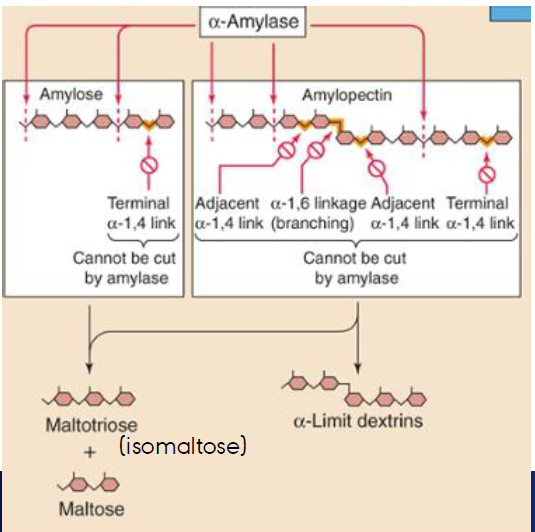
Where do salivary and pancreatic α-amylase act?
Salivary amylase starts starch digestion in the mouth and loses activity as gastric contents acidify.
Pancreatic amylase continues digestion in the duodenum and jejunum.
What do lactase, sucrase and isomaltase act on at the brush border?
Lactase splits lactose into glucose and galactose.
Sucrase splits sucrose into glucose and fructose.
Isomaltase cleaves α(1→6) branch bonds in α-limit dextrins.
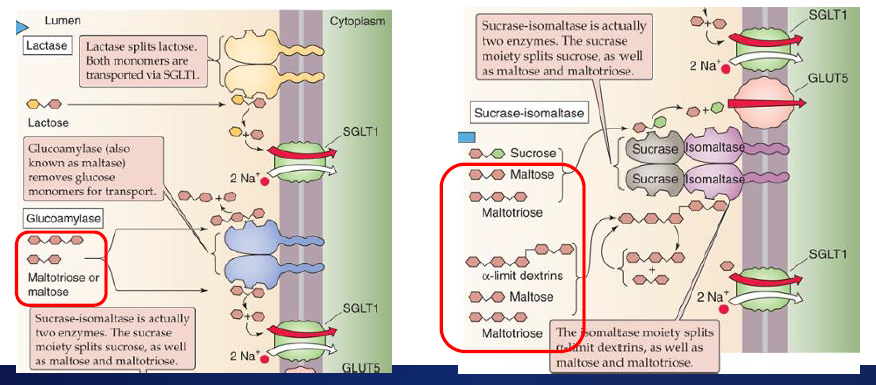
How do glucose, galactose and fructose cross an enterocyte?
Apical SGLT1 takes up glucose and galactose with Na⁺.
Apical GLUT5 takes up fructose.
All three exit through basolateral GLUT2.

How do bile salts support fat digestion and absorption?
Bile salts emulsify fat, giving pancreatic lipase more surface to act on.
They also form mixed micelles that carry digestion products to the enterocyte surface.
How are pancreatic protease precursors activated in the duodenum?
Brush-border enteropeptidase activates trypsinogen to trypsin. Trypsin then activates more trypsinogen and other pancreatic protease precursors.
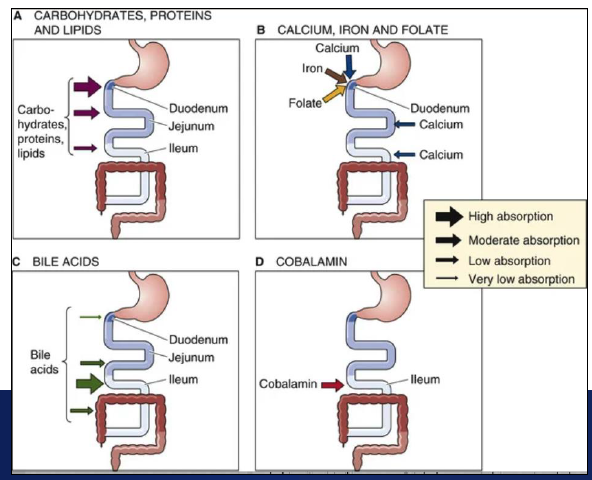
Where are most nutrients, bile acids and vitamin B₁₂ absorbed?
Most nutrients are absorbed in the small intestine, especially the proximal part. Bile acids and intrinsic factor–bound B₁₂ are absorbed mainly in the terminal ileum.
What do gastric parietal cells and chief cells secrete?
Parietal cells secrete HCl and intrinsic factor. Chief cells secrete pepsinogen.

How does gastric acid support protein digestion?
Low pH denatures dietary proteins, promotes pepsinogen activation and provides the acidic environment in which pepsin works.
What does pepsin do to dietary proteins?
Pepsin hydrolyzes internal peptide bonds, producing shorter peptides for further digestion in the small intestine.
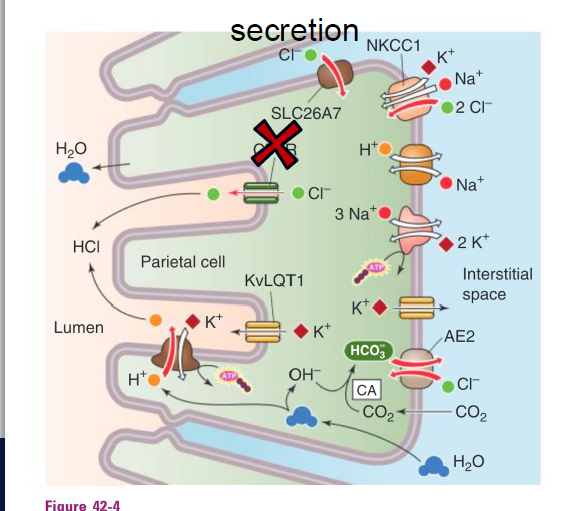
How does a gastric parietal cell generate H⁺ and HCO₃⁻?
Carbonic anhydrase catalyzes CO₂ hydration. The resulting carbonic acid dissociates into H⁺ and HCO₃⁻.
How does the apical H⁺/K⁺-ATPase secrete acid?
It uses ATP to pump H⁺ into the gastric lumen in exchange for K⁺ entering the cell.
This is primary active transport.

What are the roles of the apical K⁺ and Cl⁻ channels in a parietal cell?
K⁺ channels recycle K⁺ into the lumen so the H⁺/K⁺ pump can keep working.
Cl⁻ channels allow Cl⁻ to move into the lumen alongside secreted H⁺.
How does basolateral AE2 contribute to the alkaline tide?
AE2 brings Cl⁻ into the parietal cell in exchange for HCO₃⁻. Bicarbonate entering the blood produces a transient rise in blood pH after a meal.
How do Na⁺/K⁺-ATPase and NKCC1 support parietal cell ion transport?
The basolateral Na⁺/K⁺-ATPase pumps 3 Na⁺ out and 2 K⁺ in. NKCC1 uses the inward Na⁺ gradient to bring Na⁺, K⁺ and 2 Cl⁻ into the cell.
How does stimulation increase the number of proton pumps at the parietal cell surface?
Tubulovesicles containing H⁺/K⁺-ATPase fuse with the apical canalicular membrane, increasing the number of pumps exposed to the lumen.

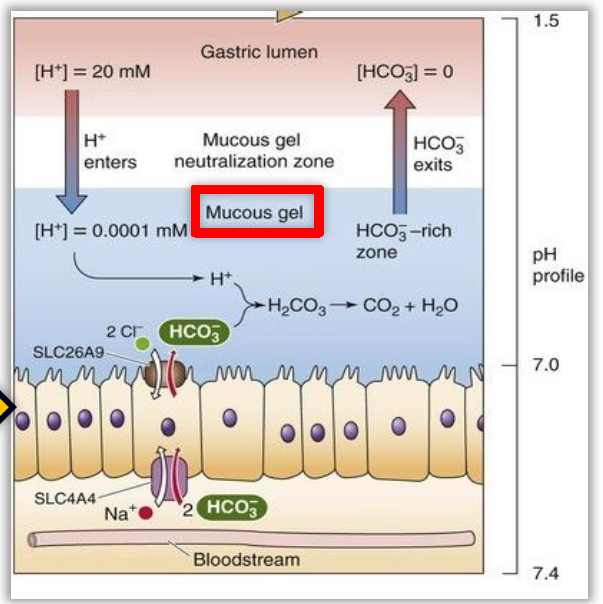
How does the gastric mucus–bicarbonate barrier protect the epithelium?
Mucus traps HCO₃⁻ near the epithelial surface.
The bicarbonate neutralizes incoming H⁺, keeping the surface pH higher than the luminal pH.
Why can NSAIDs weaken gastric mucosal protection?
NSAIDs reduce prostaglandin synthesis.
Gastric prostaglandins normally support mucus and bicarbonate secretion and help maintain mucosal blood flow.
How do proton pump inhibitors and H₂ blockers reduce acid secretion?
Proton pump inhibitors block the H⁺/K⁺-ATPase.
H₂ blockers reduce histamine signaling at the parietal cell.
How does acetylcholine signal directly in a parietal cell?
ACh (acetylcholine) binds to the M₃ muscarinic receptor, which activates the Gq protein.
Gq activates the enzyme phospholipase C (PLC).
PLC splits the membrane lipid PIP₂ into IP₃ and DAG.
IP₃ triggers Ca²⁺ release from the endoplasmic reticulum, while DAG activates protein kinase C.
These signals stimulate the parietal cell to secrete acid.
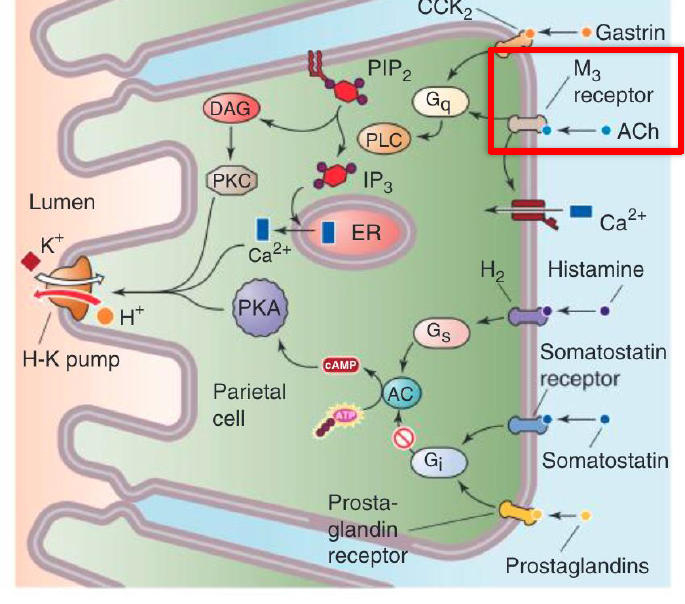
How does histamine signal directly in a parietal cell?
Histamine binds to the H₂ receptor, activating the Gs protein.
Gs activates adenylyl cyclase, which produces cAMP.
cAMP activates protein kinase A (PKA), increasing H⁺ secretion through the H⁺/K⁺-ATPase.

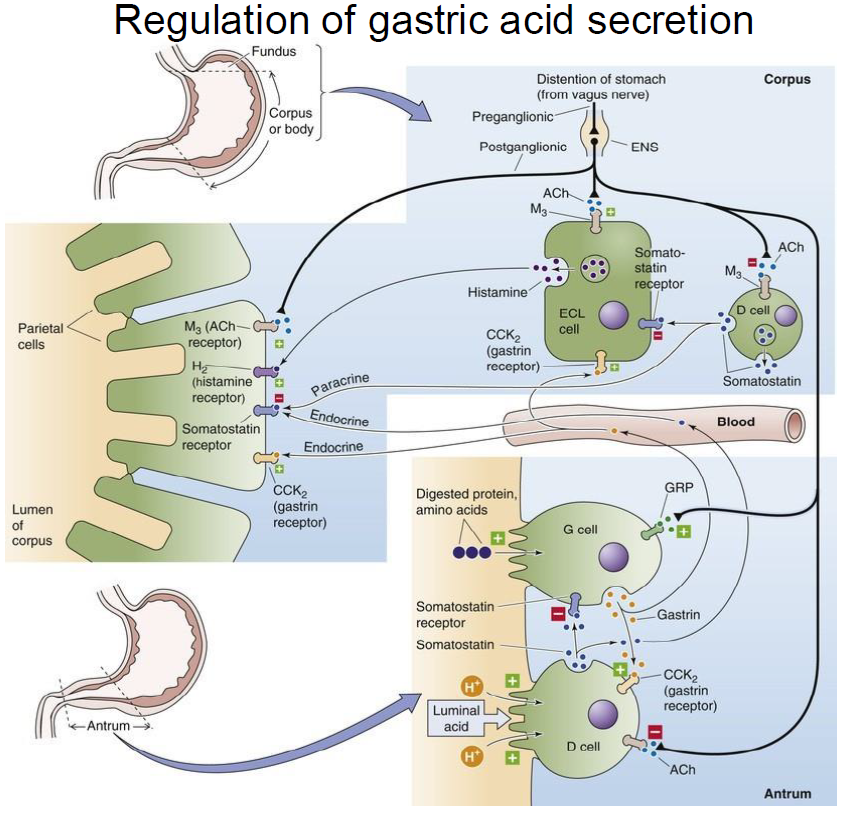
How does gastrin stimulate gastric acid secretion?
Gastrin binds to CCK₂ receptors on ECL cells, making them release histamine.
Histamine then stimulates parietal cells. Gastrin also binds directly to CCK₂ receptors on parietal cells, raising intracellular Ca²⁺ and stimulating acid secretion.
Enterochromaffin-like (ECL) cells are neuroendocrine cells in the acid-producing lining (oxyntic/corpus-fundus mucosa) of the stomach that release histamine to stimulate stomach acid secretion.

Why can gastrin and CCK bind to the same CCK₂ receptor?
Gastrin and cholecystokinin (CCK) share the same five amino acids at their C-terminal end, including an amidated terminal amino acid.
The CCK₂ receptor recognizes this shared region.

What stimulates antral G cells to release gastrin during a meal?
Peptides and amino acids stimulate G cells.
Vagal activation also stimulates gastrin release through gastrin-releasing peptide, or GRP.
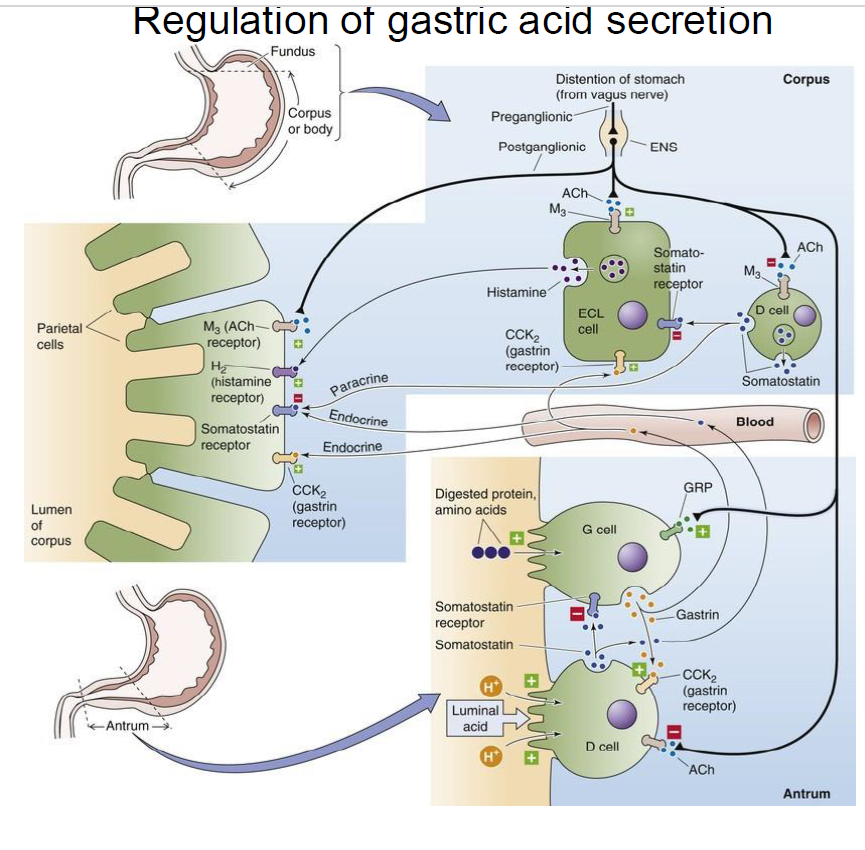
How does vagal activation increase gastric acid secretion?
The vagus activates neurons in the stomach wall.
These release acetylcholine (ACh), which stimulates parietal cells and ECL cells.
They also release gastrin-releasing peptide (GRP), which makes G cells release gastrin.
How does low antral pH reduce further gastric acid secretion?
When the antrum becomes acidic, D cells release somatostatin.
Somatostatin inhibits nearby G cells, reducing gastrin release.
Less gastrin means less stimulation of acid secretion. This forms a negative feedback loop.
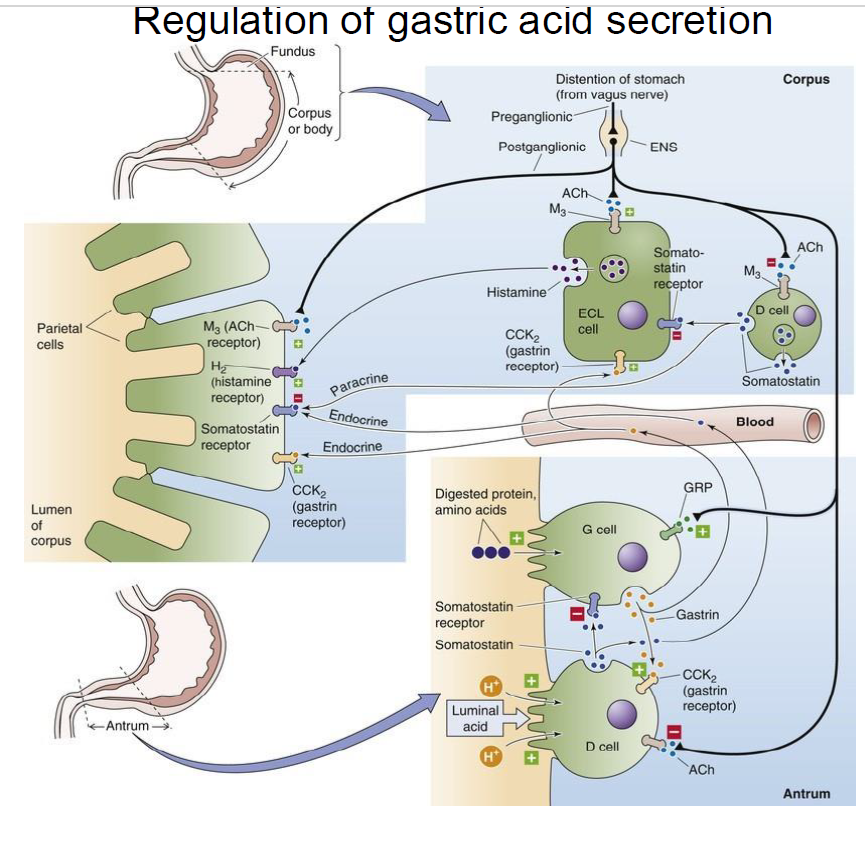
How does somatostatin inhibit ECL cells and parietal cells?
Somatostatin makes ECL cells release less histamine. It also acts directly on parietal cells, activating Gi proteins that lower cAMP and reduce acid secretion.

What does somatostatin do outside the stomach?
In the pancreas, somatostatin from δ(delta) cells inhibits insulin and glucagon release.
In the brain, hypothalamic somatostatin inhibits growth hormone release from the anterior pituitary.
How does gastrin affect the gastric mucosa?
Gastrin stimulates growth of the .
This is called a trophic effect.
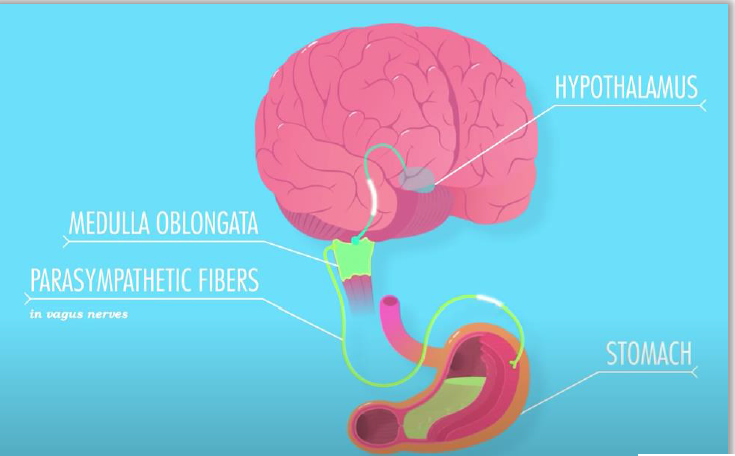
What triggers the cephalic phase of gastric acid secretion?
The sight, smell, taste or thought of food activates the vagus nerve.
This stimulates gastric acid secretion before food reaches the stomach.
What triggers the gastric phase of acid secretion?
Food stretches the stomach wall, activating local enteric and vagovagal reflexes.
Peptides and amino acids also stimulate G cells to release gastrin.
Together, these signals increase acid secretion.

How does the duodenum regulate the stomach during the intestinal phase?
Protein digestion products can briefly stimulate gastric acid secretion.
Acid and fat entering the duodenum then trigger neural and hormonal signals that reduce acid secretion and slow gastric emptying.

How does gastric pH change after a meal?
At first, pH rises because food buffers the acid already in the stomach.
As more acid is secreted and food leaves the stomach, pH falls again.
Why can loss of parietal cells cause both low gastric acidity and high gastrin?
Fewer parietal cells means less acid secretion and a higher gastric pH.
The higher pH makes antral D cells release less somatostatin.
G cells are then less inhibited and release more gastrin.
How can loss of parietal cells cause vitamin B₁₂ deficiency?
Parietal cells produce intrinsic factor, which is needed for B₁₂ absorption in the terminal ileum.
Loss of these cells reduces B₁₂ absorption and can eventually cause megaloblastic anemia.

What do pancreatic acinar cells and duct cells secrete?
Acinar cells secrete digestive enzymes and inactive enzyme precursors.
Duct cells add bicarbonate-rich fluid, which helps carry the enzymes into the duodenum and neutralizes stomach acid.
How does duodenal acid stimulate pancreatic bicarbonate secretion?
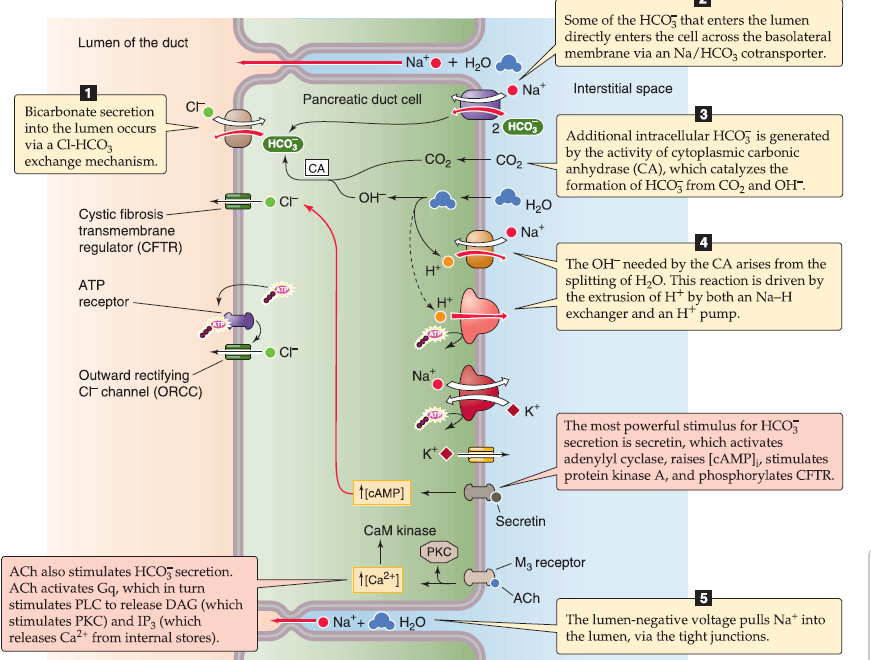
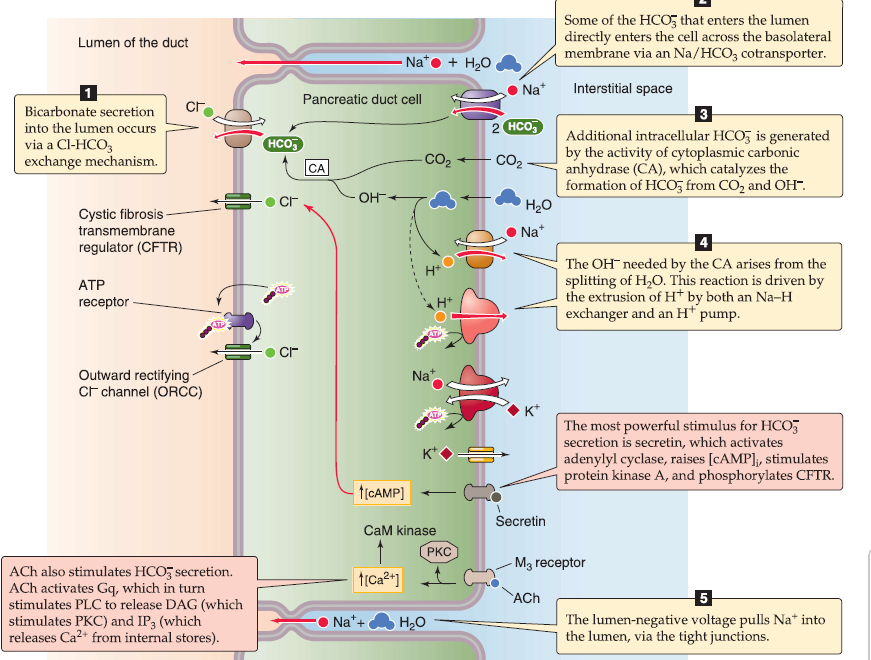
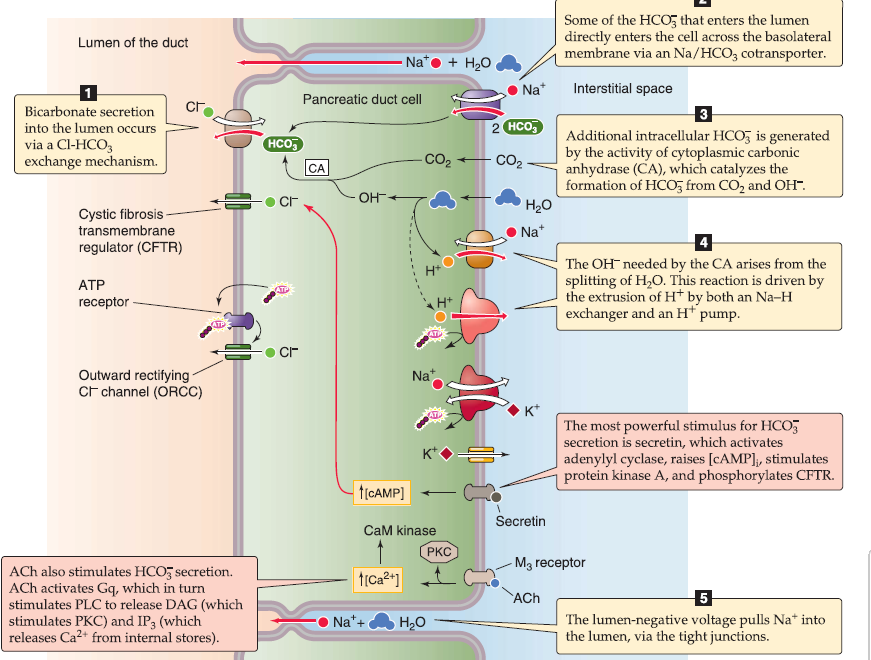
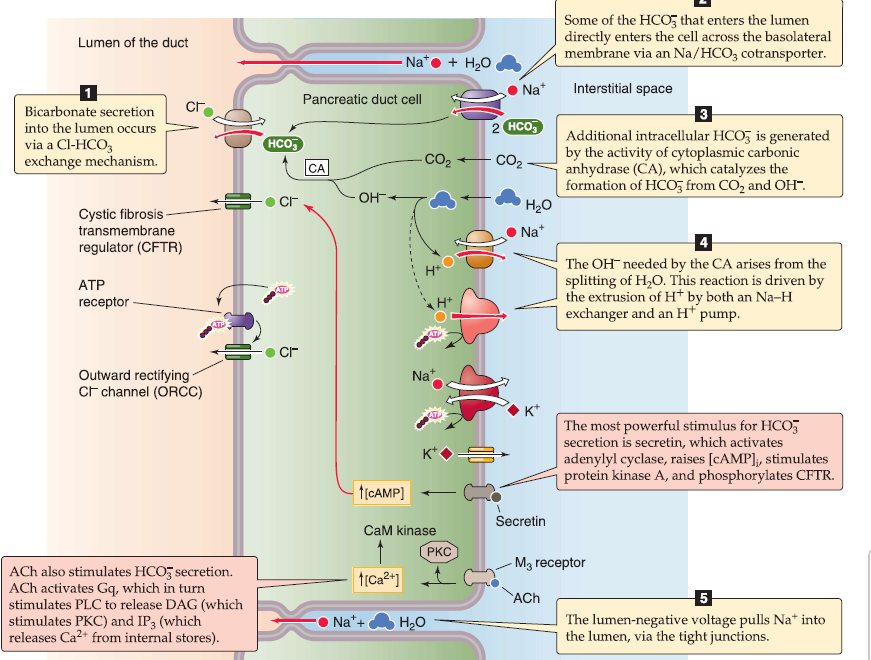
Acid makes duodenal S cells release secretin into the blood. Secretin binds to receptors on pancreatic duct cells and activates adenylyl cyclase, which raises cAMP. This activates protein kinase A (PKA), which phosphorylates CFTR and increases its channel activity, supporting bicarbonate secretion.
Figur: Figure 43-6, nederst til højre, følg secretin → cAMP → CFTR.
How does a pancreatic duct cell obtain bicarbonate for secretion?
Bicarbonate enters from the blood side through a Na⁺/HCO₃⁻ cotransporter.
Carbonic anhydrase also helps produce bicarbonate from CO₂ and water inside the cell.
The H⁺ formed in this process is transported out across the basolateral membrane.
Figur: Punkt 2–4, højre side af cellen.
How does the apical Cl⁻/HCO₃⁻ exchanger secrete bicarbonate?
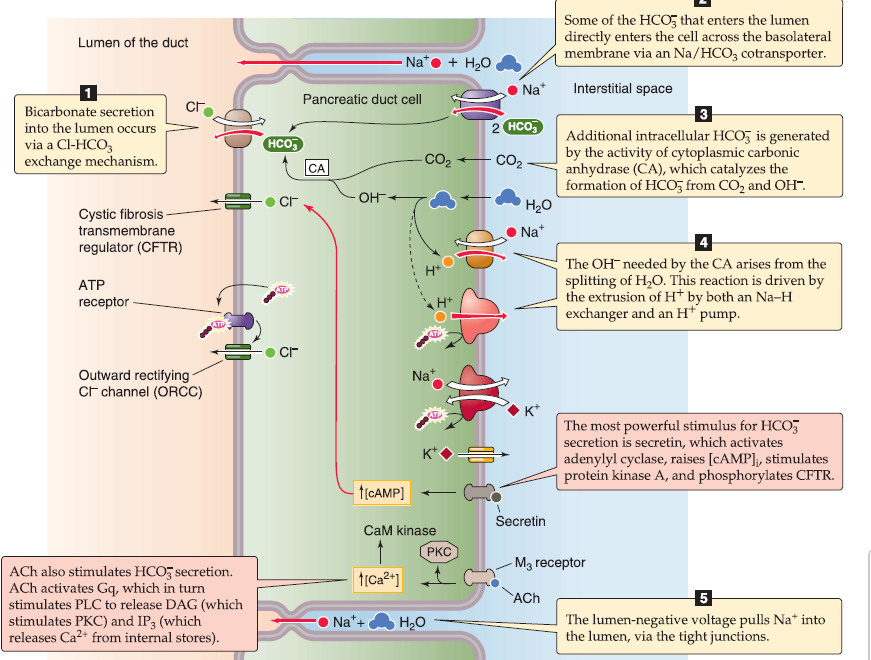
The exchanger moves bicarbonate from the duct cell into the lumen while bringing chloride into the cell. This adds bicarbonate to the pancreatic juice.
Figur: Punkt 1, øverst til venstre.

How does CFTR support pancreatic bicarbonate secretion?
CFTR allows chloride to move from the duct cell back into the lumen.
The Cl⁻/HCO₃⁻ exchanger can then take up this chloride again while secreting more bicarbonate.
Chloride is therefore recycled between the channel and the exchanger.
Figur: Venstre membran, følg Cl⁻ ud gennem CFTR og ind gennem exchangeren.

How can pancreatic ducts continue secreting bicarbonate when luminal chloride falls?
With less chloride in the lumen, the Cl⁻/HCO₃⁻ exchanger works less effectively. Bicarbonate can also pass directly through CFTR into the lumen, helping secretion continue.
Figur: B&B, PDF-side 25, Figure 43-6. Figuren viser CFTR og exchangeren, men direkte HCO₃⁻-transport gennem CFTR er ikke tegnet ind.

Why do Na⁺ and water follow pancreatic ductal anion secretion?
When negatively charged ions enter the lumen, they create an electrical driving force for Na⁺ to follow between the cells. Water follows the secreted salt by osmosis, producing pancreatic fluid.

Why must acidic chyme be neutralized in the duodenum?
Neutralization protects the duodenal lining from acid damage.
It also raises the pH so pancreatic digestive enzymes can work properly.
How does CFTR dysfunction cause pancreatic exocrine insufficiency?
Less bicarbonate and water enter the pancreatic ducts, making the secretions thick.
These can block the ducts and damage the pancreas.
Fewer digestive enzymes then reach the intestine, causing poor digestion.
How does CFTR dysfunction lead to recurrent airway infections?
The airway mucus becomes thick and poorly hydrated.
Cilia cannot clear it effectively, so mucus and microorganisms build up and cause repeated infections.
Why is sweat chloride high in cystic fibrosis?
CFTR normally helps sweat ducts reabsorb chloride as sweat moves toward the skin.
When CFTR does not work properly, less chloride is reabsorbed, so more remains in the sweat.
How can CFTR dysfunction cause intestinal obstruction?
Less anion and water secretion makes intestinal mucus and contents thick and poorly hydrated. They can build up and block the intestine.