AP Psychology: Unit 1 Exam Study Guide Biological Bases of Behavior, Sensation, and Perception
 Call Kai
 Learn
 Practice Test
 Spaced Repetition
 Match
 Flashcards
 Knowt Play
1/71

There's no tags or description
Looks like no tags are added yet.
72 Terms
Dendrites
Branch-like structures that receive the coming messages from other neurons.

Axon
Cable-like cell that sends electrical messages out of the Cell Body to other neurons and muscles. (THE BURGANS ARE COMING!!)
Soma (Cell Body)
Contains the Nucleus inside, neurons core that maintains cell health. Protects it, essentially.

Synapse
The gap between the Axon terminal where two neurons pass the messages to each other. Basically a game of telephone.

Action Potential
Brief electrical charge that travels down an Axon when the neuron fires.
Resting Potential
Waiting to be fired.
Neurotransmitters
Chemical messengers that travel across the Synapse to communicate neighboring cells.
Gamma-aminobutyric acid (GABA)
Primary neurotransmitter that calms down the nervous system activity.
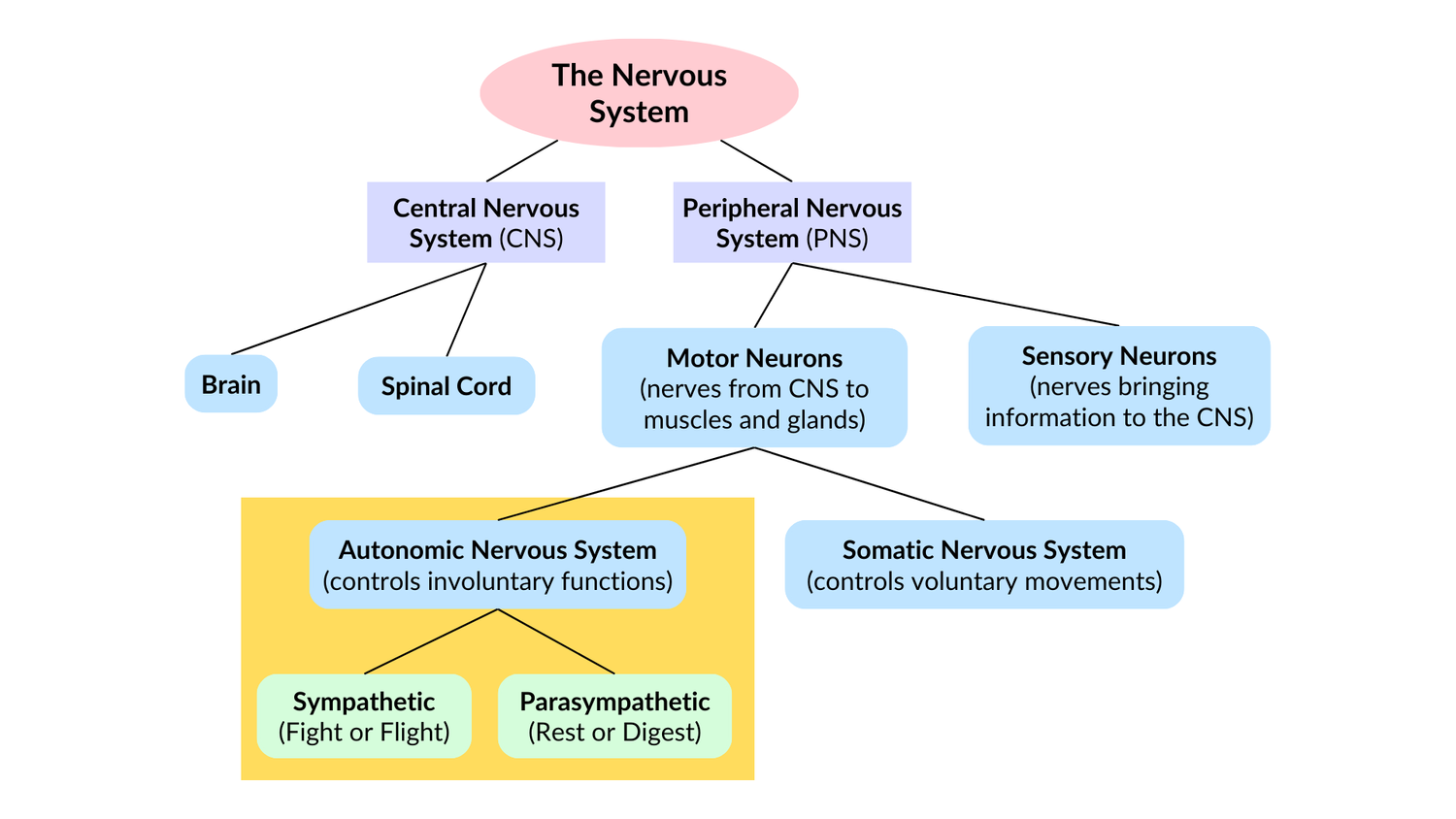
Central Nervous System (CNS)
Brain and spinal cord, which are the commander for the body.
Peripheral Nervous System (PNS)
Sensory and motor nerves connecting the CNS to the rest of the body.

Somatic Nervous System
Unconsciously controls skeletal muscles.

Automatic Nervous System
Unconsciously controls internal functions like the heart and digestion.
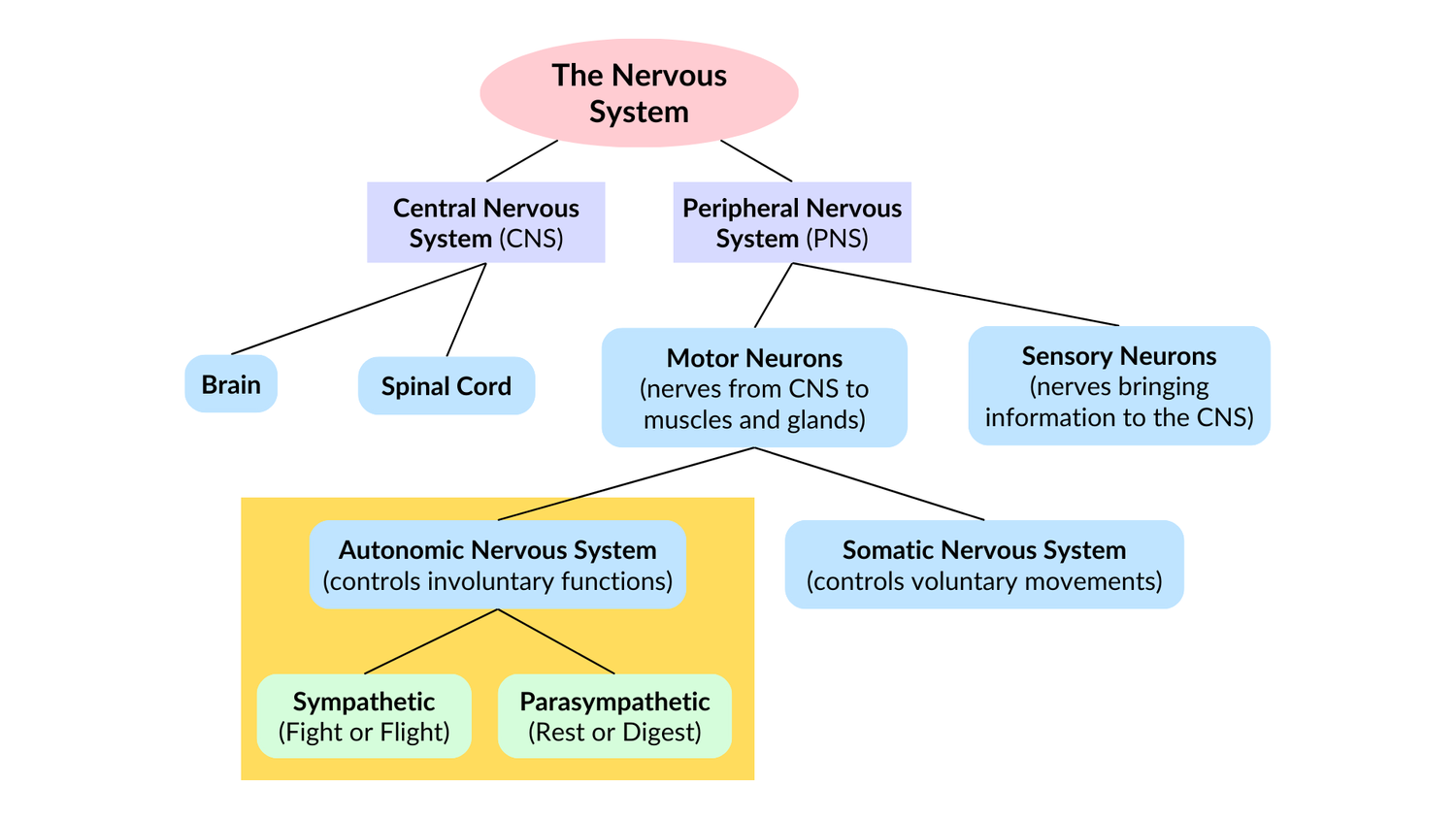
Sympathetic Nervous System
Fight-or-Flight (lwk think of Conan Gray).
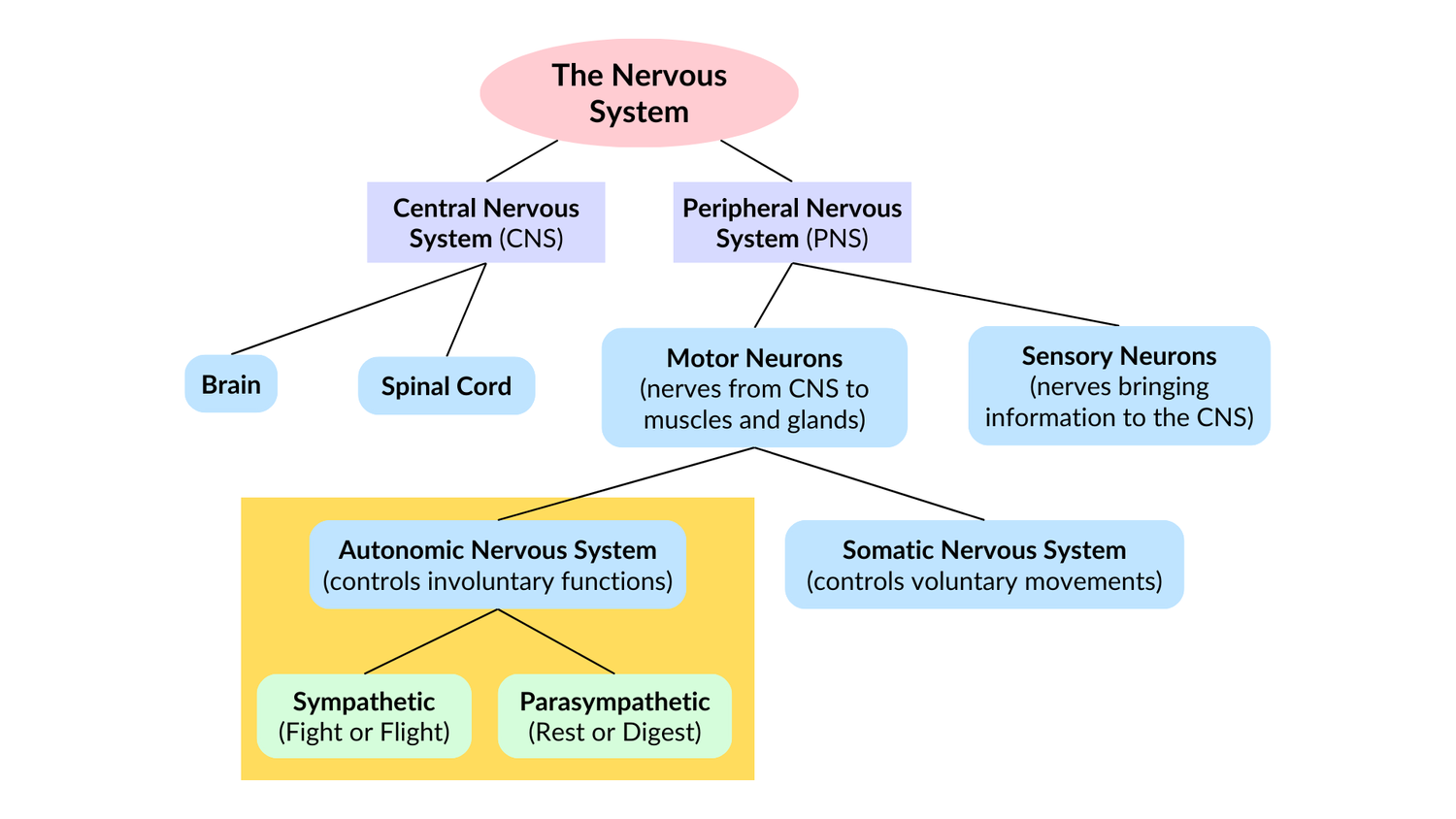
Parasympathetic Nervous System
Calms down the body, rest and digest.
Stimulants
Drugs that speed up neural activity and body functions (ex: caffeine, cocaine).
Depressants
Drugs that slow down bodily functions and neural activity (ex: alcohol, sedatives).
Tolerance
Needing larger doses of a drug over time to feel the same/stronger effect.
Withdrawal
Halting the habit of drug use and the uncomfortable physical and emotional baggage with it.
Addiction
The craving for a substance or feeling.
Frontal Lobe
Involved in speaking, muscle movements, planning, and judgment.
Parietal Lobes
Process touch, body position, and sensory input.
Temporal Lobes
Process auditory information and language comprehension.
Occipital Lobes
Process visual input coming from the eyes.
Motor Cortex
Controls voluntary muscle movements.
Somatosensory Cortex
Registers and processes body touch and movement sensations.
Broca’s Area
Controls physical speech production (frontal lobe).
Wernicke’s Area
Controls language comprehension and understanding (temporal lobe).
Cerebellum
Coordinates balance, voluntary movement, and procedural memory.
Hippocampus
Processes and consolidates conscious explicit memories.
Amygdala
Manages emotion, fear, and aggression.
Limbic System
A neural system associated with emotions and drives (includes amygdala, hippocampus, hypothalamus).
Reticular Formation
Controls arousal, alertness, and sleep-wake cycles.
Corpus Callosum
The thick band of neural fibers connecting the left and right brain hemispheres.
Brain Plasticity (Neuroplasticity)
The brain's ability to reorganize and adapt after damage or experience.
Brain Scanning Tools
Technologies used to image brain structure and function (EEG, CT, PET, MRI, fMRI).
NREM 1, 2, 3 & REM
The progressive stages of sleep, moving from light sleep to deep slow-wave sleep (NREM 3) and Rapid Eye Movement (REM) dreaming.
Delta Waves
Large, slow brain waves characteristic of deep NREM 3 sleep.
Sensation
The bottom-up process where sensory receptors detect physical energy from the environment.
Perception
The top-down mental process of organizing and interpreting sensory data.
Absolute Threshold
The minimum stimulation needed to detect a stimulus 50% of the time.
Difference Threshold (JND)
The minimum difference between two stimuli required for detection 50% of the time.
Weber’s Law
The principle that to be perceived as different, two stimuli must differ by a constant minimum percentage.
Single Detection Theory
Predicts how and when we detect the presence of a faint stimulus amid background noise, influenced by motivation and expectations.
Sensory Adaptation
Diminishing sensitivity to a constant, unchanging sensory stimulus.
Habituation
A decrease in behavioral response to a stimulus after repeated exposure.
Transduction
Converting physical energy from the environment into electrical neural impulses.
Cornea
The clear outer protective layer that bends light to help focus.

Lens
The transparent structure behind the pupil that changes shape to focus images on the retina.

Retina
The light-sensitive inner surface of the eye containing rods and cones.

Fovea
The central focal point in the retina where vision is sharpest.
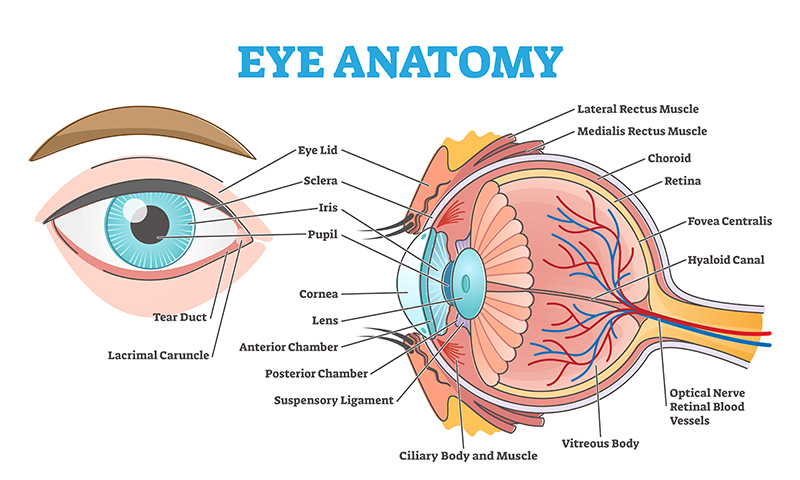
Rods and Cones
Rods handle black/white/dim light vision; cones handle color and detail in bright light.

Optic Nerve
Carries neural impulses from the eye up to the brain's visual cortex.

Feature Detectors
Specialized neurons in the visual cortex that respond to specific edges, shapes, and angles.
Trichromatic Theory
The theory that the retina contains three types of color receptors sensitive to red, green, and blue.

Opponent-Process Theory
The theory that opposing retinal processes (red-green, yellow-blue, white-black) enable color vision and produce afterimages.

Visual Cortex
The area in the occipital lobe that processes visual input.

Tympanic Membrane (Eardrum)
A tight membrane that vibrates when hit by sound waves.

Hammer, Anvil, Stirrup
Three tiny bones in the middle ear that transmit eardrum vibrations to the cochlea.

Oval Window
The membrane opening of the cochlea that receives vibrations from the stirrup.

Cochlea & Basilar Membrane
The inner ear fluid-filled coil where sound waves trigger neural impulses via hair cells.

Auditory Nerve
Transmits neural messages from the inner ear to the brain.

Vestibular Sense
The sense of body movement and balance, including the sense of head position.

Kinesthetic Sense
The system for sensing the position and movement of individual body parts.

Olfaction
The chemical sense of smell processed by the olfactory bulb.

Bottom-Up Processing
Analysis that begins with sensory receptors and works up to the brain's integration of data.
Top-Down Processing
Information processing guided by higher-level mental processes, expectations, and past experiences.
Perceptual Constancy
Perceiving objects as unchanging even as illumination and retinal images change.
Figure-Ground
The organization of the visual field into objects (figures) that stand out from their surroundings (ground).
Gestalt Principals
Rules by which the brain organizes pieces of information into meaningful wholes (proximity, continuity, closure, similarity).
Depth Perception
The ability to see objects in three dimensions, allowing us to judge distances.
Monocular & Binocular Cues
Depth cues available to either eye alone (monocular) or requiring both eyes (binocular).
Linear Perspective, Relative Size, Interposition
Common monocular cues used to judge depth on a 2D plane.