MMET 206 Exam 1 Review
 Call Kai
 Learn
 Practice Test
 Spaced Repetition
 Match
 Flashcards
 Knowt Play
1/29

There's no tags or description
Looks like no tags are added yet.
30 Terms
Material Classifications
Metals, Polymers, Ceramics, Composites, and Semiconductors.
Life-Cycle Assessment (LCA)
A systematic analysis of the environmental impacts of a product throughout its entire life cycle, in an attempt to reduce the product’s overall carbon footprint. It includes evaluating material sourcing, manufacturing processes, usage, and end-of-life options.
Environmental Stressors
Waste products, such as CO2, NOx, SOx, particulates, etc., that are emitted amidst a LCA.
Restriction on Hazardous Substances (RoHS)
Enacted by the European Union on July 1, 2006, to restrict the usage of harmful materials (Pb, Hg, Cd, Cr+6, PBB, and PBDE) in electrical and electronic equipment.
Embodied Energy
The energy required to extract, transport, and process raw resources into usable ones.
Common Recyclable Materials
Aluminum (95% less energy), Steel (33% less energy), Paper (40% less energy), Plastic (90% less energy), and Glass (30% less energy).
Carbon Footprint
The total amount of greenhouse gas (GHG) emissions caused directly and indirectly by an individual, organization (manufacturing plant), event, or product. Any GHG emissions that aren’t relative to CO2, will be translated to be so.
Common GHGs
CO2 (81%), CH4 (10%), N2O (6%), and F-gases (3%).
Main CO2 Emitters
Fossil fuel combustion for Electricity Generation and Transportation. In general, the fossil fuels from cleanest to dirtiest would rank as: Natural Gas, Petroleum, and Coal.
CO2 Levels
Based on data gathered from Antarctic ice cores, modern CO2 levels are at an all time high (~432 PPM).
Normal Stress
σ = Force/Area, in which F⟂A.
Shear Stress
𝜏 = Force/Area, in which F∥A.
Normal Strain
Longitudinal: εlong = εx = ΔLx/Lx0, in which F∥A.
Lateral: εlat = εy (= ΔLy/Ly0) = εz (= ΔLz/Lz0), in which F⟂A.
Poisson’s Ration
𝜈 = -εlat/εlong
For a perfectly incompressible material (i.e., material’s volume remains constant under load), 𝜈 = 0.5.
Shear Strain
Shear strain (𝛾) reflects the shape change caused by a shear stress. This value is measured in radians.
Hooke’s Law
σ = Eε
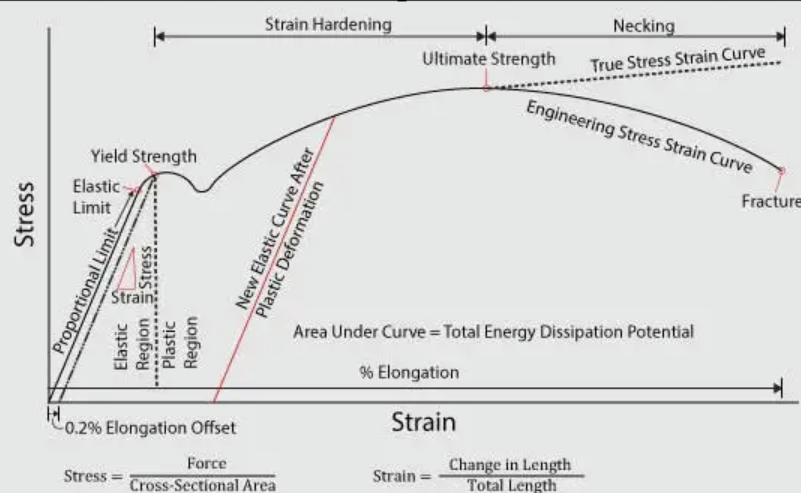
Important Information for Stress-Strain Curves
Elastic Region: Whilst in this region of the stress-strain curve, any material deformation caused by stress is temporary, with the material returning to its original form after the release of said stress.
Elastic Modulus: The slope of the linear elastic line. This value dictates the stiffness of a material.
Yield Point: This point signifies where the elastic region ends. This means that any material deformations caused beyond this point are permanent.
Plastic Region: Whilst in this region of the stress-strain curve, any material deformation caused by stress is permanent. However, when said stress is released, its return path is parallel to the linear elastic line, thus increasing its base hardness.
Strain Hardening: The process of a material growing strong after being plastically deformed.
Ultimate Tensile Strength: This point signifies the maximum stress a material can withstand prior to necking and eventual failure.
Necking: The localized thinning of a material sample that occurs after passing the ultimate tensile strength.
Fracture: This is the point at which a material completely breaks apart, due to the combining of increasingly abundant internal deformities. The strain at this point determines whether a material is ductile (>5%) or brittle (<5%).
Toughness: The area under the stress-strain curve, from ε = 0 to ε = εf, which dictates how resistant a material is to elastic deformations (e.g., bending or stretching).
Charpy and Izod Impact Test
The Charpy and Izod impact test methods aim to measure the relative impact toughness of materials. This is done through the near immediate application of a large force upon the test samples. The amount of energy absorbed can be calculated as: E = mg(hi-hf).

Creep Failure
Creep is the continued permanent deformation resulting from a constant load (prolonged application of stress) below the yield strength. Creep is influenced by the magnitude of the load, the duration over which the load is applied, and the ambient temperature.

Fatigue Failure
Fatigue failure should be considered when a material is subjected to cyclic loading (with or without stress reversal). Fatigue testing are done via an S-N curve (Stress vs. Number of Load Cycles) to identify the endurance limit, a stress level below which fatigue failure will not occur.

Hardness
The measure of a material’s resistance to localized plastic deformation (penetration or indentation) of the surface of a material by a hard indenter. There are four relevant common hardness tests. Rockwell (HR), which uses a steel ball for soft materials (HRB) and a diamond cone for harder ones (HRC). Brinell (HB), which uses a steel ball. Vickers (HV), which uses a square-based diamond pyramid. Shore Durometer A (rubbers) and B (hard plastic).
Primary Bonds
Strong chemical bonds consisting of Metallic (sea of ve-), Covalent (sharing of ve-), and Ionic (transfer of ve-) bonds. On average, Ionic bonds are the strongest (625 - 1550 kJ/mol), followed by Covalent (520 - 1200 kJ/mol), followed by Metallic (100 - 800 kJ/mol).
Secondary Bonds
Weaker chemical bonds consisting of Van der Waals and Hydrogen bonds.
Crystal
A solid in which the constituent atoms or ions are packed in an orderly, repeating, and long range pattern extending in all three spatial dimension.
Crystalline Materials
Solid materials that are made up of a single or multiple crystals (e.g., metals, ceramics, and semiconductors).
Amorphous Materials
No specific pattern in the packing of atoms (e.g., glasses).
Order of Crystal Structures
Crystal (Ore) > Crystal Structure > Crystal Lattice > Unit Cell
Crystal Structure: Orderly stacking of atoms.
Crystal Lattice: The regular array of points in space that are occupied by the atoms, ions, or molecules that make up a crystal.
Unit Cell: A subdivision (repeating unit) of the crystal lattice that still retains the overall characteristics of the entire lattice.
Three Common Unit Cells
BCC (4 1 4)
FCC (5 4 5)
HCP (7 3 7)
Lattice Directions
Format/method :[Δx Δy Δz] reduced to integers
Family of equivalent directions format: <a b c>
Lattice Planes (Miller Indices)
Format/method: (xint-1 yint-1 zint-1) reduced to integers
Family of equivalent planes format: {a b c}