03456Marine Zoology
 Call Kai
 Learn
 Practice Test
 Spaced Repetition
 Match
 Flashcards
 Knowt Play
1/27

Earn XP
Description and Tags
Sponges and cnidarians
28 Terms
海綿動物 vs 有櫛動物 vs 刺胞動物
= Sponges (Phylum Proifera)
Do not have nervous, digestive or circulatory systems and only rely on a constant water flow for food and oxygen
Collar cells to maintain flow and capture organic matter in the water (filter feed)
= Ctenophora
Diploblastic, radially symmetrical
Hermaphrodites
Carnivorous
= Cnidarians
Also diploblastic and radially symmetrical
Sexual reproduction: jellyfish
Asexual reproduction: polyp, anemoneHas cnidocytes
Fill in the blanks:
‘(_1_)の形成はおこらず、器官や発達した(_2_)を欠く、固着性.’
What animal is this talking about?
A) 刺胞動物
B) 有櫛動物
C) 海綿動物
Complex systems
Cell wall
= Formation of complex systems, lacking organs and developed cell wall, and is sessile.
Fill in the gaps:
さまざまな細胞に分化できる高度の(_1_)をもつ
What animal is this talking about?
A) 海綿動物
B) 有櫛動物
C) 刺胞動物
unspecialised cells
= They have a high degree of unspecialised cells that allows them to differentiate into a variety of cells
A) sponges
花虫綱
= Anthozoa
Class of Phylum Cnidaria containing
Fill in the blanks:
(_1_)
海綿動物のみにみられる特殊な細胞、原生生物の襟鞭毛虫に由来
動物は (_2_) に似た祖先から進化(分子系統)
襟細胞 = collar cells
襟鞭毛虫= choanoflagellates
= Collar cells
Special cells found only in sponges, derived from protists
= Animals evolved from ancestors resembling choanoflagellates
Important (重要な) classification criteria for 海綿動物:
Compare 海綿繊維 vs 骨片, and match which is under which classification:
石灰質(炭酸カルシウム)
コラーゲン繊維
珪酸質(ガラス)
海綿繊維 = Sponge fibers (spongin)
Collagen fiber
骨片 = Skeletal elements (spicules)
Calcareous (calcium carbonate)
Silica dioxide (glass)
Spicules are embedded within spongin and bound with mesohyl in a mesh-like, gelatinous matrix.
For 海綿動物, it has 3 classes. List and outline them
石灰海綿綱 = Calcarea
Skeleton of spicules of calcium carbonate
Marine
Class Demospongiae
Has siliceous spicules, spongin fibers, or both. The largest class of sponges that vary greatly in form and size
Class Hexactinellida
Skeleton primarily of siliceous spicules, lacking in spongins
Marine, only in deeper waters.
In Class Hexactinellida, describe the unique characteristics of カイロウドウケツ類
“Venus flower basket”
Entraps a pair of marine shrimp when they are young, as they eventually grow too big to exit the silica skeleton.
Symbiotic relationship: houses marine shrimp and provides food through its waste, whilst marine shrimp cleans the inside.
環境条件が悪化したとき…
海綿動物 will do what kind of reproduction?
A) 無性生殖: 体の一部の細胞塊が離れたとき
B) 有性生殖: 精子は襟細胞から、卵は襟細胞か未分化の遊走細胞から形成• 卵は中膠にとどまり、精子は大孔から外に放出
A) Asexual reproduction: when a bud from a part of the body detaches (budding)
Where as B) is:
Sexual reproduction: sperm form in collar cells and sink into mesohyl to form spermatic cysts. These will burst and be expelled through the osculum during spawning season. Eggs remain in the mesohyl (中膠).
Sponges can be:
同時的雌雄同体
段階的雌雄同体
Translate
Simultaneous hermaphroditism
Sequential hermaphroditism
From one gamete, the other gamete grows (e.g. egg → sperm)
Fill in the blanks:
刺細胞に (_1_) が存在
外側に射出できるカプセル 状の小器官
(_2_)
Cnidocyte
Nematocyte
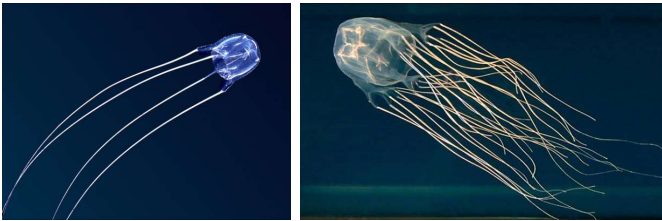
‘傘部が立法形、傘縁の四隅から触手ないし触手群が伸びる.’
What class of cnidarian does this characteristic belong to?
A) Cubozoa
B) Hydrozoa
C) Anthozoa
D) Scryphozoa
= The medusa (or bell) is rectangular, with tentacles or groups of tentacles extending from the four corners of the margin
It is A) Cubozoa (cube)
‘ 群体形成種では、個虫間で形態的.’
What class of cnidarian does this characteristic belong to?
A) Anthozoa
B) Hydrozoa
C) Cubozoa
D) Scryphozoa
= In colony-forming species, morphological behaviour occurs between individual polyp
It is B) Hydrozoa
‘ クラゲ期が卓越、ポリプ期が欠落した種もある.’
What class of cnidarian does this characteristic belong to?
A) Anthozoa
B) Hydrozoa
C) Cubozoa
D) Scryphozoa
= Some species only have a jellyfish stage and lack a polyp stage
D) Scryphozoa
Describe the life history of ミズクラゲ
Dioecious species, so the eggs are at the base of the female’s tentacles and is fertilized by sperm released by the male
Planula forms and stays in broodstock pouch for a week
‘ポリプ期のみ
口道溝、隔壁などの配列で
• 八放サンゴ亜綱
• 六放サンゴ亜綱’
What class of cnidarian does this characteristic belong to?
A) Anthozoa
B) Hydrozoa
C) Cubozoa
D) Scryphozoa
Polyp phase only
Arrangement of mouth groove (siphonoglyph) and septum)
Octocorallia (has eight tentacles per polyp and one mouth groove) ← corals
Hexacorallia (tentacles and complete septa arranged in multiples of six) ← sea anemones
A) Anthozoa (sea urchins and coral)
Fill in the blanks:
サンゴ虫(_1_)と骨格からなる(サンゴ個体)
共肉を含めた(_2_)から炭酸カルシウムを分泌
(_3_) で、拡大してサンゴ礁を形成(_4_)
ポリプ
外皮細胞層 = outer cell layers (coenosarc/ soft tissue)
無性生殖 = asexual reproduction
造礁サンゴ = reef-building corals
= Composed of a coral polyp and its skeleton (forming an individual coral unit).
Calcium carbonate is secreted by the outer cell layers (including the coenosarc/soft tissue).
Through asexual reproduction, these units expand to form coral reefs (reef-building corals).
Fill in the blanks:
造礁サンゴの構成種は (_1_)を内皮細胞層中に共生、サンゴの 色
褐虫藻 = zooxanthella
The constituent species of reef-building corals include (_1_) which live symbiotically in the endodermal cell layer, and the coral's color
Role of シオミズツボワムシ (shiomizutsubowamushi) in aquaculture
Great aquaculture food source for fish and shellfish fry or larvae
種苗生産
Seedling/seed production
Explain the causes and effects of coral bleaching (サンゴの白化)
Coral bleaching is driven by global warming and ocean acidification. The symbiotic zooxanthellae that live within the coral is easily stressed-out by the warming ocean temperatures, causing it to flee or die. Without zooxanthellae, corals will lack the nutrients they once provided and starve. Furthermore, ocean acidification from the absorption of carbon dioxide reacts with calcium carbonate present in corals; making it harder to build and maintain.
Short-term impact (短期的影響) is that herbivores, omnivores and benthic animals are able, but there is a steep drop in corallivores as the food source is no longer there.
Long-term impacts (⾧期的影響) are an:
Increase in macro algae
Increase in herbivorous fishes, which feed on the macro-algae^^
Decline in fishes that rely on corals as a habitat substrate.
冠輪動物
Lophotrochozoa
Clade of protostome animals; defined by lophophore feeding structure or a trochophore larval stage
二枚貝
Bivalves
Describe: 基質との関係により5つの型に類別できる
= They can be classified into 5 types based on their relationship with the substrate
Sediment burial
Bodies in the sediment, but inhalant siphons extend to the surface
Feed on suspended organic matter in the water or on the seafloor
Substrate surface-fixed
Attach to hard substrates, like rocks, with byssal threads (足糸) or one side of the shell
Almost all suspension feeders
Non-adhered
Significant mobility capacity; rapidly opening and closing shells with a powerful abductor muscle (貝柱が発達)
Burrowing
Excavate substrate with sharp, blade-like anterior of shells or with acidic mucus to soften the rock
Symbiosis and parasitism
Symbiotic: ウロコガイ (urokogai)
Parasitic: ヒナノズキン (hinanozukin)
‘固着することなく基質表面に生息する.’
What classification of animal is this?
A) Burrowing
B) Sediment burial
C) Symbiosis and parasitism
D) Fixed on substrate surface type
E) Non-adhered
E) Non-adhered
‘一部の種は酸性の粘液を分泌して岩盤を軟化させる.’
What classification of animal is this?
A) Burrowing
B) Sediment burial
C) Symbiosis and parasitism
D) Fixed on substrate surface type
E) Non-adhered
= Some species secrete acidic mucus to soften the rock
A) Burrowing
Outline the basic process of cultivating shellfish
Obtain mature parent shellfish
Induce spawning via exposure
Collect eggs after spawning and put into hatching tank
Collection of D-larvae into a larval rearing tank. Feed with diatoms
Juveniles are reared in another tank, fed with diatoms
Then, grown-out in either: suspended cultivation or bottom-seeding aquaculture.
Outline the process of 脱皮
= Molting