BMSC 207: Post Midterm II
 Call Kai
 Learn
 Practice Test
 Spaced Repetition
 Match
 Flashcards
 Knowt Play
1/73

There's no tags or description
Looks like no tags are added yet.
74 Terms
cardiac muscle relaxation primary mechanism
although removal of Ca2+ to extracellular space is slightly more important in cardiac muscle, reuptake into the SR is still the primary mechanism
in cardiac muscle the ____ pump is regulated by ___
SERCA, phospholamban
phospholamban
a crucial regulator of cardiac contractility
Cardiac muscle
dephosphorylated state:
Phosphorylated state:
dephosphorylated state: PLN inhibits SERCA
phosphorylated: Ca2+ pump inhibition is removed, enhancing relaxation rates and contractility.
rate and amount of Ca2+ uptake is increased, causing quicker relaxation and a larger store of Ca2+ for subsequent contractions
frequency summation in individual fibers and multiple fibre recruitment are used for regulating force generation in ____
skeletal muscle
in cardiac muscle an increase in ____ in the cardiac ____ enhances ____
intracellular Ca2+, myocytes, contractile force
in cardiac muscle an increase in intracellular Ca2+ in the cardiac myocytes, enhanced contractile force
cardiac muscle is capable of graded single twitch contractions
if cytosolic Ca2+ is low some actin remains covered by tropomyosin
increased Ca2+ → additional troponin complexes activated and increased cross bridge formation leading to increased force of contraction
length tension relationship: cardiac muscle generates a greater force when ____
slightly stretched
when are myocytes slightly stretched
when ventricle is more filled with blood
the heart has neural input that modifies conduction/contraction
the heart is innervated by the autonomic nervous system:
the sympathetic increase heart rate/conduction and contractility (autorhythmic and contractile)
the parasympathetic decreases heart rate/conduction (autorhythmic)
sympathetic modulation of contraction
phosphorylation of Ca2+ channels increases calcium conductance during action potentials (Beta 1 is exception)
phosphorylation of ryanodine receptors enhances sensitivity to Ca2+, increasing release of Ca2+ from the sarcoplasmic reticulum
increase rate of myosin ATPase
phosphorylation of SERCA (PLN) increase the speed of Ca2+ re-uptake which increases Ca2+ storage
ryanodine receptor more sensitive =
activated at lower concentration of calcium
Increases release of calcium from SR which causes more cross-bridge formation and greater force of contraction
skeletal length tension relationship explained by degree of overlap between thick and thin filaments
a slightly stretched sarcomere increases the Ca2+ sensitivity of the myofilaments, a stretched sarcomere has a decreased diameter which may reduce the distance that Ca2 needs to diffuse increasing probability of cross-bridge cycling
a slightly stretched sarcomere puts additional tension on stress-activated Ca2+ channels, increasing Ca2+ entry from extracellular space and increasing Ca2+ induced Ca2+ release
heart rate is under ____ control
tonic
autorhytmic cells can be modulated by ____ and ____ neurons and therefore
sympathetic and parasympathetic neurons and therefore heart rate is under tonic contril
with no autonomic stimulation autorhythmic cells of the SA node have…
an intrinsic firing rate of ~90 action potentauls per min
at resting heart rate of…
70-72 BPM parasympathetic is dominant
~90 APs/min = intrinsic firing rate - to get heartrates below intrinsic firing rate…
increase parasympathetic input and decrease sympathetic input - slows AP frequency to below 90 APs/min
main pacemaker
SA Node
modulating pacemaker activity
parasympathetic neurons containing ACh mainly innervate the SA and AV node influencing autorhythmic myocardial cells, decreasing the frequency of action potentials (decreasing heart rate)
ACh acts on muscarinic (M2) cholinergic receptors opening K+ channels and closing T-type Ca2+ channels and HCN channels
since the pacemaker activity does not usually reside within the AV node, these mechanisms act…
at the AV node to decrease conduction velocity
sympathetic modulation of pacemaker activity
Beta1 adrenergic receptors can be activated by NE released from sympathetic neurons or epinephrine from the adrenal medulla
increased Na+ conductance through HCN channels and Ca2+ through T-type channels causes
cells reach threshold more rapidly
a decreased level of repolarization
smooth muscle is more variable than skeletal
must operate over a range og lengths
layers may run in several directions
use less energy to generate and maintain force
can sustqin contraction without fatigue
contraction initiated electrically or chemically
controlled by autonomic NS
ca2+ from extracellular space and or SR
Ca2+ initiates cascade eventually turning on myosin ATPase
smooth muscle
spindle-shaped, uninucleate cells
troponin and T-tubules absent
no thin filament regulated
has tropomyosin but do not understand role
have caveolae
intermediate filaments (non-contractile and dense bodies) form extensive cytoskeletal structure
thin filaments are anchored to the cell membranes or dense bodies
smooth muscle is ___ filament regualted
Smooth muscle is thick filament regulated → myosin isoform is low - does not have ability to bind and hydrolyze ATP, has to be turned on - calcium turns on myosin ATPase to initiate contraction
smooth muscle organization
intermediate filaments and protein dense bodies form a cytoskeleton
actin attaches to dense bodies
each myosin molecule is surrounded by actin filament
has hinged head all along its length

smooth muscle has functional variability categorized by:
location
contraction pattern
communication with neighboring cells
location: in humans smooth muscle can be divided into 6 major groups
vascular - blood vessel walls
gastrointestinal - walls of digestive tract and associated organs i.e gallbladder
urinary - wall of bladder and ureters
respiratory - airway passages
reproductive - uterus in females and other reproductive structures in males and females
ocular - iris and ciliary body
smooth muscle from ___ to ___
esophagus to anus, some associated organs contain smooth
ocular
not extraocular - skeletal muscle moves eye
smooth muscle is muscle within eyes
contraction pattern:
phasic:
tonic:
phasic: - smooth muscle that is usually relaxed (esophagus)
muscle that cycles between contraction and relaxation
tonic: smooth muscle that is usually contracted (e.g. a sphincter that relaxes to allow material to pass)
muscles whose contraction is varied as needed

communication with neighbouring cells
unitary (single unit) smooth muscle.
linked together electrically, contains gap junctions similar to cardiac muscle
allows coordinated contraction of many cells causing muscle to contract as a single unit
since it makes up the walls of most visceral organs its often referred to as visceral smooth muscle
2. multiunit smooth muscle:
not electrically coupled
act as multiple units, each cell needs their own stimulus
iris and ciliary body of the eye in the male reproductive tract and in the uterus except just prior to labor and delivery
smooth muscle may contract in response to ____ or ____
synaptic transmission (input from neuron) or electrical coupling (electrical activity from adjacent cells that had synaptic input)
smooth muscle is usually innervated by the…
autonomic nervous system (sympathetic and parasympathetic)
tissues of ANS usually receive input from both S and PS with opposing results
can be innervated by multiple neurons, capable of releasing different neurotransmitters
receptor subtypes differences in muscles
a-adregenic: Gi vessel constriction vs. B-adrenergic: airway dilation)
aside from neural input other factors can initiate contraction/relaxation other contraction/relaxation
circulating hormones, stretch and local factors, including paracrine signals, acidity, oxgen and carbon dioxide concentration and osmolarity can also alter smooth muscle tension
action potential of smooth muscle
can be initiated by neural, hormonal or mechanical stimulation
two types of smooth muscle action potentials
spiking AP - similar to skeletal
plateau AP - APs usually occur in unitary smooth muscle (most smooth muscle is unitary)
upstroke slower because Ca2+ channels propagare the AP instead of Na+
repolarization also slower because Ca2+ channels inactivate slowly and there is a delayed activation of voltage gated K+ and in some cases Ca2+ activated K+ channels
membrane potential vary in smooth muscle
slow wave potential:
pacemaker potential:
Slow wave potential: fire action potentials when they reach threshold
slow wave potentials: smooth muscle has subset of cell that generates slow depolarization and repolarization (wave) that occasionally reaches threshold, firing APs and causing contraction
Pacemaker potential: always depolarize to threshold
like cardiac muscle, continuously fires APs causing continuous contraction
contraction without action potentials
smooth muscle cells produce a wide range of membrane potentials (Vm) and in some smooth muscle Vm oscillations can lead to tonic contractions in the absence of AP
action potentials usually do not occur in multiunit smooth muscle
autonomic neurons create a local depolarization that spreads electronically (graded fashion) throughout the muscle fiber triggering Ca2+ entry
some smooth muscle contractions without APs…
contracts because of graded depolarization
greater stimulus causes more receptors being activated, causes greater depolarization
can have hyperpolarizing graded potentials in smooth muscle due to summation
electrical activity in smooth muscle
Autonomic AP initiation
Spontaneous AP
Graded potential
Autonomic AP initiation → single unit
spikes or plateaus
Spontaneous AP → single unit
slow wave
pacemaker
Graded potential → multiunit
contraction due to electrical signaling is known as…
electromechanical coupling
both extracellular entry and intracellular release of Ca2+ activate contraction and cytosolic (Ca2+) is increased by 3 different mechanism:
ca2+ entry through voltage gated channels or ligand gated ion channels
ca2+ release from the SR
ca2 induced ca release from RyR
IP3 Ca2+ release from IP3R
ca2+ entry through voltage independent channels
store operated Ca2+ channels
stretch activated channels
Ca2+ entry through voltage gated channels
smooth muscle cells respond to graded stimulation or action potential, both of which an influx of Ca2+ through voltage-gated L-type Ca2+ channels
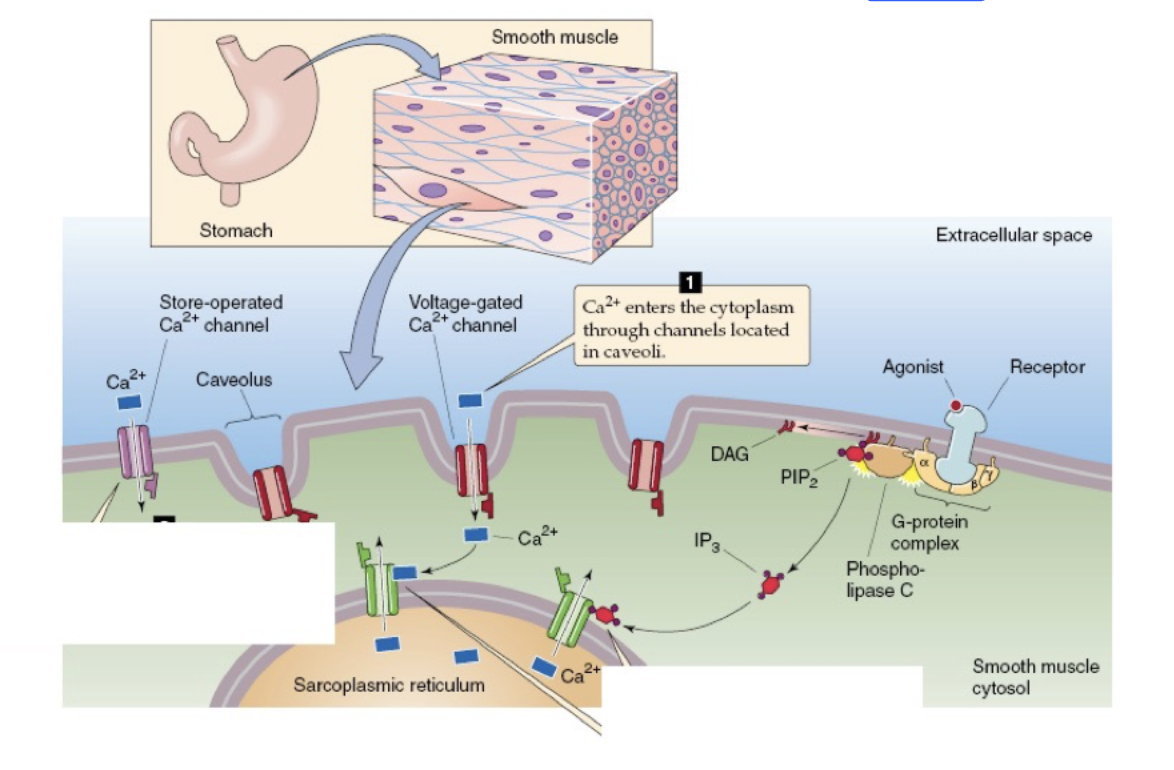
Ca2+ release from SR
less SR than in skeletal and cardiac muscle
occurs Via -induced Ca2+ release and IP3 pathway
IP3 pathway can cause contraction with minimal depolarization and negligible extracellular Ca2+ influx
calcium coming through channels can bind SR and cause calcium release from SR

IP3 pathway - GPCR-phospholipase C signal transduction

NE molecule binds the receptor
alpha 1 adrenergic and activates coupled g-protein on the cell membrane
the g protein activates PLC
PLC converts membrane phospholipids into diacylglycerols and IP3 diffuses into cytoplasm
IP3 causes release of calcium from SR, creating a calcium signal
diacylglycerol contributes to force of contraction of smooth muscle
Ca2+ entry through voltage-independent channels
depletion of Ca2+ in the SR causes activation of store-operated channels which cause a Ca2+ influx across the cell membrane
allows Ca2i to remain elevated and replenishes SR
STIM1 on SR
orai-1 proteins make up Ca2+ channel on cell membrane
STIM1 on SR senses
low caclsium store and becomes activated, signalling to store-operated channels on sarcolemma to open replenishes SR stores of calcium by bring calcium in from ECF, serca pumps bring calcium into SR
pharmacomechanical coupling
Ca2+ release from SR via IP3 pathway (IP3 binds to IP3 receptor) and entry via store voltage independent and known as pharmacomechanical coupling
drugs, excitatory neurotransmitters and hormones can induce smooth muscle contraction independent of AP generations
stretch activated contraction
there are strectch activated ion channels in the cell membrane of some smooth muscle that when activated lead to depolarization (Ca2+, CI-,TRPV4, TRPC1, TRPC6)
stretch of smooth muscle causes an internal release of Ca2+ from the SR through ryanodine receptor
stretch has been shown to cause phosphorylation of myosin light chain leading to contraction
the calcium signal in smooth muscle follows…
a unique process compared to skeletal and cardiac muscle
intracellular calcium initiates a slow chain of events ultimately increasing myosin ATPase activity
in smooth muscle myosin ATPase must be…
activated
smooth muscle requires the phoshorylation of the myosin light chain
calcium singal in smooth muscle: ____ ca2+ ions bind to…
4 ca2+ ions bind to calmodunlin, a Ca2+ binding protein similar to troponin c of striated muscle
initiating cross-bridge cycling in smooth muscle
the Ca2+ calmodulin complex then activates an enzyme known as myosin light chain kinase (MLCK)
MLCK phosphorylates the regulatory light chain near the myosin head which alters the conformation of the myosin head, increasing its ATPase activity and allows it to interact with actin (conformation change)
in skeletal and cardiac muscle ATPase activity of myosin head is always high, though cardiac muscle ATPase activity can be driven even higher by phosphorylation
smooth muscle is ___ filament regulated
which allows contraction to occir
calcium-calmoduin complex
showon to activate additional proteins calponin and caldesmon which contribute to conformation change allowing myosin actin interaction
increased Ca2+ intering increases…
MLCK activated, means more myosin heads are activated which means a larger force is generated
initiation of contraction in smooth muscle
Intracellular calcium concentrations increase when calcium enters cell and is released from SR
Calcium binds to calmodulin
Calcium-calmod complex activates MLCK
MLCK phosphorylates light chains in myosin head and increases myosin ATPase activity
Active myosin crossbridges slide along actin and create muscle tension
cross-brige cycling in smooth muscle is similar to…
skeletal and cardiac muscle but occurs more slowly because the hydrolysis of ATP is slow
cross-bridge cycling in smooth muscle
Regulatory light chain is phosphorylated, nothing is attached to myosin.
ATP binds to myosin, myosin releases actin.
Myosin slowly hydrolyzes ATP. Energy from ATP rotates the myosin head to the cocked position. Myosin binds weakly to actin.
Power stroke begins when inorganic phosphate is released. Release of Pi strengthens the bond between actin and myosin.
Actin filament moves towards M-line and head swivels during the power stroke.
Myosin very slowly releases ATP at the end of the power stroke.
smooth muscle relaxation
Ca2+ is moved back to the SR and extracellular space
inactivates MLCK, still requires MLCP to dephosphorylate light chain to relax
Ca2+ removal does not immediately lead to relaxation because calcium removal does not dephosphorylate light chain which regulates contraction
the regulatory light chain must be dephosphorylated by myosin light chain phosphatase
even after dephosphorylation of regulatory light chain some smooth muscle maintain force for an extended period of time with little ATP use known as latch state (unknown process)
the regulatory light chain must be dephosphorylated by myosin light chain phosphatase
MLCP is always activated
removes phosphate groups from light chain which reduces ATPase activity causes slight structural conformation limiting myosin and actin from interacting with each other
force of contraction of smooth muscle is balance of…
phoshorylating light chain and phosphatase depohoshorlyation light chain
neurotransmitters, hormones, and paracrine molecules can alter smooth muscles Ca2+ sensitivity by modulating
myosin light chain phosphate (MLCP)
explain

Increasing calcium signal means amount of kinase increases amount of phosphatase so contraction can occur
As you increase calcium, kinase exceeds phosphatase by more which means cycling and contraction can occur longer
Can alter amount of force by altering light chain phosphatase and kinase activity:
High phosphatase activity decreases myosin sensitivity to calcium - larger amount of calcium generates smaller amount of force
Low phosphatase activity increases myosin's sensitivity to calcium - smaller amount of calcium generates greater amount of force
Increasing Ca2+ entry and Ca2+ sensitivity to increase contractile force
contractile force in smooth muscle largely depends on the balance of MLC phosphorylation and dephosphorylation
MLC phosphorylation is regulated by the Ca2+- CaM complex which in turn depends on levels of intracellular Ca2+
smooth muscle can regulate Ca2+ over a wider range than in skeletal or cardiac muscle
contractile control by regulating Ca2+ sensitivity of proteins regulating contraction
smooth muscle can regulate Ca2+ over a wider range than in skeletal or cardiac muscle because…
because can generate graded potential can have large differences in graded contraction and amount of force
contractile control by regulating Ca2+ sensitivity of proteins regulating contraction
inhibiting MLCP or activating MLCK leading to greater contraction at lower (Ca2+)
control of smooth muscle contraction!!!

cardiovascular system
the requirement for a circulatory system is consequence of increasing size and complexity of multicellular organisms
provide a concentration gradient from the blood to cells for nutrients and in the opposite direction for waste
diffusion ____ exponentially with distance -
decreases, as organisms get larger, diffusion becomes insufficient
primary role of the circulatory system
the distribution of dissolved gases and other molecules for nutrition, growth and repair, while simultaneously removing cellular wastes
secondary roles of the circulatory system,
chemical signaling to cells by means of circulating hormones or neurohormones
dissipation of heat by delivering heat from the core to the surface of the body
mediation of inflammatory and host defense response against invading microorganisms