MBB 222 - final material
 Call Kai
 Learn
 Practice Test
 Spaced Repetition
 Match
 Flashcards
 Knowt Play
1/29

Earn XP
Description and Tags
probs more heavily questioned on this
30 Terms
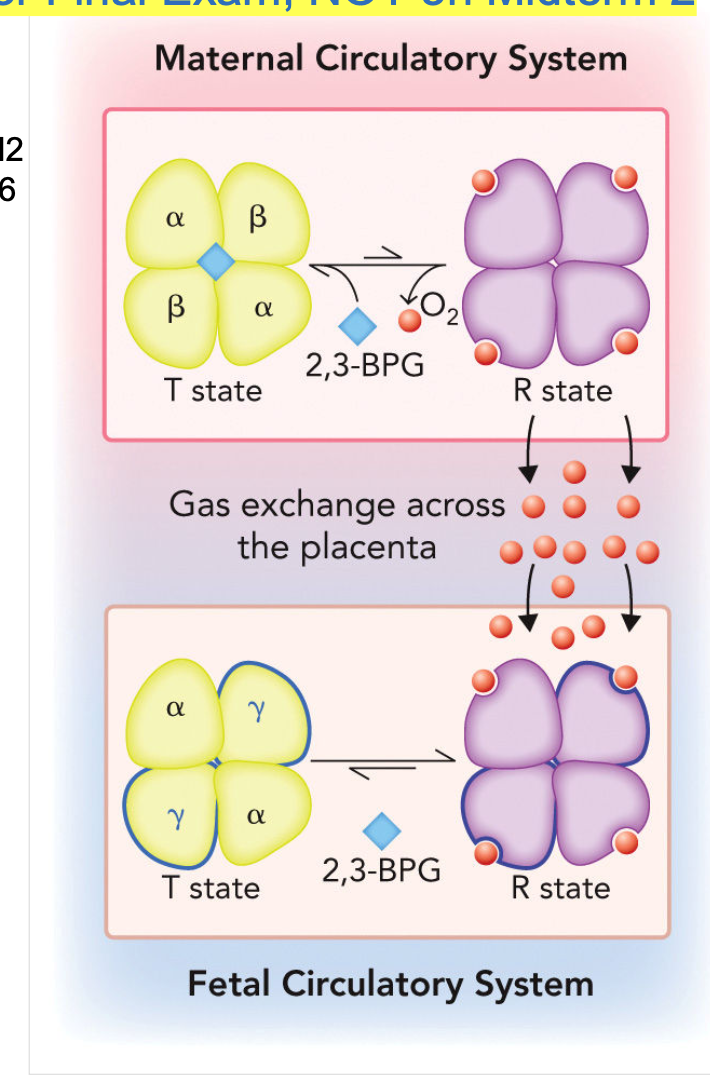
gamma (y) subunits
are protein subunits found in some forms of Hb (in place of beta (B) subunit…)
mother has A2B2 tetramer
while fetus has A2Y2 tetramer
fetal a2y2 is less effective at BPG binding + CO2 linkage
more R state with stronger average O2 affinity than mother’s A2B2
higher y = fewer sickling crises

R state
(relaxed state)
the high-affinity conformational state of hemoglobin when oxygen is bound to it.
R state » T state O2 affinity
In this state, hemoglobin more effectively binds oxygen, facilitating oxygen transport in the body.
When O2 binds to the iron-heme groups, the subunits shift and rotate by about 15 degrees, breaking certain ionic/hydrogen bonds and transitioning the protein into the R-state

T state
(tense state)
of hemoglobin (Hb) is the deoxygenated, low-affinity conformation of the protein
( releases O2 ) and is stabilized by the binding of 2,3-bisphosphoglycerate (BPG) and carbon dioxide (CO2), leading to decreased oxygen affinity compared to the R state.
When O2 binds to the T state, it pulls the iron atom into the plane of the heme, breaking inter-subunit bonds and rotating the dimers by about 15 degrees to shift into the high-affinity R state (relaxed state
Gibbs Free energy (Delta G)
BACKGROUND INFO: a system (protein molecule, or a popl’n of molecules) can change its state (chemical rx’n).
thermodynamic state variables changes (temp, pressure, volume, + Gibbs free energy)
DEF’N :measures the energy from the reaction that is
available ("free") for performing "useful work
system = constant pressure + temp. + closed
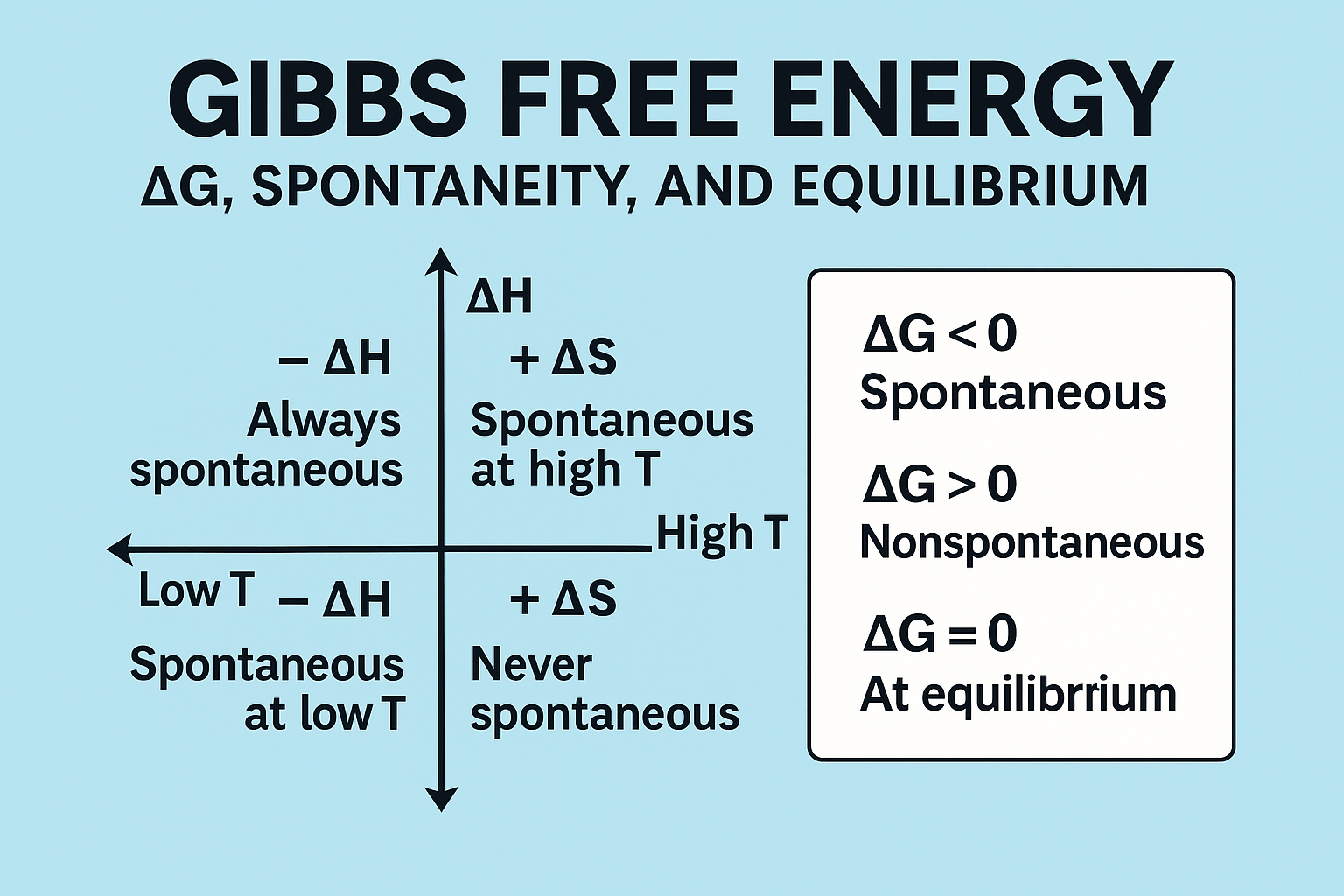
-G = exergonic
+G = endergonic
Delta G fold= -RT ln Fold
ONLY STATES BEFORE AND AFTER NOT SPECIFIC PATHWAY
exergonic
Refers to a chemical reaction that releases energy, resulting in a negative change in Gibbs free energy (ΔG < 0), which means the reaction can proceed spontaneously.
FWDS RX’N

endergonic
A type of chemical reaction that absorbs energy from its surroundings, resulting in a positive change in Gibbs free energy (ΔG > 0). This reaction requires energy input to proceed.
RVS RX’N

Negative Free gibs energy doesn’t always mean spontaneous, why?
Because spontaneity also depends on the entropy change (Delta H) of the system; if the entropy increases sufficiently, a RX’N with negative Gibbs free energy can still be non-spontaneous.
Kb and delta G bind reflect the proportion of products vs. reactants that will be found at equilibrium
Kb and delta G bind = fixed values

entropy
A measure of the disorder or randomness in a system
conformational entropy = unfavourable (protein stability) → polypeptide chain has this **** not only source of entropy
Many diff structures count as “unfolded” D state High W and high S “disordered”
Only few structures count as “folded” N state Low W and low S, “ordered”
DeltaSfold’naught > 0 (+) favours folding
DeltaSfold’naught < 0 (-) disfavours folding
Protein Folding: In N, a protein is highly ordered (low entropy). When it denatures or unfolds, it transitions into a random coil with many possible structural conformations, significantly increasing the system's entropy. [1]
Hydrophobic Effect: When nonpolar molecules are placed in water, water molecules form highly ordered "cages" around them (low entropy). To minimize this restriction, hydrophobic regions cluster together, releasing the trapped water molecules back into bulk solution, which increases the total entropy and drives spontaneous protein folding.
S = R ln W, W = degeneracy
W= # of possible molecular structures w/ same energy considered the same state

Hydrophobic effect + water entropy
The hydrophobic effect refers to the tendency of nonpolar substances to aggregate in aqueous solutions, minimizing their exposure to water. This aggregation increases the entropy of water molecules, as the ordered structure around hydrophobic molecules is reduced = more disordered state.
DeltaS(water)fold > 0 forms hydrophobic core

Hydrophobic effect (water entropy) favours …
folding
Water entropy increases from burying apolar groups in the core, but chain conformational entropy decreases by a larger amount
SO net = (-) but not by much
Attractive interactions are optimized,
including straight backbone H-bonds
of alpha-helices, and close atom packing
for London attraction

enthalpy
The total heat content of a system, reflecting the internal energy plus the product of pressure and volume.
form non-covalent interactions - favourable
constant pressure + temperature
energy (Heat + work) added to system during rx’n
DeltaHfold’naught<0 folding is exothermic
DeltaGfold’naught<0 folding is exergonic

molecular interactions
force between atoms:
H-bonds, ionic, vdW interactions are all enthalpic
Forming internal interactions
between a.a. groups (deltaH < 0)
breaking a.a.
interactions with water (deltaH > 0)
NET IS <0 BECAUSE internal interactions are optimized in strength by precise atom arrangement
straight H-bonding
close packing London attraction

Dynamic equilibrium of unfolded + folded proteins
@ equilibrium: a protein = stably folded (N) ; protein molecule spends a tiny fraction of its time in an unfolded state (D)
atoms are constantly in motion from thermal energy; any molecule continually fluctuates in structure, randomly sampling ALL its possible conformations (some more regular, some more rare)
protein folding usually exergonic: K fold = (- Delta G fold )
K fold has no units

Protein stability: Enthalpy & Entropy
Protein folding (converting denatured to native state)
is characterized by multiple energetic contributions:
-enthalpy from non-covalent interactions -favourable
-conformational entropy of the chain -unfavourable
-water entropy from hydrophobic effect -favourable
Mb
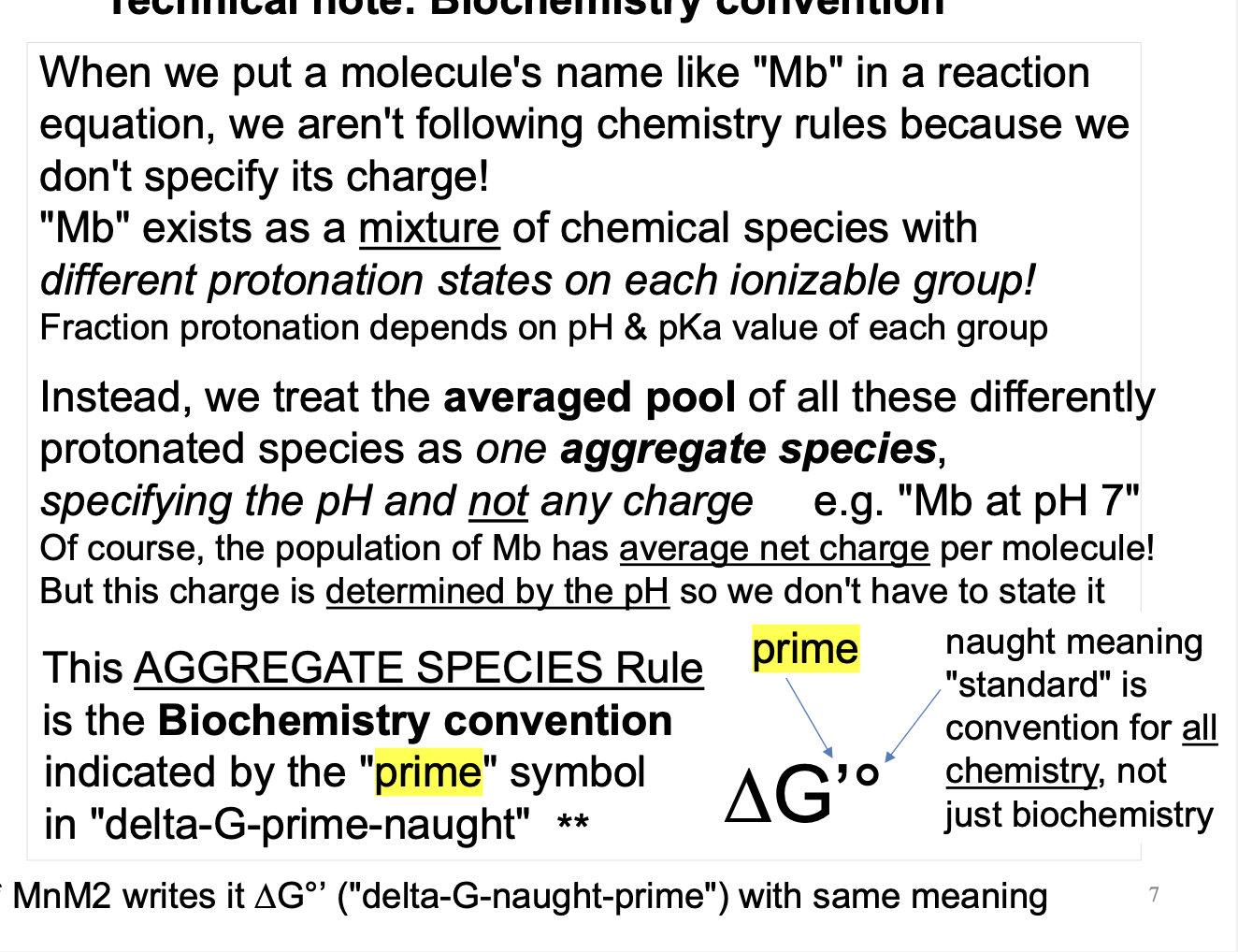
Means not following chemistry rules; just utilizing concepts
mixture of chemical species w/ diff protonation states on each ionizable group
Fraction protonation depends on pH + pKa value of each group
averaged pool = aggregate species (clumped tgt.)
Aggregate species rule
indicated by prime symbol ‘ (see this in delta g prime naught) for standard free Gibbs energy
naught = all chemistry, not biochemistry
EX: ATP does not exist as a single static ionic structure. Depending on the cellular pH and the concentration of magnesium ions (Mg²⁺), it exists in an equilibrium mixture of multiple forms:
ATP⁴⁻
HATP³⁻
H₂ATP²⁻
MgATP²⁻
How do we alter conditions for Fold and DeltaGfold’naught?
chemical denaturants ( urea, guanidinium) or high temperature decrease value of Kfold.
Each test tube is at equilibrium with Kfold & deltaGfoldʼ°at
fixed values ...
but these values
depend on the
test tube condition
Cm = melting concentration
-denaturant concentration where 50% of the protein is unfolded (Kfold = 1, deltaGfoldʼ° = 0)
Tm = melting temperature
-temperature where 50% of the protein is unfolded

Altering stability with a mutation
Mutation that disrupts the hydrophobic core (favoured)
(changing an apolar side chain to a polar side chain)
lowers Cm & Tm (decreases stability)

Activity rule
Express all concentrations in molar units(M)
- then convert to chemical activity(dimensionless)


Energy converted from 1 form to another
energy for helices to do work unwinding DNA duplex comes from ATP fuel
energy for making ATP through respiration comes from food fuel (plants)
Energy for plants to make food fuel comes from the sun

ATP anhydride
A high-energy molecule formed by the removal of a water molecule from ATP.
ANHYDRIDE + H20 = ACID + ACID
anhydride linkage is between beta and y phosphates of ATP.
hydrolysis of anhydride = highly exergonic (-)
structurally unfavourable → “high-energy” state
carries PE that myosin converts into physical work

myosin
A motor protein that interacts with actin filaments to produce muscle contraction and movement in cells.
muscle hydrolyses ATP pulls an actin cable
First Law of Thermodynamics
(Energy Conservation Law):
Different forms of energy are
interconvertible (and this conversion
neither creates or destroys the total energy) → catalytic
in a closed system. It states that the total energy of an isolated system remains constant, although it may change from one form to another, such as c KE to PE.
ATP anhydride:
structurally unfavourable → “high-energy” state
carries PE that myosin converts into physical work
non-enzymatic ATP hydrolisis releases energy as heat, not work

PE of phosphorylation functional groups
Ns = nucleoside
for an acid hydrolysis = exchanging one OH for another
highly exergonic = higher PE

PE of carbonyl functional groups
.

ATP PE energy: driving an endergonic RX’N
Converting an acid to an amide: moderately endergonic(+) (higher PE)
Converting an anhydride to an acid: highly exergonic(-)
RX’N 1 + 2 = 3 RX’N 3 (smaller PE)
Glu + NH3 + ATP → Gln + ADP + Pi; enzyme ( glutamine synthétase) couples the 2 partial rx’ns for a net run’ = exergonic(-)

Net deltaG depends only on starting vs. ending states
Glu + NH3 → Gln (+ H2O)
ATP + (H2O) → ADP + Pi
Glu + NH3 + ATP → Gln + ADP + P

How do we get to rx’n 3, what about glutamine synthetase
Condensation of Glu + NH3 (Rxn 1) followed by ATP hydrolysis (Rxn 2)
is one way to perform Rxn 3, but that's not how glutamine synthetase
does it!
Rather, glutamine synthetase does Rxn 3 using different steps:
it directly phosphorylates Glu, activating it for amination with NH3.
ATP → ADP
NH4^+ → Pi
RX’n 3 = RX’n (i) + RX’n (ii); H20 doesnt participate in any partial rx’ns

Energetics of familiar enzymes
Enzyme Conversion:
Protease: Amide (+ H2O) into acid with amino released
Nuclease: Ester (+ H2O) into acid with alcohol released
Myosin: Anhydride (+ H2O) into acid with acid released (ADP)
DNA polymerase or RNA polymerase: Anhydride (+ alcohol); dNTP or NTP; into ester with acid released (PPi)
all rx’ns exergonic
DNA Ligase:
Acid (+ alcohol) into ester. endergonic partial rx’n
+
ATP anhydride into acid exergonic partial rx’n

Energy coupling
With coupling by a suitable enzyme,
exergonic cleavage of a linkage with high PE (like the anhydrideof ATP)
can drive the
endergonic formation of a lower-energy linkage
(like converting an acid into an amide or ester)
