15. Competition
 Call Kai
 Learn
 Practice Test
 Spaced Repetition
 Match
 Flashcards
 Knowt Play
1/26

There's no tags or description
Looks like no tags are added yet.
27 Terms

Interspecific competition
Competition between different species

Intraspecific competition
Competition among the same species
Renewable resources
Natural resources that can be replaced within a short time frame
- Solar
- Wind
_Water
Nonrenewable resources
A natural resource that is not replaced in a useful time frame.
- Space
- Nutrients

Liebig's Law of the Minimum
Population size is limited by the resource in shortest supply
- More efficient use of resource ensure survival


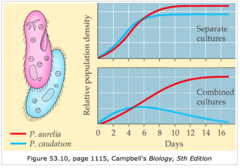
Gause's Competitive Exclusion Principle
When resources are limited, two species with similar needs cannot coexist (1 species will be out-competed).
- Paramecium grown separately do fine
- Paramecium grown together excludes P.caudatum
- P. aurelia is the more efficient user; Wins
R* Rule
There is a level of resource needed to keep a population mortality balanced.
Whoever has the LOWEST R* value needs LESS resource to maintain population balance
- Is the better competitor
Ex: 2 ; 6 ; 10 ; 3
- 2 is smallest so the pop. requires less resource and will win
Ecological Niche
An organism's role in an ecosystem. The biotic and abiotic factors required.
- the food web
- breeding area
- times of activity
- temperature
- mutualisms
- nutrients
- habitat

Habitat
Place where an organism lives - defined by it's niche

Geographic Range
The entire geographic region over which a species is found

N-dimensional hypervolume
Analytical model that shows multiple dimensions to a species niche
n equals the number of environmental factors important to the survival and reproduction of the species
By George Hutchinson
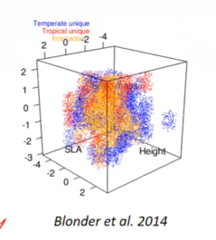

Ecological Niche Modeling
If the niche is known, you can predict...
- Location of rare species
- Predicting expansion range of invasive species
- Range shifts due to climate change

Fundamental Niche
The FULL niche species could potentially occupy.

Realized Niche
The niche species ACTUALLY occupies.

Niche Separation
The difference in optimal resource use

Niche breadth
Diversity of conditions an individual/ species tolerates

Barnacle Niche Case Study
Joseph Connel
- Why was one barnacle in sub-optimal conditions?
- Competitive exclusion
- Differences is desiccation resistance
- One species was a stronger competitor
- The weaker competitor had a wider fundamental niche


Interference Competition
Aggression or fighting over access to resources
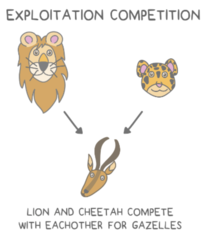
Exploitation Competition
Resource use by one organism depletes the resources available for another organism.
- No aggression

Apparent competition
Two prey species compete for survival through a shared predator
- Not actual competition

Lotka-Volterra Model
Predict the outcome of interspecific competition
alpha = effect an individual of species 2 has on the pop. growth species 1
Beta = effect an individual of species 1 has on the pop. growth species 2

Parallel Species Growth Isocline
Whichever species line is on the OUTSIDE wins

Unstable Equilibrium Species Growth Isocline
The K for each species is on the corresponding species axis
- K are on the outside
- Species will compete
- Competition goes either way
- Depends on how many individuals are present of each species
- The species with the most will win

Stable Equilibrium Species Growth Isocline
The K for each species is on the corresponding species axis
- K are on the inside
- Species can coexist

Niche Partitioning
Competing species use the environment differently in a way that helps them to coexist

Temporal Partitioning
Two species reduce competition by utilizing a resource a different times
Ex: Spiny mice species going out at different times of the day

Character Displacement
Species evolve non-overlapping traits to avoid competition