Bates 25 Tests/Manuevers
 Call Kai
 Learn
Learn Practice Test
 Spaced Repetition
 Match
Match Flashcards
 Knowt Play
1/63

There's no tags or description
Looks like no tags are added yet.
Name | Mastery | Learn | Test | Matching | Spaced | Call with Kai | Chat |
|---|
No analytics yet
Send a link to your students to track their progress
64 Terms

TMJ Palpation
Muscles of Mastication:
1. Masseters
2. Temporal muscles
3. Pterygoid muscles (difficult)

Cervical Flexion

Cervical Extension

Cervical Rotation

Cervical Lateral Bending

Spurling Test
Structures assessed: cervical nerve roots
Facet loading maneuver
Structures assessed: facet joint
- Have the patient sit up straight. Ask the patient to move their head into extension and rotation. NO downward pressure is applied. Observe the patient's response.

Palpating the SITS muscle insertions and subacromial bursa.

Palpating the long head of biceps along bicipital groove.

Shoulder Flexion

Shoulder Extension

Shoulder ABduction

Shoulder ADduction

Internal Rotation - shoulder
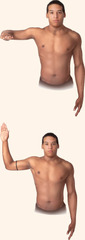
External Rotation - shoulder

SM - Crossover or crossed body adduction test
Structures assessed:
1. Glenohumeral joint
2. Acromioclavicular joint
3. The muscles and tendons of the rotator cuff

SM - Apley Scratch Test (ABduction/external rotation photo)
Structures assessed:
1. Rotator cuff muscles (supraspinatus muscle)
2. Mobility of the glenohumeral joint

SM - Apley Scratch Test (ADduction/internal rotation photo)

Painful Arc Test
Structures assessed:
1. Subacromial subdeltoid bursa
2. Rotator cuff

Neer Impingement Test
Structures assessed:
1. Internal structures of the shoulder (rotator cuff)
2. Subacromial space
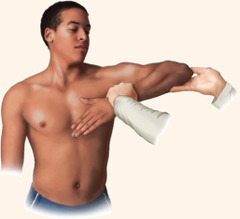
Hawkins Impingement Test
Structures assessed:
1. Internal structures of the shoulder (rotator cuff)
Modified Hawkins-Kennedy test
Starts similarly as the Hawkins test but instead of forcibly internally rotating the shoulder, the modified version allows for passive internal rotation by gently bringing the patient's forearm across their body.
- Observe their response for any pain or discomfort.
- These tests complement the Neer test in diagnosing rotator cuff issues.

Internal rotation lag test (lift-off test)
Structures assessed:
1. Function of the subscapularis muscle (internal rotation)

External rotation lag test
Structures assessed:
1. Function of the supraspinatus and infraspinatus muscles (external rotation)

Drop Arm Test
Structures assessed:
1. Function of the supraspinatus muscle (aBduction)

External rotation resistance test
Structures assessed:
1. Function of the infraspinatus muscle (external rotation) and strength

Empty Can Test
Structures assessed:
1. Function of the supraspinatus muscle (abduction) and strength

Palpating the epicondyles for tenderness.

Elbow supination and pronation.

Cozen test for lateral epicondylitis or "tennis elbow."

Mill test

Maudsley test
- Patient lifts their middle finger up against resistance, keeping their wrist straight and forearm in pronation.

Reverse Cozen test
Assess:
Medial epicondyle
- Hold the patient's elbow with their palm facing upward. Ask them to bend their wrist and twist it downward against your resistance.

Golfer's elbow test (genuinely no photos of this exist)
- Passively extend the patient's elbow and wrist while maintaining the forearm in supination.

Hook test
Assess:
Distal biceps tendon
- Ask the patient to bend their arm at the elbow and flex their biceps. Try to hook your finger under the tendon near the elbow crease.

Palpating the distal radioulnar joint.

Palpating the anatomical snuffbox.

Palpating the metacarpophalangeal joints of the left hand.

Palpating the distal interphalangeal joints.

Flexion of the Wrist

Extension of the Wrist

Radial Deviation of the Wrist
(Bending your wrist toward your thumb side)

Ulnar Deviation of the Wrist
(Bending your wrist toward your pinky side)

Circumduction

Combined finger flexion (full fist formation)

Combined finger extension
(Spread your fingers as wide as you can, straightening all joints)

MCP joint flexion
(Bend your fingers at the base joints toward your palm)

MCP joint extension
(Straighten your fingers at the base joints)

MCP joint aBduction
(Move your fingers apart at the base of your fingers)

MCP joint ADduction
(Bring your fingers together at the base of your fingers)

PIP/DIP joint flexion
(Bend your fingers at the middle and end joints, while I hold your finger at the base)

PIP/DIP joint extension
(Straighten your fingers at the middle and end joints, while I hold your finger at the base)

Thumb flexion at MCP and IP joints

Thumb extension at MCP and IP joints

Palmar abduction at CMC joint
(With your palm facing forward, lift your thumb upward, moving it away from the palm perpendicularly)

Radial abduction at CMC joint
(With your palm facing forward, slide your thumb outward, away from the hand, keeping it in line with the plane of the palm)

Thumb adduction at CMC joint
(Bring your thumb back toward your hand)

Thumb opposition at CMC joint
(Touch the tip of your thumb to the tip of your pinky)

Hand strength test
- Wrist joints, finger flexors, and intrinsic hand muscles
Ask the patient to grasp your second and third fingers tightly.
- Then test finger abduction by having the patient spread their fingers and push inward against your second and fifth fingers.

Finkelstein test ( i though ts is how u break ur thumb)
- Tendons of the abductor pollicis longus and extensor pollicis brevis
- Instruct the patient to grasp their thumb against the palm and then move the wrist into ulnar deviation

Thumb abduction test
- Median nerve in the carpal tunnel
- Ask the patient to turn their hand palm up and raise their thumb straight up away from the palm, forming a 90° angle with the hand. Apply gentle downward resistance to the thumb

Thumb opposition test
- Median nerve, opponens pollicis muscle, and thenar muscles
- Instruct the patient to touch their thumb to the tip of their little finger while you apply outward pressure against the base of their thumb

Tinel sign
- Median nerve in the carpal tunnel
- Gently tap over the course of the median nerve as it runs through the carpal tunnel on the patient's wrist

Phalen sign
- Median nerve in the carpal tunnel
- Ask the patient to flex their wrists maximally, either by holding their wrists in full flexion for 60 seconds or by pressing the backs of both hands together to form right angles